Top SEO directories are not the biggest lists on the internet. They are the directories that match your audience, maintain quality standards, and allow a complete business profile.
The fastest way to waste effort is to submit everywhere. The better way is to score directories by fit, trust, and maintainability, then publish in controlled waves.
Use this article as a practical filter for directory selection and submission execution. If you need a structured rollout process, Start with ListingBott after defining your quality criteria.
Methodology
This method is designed for operators, not list collectors. It helps you choose directories that support long-term SEO and discovery quality.
1) Scoring model for directory selection
Use a weighted model before any submission.
| Dimension | Weight | What to check |
|---|---|---|
| Relevance fit | 30 | Does this directory match your category and audience intent? |
| Editorial quality | 25 | Are listings curated and generally credible? |
| Profile depth | 20 | Can you add enough detail to represent your business clearly? |
| Operational effort | 15 | How hard is submission and maintenance? |
| Signal durability | 10 | Is value likely to persist over time? |
This prevents over-investment in low-value channels.
2) Hard filters before scoring
Discard any directory that fails core quality checks:
- unclear category structure,
- mostly thin or spam-like listings,
- no reliable update process,
- weak fit with your actual market.
Hard filters save time and reduce correction debt.
3) Tiering logic
After scoring:
- Tier 1 (80-100): launch first.
- Tier 2 (65-79): add after Tier 1 quality stabilizes.
- Tier 3 (<65): avoid unless there is a strong reason.
Tiering keeps execution controlled and measurable.
sbb-itb-8e44301
Practical implementation checklist
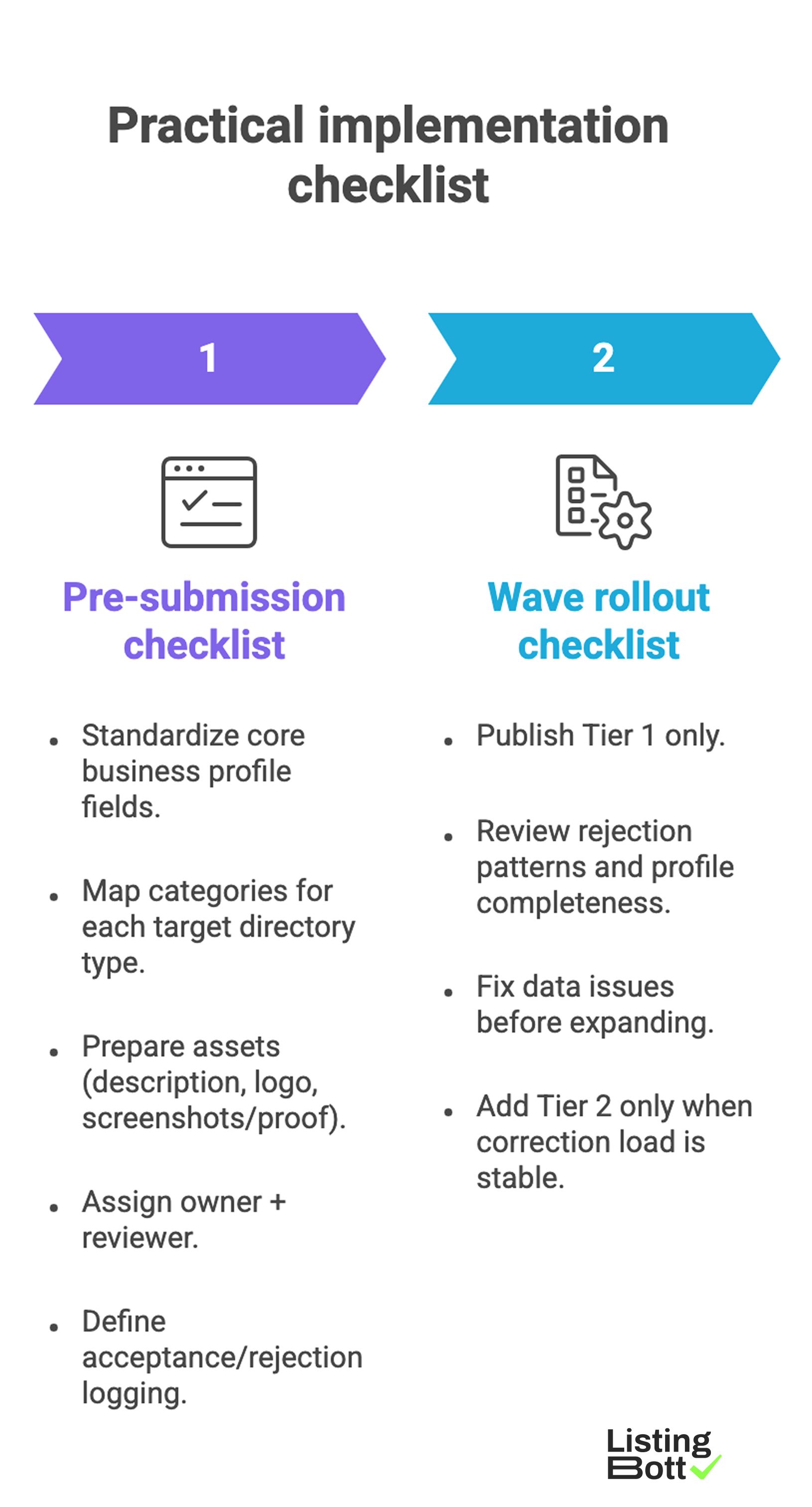
Practical Implementation Checklist
Use this checklist to turn directory strategy into production quality.
Pre-submission checklist
- Standardize core business profile fields.
- Map categories for each target directory type.
- Prepare assets (description, logo, screenshots/proof).
- Assign owner + reviewer.
- Define acceptance/rejection logging.
Wave rollout checklist
- Publish Tier 1 only.
- Review rejection patterns and profile completeness.
- Fix data issues before expanding.
- Add Tier 2 only when correction load is stable.
Real examples from your categories dataset
Below are examples pulled from Backlinks for tool our tools - Сategories.tsv (categories: JustSaasListings, Industry Directory). These are example candidates for evaluation, not universal endorsements.
| Example directory | Category | DA | Traffic | Type |
|---|---|---|---|---|
| https://shipybara.com/ | JustSaasListings | 41 | 1,000.00 | Nofollow |
| https://openhunts.com/ | JustSaasListings | 29 | 1,000.00 | Dofollow |
| https://www.findyoursaas.com | JustSaasListings | 19 | 1,000.00 | Dofollow |
| https://ramen.tools/ | JustSaasListings | 53 | 17,700.00 | Dofollow |
| https://peerpush.net/ | JustSaasListings | 58 | 2,900.00 | Dofollow |
| https://open-launch.com | JustSaasListings | 38 | 7,400.00 | Nofollow |
| https://www.localhomeservicepros.com/ | Industry Directory | 58 | 11,900.00 | Dofollow |
| https://www.click4homeservices.com/ | Industry Directory | 56 | 3,100.00 | Dofollow |
How to use this list correctly:
- score relevance first,
- include a mix of dofollow and nofollow where quality is strong,
- validate profile depth before submission.
How ListingBott solves this
The main failure point in directory SEO is operational inconsistency: weak category mapping, incomplete listings, and unclear ownership.
ListingBott provides a structured submission workflow with one-time payment, approved directory list, publication process, and report handoff. It is a tool flow, not a call-based service model.
For teams handling many listings, this reduces manual coordination and helps maintain quality standards.
If your goal is consistent directory execution with reporting, use a directory submission workflow as your baseline operating model.
What you get
With a controlled directory process, teams usually gain:
- better consistency across listing data,
- fewer low-quality submissions,
- clearer prioritization by relevance and trust,
- cleaner visibility into what was published and why.
Offer alignment for ListingBott-facing implementation:
- one-time payment model,
- publication to 100+ directories (per current website language),
- refund possible if process has not started,
- no hidden extra fees (per current FAQ language).
When scaling beyond first-wave submission, linking this to automated directory submissions helps teams keep execution velocity without losing QA control.
When to use manual vs ListingBott
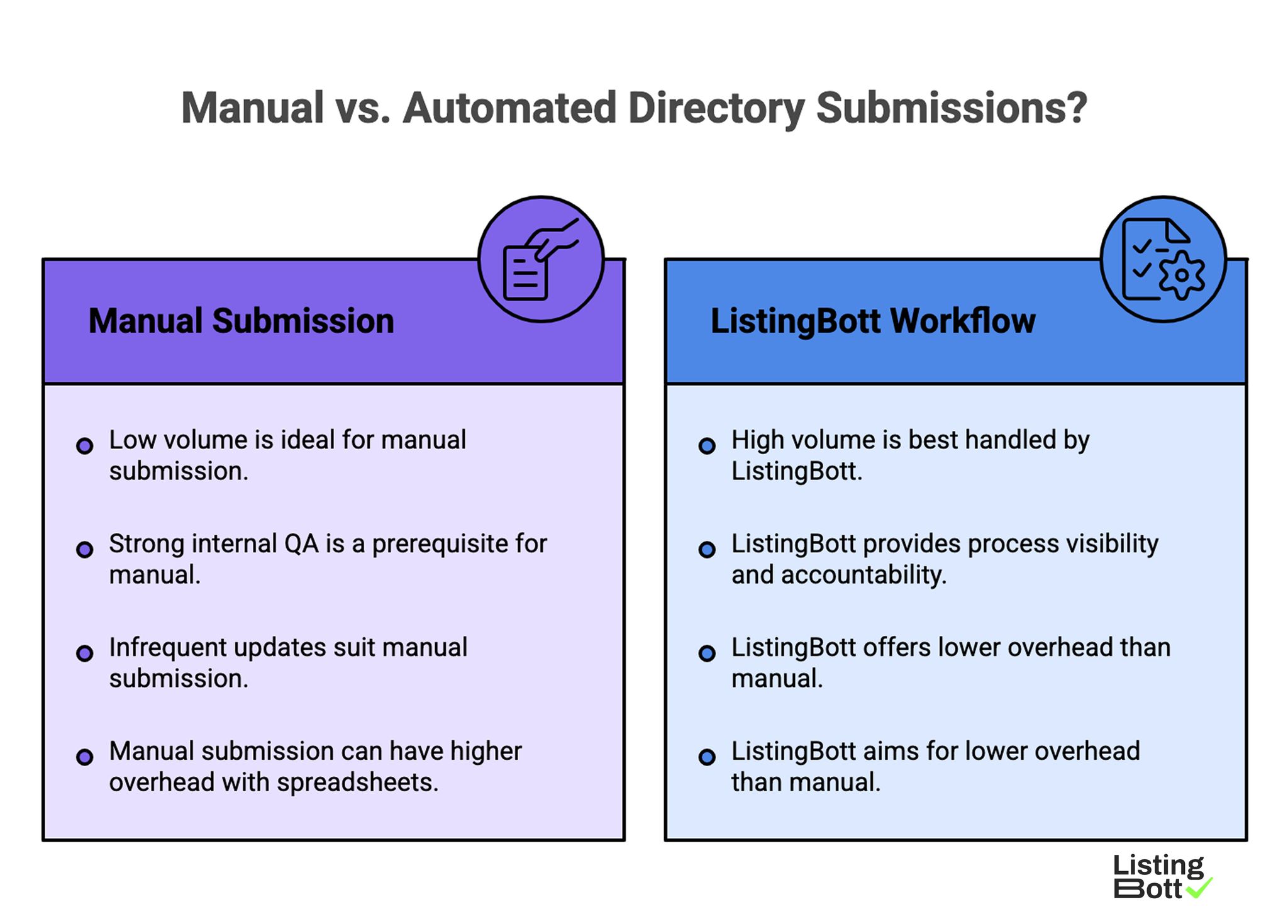
Manual vs Automated Directory Submissions
Use manual submission when:
- volume is low,
- internal QA is strong,
- updates are infrequent.
Use ListingBott workflow when:
- you need repeatable submissions across many targets,
- you need process visibility and accountability,
- you want lower overhead than spreadsheet-led operations.
In both cases, keep expectations realistic: directory work supports authority and discovery directionally, but outcomes are influenced by many external factors.
FAQ: Top SEO Directories
Are directory listings still useful for SEO?
Yes, when selected by relevance and quality. Low-trust bulk submission usually underperforms.
How many directories should I start with?
Start with a small Tier 1 set and expand only after quality is stable.
Should I avoid nofollow directories entirely?
Not always. A nofollow listing can still be useful if the source is relevant and trusted.
What is the biggest mistake in directory submission?
Submitting at high volume without quality gates, category discipline, and ownership control.
Can directory submission alone guarantee SEO growth?
No. It works best as part of a broader SEO system with strong content and technical foundations.