Looking to improve your SEO without spending a dime? Free directory submission tools can help you list your business across multiple platforms, build quality backlinks, and boost your local search visibility. While free directory submissions are a great starting point, businesses looking to scale their SEO results often combine them with professional link building services. A balanced approach helps build a stronger backlink profile by combining directory citations, niche placements, digital PR, and relevant industry links. Here's what you need to know:
- Focus on high-authority directories (Domain Authority 50+).
- Ensure consistent NAP details (Name, Address, Phone) across listings to avoid losing customer trust.
- Prioritize directories that align with your industry and location for better engagement.
- Use tools like Google Business Profile, Yelp, and Apple Business Connect for local SEO.
- For niche industries, Listing Bot simplifies submissions to over 100 relevant directories.
Quick Comparison
| Tool | Focus | Free Features | Best Use Case |
|---|---|---|---|
| Google Business Profile | Local | Maps listing, reviews, posts, photos | All local businesses |
| Yelp Business Listing | Local/Service | Reviews, unlimited descriptions, photo uploads | Restaurants, retail, home services |
| Apple Business Connect | Local/Mobile | Apple Maps listing, custom promotions, photos | Businesses targeting iOS users |
| Bing Places | Local/B2B | Bing Maps listing, Google sync, bulk uploads | B2B, professional services |
| Listing Bot | Niche/Tech | Automated submissions, backlink tracking | SaaS, startups, tech industries |
| ProLinkDirectory | General | Basic listing, geo-targeting | New websites needing backlinks |
Start with platforms that match your audience, then expand to niche directories for added SEO benefits. Follow directory submission best practices and regularly update listings to maintain accuracy and improve rankings.
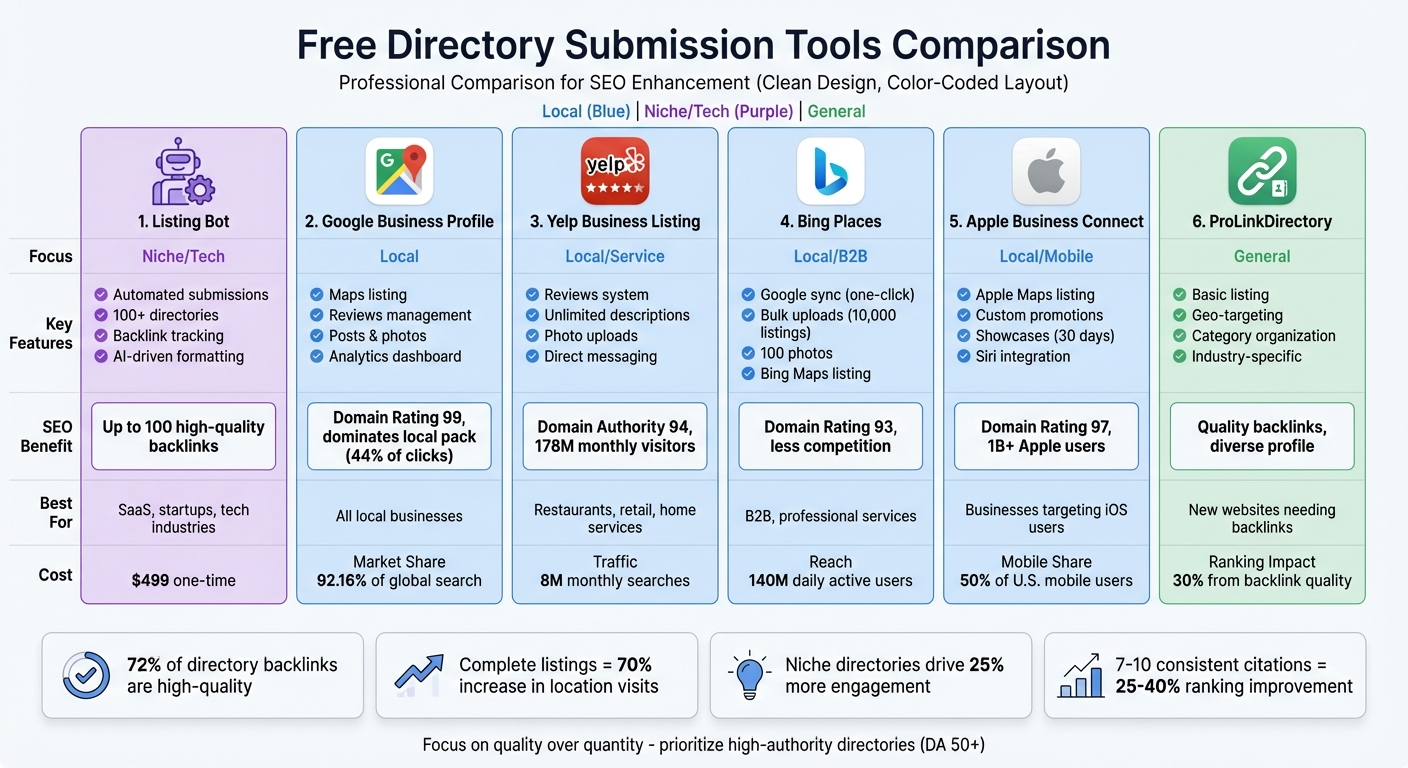
Free Directory Submission Tools Comparison for SEO
SEO Citations & Directory Submissions: Ultimate Guide
To get started, you can explore a list of top free web directories that provide high-quality backlinks.
How to Evaluate Free Directory Submission Tools
Not all directory submission tools are created equal. The key to success lies in prioritizing quality over quantity - a handful of listings on high-authority directories will always outperform scattering your business details across countless low-quality sites. This principle forms the foundation for assessing the value of each tool.
Start by checking the Domain Authority (DA) of the directories. Aim for platforms with a DA of 40 or higher, and ideally above 50, as these provide stronger link equity to your site. Tools like SimilarWeb or Ahrefs can help confirm the directory’s traffic - real visitor numbers indicate that the platform can drive referral traffic, not just backlinks. Before committing, run a quick Google search using site:directoryurl.com to ensure the directory’s pages are indexed. If Google isn’t crawling the site, your listing won’t contribute to SEO.
Relevance is just as important as authority. Niche-specific directories can drive about 25% more engagement than general ones. For example, a tech company will benefit more from a directory focused on software or technology than from a broad business listing site. Similarly, local businesses should focus on geo-targeted directories that cater to their specific region. If you work in property or local lead generation, this real estate website template is a strong starting point before you push listings into geo-targeted directories. The tool must also support accurate NAP fields (Name, Address, Phone number) - NAP consistency is crucial for SEO.
Another factor to consider is whether the tool offers manual or automated submissions. Manual submissions provide greater control, allowing you to pick directories carefully and customize entries for niche audiences. They also help you avoid duplicate listings, a common issue with automated tools. Additionally, check the data fields the tool supports. Beyond basic NAP details, features like business hours, categories, descriptions, and images can make your listing more appealing. The ability to update and manage listings after submission is equally important - outdated information can harm your credibility.
"A few high-quality backlinks are far more valuable than many low-quality ones." - MEGA SEO
Be cautious of red flags. Avoid directories that demand reciprocal links, are overloaded with ads, or cram thousands of unrelated links onto a single page. To stay organized, maintain a submission log in a spreadsheet. Track details like submission dates, directory names, categories, and approval status. This not only prevents duplicate entries but also helps you measure which directories bring actual results. By applying these criteria, you can effectively integrate directory tools into your SEO strategy.
1. Listing Bot
Directory Focus (Local, General, Niche)
Listing Bot zeroes in on niche directories tailored to industries like SaaS, AI, NoCode, Dev Tools, Agencies, Ecommerce, and Marketplaces. For client-service firms, pairing directory submissions with a focused digital agency website template usually produces cleaner positioning and better landing pages. It connects you with over 100 carefully chosen platforms where your target audience is actively searching. This targeted approach prioritizes quality and relevance, aligning with key evaluation standards.
Features and Submission Options
For a one-time fee of $499, Listing Bot provides a centralized dashboard to manage all your directory listings for SEO. Its AI-driven formatting ensures your business information is automatically adjusted for each directory, keeping your NAP (Name, Address, Phone) data consistent and eliminating the hassle of manual reformatting. Any updates to your product or business details are instantly applied across all directories. Plus, the one-click submission feature simplifies the entire process, saving you valuable time.
SEO Benefits (Backlinks, Visibility, Authority)
Listing Bot generates up to 100 high-quality backlinks, boosting your Domain Rating. Complete and accurate listings increase the likelihood of attracting local visits by 70%. The dashboard also includes performance analytics, allowing you to track referral traffic and measure the SEO impact. Up next, check out other free directory tools to further strengthen your SEO strategy.
2. Google Business Profile
Directory Focus (Local, General, Niche)
Google Business Profile is specifically tailored for local businesses with physical locations or those that directly interact with customers. It’s not an option for digital-only businesses. Considering Google controls a staggering 92.16% of the global search market, and nearly half (46%) of all searches have local intent, this platform is a game-changer. That’s roughly 2.7 billion daily searches for nearby goods and services. To put it into perspective, searches aimed at supporting local businesses surged by 20,000% in 2020 alone [13, 14]. With such numbers, Google Business Profile becomes an essential tool for boosting local visibility.
Free Features (Fields Supported, Submission Options)
Google Business Profile offers a variety of free tools to help businesses stand out on Google Search and Maps. These tools allow you to showcase essential details like your business name, address, phone number, website, operating hours, and categories. Beyond the basics, the platform includes features like Google Posts for sharing updates and promotions, a Q&A section for customer inquiries, tools to manage reviews, and options to upload photos, videos, and even product inventories. You’ll also have access to a free analytics dashboard that reveals valuable insights, such as the keywords customers use to find your business, call volumes, and requests for directions [13, 14, 15].
SEO Benefits (Backlinks, Visibility, Authority)
Your Google Business Profile doubles as a powerful citation with a Domain Rating of 99. The profile’s URL field provides a direct backlink to your website, which can enhance your site’s authority. For software companies, there are specific ways to increase domain rating for SaaS platforms through strategic link building. Google also considers the number of external websites linking to your business when calculating your “Prominence” in local rankings [20, 21]. Verifying your profile is crucial - it signals to Google that you’re officially authorized to represent your business. This step increases your chances of appearing in the highly coveted Local Pack, which showcases the top three local search results. As one business owner from Yogolandia Yogurt and Botana Bar in Chicago shared:
"Getting Yogolandia on Google was key. It truly legitimizes you as a business. It's free, there are photos, and we've gotten phenomenal reviews".
Limitations of the Free Tier
While Google Business Profile offers immense benefits, it does come with some restrictions. Only businesses that engage directly with customers in person are eligible, meaning properties for rent or sale and entirely digital operations don’t qualify. Additionally, support is mainly provided through Google’s Help Community Forum rather than direct assistance. Users may occasionally face challenges like listing errors or spam reviews. Although managing your profile is free, Google has been incorporating paid features, such as Local Service Ads, into local search results. These limitations are worth considering as you weigh the platform’s advantages.
3. Yelp Business Listing
Directory Focus (Local, General, Niche)
Yelp is tailored for local businesses, with a strong focus on restaurants, hospitality, and retail. Service-based businesses also find success here. The platform is especially popular in major U.S. cities, driving around 8 million monthly searches. If your business thrives on local foot traffic or customer reviews, Yelp’s community-driven setup is a great match.
Free Features (Fields Supported, Submission Options)
You can verify your Yelp listing for free via email or phone, typically within 1–3 days. Once verified, you can add key details such as your business name, address, phone number, and website. Unlike many directories that limit description length, Yelp allows unlimited characters for your business description. You can also upload photos of your location, products, and logo. Be mindful to use original images - stock or watermarked photos may get flagged. Yelp’s review management system is another standout feature, enabling you to read and respond to customer reviews directly, which helps build trust with your local audience.
SEO Benefits (Backlinks, Visibility, Authority)
Yelp offers solid SEO advantages thanks to its Domain Authority of 94 in the U.S.. Adding your business to Yelp provides a permanent backlink from this high-authority site, boosting your website’s credibility. Yelp listings often appear in top organic search results for local queries like "personal trainer New York". Keeping your NAP (Name, Address, Phone) consistent across Yelp and other directories can also improve your chances of ranking in Google’s "3 pack" and Maps results. While Yelp uses "nofollow" tags for website links, the citation value and referral traffic still positively influence search engines. As Brian Dean, Founder of Backlinko, explains:
"Links from the right directories can still do wonders for your site".
Accurate and consistent business details across platforms remain a critical part of any SEO strategy.
Limitations of the Free Tier
The free version of Yelp does come with some drawbacks. Competitor ads may appear on your business profile, which could divert potential customers. Additionally, priority placement in search results is reserved for premium users, with plans starting at around $300 per month. Upgrading to the premium tier removes competitor ads and provides access to Cost-Per-Click advertising options. To perform well, your profile must be 100% complete, as incomplete listings tend to rank lower and convert less effectively.
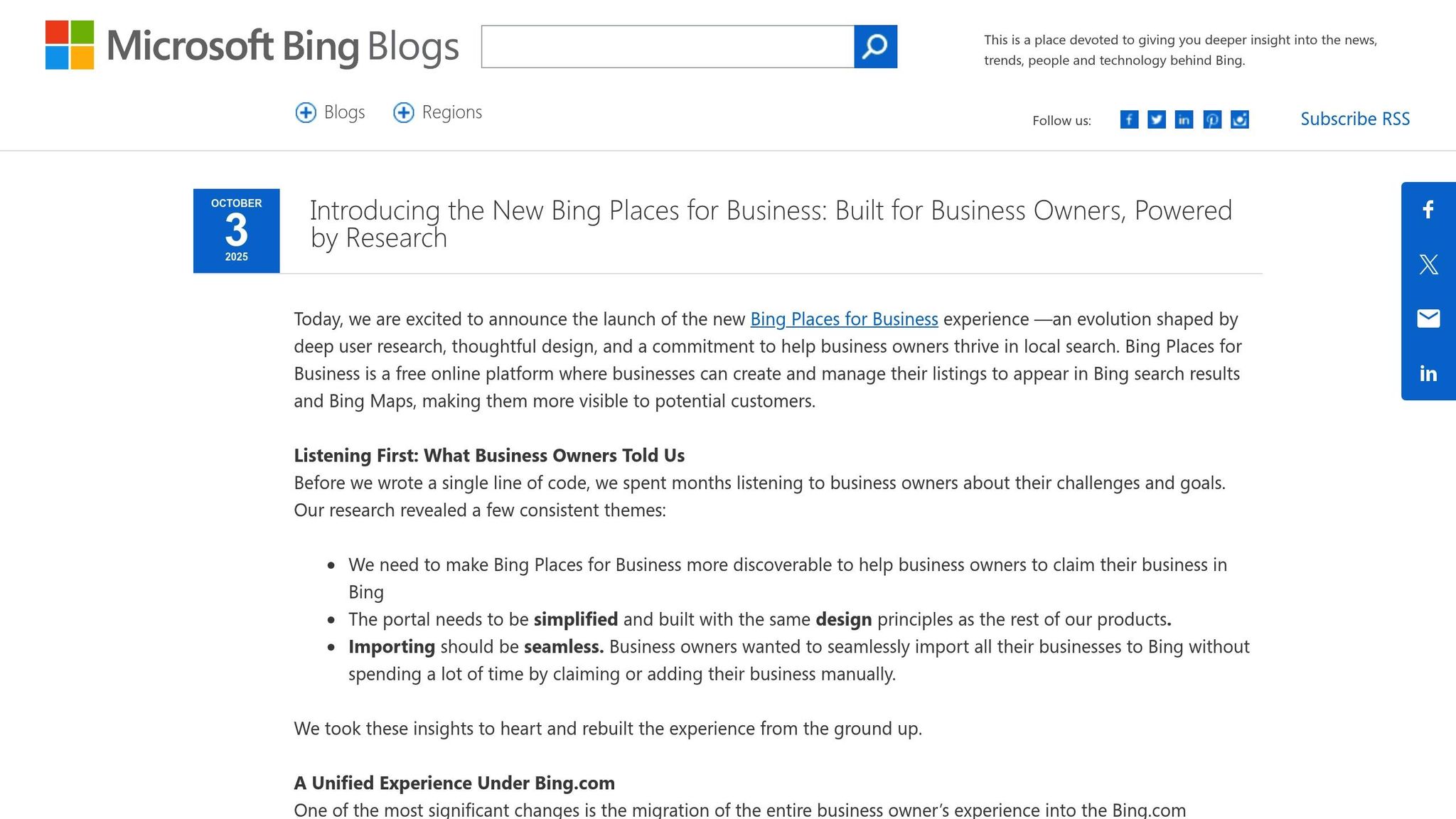
4. Bing Places for Business
Directory Focus (Local, General, Niche)
Bing Places for Business is another tool to expand your local and general SEO efforts. It helps businesses establish a stronger online presence on Bing Search and Maps. With over 140 million daily active users and 900 million search queries per day, Bing provides a significant platform for visibility, especially as it’s the default search engine for Windows devices.
Free Features (Fields Supported, Submission Options)
Bing Places allows you to include key business details like your name, address, phone number, website, operating hours, and detailed descriptions. You can also upload up to 100 photos to showcase your business visually. If you already use Google Business Profile, syncing your data is a breeze with Bing’s one-click import feature, ensuring consistency across platforms. For businesses with multiple locations, the bulk upload tool supports up to 10,000 listings at once, saving time. Verification is straightforward and can be done via mail, phone, or email, though mail verification may take up to a week.
SEO Benefits (Backlinks, Visibility, Authority)
Bing Places provides an authoritative backlink from bing.com, which boasts a Domain Rating of 93. By listing your business here, you not only strengthen your NAP (Name, Address, Phone) consistency but also gain valuable local SEO citations. Bing Places listings can integrate with Facebook, allowing your ratings and reviews to appear seamlessly. Plus, with less competition compared to Google, smaller businesses often find it easier to rank higher on Bing.
Limitations of the Free Tier
While Bing Places offers many benefits, it does have some limitations. Reviews are aggregated from third-party platforms like Facebook, Yelp, and TripAdvisor, which means you’ll need to actively manage your online reputation across these sources. Additionally, after verification, it can take one to two weeks for your listing to appear. Lastly, accessing the Bing Places dashboard requires a Microsoft account, which may add an extra step for some users.
sbb-itb-8e44301
5. Apple Business Connect
Directory Focus (Local, General, Niche)
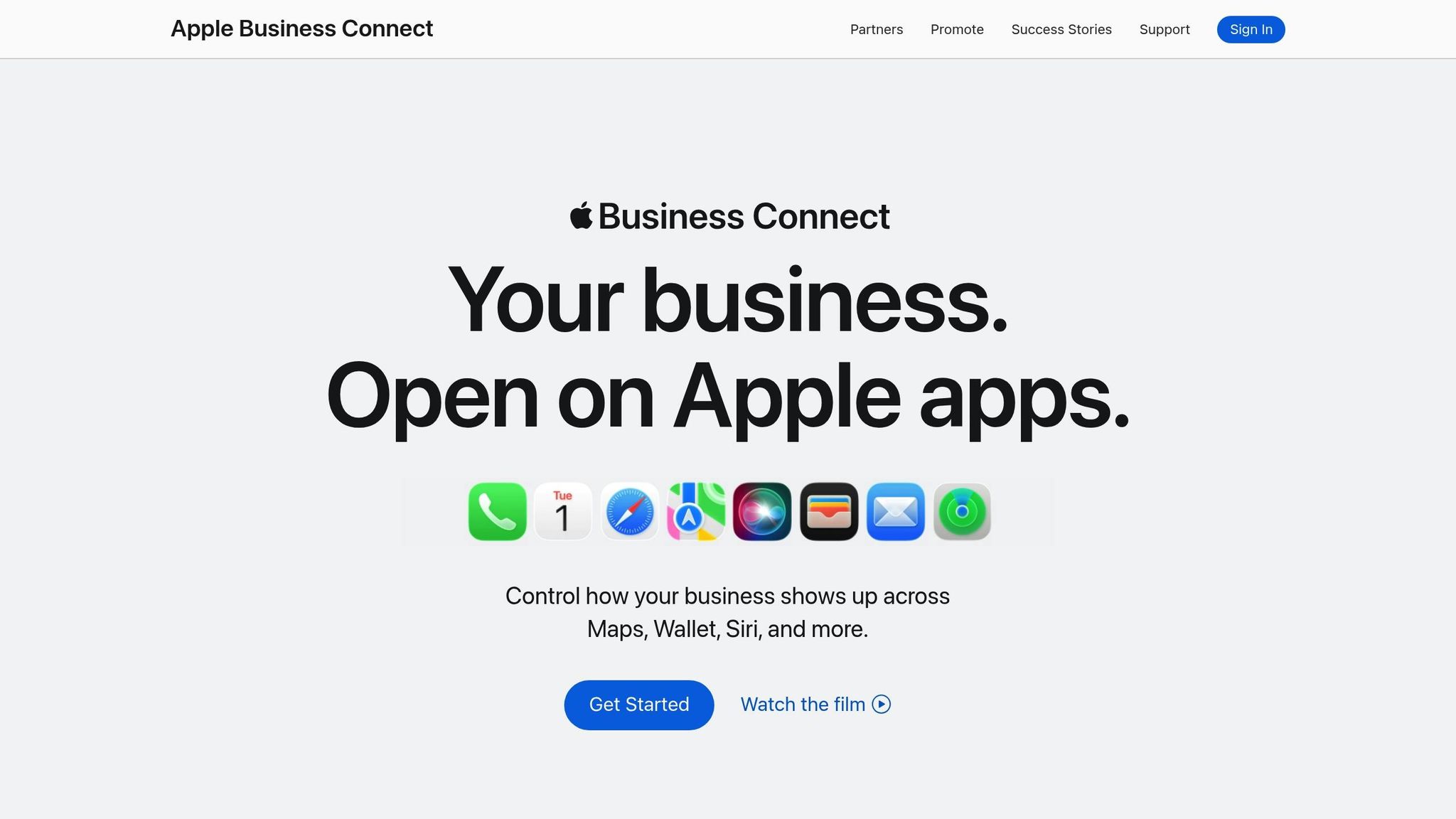
Apple Business Connect is a free, web-based tool that helps businesses manage their presence across the Apple ecosystem, including platforms like Apple Maps, Siri, Wallet, and Messages. While primarily designed for local businesses, it also supports virtual operations such as online stores, tutoring services, staffing agencies, and mobile businesses. This versatility makes it a useful resource for both traditional brick-and-mortar establishments and digital-first companies looking to tap into Apple's extensive user base.
Free Features (Fields Supported, Submission Options)
With Apple Business Connect, you can customize your digital storefront by uploading a 1024x1024 logo, a 1600x1040 banner, and providing key business details like your address, phone number, hours of operation, and website. The platform’s Showcases feature allows you to promote seasonal deals, discounts, or events for up to 30 days. You can also add Custom Actions - interactive buttons such as "Order Now", "Make a Reservation", or "Book an Appointment" - to drive customer engagement. Verification is straightforward, with options to verify by phone or through document review, typically completed within five business days [40,41].
SEO Benefits (Backlinks, Visibility, Authority)
The platform’s features not only simplify your setup but also boost your SEO efforts. Apple Business Connect provides a valuable backlink from apple.com, a site with an impressive Domain Rating of 97. Listing your business here gives you access to over 1 billion Apple users and 2 billion active iPhone users [38,42]. Additionally, the Insights dashboard offers data on the search terms customers use to find your business, helping you fine-tune your local SEO strategy. Since Apple Maps is the default navigation app on all Apple devices and powers Siri voice searches, maintaining consistent NAP (Name, Address, Phone) details is critical. As Elizabeth Rule, Local SEO Analyst at Sterling Sky, explains:
"Owning your business information on Apple is crucial to making sure the over 70 million people who use Apple Maps are able to find your business and contact you".
Limitations of the Free Tier
Apple Business Connect does have its limitations. For example, it aggregates reviews from third-party platforms like Yelp, Facebook, and TripAdvisor. This means you’ll need to actively manage your reputation on these channels. Additionally, as of mid-2023, about 58% of businesses had not yet claimed their Apple Maps listing. This presents an opportunity, but it also highlights the importance of maintaining an accurate Yelp profile, as Apple may pull data from it. Lastly, accessing the Business Connect dashboard requires an Apple ID, which adds an extra step to the registration process.
6. ProLinkDirectory
Directory Focus (Local, General, Niche)
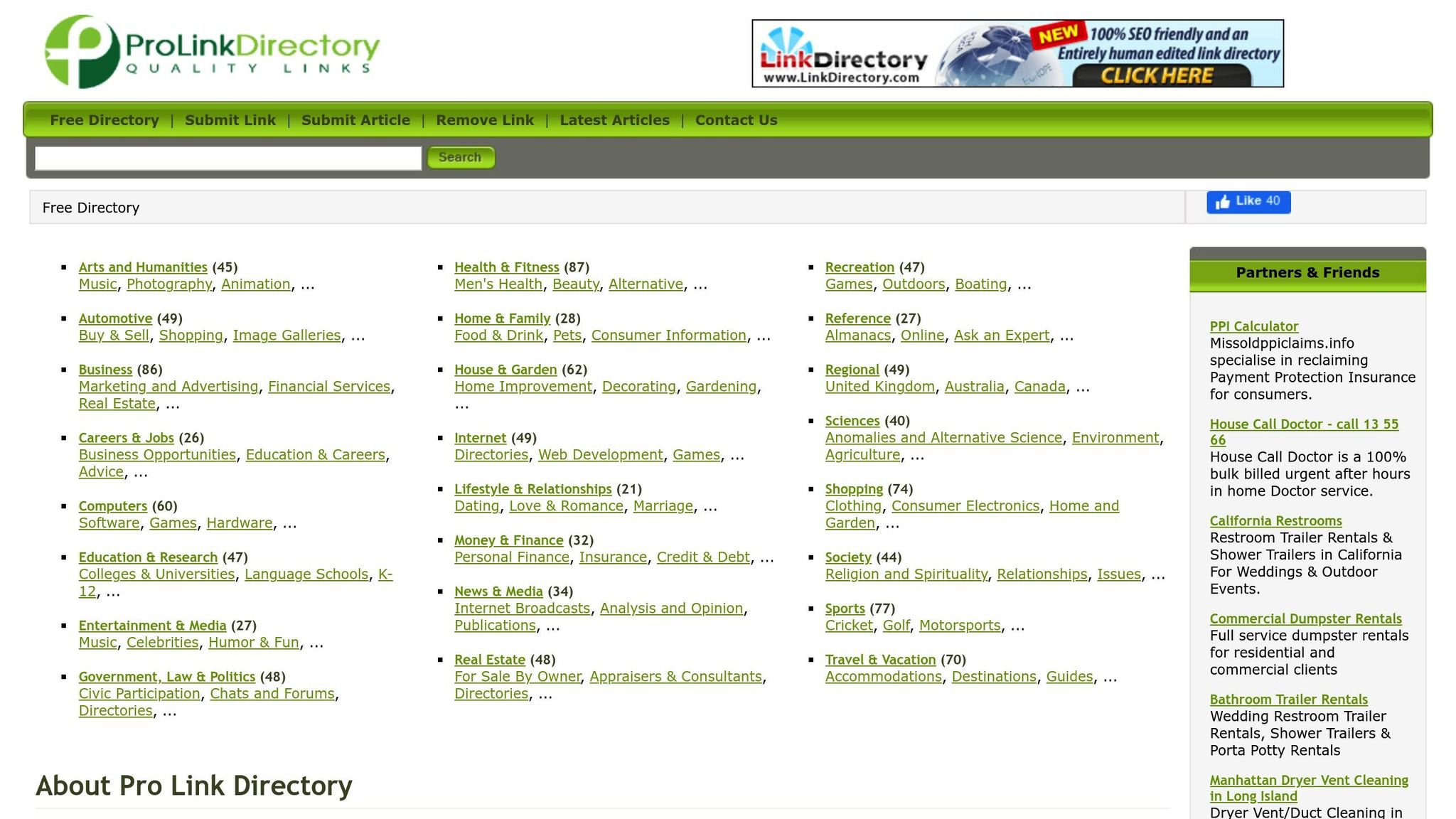
ProLinkDirectory is a general directory that organizes websites by industry and location. It supports a broad range of industries, categorizing submissions into specific niches and offering geo-targeting options. This allows businesses to list their websites under relevant geographic areas, making it easier to connect with the right audience.
Free Features (Fields Supported, Submission Options)
Submitting your site to ProLinkDirectory is straightforward. All you need is your website URL, a brief description, and the right category. This simplicity makes it a practical choice for businesses aiming to establish their online presence and credibility, especially those new to SEO. WordPress expert Coling Newcomer emphasizes:
"Directory submission isn't dead. It's evolved - and when done smartly, it can still help you earn quality backlinks, brand exposure, and higher search rankings in 2025".
This streamlined process lays the groundwork for meaningful SEO gains.
SEO Benefits (Backlinks, Visibility, Authority)
ProLinkDirectory’s user-friendly submission process comes with clear SEO perks. It helps generate quality backlinks, increases visibility for targeted searches, and strengthens brand authority. Studies show that backlink quality contributes to around 30% of a webpage's ranking score, while business directories appear in 31% of the top ten organic results for local-intent searches. These insights highlight the directory's potential to boost your online presence effectively.
Limitations of the Free Tier
The free tier of ProLinkDirectory has a few drawbacks. Approval times are longer due to manual review, and free listings may not receive as much visibility as premium options. To get the most out of your listing, ensure the directory has a low spam score (preferably under 10%) and choose the most specific category for your site. This approach ensures contextual relevance and reduces the risk of rejection.
How to Add Directory Tools to Your SEO Workflow
Start by creating a master spreadsheet that includes your verified NAP+H (Name, Address, Phone, and Hours). Think of this as your go-to reference for ensuring consistent formatting across all platforms. Consistency is key - search engines can get confused by even small variations, which might hurt your local rankings. Stick to Google Business Profile guidelines: use the exact business name from your signage, place suite or mailbox numbers on Line 2, and always use a local area code for your phone numbers. This solid foundation simplifies submissions and strengthens your local SEO.
Prioritize core directories like Google Business Profile, Bing Places, Apple Business Connect, and Yelp. These platforms carry significant weight in local search rankings, with directories showing up in 31% of the top ten organic local-intent search results. Plus, 76% of users performing "near me" searches visit a business within 24 hours. If your business operates in multiple locations, make sure each directory listing links directly to its corresponding location landing page. This improves both user experience and local search relevance.
Once you’ve covered the basics, expand your reach using tools like Listing Bot. This tool identifies additional industry-specific directories and automates submissions to over 100 platforms, ensuring your NAP stays consistent everywhere. It also lets you fine-tune business descriptions and manage directory reviews efficiently. Incorporating tools like these not only saves time but also boosts your SEO efforts.
Finally, conduct quarterly audits of your online presence to catch inconsistencies, outdated details, or duplicate listings. Online presence checkers can help you spot issues like old addresses or user-suggested changes. As Miriam Ellis of Moz points out, ignoring reviews doesn’t just hurt engagement - it also means missing out on valuable customer insights. Regular audits ensure your listings stay accurate, even during changes like holiday hours or relocations. Keeping everything up-to-date safeguards your SEO performance and keeps your business visible to potential customers.
Comparison Table
Here's a breakdown of how these free directory submission services perform for U.S.-based businesses. Each platform has its own strengths, so knowing their differences can help you shape an effective SEO strategy.
You can submit to these directories yourself, or review directory submission service for websites when you want help selecting targets and running the campaign.
| Tool | Focus | Free Features | SEO Benefits | Best Use Case (U.S.) |
|---|---|---|---|---|
| Listing Bot | Niche/Tech | AI automation, 100+ directory submissions, backlink building | Improves domain rating with quality backlinks and saves time with one-click submissions | SaaS, AI tools, startups, tech products |
| Google Business Profile | Local | Maps/search listing, reviews, posts, photos, business attributes | Dominates local pack rankings and captures 44% of local search clicks | All U.S. local businesses |
| Yelp Business Listing | Local/Service | Reviews, business history, messaging, photo uploads | Attracts high-intent traffic from 178 million monthly visitors | Restaurants, retail stores, home services |
| Bing Places for Business | Local/B2B | Direct import from Google Business Profile, Bing Maps listing | Reaches corporate users and boosts visibility on alternative search engines | B2B companies, professional services |
| Apple Business Connect | Local/Mobile | Siri integration, Apple Maps listing, photos, special offers | Connects with approximately 50% of U.S. mobile users on iOS devices | Businesses targeting iPhone users |
| ProLinkDirectory | General | Wide category coverage, basic listing submission | Builds a diverse backlink profile to help new websites gain initial exposure | New websites needing exposure and backlinks |
This table highlights the unique advantages of each tool, helping U.S. businesses choose the right platforms to reach their target audience. Research shows that maintaining consistent citations across 7–10 directories can improve local rankings by 25% to 40%. Additionally, complete and accurate listings can increase location visits by 70% and boost conversions by 50%. Niche directories, in particular, drive 25% more engagement, and an impressive 72% of directory backlinks are considered high-quality.
"Google Business Profile is the single most important directory for local businesses seeking free exposure" – Turnkey Directories
For local service businesses, platforms like Google Business Profile, Yelp, and Apple Business Connect are essential to capture high-intent customers searching for nearby solutions. On the other hand, tech companies and SaaS products can benefit from Listing Bot, which simplifies submissions to industry-specific directories while building the backlink volume needed to strengthen domain authority. B2B companies should consider Bing Places, as it effectively reaches corporate users where Bing is often the default search engine.
Start by focusing on platforms that align with your audience’s needs, then expand your strategy from there. Combining local directories for immediate visibility with niche directories for long-term authority is a powerful approach.
Conclusion
Directory submissions remain a reliable SEO strategy that delivers real, measurable results. The free tools highlighted in this guide provide U.S. businesses with an affordable way to secure quality backlinks, boost domain authority, and attract traffic from users actively searching for specific solutions. Accurate and complete listings not only improve visibility but also drive more foot traffic and higher conversion rates - making them a must-have in any SEO plan.
"Directory submission isn't just an outdated SEO trick - it's a timeless tactic that still drives visibility, trust, and authority when done right." – Coling Newcomer, WordPress Expert
The secret lies in prioritizing consistency and accuracy over sheer volume. Ensuring that your Name, Address, and Phone (NAP) details are uniform across major directories is crucial for excelling in local search rankings. Tools like Listing Bot and Google Business Profile are prime examples of how businesses can leverage directory submissions effectively. Listing Bot simplifies the process by automating submissions to over 100 niche directories, laying the groundwork for tech companies and SaaS brands to stand out in crowded markets. Meanwhile, platforms like Google Business Profile, Yelp, and Apple Business Connect are indispensable for local service businesses, helping them attract mobile users and strengthen their local SEO efforts.
To maximize results, claim and optimize profiles on directories that align with your target audience. Regularly auditing and updating these profiles - ideally every quarter - can lead to a 35% increase in engagement compared to businesses with outdated listings. Use UTM parameters to track which directories are driving the most qualified leads, and refine your approach based on the data.
FAQs
What should I look for in a directory submission tool to improve my SEO?
When selecting a directory submission tool, prioritize features that can save you time and improve your SEO efforts. Opt for tools that can automate bulk submissions, use AI to match your site with the most relevant directories, and offer a centralized dashboard to track the status of your listings. It's also crucial to have clear reporting features so you can see which directories have accepted your submissions.
Choose a tool that aligns with your specific goals, whether you're focusing on niche, local, or industry-specific directories. Check how simple it is to set up and ensure the tool can grow with your business. Don't overlook practical considerations like cost, user-friendliness, and the quality of customer support. A well-suited tool can simplify the submission process, cut down on manual work, and contribute to noticeable SEO progress.
What are the advantages of using high-authority directories for SEO?
High-authority directories are well-regarded platforms that can play an important role in improving your website's SEO. When you list your site on these directories, you gain high-quality backlinks - a key factor in boosting your website's credibility. These links signal to search engines that your site is trustworthy and relevant, which can result in better search rankings and improved domain authority.
Another advantage is that these directories often perform well in niche-specific searches. This means your business could gain more visibility, attracting organic traffic, direct referrals, and potential customers who are actively looking for products or services like yours. Plus, being listed alongside other reputable businesses enhances your brand's credibility - not just with users, but also with search engines.
Altogether, submitting your site to high-authority directories is a cost-effective way to expand your online presence and strengthen your overall SEO strategy.
How can I keep my business information consistent across all directories?
Consistency in your business information plays a big role in improving local SEO. Search engines depend on accurate NAP details - Name, Address, Phone number - to determine your business's credibility and ranking. Even minor inconsistencies can hurt your visibility. To keep everything aligned, create a master record that includes your exact business name, complete address (don’t forget suite or unit numbers), phone number in the same format (e.g., (555) 123-4567), website URL, and business hours. This record should serve as your go-to reference for all directory submissions.
To simplify the process, you might want to use a centralized listing management tool. These tools let you update your business information in one place, and they automatically sync those updates across multiple directories, helping you avoid errors. Make it a habit to audit your listings regularly to catch and correct duplicates or outdated details. Additionally, using structured data on your website - like Schema.org LocalBusiness markup - can boost search engines' confidence in your information, ensuring it’s displayed correctly.