Quick answer
NAP consistency means your business Name, Address, and Phone are identical across all listings and channels. Inconsistent NAP data creates trust issues, citation conflicts, and weaker local search signals.
For local SEO, NAP consistency is not a one-time setup. It is an ongoing operational process with ownership, audits, and update controls.
The safest approach is to maintain one canonical business profile, publish in controlled waves, and review changes every month.
If your team needs structured submission and update execution, Start with ListingBott after defining your NAP governance rules.
sbb-itb-8e44301
Methodology
This framework treats NAP consistency as a data-quality system, not only a local SEO tactic.
1) Canonical NAP source first
Create one source-of-truth record that includes:
- business legal/trading name,
- address standard,
- primary phone format,
- location-specific notes,
- allowed abbreviations.
No listing should be edited without checking this canonical record.
2) Define variance rules
Some platforms enforce formatting differences. Define allowed vs disallowed variance:
| Field | Allowed variation | Disallowed variation |
|---|---|---|
| Business name | Minor punctuation differences only | Different brand/entity names |
| Address | Standard postal abbreviations | Missing suite/unit where required |
| Phone | Consistent country/area formatting | Different numbers across channels |
This prevents accidental drift.
3) Local listing quality score
Score each listing update before publish:
| Dimension | Weight | Check |
|---|---|---|
| NAP exactness | 40 | Match with canonical source |
| Category fit | 25 | Correct local/industry category |
| Profile completeness | 20 | Services, hours, description, assets |
| Update traceability | 15 | Change logged with owner + date |
Use this score for go/no-go decisions.
Practical implementation checklist
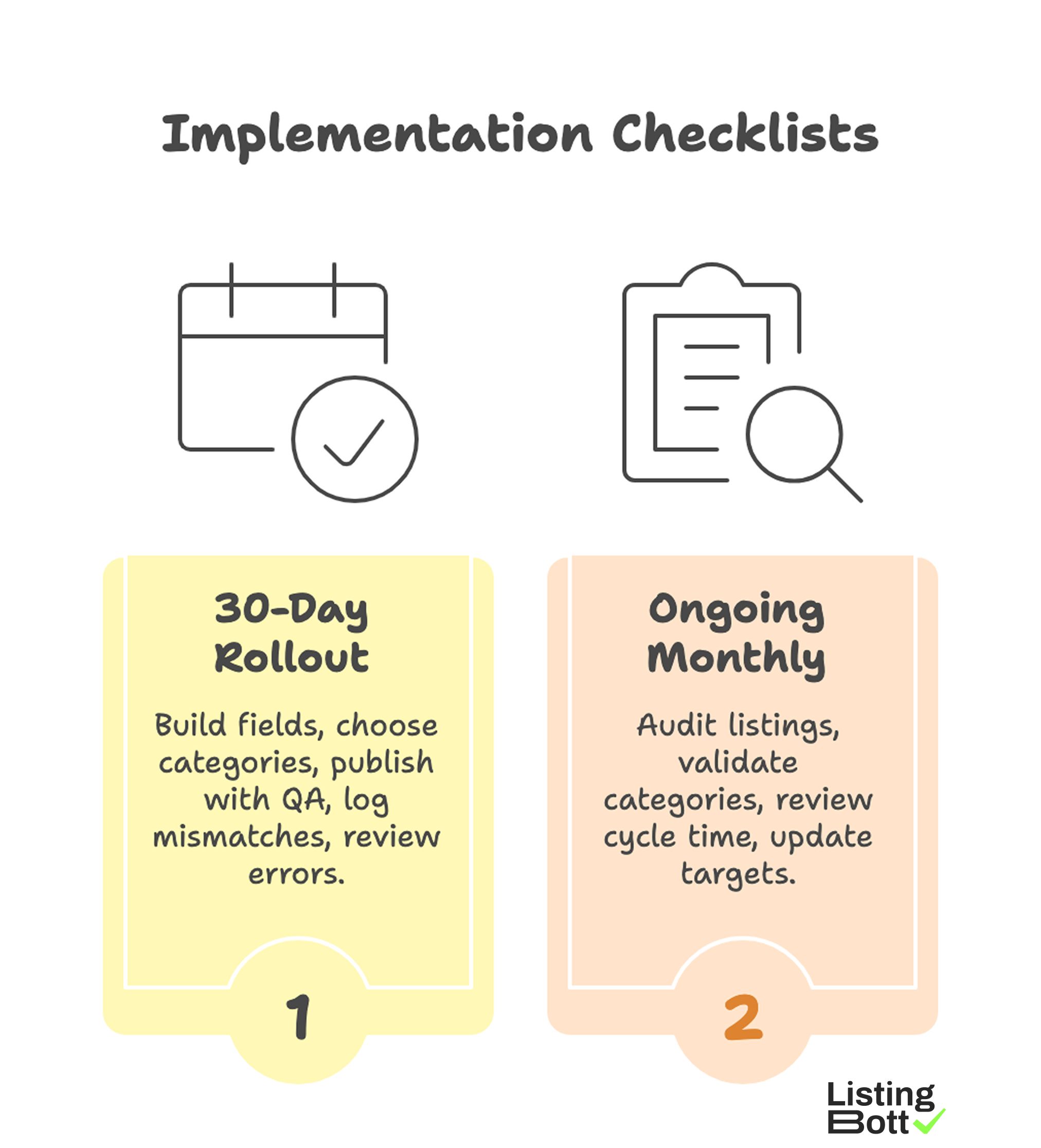
Implementation Checklist
The 7 practical rules
- Build one canonical NAP source document.
- Enforce one name format and one phone format.
- Audit all current listings before new submissions.
- Correct highest-visibility listings first.
- Add location-level ownership for multi-location businesses.
- Log every listing edit with date and owner.
- Run monthly variance checks and correction cycles.
What to do when business data changes
When address/phone/business naming changes:
- Update canonical NAP source first.
- Prioritize core listings and map/business profiles.
- Update high-traffic industry directories next.
- Track completion and unresolved mismatches.
Local listing examples from your categories dataset
The examples below are sourced from Backlinks for tool our tools - Сategories.tsv (category: Industry Directory). They are examples for evaluation workflow, not blanket endorsements.
| Directory example | DA | Traffic | Type |
|---|---|---|---|
| https://www.localhomeservicepros.com/ | 58 | 11,900.00 | Dofollow |
| https://www.click4homeservices.com/ | 56 | 3,100.00 | Dofollow |
| https://www.localplumbersdirectory.com | 0.1 | 1,000.00 | Nofollow |
| https://www.myzipplumbers.com | 26 | 1,700.00 | |
| https://www.usaplumbing.info | 38 | 2,100.00 | |
| https://plumbingvia.com | 2.2 | 1,100.00 | |
| https://thehomeimprovementdirectory.com | 33 | 1,200.00 | |
| https://www.fixthehome.com | 19 | 1,000.00 |
How to apply these examples:
- choose by category fit and local intent,
- keep NAP fields identical across all chosen listings,
- audit and correct in monthly cycles.
How ListingBott solves this
NAP consistency programs often fail due to fragmented ownership, spreadsheet drift, and inconsistent profile updates.
ListingBott provides a one-time-payment workflow with intake, approved directory list, publication process, and report handoff. It is a tool workflow, not a consulting-call service model.
For local submission operations, this helps centralize execution and reduce inconsistency across listing waves.
If your team needs standardized rollout for local citations, use a business directory submission workflow as your execution baseline.
What you get
A disciplined NAP process plus structured listing execution usually gives:
- fewer duplicate or conflicting citations,
- better consistency across local profiles,
- faster correction cycles,
- clearer accountability for listing updates.
Offer-policy alignment for ListingBott-facing work:
- one-time payment model,
- publication to 100+ directories (per current website language),
- refund possible if process has not started,
- no hidden extra fees (per current FAQ language).
For teams scaling across locations, combining submissions with automated directory submissions helps maintain speed with process controls.
When to use manual vs ListingBott
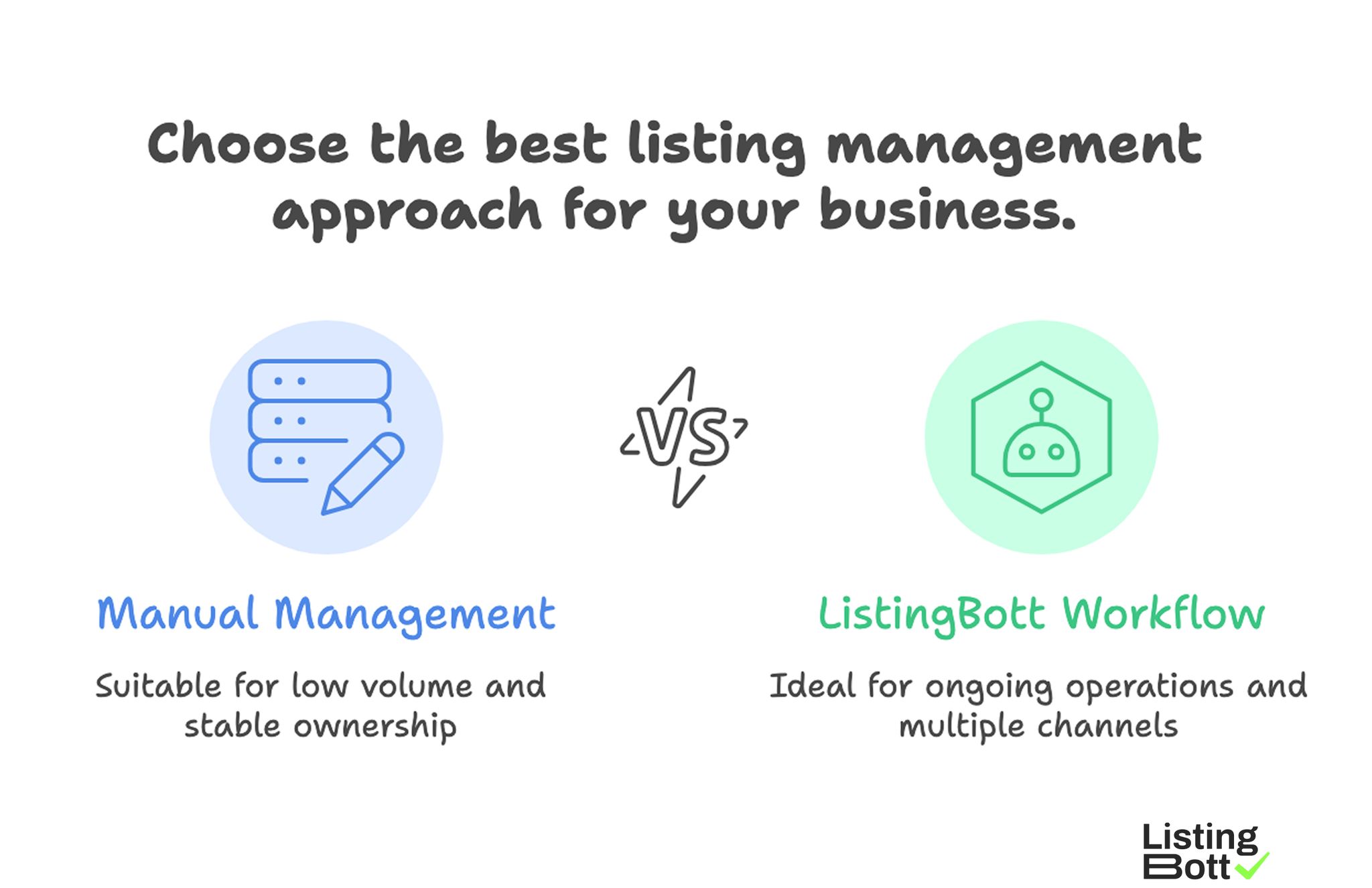
Choose the Best Listing Management Approach for your Business
Use manual execution when:
- listing volume is small,
- local footprint is limited,
- internal ownership is clear and stable.
Use ListingBott workflow when:
- listing count is high,
- multiple locations require repeated updates,
- internal teams need standardized QA and reporting.
Boundary reminder: NAP consistency supports local visibility directionally, but it does not control third-party platform outcomes.
FAQ
Why does NAP consistency matter so much for local SEO?
It helps search systems and users trust that your business information is accurate and stable.
How often should I run NAP audits?
At least monthly, and immediately after any business info change.
What is the most common NAP mistake?
Using different phone/address/name formats across listings and social profiles.
Should I update all directories at once?
Use priority waves: core listings first, then high-value niche directories.
Can NAP fixes alone solve local SEO performance issues?
No. They are foundational, but content, reviews, and overall site quality still matter.