Quick answer
The best way to choose business listing sites in the USA is not to chase the largest possible list. Teams usually get better outcomes by scoring listing categories for relevance and trust, then publishing in controlled waves.
A practical sequence:
- Build a shortlist from high-fit listing categories.
- Validate profile completeness and data consistency.
- Expand only when first-wave quality is stable.
Use this guide to evaluate top business listing sites with a workflow that balances visibility goals and maintenance reality.
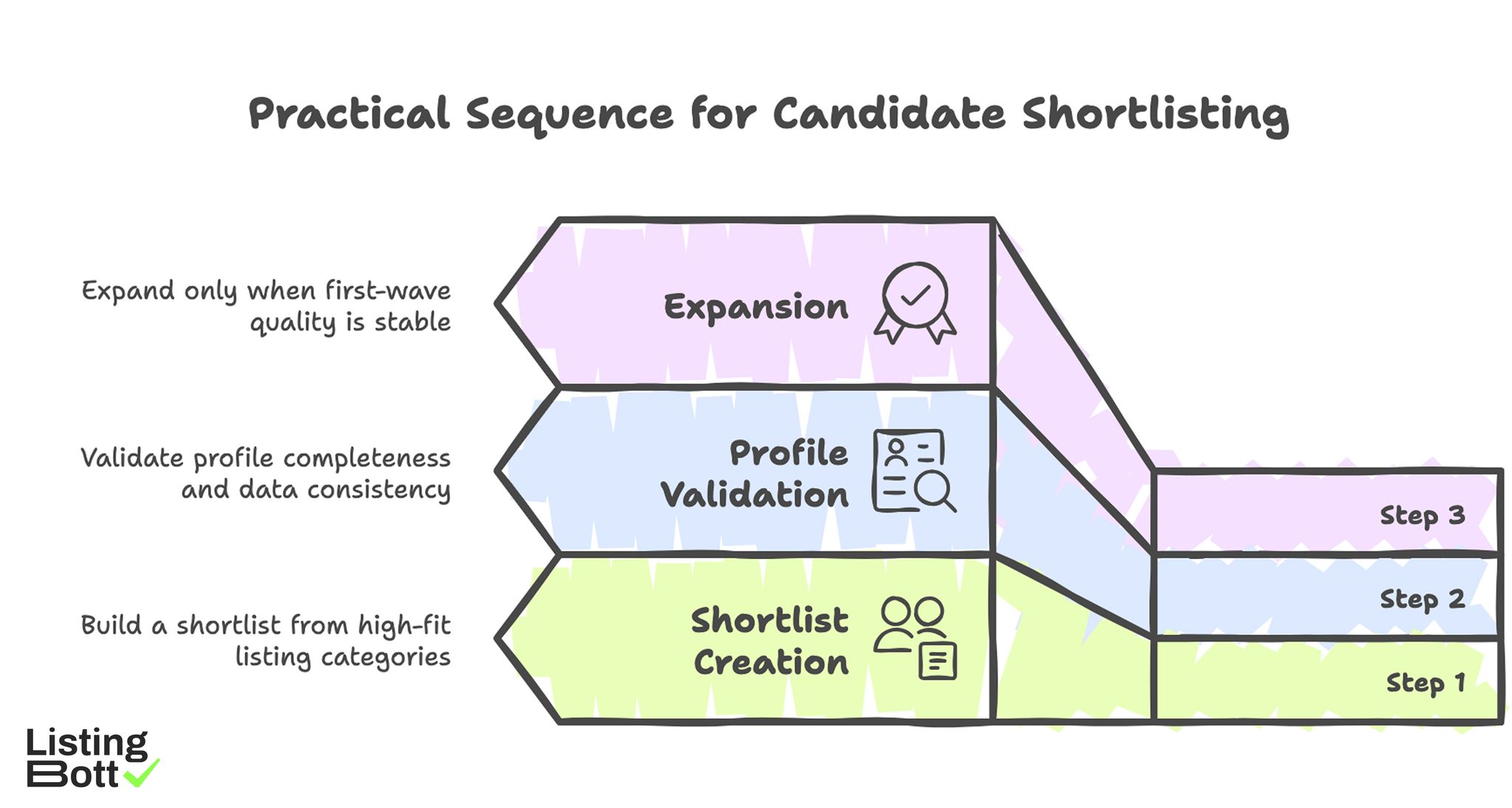
Practical Sequence for Candidate Shortlisting
sbb-itb-8e44301
Methodology
This model is built for operators who need repeatable execution across one or many US markets. It combines editorial filtering, operational risk checks, and rollout sequencing.
5-dimension scoring model (100 points)
| Dimension | Weight | Core question | Why it matters |
|---|---|---|---|
| Relevance and intent fit | 30 | Does this listing category match how target customers search? | Improves discovery quality |
| Trust and editorial quality | 20 | Are listings moderated and generally credible? | Reduces weak-signal expansion |
| Profile depth potential | 20 | Can you present meaningful business details? | Supports stronger user understanding |
| Execution friction | 15 | How difficult is submission and validation? | Affects speed and team workload |
| Maintenance burden | 15 | How complex are updates over time? | Determines sustainable scale |
Higher scores indicate stronger priority for initial rollout.
Tiering framework
- Tier 1 (80-100): should be included in Wave 1.
- Tier 2 (65-79): include after Tier 1 quality is stable.
- Tier 3 (<65): exclude unless a specific strategic reason exists.
Tiering prevents teams from over-expanding into low-value channels.
Pre-launch readiness checklist
| Readiness check | Required state | Risk if missed |
|---|---|---|
| Canonical business profile | Name, site, location info, core description standardized | Duplicate/inconsistent listings |
| Category mapping | Primary + secondary category logic set | Wrong audience intent alignment |
| Asset pack | Logo, photos, proof points, service details ready | Thin profile quality |
| Ownership model | Named editor + approver per wave | Untracked edits and delays |
| Issue log | Publish/update errors tracked with status | Slow correction cycles |
Most listing inefficiency comes from poor inputs, not from missing directories.
Workflow sequence for USA coverage
- Score listing categories using the 100-point model.
- Select up to three Tier 1 categories for first wave.
- Complete profiles before submitting to any new site.
- Run QA checks after first wave and fix all critical issues.
- Expand to Tier 2 only when correction backlog remains low.
This approach is safer than simultaneous wide submission.
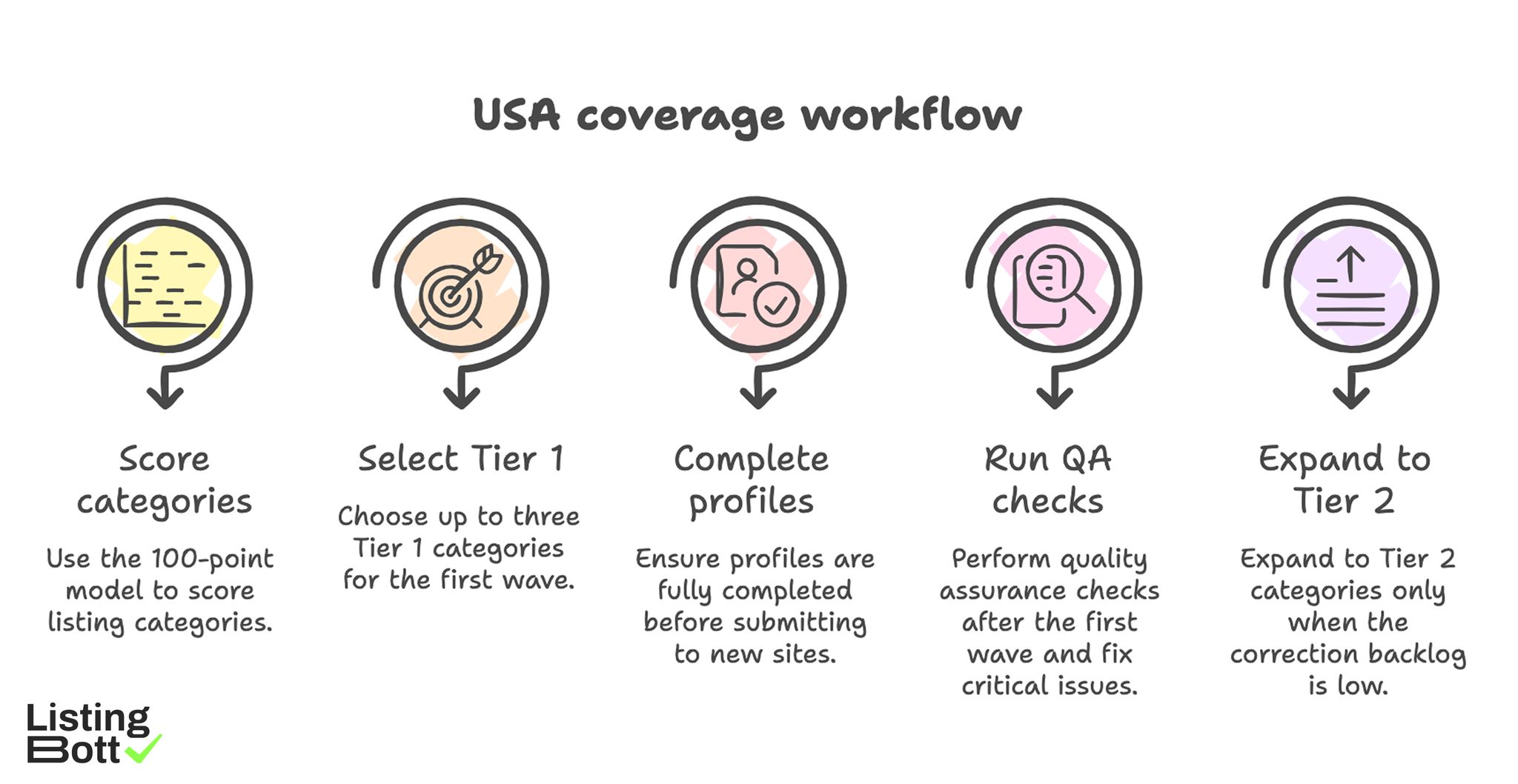
USA Coverage Workflow
90-day practical timeline
| Period | Primary objective | Output |
|---|---|---|
| Days 1-14 | Source profile finalization and tier scoring | Approved Tier 1 plan |
| Days 15-40 | First-wave publishing | Core listings active |
| Days 41-65 | QA corrections and profile improvements | Stabilized quality baseline |
| Days 66-90 | Conditional Tier 2 expansion | Controlled growth without quality drop |
The timeline keeps decision quality ahead of volume.
Comparison table
The table below compares major business listing groups commonly used in US campaigns.
| Listing group | Typical use case | Key strength | Main limitation | Recommended priority |
|---|---|---|---|---|
| Core map/business platforms | Most local and multi-location businesses | Strong baseline local discovery | Requires strict data consistency | Tier 1 |
| Industry-specific directories | Legal, healthcare, home services, SaaS niches | Better intent and category fit | Narrower audience outside niche | Tier 1 |
| SaaS/B2B software directories | B2B products and tools | Structured buyer-oriented profiles | Requires stronger profile depth | Tier 1 or Tier 2 |
| National general directories | Baseline citation coverage | Broad footprint and simple inclusion | Lower average relevance | Tier 2 |
| Local community/chamber sites | Local service firms and B2B | Trust and legitimacy signal | Variable traffic levels | Tier 2 |
| High-volume low-trust networks | Volume-first listing pushes | Fast count growth | Weak strategic value, higher maintenance | Usually exclude |
Example scoring snapshot
| Group | Relevance (30) | Trust (20) | Profile depth (20) | Friction (15) | Maintenance (15) | Total |
|---|---|---|---|---|---|---|
| Core map/business | 27 | 18 | 16 | 12 | 13 | 86 |
| Industry-specific | 26 | 17 | 15 | 10 | 12 | 80 |
| SaaS/B2B directories | 23 | 16 | 17 | 9 | 10 | 75 |
| National general | 17 | 13 | 10 | 14 | 11 | 65 |
| Community/chamber | 18 | 14 | 11 | 12 | 9 | 64 |
| Low-trust networks | 9 | 6 | 7 | 13 | 8 | 43 |
This shows why broad directories can support baseline coverage but should not dominate first-wave effort.
Selection guardrails
- Keep first wave limited to highest-confidence tiers.
- Do not add new groups while unresolved profile errors are rising.
- Require one canonical profile source for all editors.
- Track exclusions and reasons to support future refresh decisions.
Shortlist by use case
The same list does not fit every business model. Use-case targeting keeps execution precise. The same logic applies to recruiting niches too: a clear job board website template helps you organize openings, employer pages, and location filters before you start distributing listings.
1) Single-location local service business
Priority order:
- Core map/business listings.
- Industry-specific local directories.
- Review-driven or trust-oriented local channels.
Execution focus:
- service-area accuracy,
- contact consistency,
- category precision.
For brokers, agencies, and local property teams, a focused real estate website template makes it easier to align service-area pages, lead forms, and listing profiles before rollout.
For a related perspective on local listings, directory submissions, and local SEO visibility, see our Website Builders: Maximizing SEO with Directory Submissions.
2) Multi-location brand
Priority order:
- Scalable core business listings.
- National directories with location support.
- Vertical channels in priority markets.
Execution focus:
- cluster-based rollout,
- location template governance,
- periodic spot audits.
3) B2B software company
Priority order:
- SaaS/B2B software directories.
- Industry-specific directories.
- Selected general directories for baseline coverage.
Execution focus:
- clear product positioning,
- complete profile context,
- consistent category mapping.
4) Professional services firm (legal, consulting, accounting)
Priority order:
- Industry-specific directories.
- Core map/business listings.
- Chamber/community channels for trust support.
Execution focus:
- service taxonomy accuracy,
- team or office details,
- compliance-safe profile language.
5) Early-stage startup with limited bandwidth
Priority order:
- Two highest-scoring Tier 1 groups only.
- No expansion until correction backlog is controlled.
Execution focus:
- quality over breadth,
- strict ownership,
- operational simplicity.
Operational workflow option
Many teams can identify the right categories but still lose momentum during execution and QA.
ListingBott is a productized workflow for directory publication with one-time payment, intake, approved directory list, publication workflow, and report handoff. It is a tool, not a consulting call model.
If your team needs structured business listing automation without managing each submission manually, this approach helps maintain consistency while scaling coverage.
Risks/limits
Business listing strategies can improve representation consistency and support visibility, but no workflow can fully control third-party directory behavior.
Frequent risk patterns
| Risk | Typical trigger | Mitigation |
|---|---|---|
| Over-expansion | Too many listing groups launched at once | Limit first wave and gate expansion |
| Category mismatch | Generic categories reused across business lines | Validate mapping by use case |
| Data drift | Multiple editors changing core fields | Enforce canonical source profile |
| Correction backlog | No post-wave QA checkpoint | Pause and resolve before adding volume |
| Vanity metrics | Tracking submissions without quality context | Pair activity metrics with QA outcomes |
What this process can support
- stronger listing consistency,
- cleaner category alignment,
- better operational control during rollout.
What this process cannot guarantee
- fixed ranking positions,
- guaranteed traffic by a specific date,
- guaranteed indexing speed,
- outcomes owned by external directory platforms.
DR-related promise condition
When DR growth to 15 is referenced, it is a qualified condition only: starting DR below 15, explicit domain growth goal, and client-approved directory list.
Offer-policy alignment
Use approved commercial language consistently:
- one-time payment model,
- publication to 100+ directories (per current website language),
- refund possible if process has not started,
- no hidden extra fees (per current FAQ language).
FAQ
1) How many listing groups should I start with in the USA?
Two or three Tier 1 groups are usually enough for Wave 1.
2) Are national general directories still useful?
Yes, mainly as Tier 2 support after high-relevance categories are stable.
For a broader comparison set around this topic, review our best Business Listing Sites guide.
For a broader comparison set around this topic, review our best Online Business Directories guide.
For a broader comparison set around this topic, review our top Business Directories in USA 2026 guide.
For a broader comparison set around this topic, review our free Business Listing Sites USA 2026 guide.
For a broader comparison set around this topic, review our business Directories for SEO 2026 guide.
3) Should multi-location businesses publish all locations at once?
Usually no. Phased rollout by location cluster is safer for quality control.
4) Do listing submissions guarantee ranking growth?
No. Listings support consistency and visibility, but rankings depend on many external factors.
5) What causes the biggest loss of listing quality over time?
Inconsistent core business data and expansion without ownership controls.
6) How often should listing priorities be reviewed?
Review after each wave and perform a deeper strategic refresh quarterly.