Quick answer
The best local-directory strategy in the USA is not a universal list copied across industries. Local intent, profile requirements, and maintenance risk vary by sector, so directory priorities should be built by industry first and location second.
A practical rule:
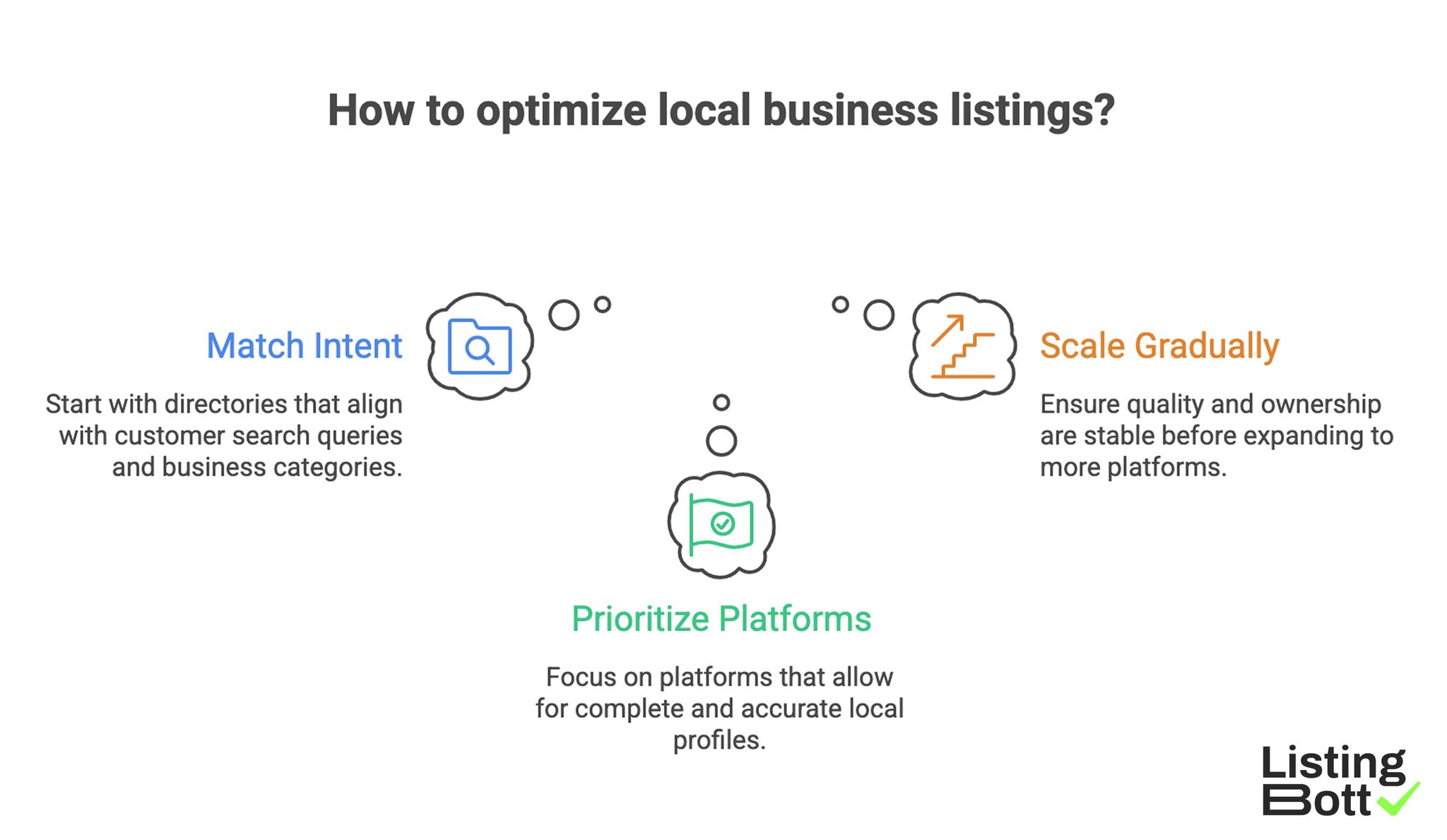
- Start with directories that match your customer intent and category model.
- Prioritize platforms where you can publish complete, accurate local profiles.
- Scale in waves only after quality and ownership are stable.
If your team is planning local growth, use this guide to evaluate top local business directories by business type and operating capacity.
Local Business Listing Optimization
sbb-itb-8e44301
Methodology
This methodology is built for US businesses managing one or many locations. It scores directory categories by local discovery potential and operational sustainability, not by raw directory count.
Scoring framework (100 points)
| Dimension | Weight | Evaluation question | Why it matters |
|---|---|---|---|
| Local-intent fit | 30 | Does this category match how buyers search locally? | Higher relevance and better discovery alignment |
| Industry category accuracy | 20 | Can you classify the business correctly for this sector? | Reduces category mismatch and weak traffic intent |
| Profile depth and trust signals | 20 | Can you publish complete local details and context? | Improves user confidence and profile quality |
| Multi-location feasibility | 15 | Is the platform practical for one-to-many location operations? | Prevents rollout bottlenecks |
| Ongoing maintenance burden | 15 | How hard is it to keep data current over time? | Protects long-term consistency |
Use this score to assign priority tiers before execution.
Priority tiers for USA-local execution
- Tier 1 (80-100): core local channels to launch first.
- Tier 2 (65-79): expansion channels after Tier 1 quality stabilizes.
- Tier 3 (<65): usually excluded unless there is a clear strategic reason.
This keeps local growth focused on quality signals rather than volume-only submissions.
Industry-first mapping process
- Define local intent patterns for each industry line.
- Map required profile fields by directory category.
- Score directory categories with the 100-point model.
- Build first-wave shortlist (Tier 1 only).
- Run QA review before adding Tier 2.
Industry-first mapping avoids a common problem: using one directory stack for every business model.
Data integrity controls before submission
| Control | What to standardize | Failure risk if skipped |
|---|---|---|
| Core identity fields | Business name, website, phone, location details | Duplicate or conflicting local profiles |
| Service descriptors | Industry-specific service taxonomy | Wrong category placement |
| Proof assets | Logos, photos, descriptions, business facts | Thin or low-trust listings |
| Ownership model | Editor + approver per wave | Untracked edits and correction backlog |
| Change logging | Where and when each listing was updated | Slow issue diagnosis |
These controls are more important in local SEO than many teams expect. Most local listing decay starts with inconsistent source data.
90-day rollout model (refresh-safe)
| Window | Primary objective | Output |
|---|---|---|
| Days 1-14 | Finalize local source profile and industry scoring | Approved Tier 1 plan |
| Days 15-45 | Execute Tier 1 submissions and validate profile quality | Stable local coverage baseline |
| Days 46-70 | Correct errors and harmonize category mappings | Low correction backlog |
| Days 71-90 | Expand to Tier 2 where capacity allows | Controlled incremental growth |
Wave sequencing reduces rework and supports clean refresh cycles on existing URLs.
Comparison table
The table below compares local directory groups by industry suitability in the USA.
| Directory group | Strong-fit industries | Advantages | Common limitations | Suggested priority |
|---|---|---|---|---|
| Core local map/business directories | Home services, legal, clinics, restaurants, retail | Strong local-intent visibility and map alignment | Quality depends on data consistency | Tier 1 |
| Industry-specific local directories | Legal, healthcare, contractors, professional services | Better intent precision and category match | Narrower audience outside niche | Tier 1 |
| Local chamber/community directories | Professional services, local B2B, neighborhood retail | Trust and local legitimacy signals | Variable traffic volume | Tier 2 |
| National directory networks with local pages | Multi-location chains, franchises | Scalable location coverage patterns | Template quality can be uneven | Tier 2 |
| Review-driven local platforms | Hospitality, health/wellness, service businesses | Buyer trust support and social proof context | Requires ongoing reputation management | Tier 1 or Tier 2 |
| Generic low-trust listing networks | Any industry (tempting for bulk volume) | Fast count increase only | High maintenance and weak strategic value | Usually exclude |
Industry priority matrix
| Industry | Local-intent strength | Category precision need | Maintenance complexity | Recommended mix |
|---|---|---|---|---|
| Home services | High | High | Medium | Core local + industry-specific |
| Legal services | High | Very high | High | Core local + strict legal-category directories |
| Healthcare/wellness | High | Very high | High | Core local + trusted vertical directories |
| Restaurants/hospitality | Very high | Medium | High | Core local + review-driven platforms |
| Retail (single location) | Medium-High | Medium | Medium | Core local + local community channels |
| Multi-location retail | Medium-High | Medium | High | Core local + scalable national-local networks |
| B2B local services | Medium | High | Medium | Industry-specific + chamber/community directories |
This matrix helps teams decide where local-directory effort produces the best operational return.
Selection rules that prevent over-expansion
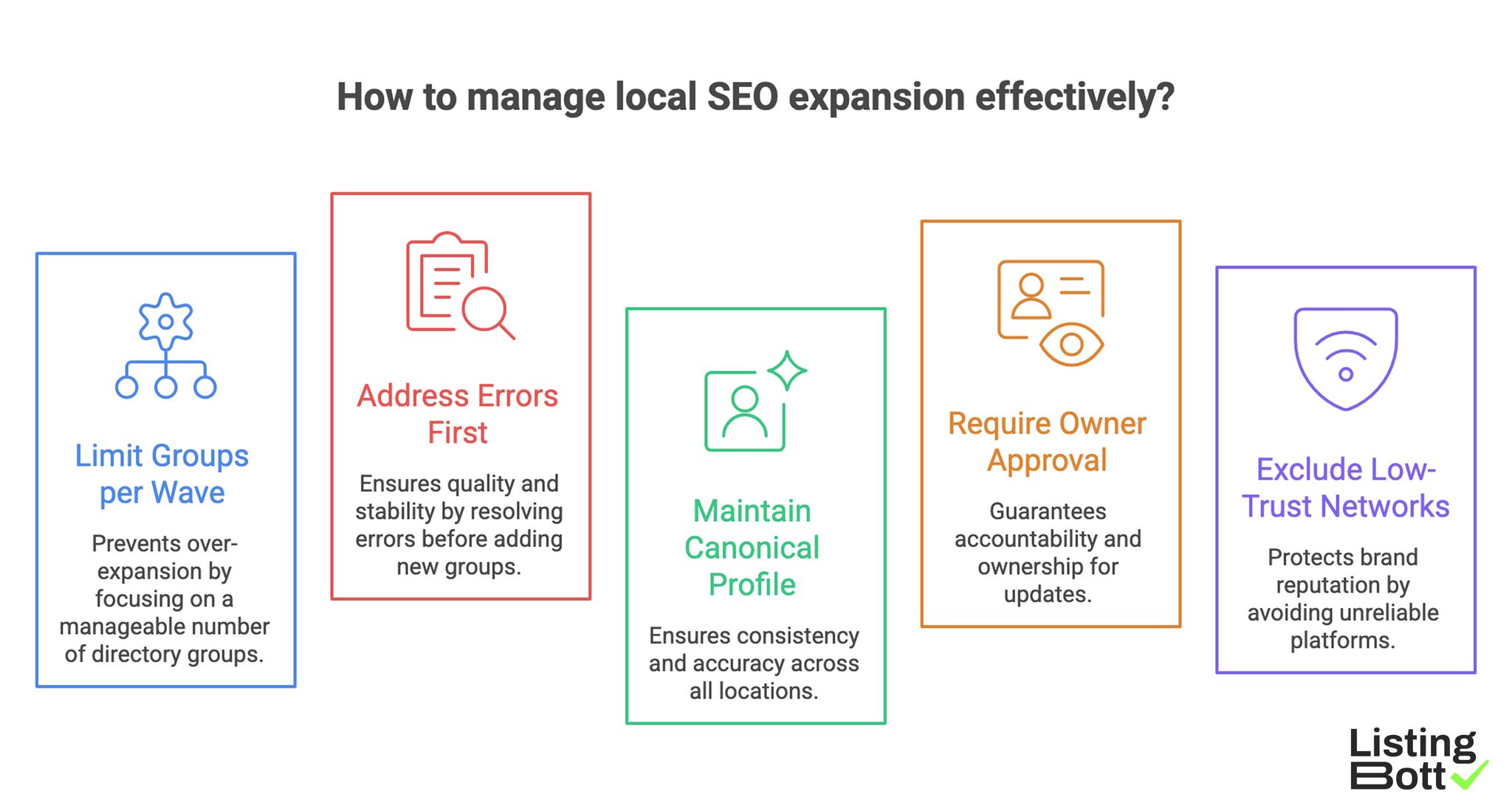
- Launch no more than three high-confidence directory groups per wave.
- Do not add new groups while unresolved errors are growing.
- Keep one canonical source profile for all locations.
- Require an owner for every update cycle before expansion.
-
Exclude low-trust networks even if they promise fast volume.
Effective Local SEO Expansion Management Improves Visibility and Growth
Shortlist by use case
Local priorities change by business model. The examples below are designed for real operating constraints in US markets.
1) Home services (plumbing, HVAC, roofing, electrical)
Recommended stack:
- Core local map/business directories.
- Contractor and service-specific local directories.
- Select review-driven local platforms.
Execution focus:
- service-area precision,
- consistent contact details,
- structured service descriptions.
2) Legal practices
Recommended stack:
- Core local directories.
- Legal-specific directories with strict practice categories.
- Select local chamber/trust directories.
Execution focus:
- practice-area accuracy,
- attorney or office profile clarity,
- controlled update ownership.
3) Healthcare and wellness clinics
Recommended stack:
- Core local directories.
- Healthcare-focused local directories.
- Trust-oriented local channels where profile depth is strong.
Execution focus:
- service and specialty accuracy,
- location-level consistency,
- conservative claims language.
4) Restaurants and hospitality
Recommended stack:
- Core local directories.
- Review-driven local platforms.
- Local city/visitor channels where available.
Execution focus:
- category precision,
- accurate hours and business details,
- faster maintenance cadence during seasonal changes.
5) Multi-location brands
Recommended stack:
- Scalable core local directories.
- National-local networks that support location templates.
- Vertical channels only for highest-value markets.
Execution focus:
- phased regional rollout,
- spot audits per location cluster,
- strict correction SLAs.
6) Local B2B service companies
Recommended stack:
- Industry-specific directories.
- Core local directories.
- Chamber/community directories for trust reinforcement.
Execution focus:
- clear service scope,
- industry-language fit,
- consistent proof assets.
Workflow option for teams with limited bandwidth
When the team cannot coordinate manual submissions across many directories, process discipline becomes the bottleneck.
ListingBott is designed as a tool workflow with one-time payment, intake, approved directory list, publication workflow, and report handoff. It is not a consulting-call model.
Teams that need to manage local listings at scale can use this approach to reduce spreadsheet-heavy coordination while preserving review control.
Risks/limits
A local directory strategy improves consistency and directional visibility, but it cannot control outcomes owned by third-party platforms.
Common risks in USA-local execution
| Risk | Typical trigger | Mitigation |
|---|---|---|
| Category mismatch | Generic category assignments across industries | Use industry-specific mapping before submit |
| Location drift | Multiple editors updating profiles inconsistently | Centralize canonical source profile |
| Correction debt | Rapid expansion without QA gates | Pause expansion until backlog is resolved |
| Reporting noise | Counting submissions instead of quality outcomes | Track quality and error metrics together |
| Low-trust dependency | Chasing quick listing volume | Exclude weak-signal networks |
Promise boundaries
Do not position directory work as guaranteed ranking or guaranteed traffic by date. Local visibility outcomes depend on many variables outside one workflow.
What can be promised safely:
- structured local-directory execution,
- transparent process and reporting,
- consistency improvements when data governance is followed.
What should not be promised universally:
- guaranteed ranking position,
- guaranteed indexing speed,
- guaranteed outcomes on third-party platforms.
DR-specific condition (qualified only)
If DR growth to 15 is referenced, it is only under qualified conditions: starting DR below 15, explicit domain growth goal, and client-approved directory list.
Commercial policy consistency
Approved policy language should remain consistent:
- one-time payment model,
- publication to 100+ directories (per current website language),
- refund possible if process has not started,
- no hidden extra fees (per current FAQ language).
FAQ
1) Are the same local directories best for every industry?
No. Industry intent and category precision differ, so local directory priorities should be industry-specific.
For a related perspective on local listings, directory submissions, and local SEO visibility, see our Accelerating Indexing with Directory Submissions.
For a broader comparison set around this topic, review our best Business Listing Sites guide.
For a broader comparison set around this topic, review our best Online Business Directories guide.
For a broader comparison set around this topic, review our best Websites for Business Listings in the USA guide.
For a broader comparison set around this topic, review our top Business Directories in USA 2026 guide.
For a broader comparison set around this topic, review our free Business Listing Sites USA 2026 guide.
2) How many directory groups should I launch first?
For most teams, two or three Tier 1 groups are enough for a first wave.
3) Should multi-location brands submit all locations at once?
Usually no. Clustered rollouts with spot audits reduce correction debt and improve control.
4) Do local directories guarantee rankings in the USA?
No. They can strengthen local consistency and support discovery, but rankings are influenced by many external factors.
5) What causes most local listing failures?
Inconsistent source data, weak category mapping, and expansion without QA ownership are the most common causes.
6) When should I expand from Tier 1 to Tier 2?
Expand only when Tier 1 profiles are stable and correction backlog remains low for consecutive review cycles.