Table of Contents
- Why this matters in 2026
- Best-fit listing platforms for free online business directories
- 30-day implementation checklist
- Practical rules for updating listings over time
- Common mistakes to avoid
- FAQ
sbb-itb-8e44301
Quick answer
Free online business directories can still be useful in 2026, but only when they are selected and managed like an operations program, not a one-time submission blast.
The practical goal is not “submit everywhere for free.” The practical goal is to build a focused listing set that improves discoverability, supports trust signals, and stays accurate over time.
A reliable starting sequence is:
- choose 8-12 directories with proven relevance,
- publish one canonical business profile across all selected platforms,
- run a 30-day quality review,
- expand only when listing consistency and referral quality remain stable.
Most underperforming campaigns fail for one reason: no maintenance discipline after initial submission. If profile data drifts, listing value drops quickly.
Why this matters in 2026
The value of online directories for businesses is no longer just about basic link acquisition. In 2026, directory quality affects:
- entity clarity across public business data sources,
- trust consistency for buyers who verify your company in third-party environments,
- practical referral discovery from users searching by category and location.
This is why an online directories list should be treated as a quality-controlled shortlist, not a giant unfiltered spreadsheet.
Teams usually make three costly mistakes:
- they confuse low cost with low risk,
- they prioritize quantity over fit,
- they skip online listings management after publishing.
Free channels are useful when they fit your audience and you can maintain them. Free channels are harmful when they create mismatched profiles you do not have capacity to update.
Method: The DIRECT-7 framework
Use this framework before adding any platform from a free directory list.
| Dimension | Validation question | Why it matters | Score guide (1-5) |
| Discovery fit | Does your target customer actually use this platform? | Avoids irrelevant exposure | 1 = weak fit, 5 = strong fit |
| Integrity level | Is the directory moderated and credible? | Protects trust quality | 1 = noisy, 5 = reliable |
| Record depth | Can your profile include meaningful business details? | Improves decision readiness | 1 = shallow, 5 = deep profile support |
| Edit speed | How quickly can you update profile fields? | Reduces stale-data risk | 1 = slow, 5 = fast |
| Category match | Are category and taxonomy options usable? | Prevents misclassification | 1 = weak mapping, 5 = clean mapping |
| Tracking value | Can you monitor useful outcomes from this listing? | Enables decision-making | 1 = unclear, 5 = measurable |
| Capacity fit | Can your team maintain this listing set monthly? | Prevents sprawl | 1 = not sustainable, 5 = sustainable |
Operating thresholds
- Launch set: directories scoring 24+ out of 35.
- Test set: directories scoring 20-23.
- De-prioritize: directories below 20 unless there is a specific reason.
This threshold logic helps you avoid random expansion driven by very broad “100+ free directories” posts.
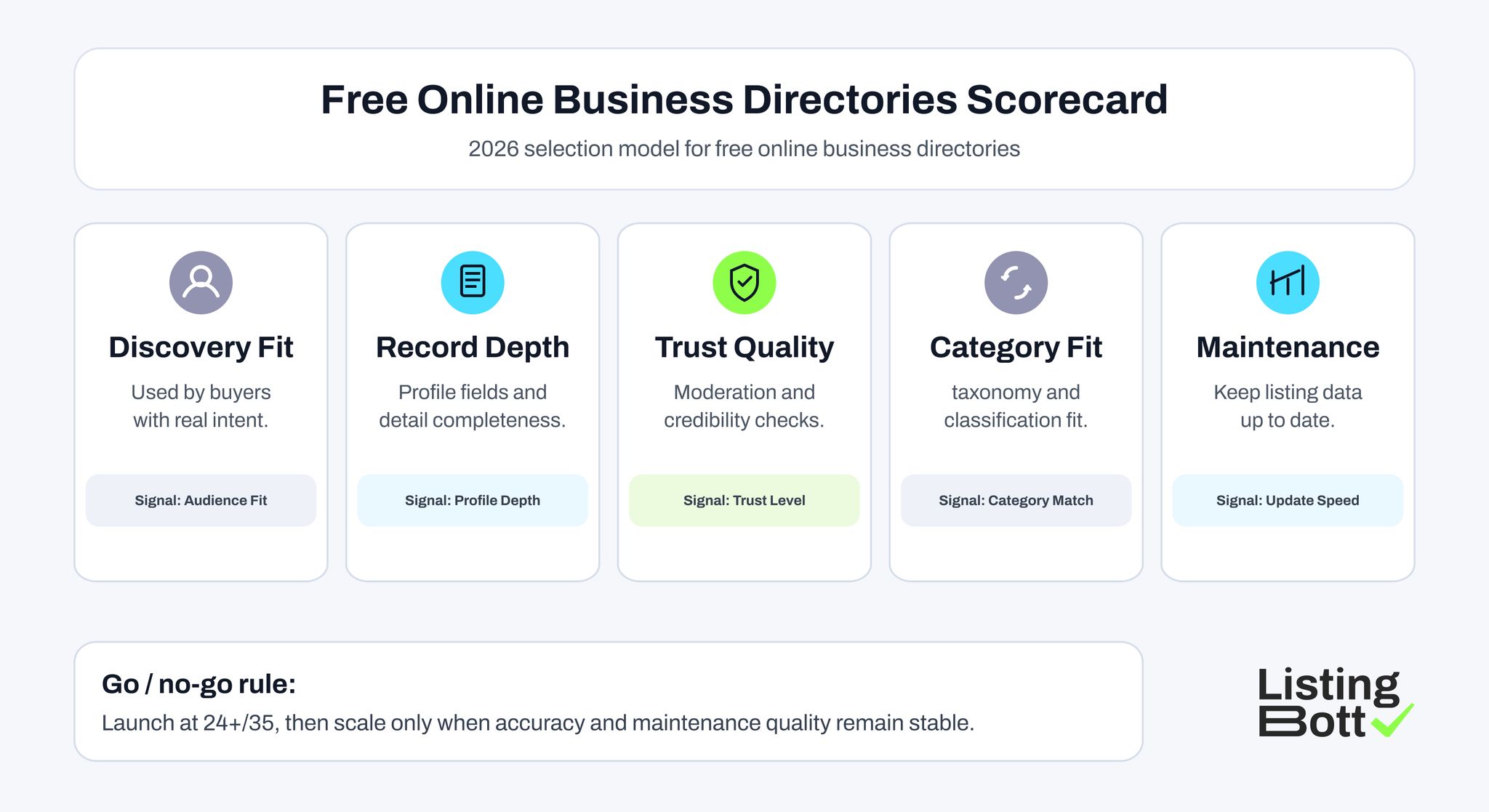
Free Online Business Directories Scorecard
Best-fit listing platforms for free online business directories
The platforms below are grounded in your local reference corpus (BrightLocal, Whitespark, Wytlabs, and related local citation source files).
| Platform | URL | Why it is a best fit | Ideal company profile | Submission note |
| Google Business Profile | https://www.google.com/business/ | Core business visibility layer for local and branded discovery | Local SMBs and hybrid local-first teams | Keep NAP, categories, and hours strictly accurate |
| Yelp | https://www.yelp.com/ | Strong consumer discovery and review-driven trust signal | Local service businesses, hospitality, retail, clinics | Review and response workflow matters as much as profile setup |
| Yellow Pages | https://www.yellowpages.com/ | Broad legacy directory visibility with category-level discovery | SMBs needing baseline citation coverage | Category precision improves relevance quality |
| Better Business Bureau | https://www.bbb.org/ | Adds credibility context for trust-sensitive categories | Professional services, home services, B2B SMBs | Keep core company details synchronized with site profiles |
| Foursquare | https://foursquare.com/ | Useful location and place-data signal in citation ecosystems | Businesses with location-driven discovery | Validate location attributes and category tags carefully |
| MapQuest | https://www.mapquest.com/ | Supplemental map/discovery presence for local search coverage | Regional SMBs and multi-location operators | Maintain address consistency with primary map properties |
| Manta | https://www.manta.com/ | Useful broad business listing layer for SMB discoverability | Smaller businesses building foundational presence | Ensure company summary and services stay current |
| Chamber of Commerce | https://www.chamberofcommerce.com/ | Practical category discovery plus local business context | Local businesses with community-oriented demand | Treat profile as trust/verification support, not primary conversion channel |
How to use this platform block
Do not assume every listed platform deserves the same effort.
A practical tiering approach:
- Tier 1 (core): Google Business Profile, Yelp, Yellow Pages.
- Tier 2 (support): BBB, Foursquare, MapQuest.
- Tier 3 (test): Manta, ChamberOfCommerce.
If your operating team is small, start with Tier 1 + one Tier 2 platform, then expand only after quality control stabilizes.
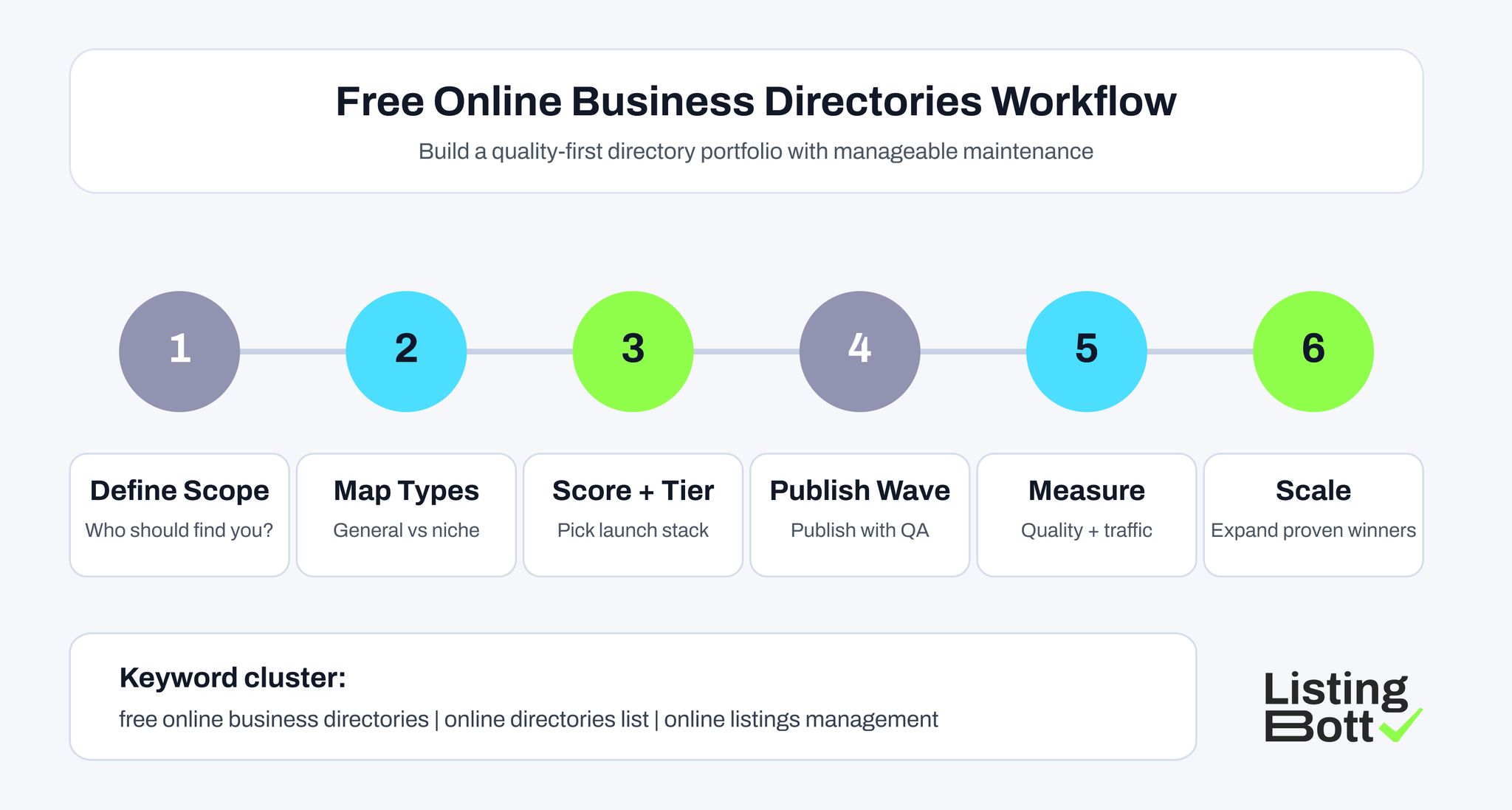
Free Online Business Directories Workflow
Build a quality-first free directory stack
A useful first-wave structure is 10 listings max:
- 3 core directories,
- 4 supporting directories,
- 3 test directories.
Core directory objectives
Use core platforms for:
- complete business profile depth,
- review and trust visibility,
- high-priority accuracy maintenance.
Supporting directory objectives
Use support platforms for:
- broader presence,
- citation consistency,
- category reinforcement.
Test directory objectives
Use test platforms for:
- niche opportunity checks,
- low-risk discovery experiments,
- measurable keep/de-prioritize decisions.
This structure keeps online listings management feasible and reduces maintenance debt.
30-day implementation checklist
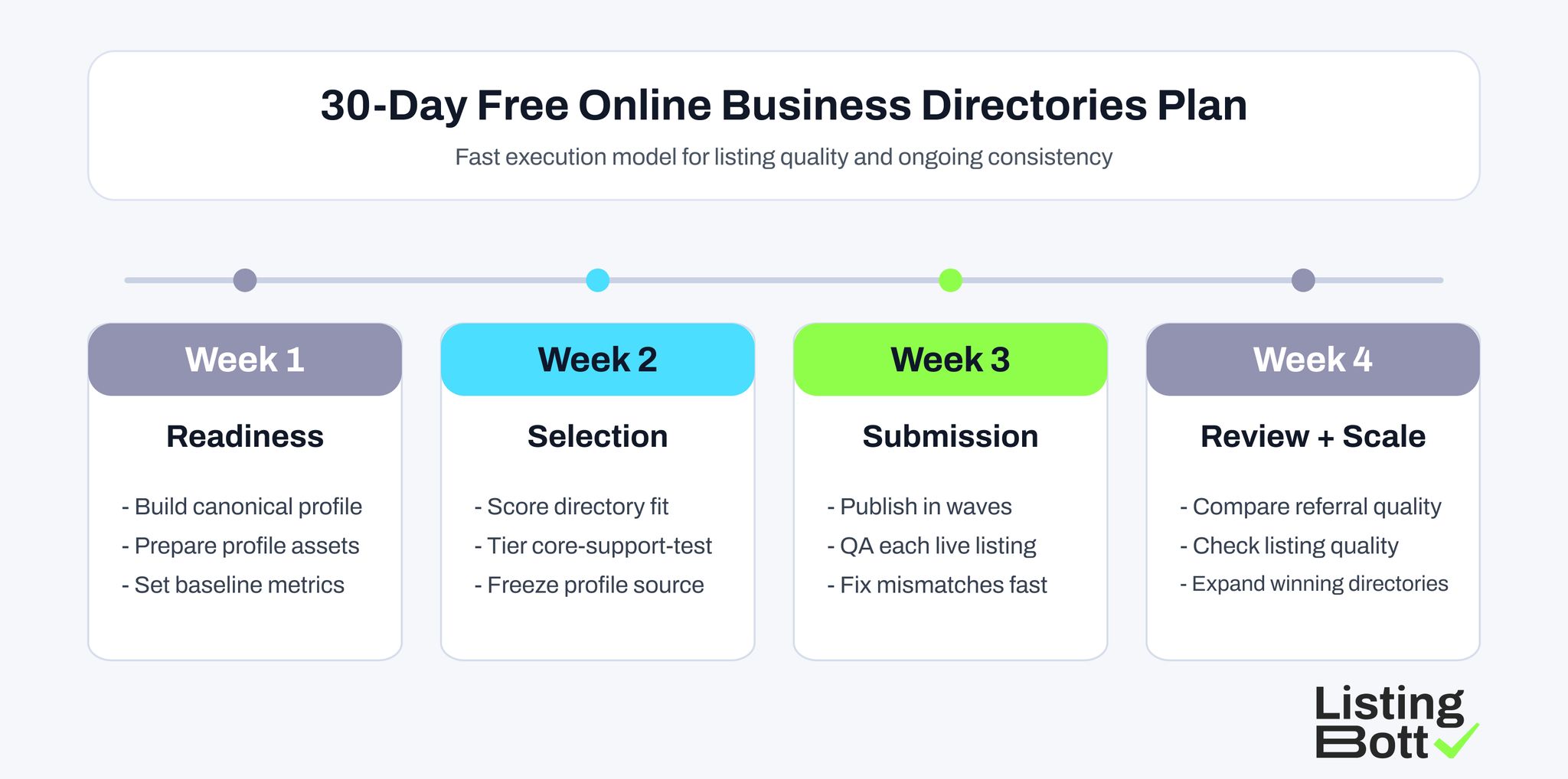
30-Day Free Online Business Directories Plan
Week 1: Canonical data and source control
-
Build one canonical profile pack:
- business name,
- address and phone,
- category mapping,
- service descriptions,
- business hours,
- website destination URL.
- Define ownership for updates.
- Set baseline KPIs before first submission.
Week 2: Directory scoring and launch set
- Score each platform using DIRECT-7.
- Select 8-12 first-wave directories.
- Create platform-specific submission checklist.
Week 3: Submission and verification
- Publish in controlled batches.
- Verify each live listing against canonical source data.
- Correct category or data mismatches immediately.
Week 4: Performance and quality review
- Compare referral quality by platform.
- Check profile consistency health.
- Keep high-value directories active.
- De-prioritize low-value or high-friction directories.
Practical rules for updating listings over time
If you need to update online business listings reliably, treat updates like release management.
Trigger-based update rules
Update listings when any of these change:
- address or phone,
- business hours,
- primary service categories,
- brand naming conventions,
- critical offer messaging.
Cadence rules
- Monthly: full consistency check for core directories.
- Quarterly: full support-directory validation.
- Event-driven: immediate update after business-critical changes.
Escalation rules
If a platform repeatedly creates correction friction, move it from core/support to test or de-prioritize status.
This process keeps your directory layer accurate without unnecessary operational drag.
Free vs paid: execution reality
Some teams ask whether free directories are enough. The real answer depends on your capacity and goals.
| Model | Main advantage | Main risk | Best fit |
| Free-only | Low entry cost | High management burden if unstructured | Very small teams with controlled scope |
| Mixed free + selective paid | Better distribution control | Requires clearer channel strategy | Growth teams needing scalable operations |
| Paid-heavy distribution | Faster expansion potential | Can create waste without strict QA | Teams with strong ops capacity and clear ROI model |
This is where the online directory business model question becomes practical. The winning model is the one your team can maintain accurately.
Common mistakes to avoid
1) Submitting to every directory in one week
This creates low-quality sprawl and weak maintenance.
Fix:
- cap first wave,
- use scoring thresholds,
- expand only after review.
2) Ignoring category integrity
Wrong categories reduce relevance and lead quality.
Fix:
- define category map before submit,
- QA categories after publish.
3) Treating all directories as equal
Not all directories deserve ongoing effort.
Fix:
- tier platforms,
- allocate maintenance by platform value.
4) No operating owner for updates
Without ownership, profiles drift.
Fix:
- assign explicit owner,
- track monthly consistency checks.
5) Measuring only click volume
Traffic alone is weak decision input.
Fix:
- track engagement quality and assisted outcomes,
- compare effort-to-value by platform.
KPI dashboard for directory decisions
Use a simple monthly KPI table.
| KPI | What it indicates | Healthy signal | De-prioritize signal |
| Listing accuracy rate | Data consistency quality | high match across core profiles | repeated field mismatches |
| Approval/survival rate | Platform compatibility | stable publish quality | frequent rejections or removals |
| Referral quality | Visitor intent quality | engaged sessions from listings | thin low-intent traffic |
| Update turnaround | Ops responsiveness | fast correction cycle | prolonged stale records |
| Effort-to-value ratio | Resource efficiency | manageable hours per useful outcome | growing maintenance load with weak outcome |
Keep/de-prioritize logic
- Keep: strong quality + stable maintenance + useful traffic quality.
- Stabilize: mixed results with clear optimization path.
- De-prioritize: weak quality plus high correction burden after one full cycle.
Execution templates you can apply immediately
If you want this directory program to stay clean after month one, use small templates instead of ad-hoc edits.
Template 1: Canonical profile source sheet
Keep one source sheet with fixed fields:
- business name (exact format),
- address and phone (single master format),
- core category set,
- short and long descriptions,
- homepage and key landing URLs,
- opening hours and update timestamp.
Rule: never update listings directly first. Update source sheet first, then propagate changes.
Template 2: Directory-level QA checklist
Before marking a listing as complete, verify:
- category mapping is correct,
- contact details match canonical source,
- destination URL is correct and live,
- duplicate profile is not already published,
- visible profile text has no outdated offers.
This checklist alone usually removes most avoidable quality issues.
Template 3: Monthly review board
At month end, review each platform with three labels:
- keep active,
- stabilize,
- de-prioritize.
For each decision, log one reason tied to KPI evidence.
This keeps the process objective and avoids “we should keep it because it is free” decisions.
Practical variations by business type
The same free-directory strategy should not be copied across every company type.
Local service business
Primary objective:
- map and discovery coverage.
Priority platforms:
- Google Business Profile,
- Yelp,
- Yellow Pages,
- BBB.
Execution emphasis:
- location accuracy,
- review response cadence,
- service-area consistency.
Multi-location SMB
Primary objective:
- stable profile governance across branches.
Priority platforms:
- core map and citation directories first,
- secondary directories only after location data quality stabilizes.
Execution emphasis:
- branch-level QA,
- update workflow by region,
- centralized source of truth.
Digital-first business with hybrid local demand
Primary objective:
- combine trust and discoverability without over-indexing on local-only channels.
Priority platforms:
- core trust directories first,
- targeted local listings where location intent exists.
Execution emphasis:
- category intent mapping,
- link destination relevance by market,
- clear limits on directory count to protect operations.
This is where online business directory website decisions should stay practical.
Choose channels that match your operating model and buyer behavior, not just channels with big raw domain metrics.
Where ListingBott fits
ListingBott is useful when you want execution consistency across a larger directory set without relying on manual spreadsheet tracking.
Practical workflow:
- complete the client form,
- review and approve the directory list,
- run publication flow,
- receive report and next-step guidance.
Offer alignment from your current product docs:
- one-time payment model,
- publication to 100+ directories,
- refund possible if process has not started,
- no hidden extra fees.
Important limits to keep explicit:
- no guaranteed ranking position,
- no guaranteed traffic by a specific date,
- no guaranteed indexing speed,
- no guaranteed outcomes controlled by third-party platforms.
Qualified DR note: DR growth to 15 is only a qualified promise when starting DR is below 15, the goal is explicitly set to domain growth, and the client-approved listing set is in place.
FAQ: Free online business directories
Are free online business directories still worth using in 2026?
Yes, when they are selected by fit and maintained consistently. Free access does not remove the need for quality control.
How many directories should we start with?
Most teams should start with 8-12, run one quality cycle, and then expand only from proven performers.
What is the difference between an online directories list and a working strategy?
A list is a source set. A strategy defines selection rules, execution sequence, ownership, and KPI-based keep/de-prioritize decisions.
How often should we update online business listings?
At minimum, monthly for core directories and immediately after any critical business-data change.
Can local business listing sites help non-local companies?
They can help hybrid models, but pure non-local businesses should prioritize directories that match their actual buyer journey.
Is online listings management really necessary for free directories?
Yes. Without active management, free listings frequently become inaccurate and lose practical value.