Quick answer
The best free business listing directories are the ones that match your business model, allow enough profile depth to represent you properly, and are realistic to maintain over time.
That means a local service business, a SaaS company, an agency, and an ecommerce brand should not use the exact same directory shortlist.
For most teams, the smarter workflow is:
- choose the directory types that fit your business,
- publish complete and consistent profiles,
- review what actually gets approved and indexed,
- expand only after the first wave is stable.
If you are trying to build presence quickly, it is tempting to submit everywhere. In practice, a smaller and better-matched directory portfolio usually performs better than a giant low-trust list.
If you want help turning this into a repeatable submission workflow instead of a spreadsheet project, ListingBott can help you organize, publish, and track directory submissions across the channels that actually fit your business.
You can submit to these directories yourself, or review directory submission service for websites when you want help selecting targets and running the campaign.
sbb-itb-8e44301
Why most business-directory articles underperform
A lot of pages in this topic cluster make one of two mistakes.
The first mistake is treating every directory as equally useful. The second is writing for one narrow business type while promising a much broader answer in the URL and search snippet.
That is exactly where this topic gets messy.
A directory can serve very different jobs:
- baseline business presence,
- local citation support,
- startup discovery,
- software comparison,
- or industry-specific visibility.
Those jobs are not interchangeable.
That is why the better question is not just "Which directories are free?" It is:
- Which directory type fits my business?
- Which ones allow enough profile depth to be useful?
- Which ones are worth the effort to keep accurate?
- Which ones should I skip because they add maintenance but no meaningful upside?
This matters even more now because search discovery is spread across:
- traditional web search,
- local search,
- software comparison environments,
- niche business directories,
- and AI-assisted research flows that pull information from multiple sources.
So the goal is not maximum directory count. The goal is a clean, high-fit portfolio.
Methodology
This guide uses a practical evaluation framework instead of a popularity-only list.
Each directory type should be judged on five dimensions:
| Dimension | What to check | Why it matters |
|---|---|---|
| Intent fit | Does this directory match your business model and audience? | Prevents irrelevant submissions |
| Profile depth | Can you explain what the business actually does? | Thin listings rarely convert well |
| Trust quality | Does the directory appear curated, useful, and maintained? | Low-trust directories create noise |
| Submission effort | How much time does publication and cleanup require? | High-friction channels need stronger upside |
| Maintenance burden | Can you keep the listing accurate over time? | Stale listings reduce trust quickly |
Practical rule:
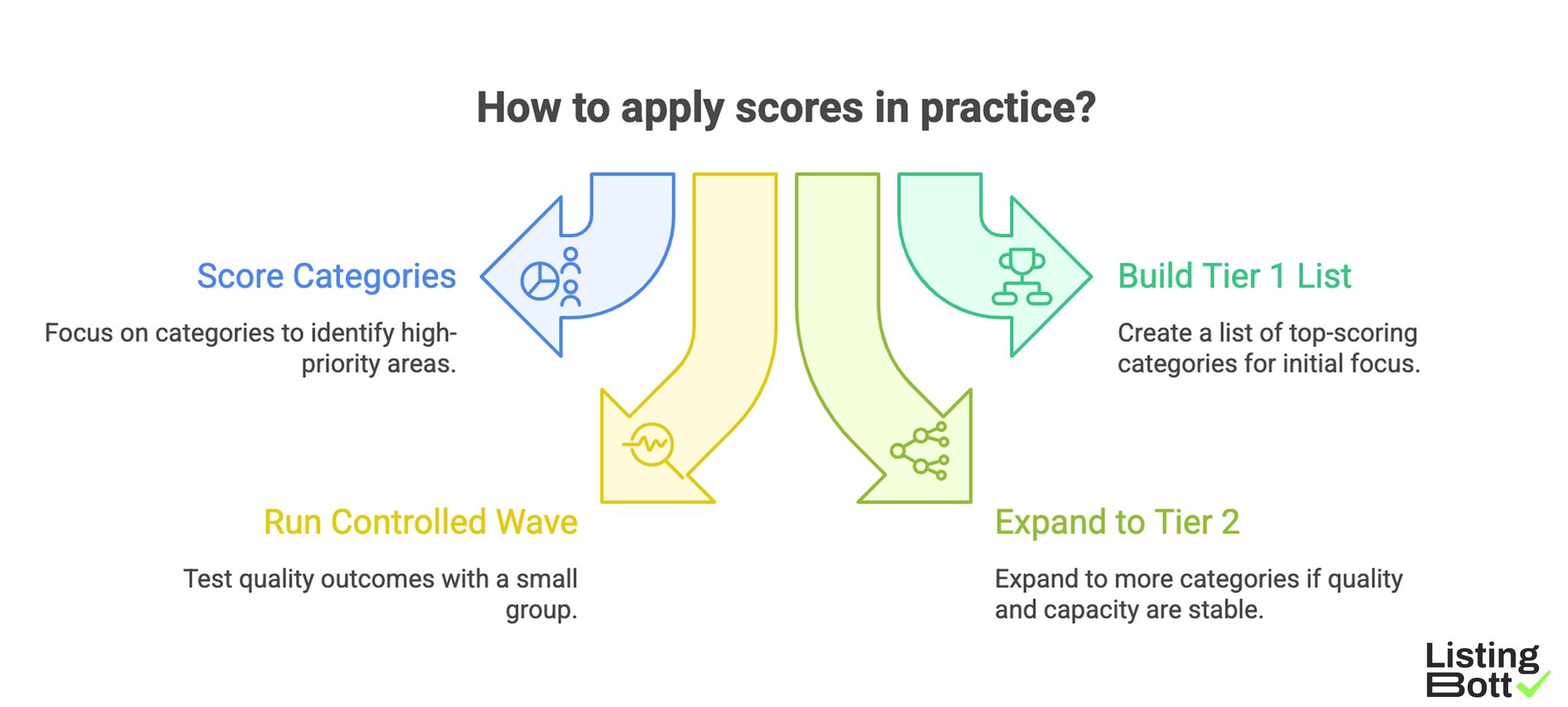
- prioritize high-fit, high-trust directories first,
- test medium-fit categories in a controlled second wave,
-
skip directories that are broad, shallow, or obviously low-value.
How to Apply Scores in Practice?
Comparison table by directory type
This table is the right starting point because most businesses should choose directory categories before choosing individual sites.
| Directory type | Best for | Main upside | Main limitation | Priority |
|---|---|---|---|---|
| General business directories | Broad baseline presence | Useful for foundational visibility and citations | Often too broad to drive strong qualified traffic | Medium |
| Local business directories | Local services, multi-location businesses, regional brands | Strongest for geographic trust and local discovery | Requires strict NAP consistency and ongoing maintenance | High for local businesses |
| Startup directories | New products, launches, venture-backed or indie startups | Helpful for launch awareness and early discovery | Not the right core layer for every business | High for startups, low for others |
| SaaS/software directories | Software tools, B2B SaaS, apps | Better fit for evaluation and comparison intent | Weak fit for offline or non-software businesses | High for SaaS |
| Industry-specific directories | Agencies, healthcare, legal, real estate, niche service categories | Stronger context and audience fit | Reach is narrower and quality varies by niche | High when niche fit is clear |
| Low-trust mass directories | Almost nobody as a first choice | Fast volume only | High maintenance, low signal, weak trust | Usually skip |
How to use it:
- choose the category layers that match your business,
- build your first submission wave around those layers,
- and avoid expanding into low-fit categories just to grow the count.
Best options by business type
The right directory mix depends on what kind of business you run.
1. Best directory mix for startups
Startups often need two things at the same time:
- early discovery,
- and a baseline business presence that does not look thin or inconsistent.
That is why startup-specific directories should stay in the strategy, but they should not define this whole page.
Best mix for startups:
- startup directories,
- a small set of general business directories,
- industry-specific directories if the niche is clear,
- local directories only if geography matters.
This is where the older categorization logic still helps. Startups should work in waves, not in one giant directory dump.
A useful first-pass order looks like this:
- launch and startup discovery channels,
- one or two strong general business listings,
- niche directories that match the product or service,
- local layers only if local discovery is part of the funnel.
If your startup is also a software product, this page should connect with a more software-specific flow. In that case, a guide like best directory listing services is often a better operational next step than adding more broad directories too early.
2. Best directory mix for local businesses
Local businesses should usually prioritize local-intent directories over startup-style discovery platforms.
Best mix for local businesses:
- local business directories,
- high-trust general business directories,
- niche local or service-category directories,
- state or regional citation layers where appropriate.
This works best when the business can maintain:
- accurate name,
- address,
- phone,
- website,
- business category,
- and operating details.
If you are working on local coverage in the United States, the strongest supporting next read is local business directory submission USA, because the rollout logic is different from a national SaaS or startup strategy.
3. Best directory mix for SaaS and software companies
SaaS businesses usually underperform when they rely too heavily on broad generic directories.
Best mix for SaaS:
- software and SaaS directories,
- selected business directories for baseline company presence,
- vertical directories when the product has a clear industry niche,
- startup directories only if launch visibility still matters.
This is a good example of why the page identity needed correction. A software product may technically be a business, but the best distribution layer is often a software-discovery environment, not a generic business directory.
So for SaaS, business listing directories should usually play a supporting role rather than being the whole strategy.
4. Best directory mix for agencies and service businesses
Agencies and B2B services usually need a different profile than software products.
Best mix for agencies:
- high-trust general business directories,
- niche service directories,
- local or regional business directories if geography matters,
- selective industry lists where the audience fit is clear.
For agencies, profile depth matters more than sheer count. A strong agency listing should usually support:
- service description,
- specialization,
- industry focus,
- portfolio or proof links,
- and contact information that matches the main site.
If the profile is too thin to explain what the agency actually does, the directory is usually not worth the effort.
5. Best directory mix for ecommerce brands
Ecommerce businesses often need a hybrid approach.
Best mix for ecommerce:
- business directories that support brand legitimacy,
- product-listing or shopping-oriented platforms,
- niche ecommerce or catalog directories,
- local layers only if there is an offline or regional component.
This is one of the most common mistakes in this cluster: confusing business directories with product listing sites. They overlap, but they are not the same job.
If your main goal is product discovery rather than business presence, the stronger companion page is top free product listing sites. Use this page when you need the broader company-presence layer.
Should We Expand or Pause Directory Operation?
Priority tiers: how to choose what goes first
A cleaner directory strategy starts with tiers, not one giant list.
| Tier | What belongs here | When to use it |
|---|---|---|
| Tier 1 | Highest-fit directory types for your business model | First wave |
| Tier 2 | Supporting categories that add breadth without much confusion | Second wave after quality is stable |
| Tier 3 | Experimental or low-confidence directories | Only test if there is a clear reason |
| Skip | Low-trust mass directories or poor-fit categories | Do not include by default |
A simple decision framework:
- choose one primary directory layer,
- choose one supporting layer,
- publish a complete first wave,
- audit approval quality and consistency,
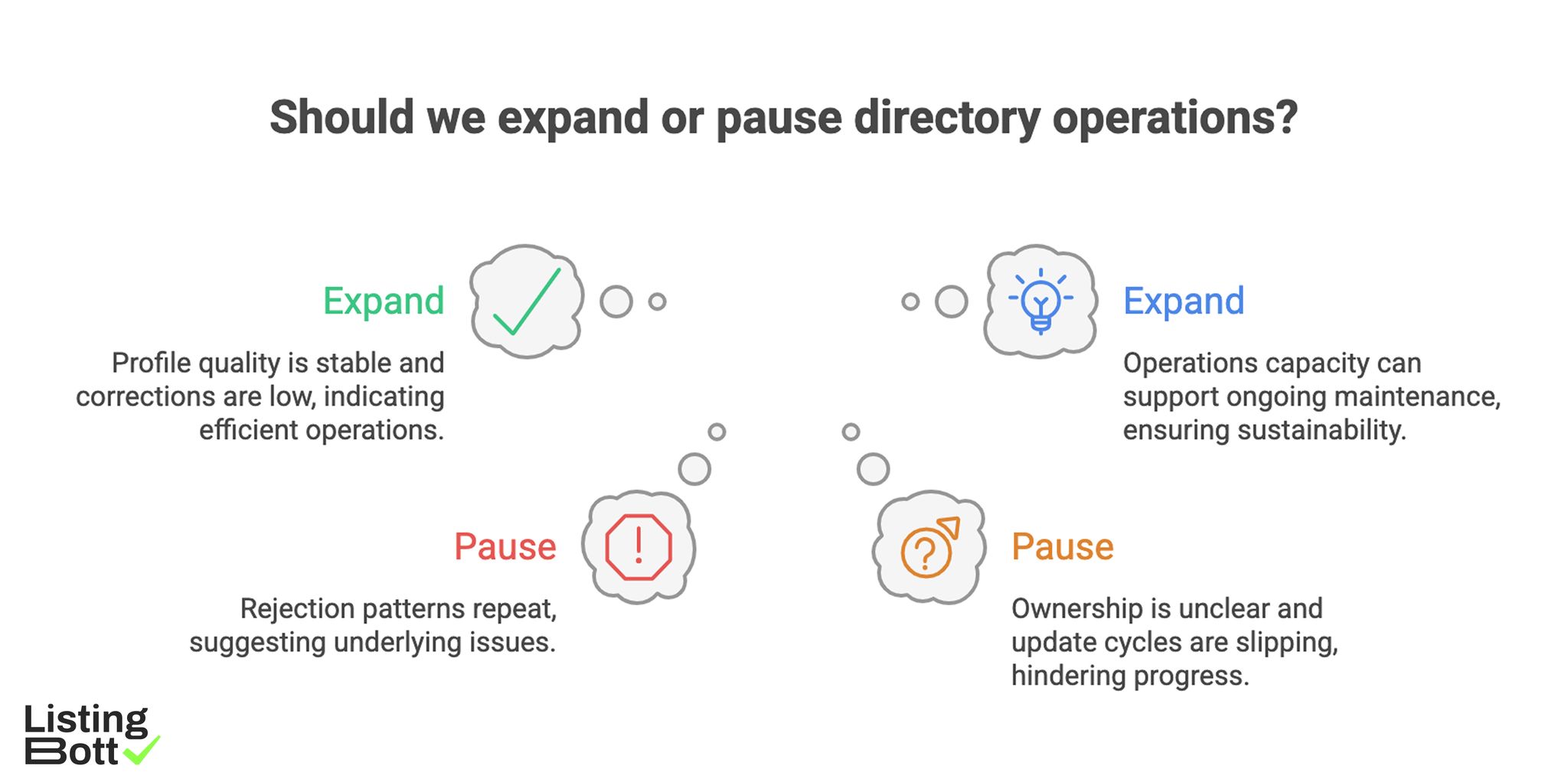
- expand only if the results justify the extra maintenance.
That keeps the program manageable and prevents directory sprawl.
Submission-readiness checklist
Before you submit anywhere, prepare one reusable business profile pack.
Minimum checklist:
- business name,
- website URL,
- short one-line summary,
- longer business description,
- main category,
- secondary category if needed,
- logo,
- key images or screenshots,
- target market or location,
- support or contact email,
- social profiles where relevant.
Operational checklist:
- decide who owns approvals,
- track what was submitted and where,
- track what was approved or rejected,
- document variations used in each listing,
- keep a log for future edits.
This matters because the hardest part of directory work is rarely the first submission. It is the long tail of keeping listings clean, accurate, and consistent.
What makes a directory low-value or risky
Not every free directory is worth using.
A directory becomes low-value when:
- it is too broad to create meaningful relevance,
- it looks abandoned or poorly maintained,
- it does not allow enough business detail,
- it exists mainly to inflate coverage counts,
- or it creates a lot of manual work with no visible strategic upside.
Common risk patterns:
| Risk | Why it happens | Safer response |
|---|---|---|
| Over-submission | Teams prioritize count over fit | Use tiers and limited waves |
| Inconsistent profiles | Multiple editors or unclear standards | Keep one canonical profile pack |
| Weak category match | Businesses submit everywhere | Filter by business type first |
| Maintenance overload | Too many low-priority listings | Expand only after first-wave stability |
| Misleading reporting | Teams track activity but not quality | Track approvals, completeness, and next actions |
A good directory strategy should reduce noise, not multiply it.
How ListingBott helps
The hard part of directory work is not finding one site. It is running the whole system cleanly.
That usually means:
- deciding which directories actually fit,
- preparing consistent profile data,
- requesting approval when needed,
- publishing in batches,
- and tracking the report afterward.
ListingBott is useful when you want help with the execution layer:
- organizing submissions,
- keeping profile inputs consistent,
- reducing manual coordination,
- and getting a clearer publish-and-report workflow.
The product truth should stay simple:
- ListingBott helps execute directory submission workflows,
- it does not guarantee rankings or traffic by a specific date,
- and it works best after you define the right directory mix.
If your next step is more local, best local business directories is the better follow-on read. If your next step is operational selection, best directory listing services is the better BOFU handoff. If your use case is U.S.-specific free listings, free business listing sites USA is the more specific geo variant.
FAQ
1. What are the best free business listing directories for most companies?
The best options depend on the business model. Local companies usually benefit most from local directories, SaaS businesses from software directories plus selected business listings, and startups from a mix of startup discovery plus baseline business presence.
2. Are startup directories the same as business listing directories?
No. Startup directories are one subset of the broader directory landscape. They can be useful for launches and early discovery, but they should not be treated as the default answer for every business.
3. Should local businesses use the same directory list as SaaS companies?
Usually no. Local businesses need geographic accuracy and citation consistency, while SaaS companies usually benefit more from software discovery and comparison environments.
4. How many business listing directories should I start with?
Start with a small first wave of high-fit directories. For most teams, a focused Tier 1 set is safer than publishing to dozens of low-priority platforms at once.
5. Can business listing directories guarantee rankings or traffic?
No. They can support visibility, consistency, and discovery, but fixed ranking or traffic guarantees are not reliable because outcomes depend on many factors outside the directory workflow.
6. What is the biggest mistake teams make with directory submissions?
The most common mistake is prioritizing volume over fit. A smaller, better-maintained set of directories usually works better than a huge list of low-quality or irrelevant submissions.