Quick answer
The best real estate software directory strategy in 2026 is not about getting listed on every site with a real-estate label. Proptech vendors need to separate software discovery from property search, realtor lead-gen directories, and consumer-facing listing portals.
For most real estate software companies, the strongest mix includes:
- proptech-specific discovery and buyer-guide surfaces such as HousingWire's real estate software guide and RealPage's real estate management software guide,
- software-category marketplaces and review platforms such as G2, GetApp, Software Advice, TrustRadius, and Capterra,
- a supporting layer of software catalogs, launch platforms, and broad directories,
- a clear list of real-estate-themed surfaces that look relevant but are actually weak or mixed-intent for software vendors.
That distinction matters because a buyer looking for a real estate CRM, IDX website tool, property management platform, or lease administration system is doing a very different job from a renter looking for apartments or a homebuyer browsing listings.
If your team already knows proptech visibility matters but does not want to manage every listing manually, ListingBott can help structure the workflow: collect company data, prepare a target list, get approval, publish, and report what went live and what still needs follow-up.
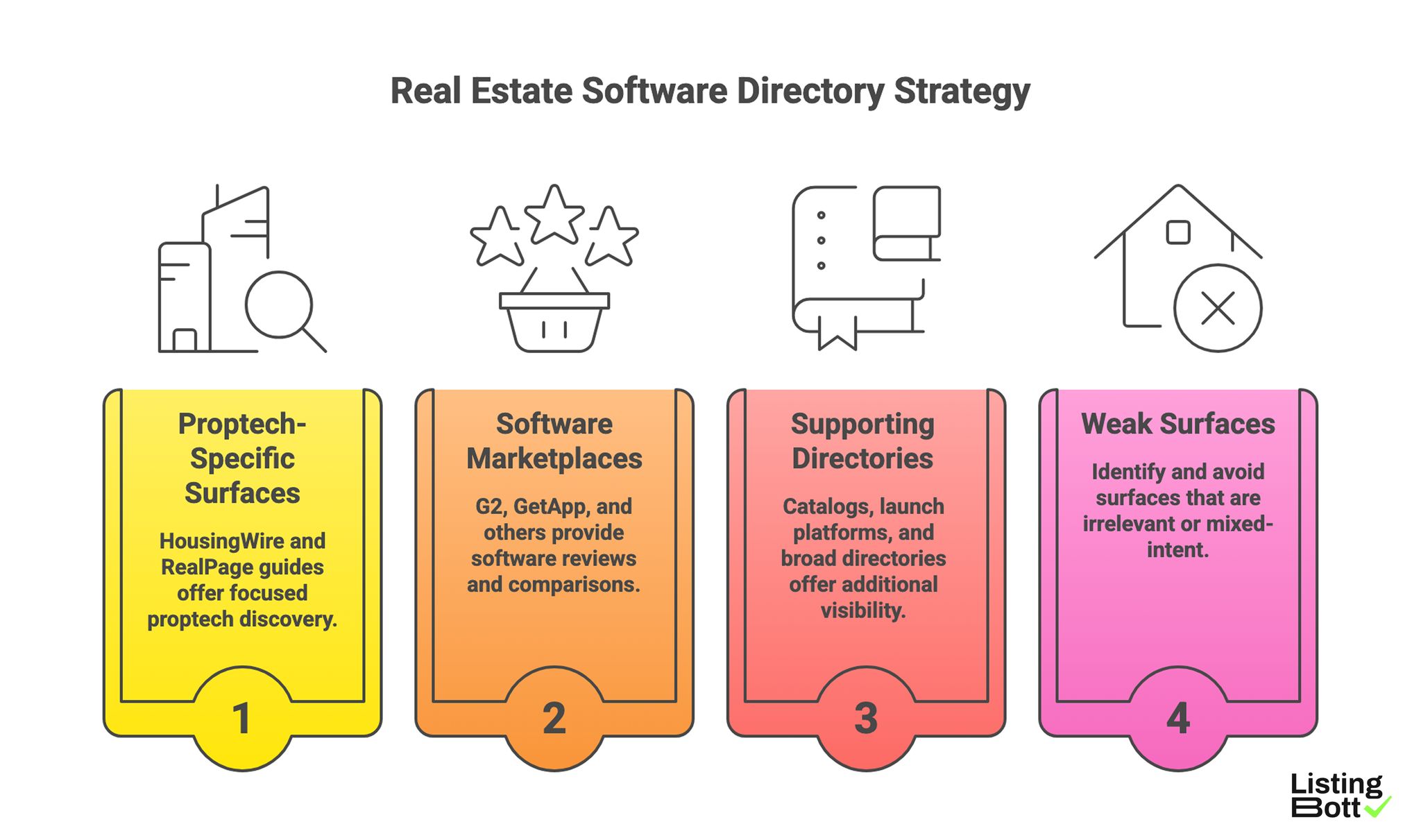
Real Estate Software Directory Strategy
sbb-itb-8e44301
Methodology
This page is built for proptech vendors, not for renters, homebuyers, or local realtor lead generation.
The recommendations below are based on four inputs:
- current 2026 Google results for real estate software discovery queries,
- proptech buyer guides and category pages already shaping the SERP,
- ListingBott's internal directory database,
- vendor-side selection criteria such as buyer-intent quality, category fit, operational depth, and long-term maintainability.
Each platform is evaluated with five questions:
- Does it attract software-evaluation intent or consumer property-search intent?
- Can a proptech vendor explain product category, workflow value, and implementation fit clearly?
- Does the surface help with discovery, shortlist comparison, or validation?
- Is the audience relevant to brokers, operators, property managers, investors, or proptech buyers?
- Is the maintenance cost justified?
That is why this page does not rank every real-estate-themed site equally. Some platforms deserve to sit in the main shortlist. Some are worth testing only after core coverage is in place. Some are useful mainly as examples of what not to center in a proptech SEO strategy.
What counts as a real estate software directory in 2026
In 2026, a real estate software directory is not just a page that happens to mention real estate companies.
For a related perspective on real estate software positioning and property lead conversion, see our Real Estate Sites in 2026: A Practical System for Trust, Lead Quality, and Faster Deal Progression.
For vendor discovery, the phrase now covers several different surface types.
1. Proptech buyer guides and category-discovery surfaces
These are some of the most useful surfaces because they reflect how real buyers actually research the space. Examples include HousingWire's real estate software guide and RealPage's real estate management software guide.
These matter because they segment the market by workflow: CRM, lead generation, IDX websites, property management, investment management, marketing, AI tools, and operational software.
2. Software review and category marketplaces
These remain essential because software buyers still compare vendors in broader review ecosystems. Examples include G2, GetApp, Software Advice, TrustRadius, and Capterra.
3. Software catalogs and alternatives surfaces
These help with broader discovery and alternatives intent. Examples include SaaSHub, Serchen, FinancesOnline, and AlternativeTo.
4. Launch and company-discovery platforms
These are more useful for newer proptech tools than for mature buying decisions. Examples include Product Hunt, BetaList, and Crunchbase.
5. Broad business directories and cross-category listings
These include EnrollBusiness, ClassDirectory, RelevantDirectories, JustDirectory, and 1st Directory.
These can support visibility, but they should not be mistaken for high-intent proptech buying surfaces.
6. Real-estate-themed directories with mixed intent
These include internal-database examples such as RealtyWW, READirectory, and RealEstatesSEO.
These may be worth testing as niche or adjacent surfaces, but they need stricter judgment because real-estate-themed visibility is not the same thing as real estate software buying intent.
7. Consumer property and realtor directories
These are the biggest wrong-intent trap. If a platform is mainly for property search, agent discovery, or consumer lead generation, it may produce visibility in the wrong market for software vendors.
That does not make those platforms bad. It just means they solve a different problem.
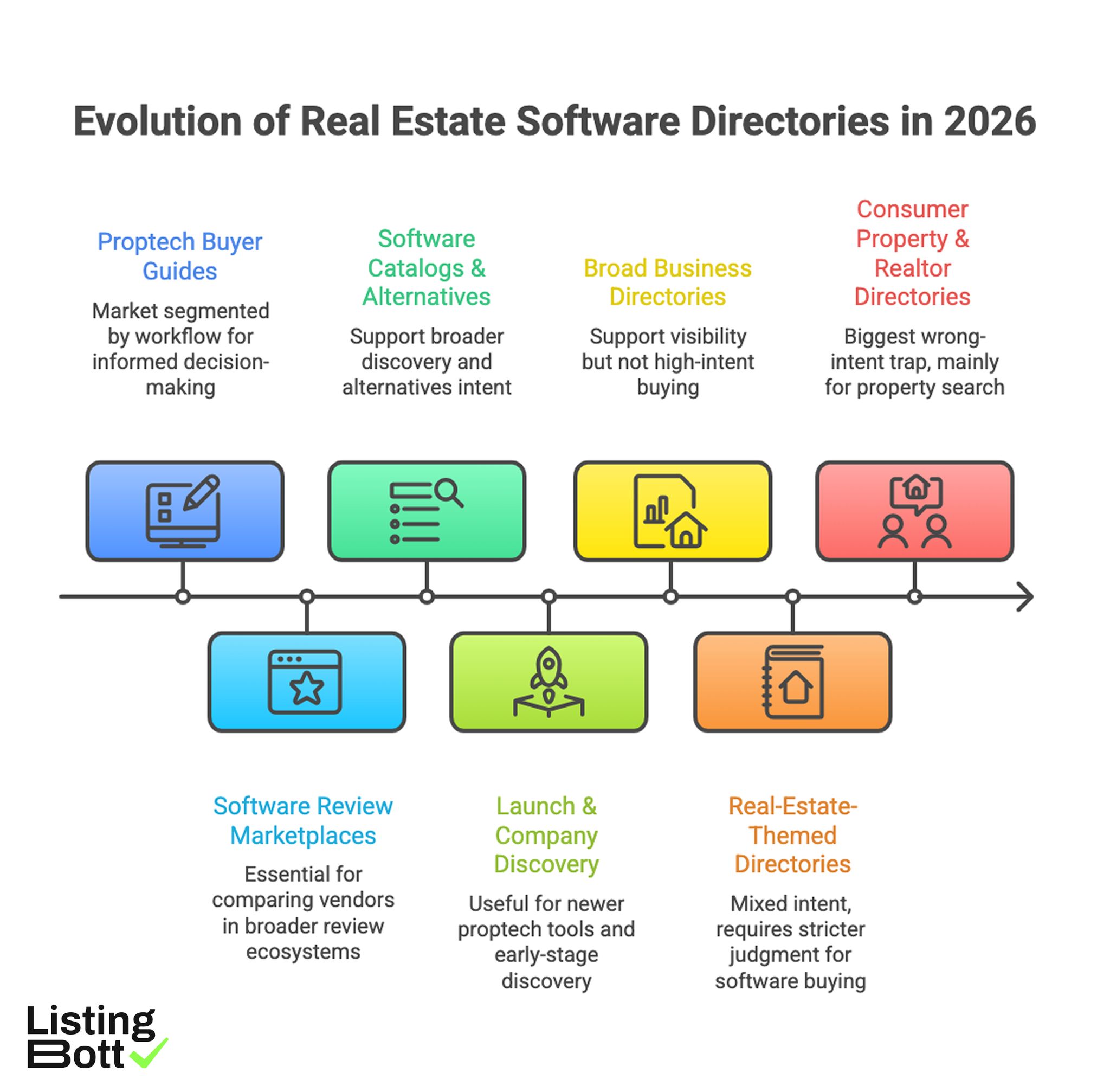
Evolution of Real Estate Software Directories in 2026
Real estate software directories vs real estate directories
This is the core identity issue for the page.
A real estate software directory helps operators, brokers, marketers, property managers, and investors compare software. A real estate directory often helps consumers find properties, agents, or local services.
Those are not the same search job.
| Surface type | Main user | Main job | Strength | Limitation | Best use |
|---|---|---|---|---|---|
| Proptech buyer guide | Software buyer | Understand categories and shortlist tools | Strong workflow context | Less profile control than true listings | Early discovery and category framing |
| Software review platform | Software evaluator | Compare vendors before shortlist decisions | Reviews, category depth, feature comparisons | Competitive environment | Mid-funnel evaluation |
| Software catalog / alternatives site | Buyer exploring options | Compare alternatives and replacements | Broad discovery reach | Lower real-estate specificity | Supporting visibility |
| Broad directory | General company discovery | Expand surface area | Easy inclusion | Weak buyer intent | Secondary support only |
| Consumer property or realtor directory | Property seeker or local buyer | Find homes, rentals, or agents | Strong consumer visibility | Wrong audience for software vendors | Usually wrong fit for proptech SEO |
That is why a proptech vendor should not assume a real-estate-themed listing is automatically useful. The right question is whether the user arrives looking for software or looking for property.
Comparison table: the best platforms for proptech vendors
The main shortlist should focus on software-discovery value first.
The same buyer-intent filtering issue shows up in our HR Software Directories and Review Sites 2026 guide, which is useful as a cross-vertical comparison.
The same buyer-intent filtering issue shows up in our legal Software Directories Review Sites 2026 guide, which is useful as a cross-vertical comparison.
For a broader supporting-directory layer beyond this niche, see our best Business Listing Sites guide.
For a broader supporting-directory layer beyond this niche, see our business Directories for SEO 2026 guide.
| Platform | Type | Best for | Why it matters | Watch-out |
|---|---|---|---|---|
| HousingWire real estate software guide | Proptech buyer guide | CRM, lead gen, website, marketing, and AI software discovery | Strong category segmentation and buyer-language fit | Editorial guide, not a vendor-owned listing profile |
| RealPage real estate management software guide | Proptech operational guide | Property management, operational software, and long-term platform fit | Strong operational framing around scalability, workload, and NOI | Best for operations-heavy segments, not every proptech niche |
| G2 real estate software category | Category marketplace | Broad proptech comparison and shortlist building | Strong category depth across CRM, PMS, investment, and marketing | Needs a strong profile to stand out |
| GetApp | Review / comparison platform | Mid-funnel real estate software comparisons | Useful for practical vendor evaluation | Less proptech-native than vertical guides |
| Software Advice | Review / advisory platform | Buyers narrowing the field | Strong decision-stage intent | Not every proptech segment gets equal depth |
| TrustRadius | Review platform | Validation and proof before purchase | Helpful for detailed review context | Category coverage depends on segment maturity |
| Capterra | Review platform | SMB and mid-market software shopping | Strong buyer familiarity and comparison behavior | Easy to become generic without clear positioning |
| READirectory | Real-estate-themed directory | Secondary niche testing | Useful as a themed supporting surface | Needs stricter quality judgment than review platforms |
| RealEstatesSEO | Real-estate-adjacent discovery surface | Secondary test visibility for marketing-adjacent proptech | Can support niche visibility experiments | Not a substitute for real software-discovery platforms |
| SaaSHub | Software catalog | Alternative discovery and supporting visibility | Useful for broader software reach | Lower proptech buyer intent |
| Product Hunt | Launch platform | Newer proptech and AI tools | Good for awareness and launch momentum | Weak substitute for decision-stage coverage |
| Crunchbase | Company-discovery platform | Brand and company-level visibility | Useful for company discovery and investor-facing credibility | Not a core product-comparison surface |
Best options by proptech category
Real estate software is too broad for one generic recommendation stack.
CRM, lead generation, and marketing software
Best-fit surfaces:
Why these work:
- buyers often compare lead flow, nurture systems, CRM depth, and marketing workflows,
- category language matters,
- and newer AI-led tools still benefit from discovery surfaces that support experimentation.
IDX websites, websites + CRM, and AI lead nurturing
Best-fit surfaces:
This segment is where modern proptech pages increasingly mention AI in practical terms. The useful angle is not "AI" alone. It is AI attached to lead nurturing, website conversion, routing, and operator workflows.
Property management, resident operations, and PMS software
Best-fit surfaces:
This is where operational fit matters most. Buyers care about staff workload, reporting, maintenance workflows, resident management, accounting, and long-term platform stability.
Lease administration, investment management, and property intelligence
Best-fit surfaces:
This segment tends to reward stronger business-case messaging. Buyers are often comparing operational depth, workflow scale, and long-term commercial fit, not just feature checklists.
Emerging proptech and niche tools
Best-fit surfaces:
These surfaces can help with awareness, but they should not become the full strategy. A proptech startup can earn launch attention and still miss serious evaluation demand if it lacks coverage on stronger buyer-facing platforms.
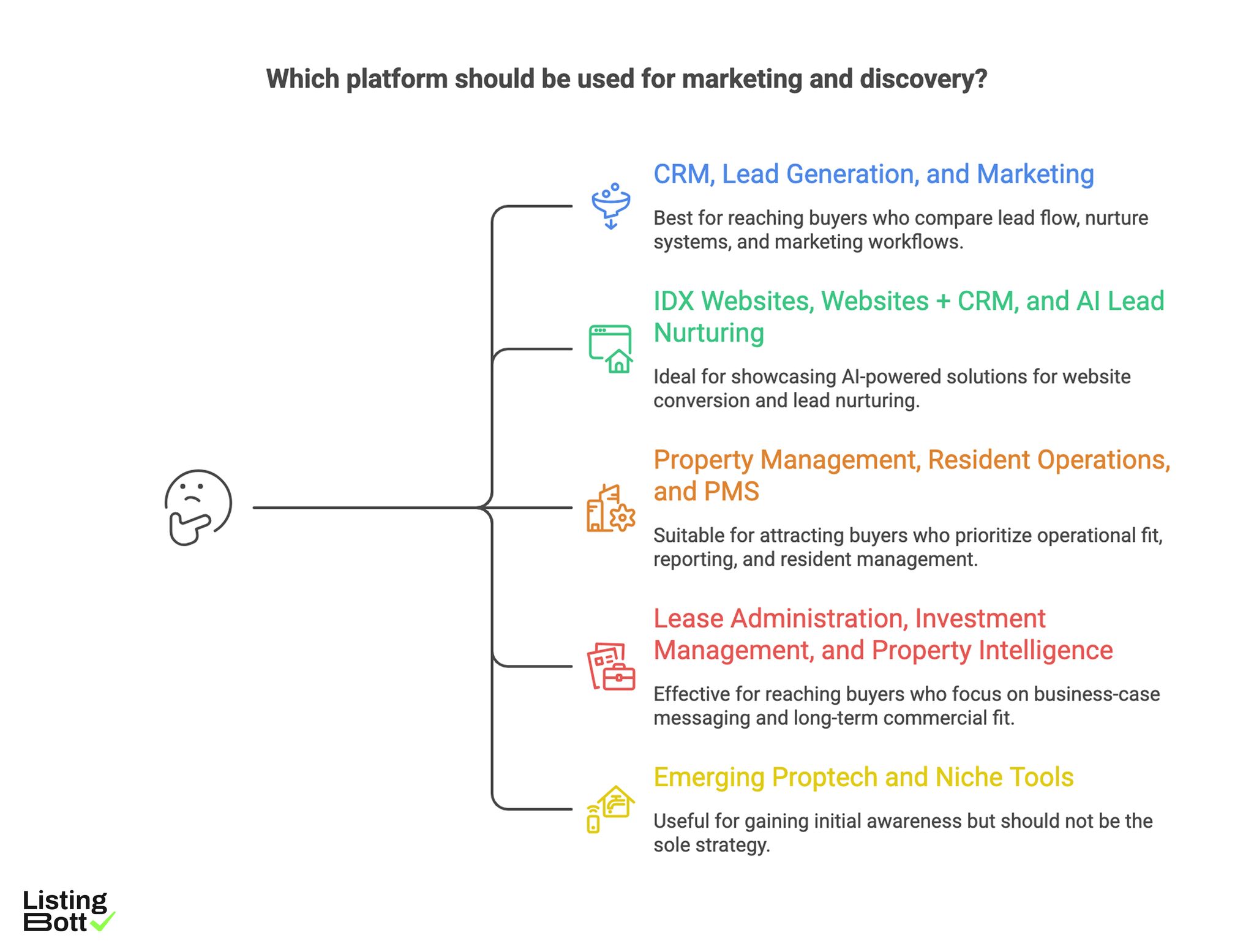
Marketing and Discovery Platform for Promoting Websites, Apps, and Digital products.
Other listing surfaces from our database: keep, test, or downgrade
This is where the internal database becomes most useful.
Good secondary software-discovery surfaces
These can help after the core stack is already covered:
How to treat them:
- Slashdot is more useful when the product has a technical or developer-adjacent angle.
- Clutch matters more if the company sells service-heavy real estate implementation, consulting, or website work alongside software.
- SaaSHub, Serchen, and FinancesOnline are supporting software-discovery surfaces, not proptech-native category leaders.
- Product Hunt, BetaList, and Crunchbase help discovery and brand visibility, especially for newer tools.
Broad directories worth testing carefully
These are reasonable supporting layers, but they should not be confused with core buying surfaces:
These are useful when the goal is broader visibility or additional citation-style reach, not when the goal is deep proptech evaluation intent.
Real-estate-themed surfaces that need stricter filtering
These are worth discussing because they look relevant on the surface:
How to think about them:
- RealtyWW is a mixed-intent surface and can easily drift toward property-search rather than software discovery.
- READirectory can be treated as a niche themed layer, but not as a replacement for true software-comparison platforms.
- RealEstatesSEO is better treated as an adjacent real-estate visibility surface than as a core software-review destination.
That is the pattern to watch in this vertical: real-estate-themed does not automatically mean proptech-buyer intent.
How proptech vendors should prepare listings
The quality of the listing package usually matters more than the number of sites.
After the shortlist is built, our online Listing Management Automation guide explains how to publish, QA, and maintain listings at scale.
A strong proptech profile should include:
- one clear category,
- a short positioning statement,
- a longer description tied to operational use cases,
- feature summaries,
- integrations,
- screenshots,
- pricing posture if appropriate,
- implementation or onboarding signals,
- and proof around workflow fit.
The most important preparation steps
1. Lead with the correct proptech category
Do not call the same product a CRM, marketing suite, website builder, PMS, investment platform, and AI assistant everywhere at once.
Common categories that need clearer separation:
- real estate CRM
- IDX website + CRM
- lead generation and nurture
- real estate marketing
- property management / PMS
- lease administration
- investment management
- property intelligence
- AI workflow tools for real estate
2. Match the profile to the operator workflow
A weak profile says, "all-in-one real estate platform for modern teams." A strong profile says what kind of real-estate team it serves, what workflow it improves, and where it fits in the stack.
3. Show implementation and operational depth
In proptech, buyers often care about process fit, reporting, onboarding burden, staff workload, and scale. A feature list alone is rarely enough.
4. Use AI as workflow support, not hype
AI matters more now, but only when it is attached to lead routing, nurture workflows, analysis, content support, or operational efficiency.
5. Keep category naming consistent across platforms
If one profile says PMS, another says CRM, and another says proptech growth platform, buyers and crawlers both get a blurry picture.
Common mistakes
The biggest real-estate-software SEO problem is mixed intent.
Mistake 1: Treating property directories as software directories
A proptech company can get listed on real-estate-themed sites and still miss the buyers who are actually searching for software.
Mistake 2: Ignoring proptech category depth
Real estate software discovery is category-heavy. Buyers want to know whether the tool is for CRM, marketing, property management, investment workflows, or operations.
Mistake 3: Letting broad review platforms become the entire strategy
Broad software marketplaces matter, but in this niche they work best when paired with proptech-native guides and category-specific framing.
Mistake 4: Using generic copy across every surface
That usually produces weak positioning and makes the product harder to place inside the right workflow category.
Mistake 5: Chasing themed visibility before validating buyer intent
A real-estate label alone is not enough. The right question is whether the surface helps actual software comparison or only broad visibility.
How ListingBott fits
ListingBott is most useful once the proptech vendor already knows its category and wants a cleaner listing workflow.
What ListingBott does
ListingBott helps companies submit their website or product to multiple directories through a structured execution flow:
- collect company data through a client form,
- prepare a list of directories,
- request approval,
- publish within scope,
- deliver a report showing submitted and pending items.
When it is a good fit
ListingBott makes the most sense when:
- the product category is already clear,
- the team wants repeatable execution,
- approval before publishing matters,
- and reporting quality matters more than raw listing count.
What it does not promise
ListingBott does not promise guaranteed rankings, guaranteed traffic by a specific date, guaranteed indexing speed, or a blanket DR increase for every project.
That matters in proptech because the real win is better channel selection and cleaner execution, not noisy volume.
A practical rollout plan for proptech vendors
A strong rollout usually works in three phases.
Phase 1: Secure core proptech discovery
Start with:
Phase 2: Add supporting software-discovery surfaces
Then expand into:
Phase 3: Add themed and broad-support listings selectively
Only after the main stack is stable should you expand into:
- READirectory
- RealEstatesSEO
- EnrollBusiness
- ClassDirectory
- RelevantDirectories
- JustDirectory
- 1st Directory
For broader supporting visibility, this guide to best business listing sites is the best companion read. If you want the workflow side after the shortlist is built, online listing management automation is the most relevant next step.
FAQ
What is a real estate software directory?
A real estate software directory is any surface that helps brokers, operators, property managers, investors, or proptech buyers discover and compare software vendors. In 2026 that includes proptech buyer guides, review platforms, software catalogs, and selected supporting directories.
Is a real estate directory the same thing as a real estate software directory?
No. A real estate directory often helps consumers find homes, rentals, agents, or local services. A real estate software directory is meant for software discovery and vendor comparison.
Should proptech vendors prioritize vertical real-estate surfaces or broad review platforms?
Usually both. Vertical real-estate surfaces are stronger for category context and buyer-language fit. Broad review platforms are stronger for shortlist comparison and proof.
Are property-search sites useful for proptech vendors?
Usually only as edge-case visibility layers. For most software vendors they create mixed or wrong intent rather than strong software-evaluation demand.
Does AI matter in real estate software discovery now?
Yes. In 2026, AI is increasingly evaluated in practical terms such as lead nurturing, routing, website conversion, analysis, and operator efficiency rather than as a generic feature claim.
Does ListingBott offer an Enterprise plan?
No. Based on current ListingBott guidance, there is no Enterprise plan.