Quick answer
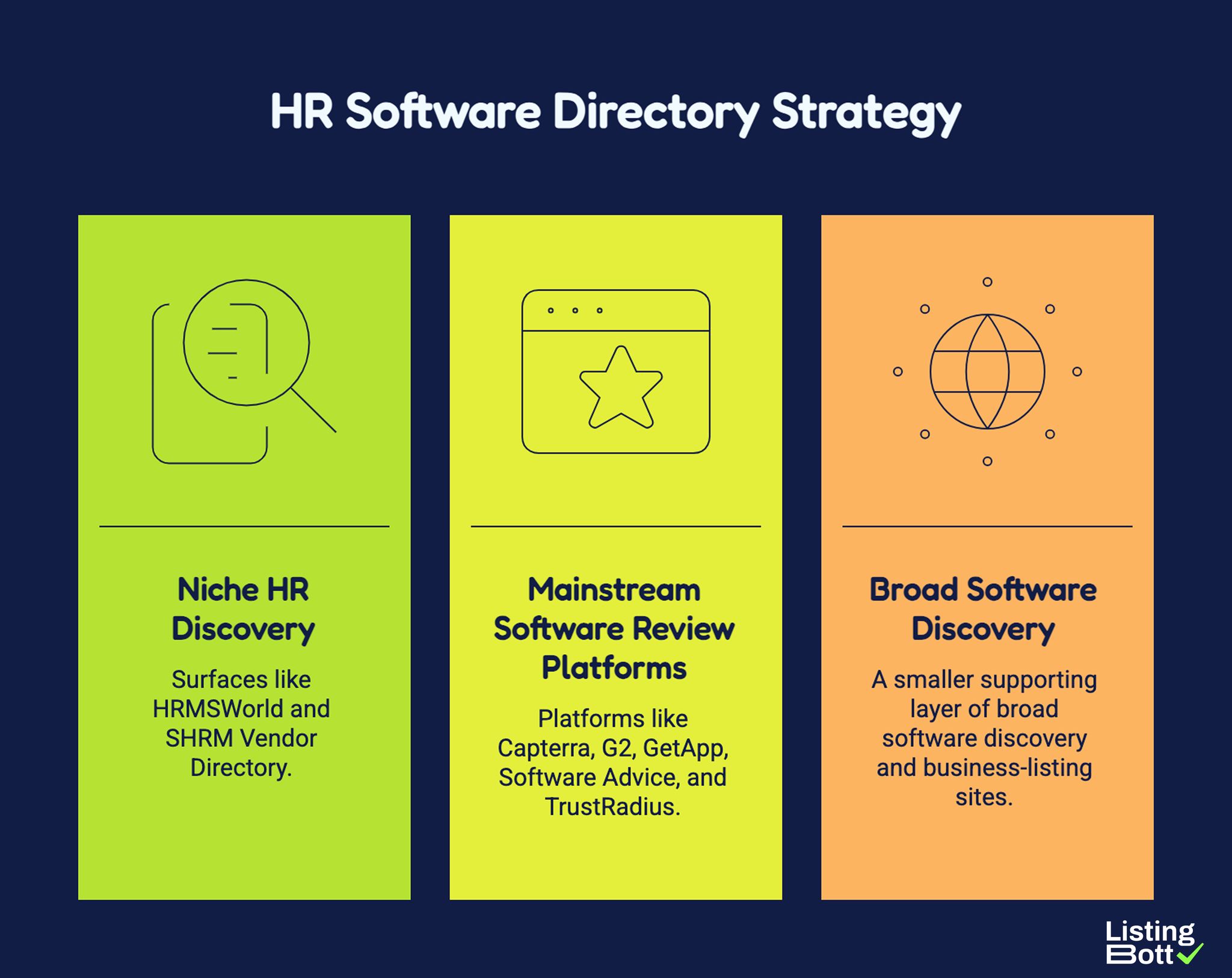
The best HR software directory strategy in 2026 is not "submit everywhere." Most HR software companies need three layers:
- niche HR discovery surfaces such as HRMSWorld and SHRM Vendor Directory,
- mainstream software review platforms such as Capterra, G2, GetApp, Software Advice, and TrustRadius,
- a smaller supporting layer of broad software discovery and business-listing sites.
That matters because HR buyers do not discover vendors in one place anymore. They jump between category pages, review sites, niche vendor directories, and broad comparison surfaces before they shortlist anything.
If you are an HRIS, HCM, ATS, payroll, benefits, or workforce analytics vendor, the practical goal is not more listings by count. The goal is better placement on the surfaces buyers already trust, with a company profile that clearly explains category fit, use case, integrations, and implementation reality.
If your team already knows directory visibility matters but does not want to manage every listing manually, ListingBott can help structure the workflow: collect profile data, prepare a target list, get approval, publish, and send a report showing what went live and what is still pending.
HR Software Directory Strategy
sbb-itb-8e44301
Methodology
This article is built for vendor-side HR software visibility, not for HR teams shopping for software.
The recommendations here are based on four inputs:
- current 2026 Google SERP patterns for HR software discovery queries,
- the strongest HR-adjacent pages currently showing up in US results,
- ListingBott's internal directory database,
- practical buyer-intent criteria, not just domain-level popularity.
Each platform below is evaluated against five questions:
- Does it attract software-comparison intent or only generic traffic?
- Can an HR software vendor build a profile with enough category depth?
- Does the surface help at early discovery, shortlist evaluation, or final validation?
- Is the audience actually relevant to HR buyers?
- Is the maintenance effort justified?
That is why this page does not treat every site equally. Some platforms deserve to be part of the main shortlist. Some are only useful as secondary visibility layers. Some are wrong-fit for most HR software companies.
What counts as an HR software directory in 2026
In 2026, an HR software directory is no longer just a simple alphabetical vendor list.
For a step-by-step companion on HR software discovery and workforce tooling, see our SaaS Payroll Software Costs 2024: Pricing Guide.
For practical SEO and buyer-discovery work, the phrase now covers several different surface types:
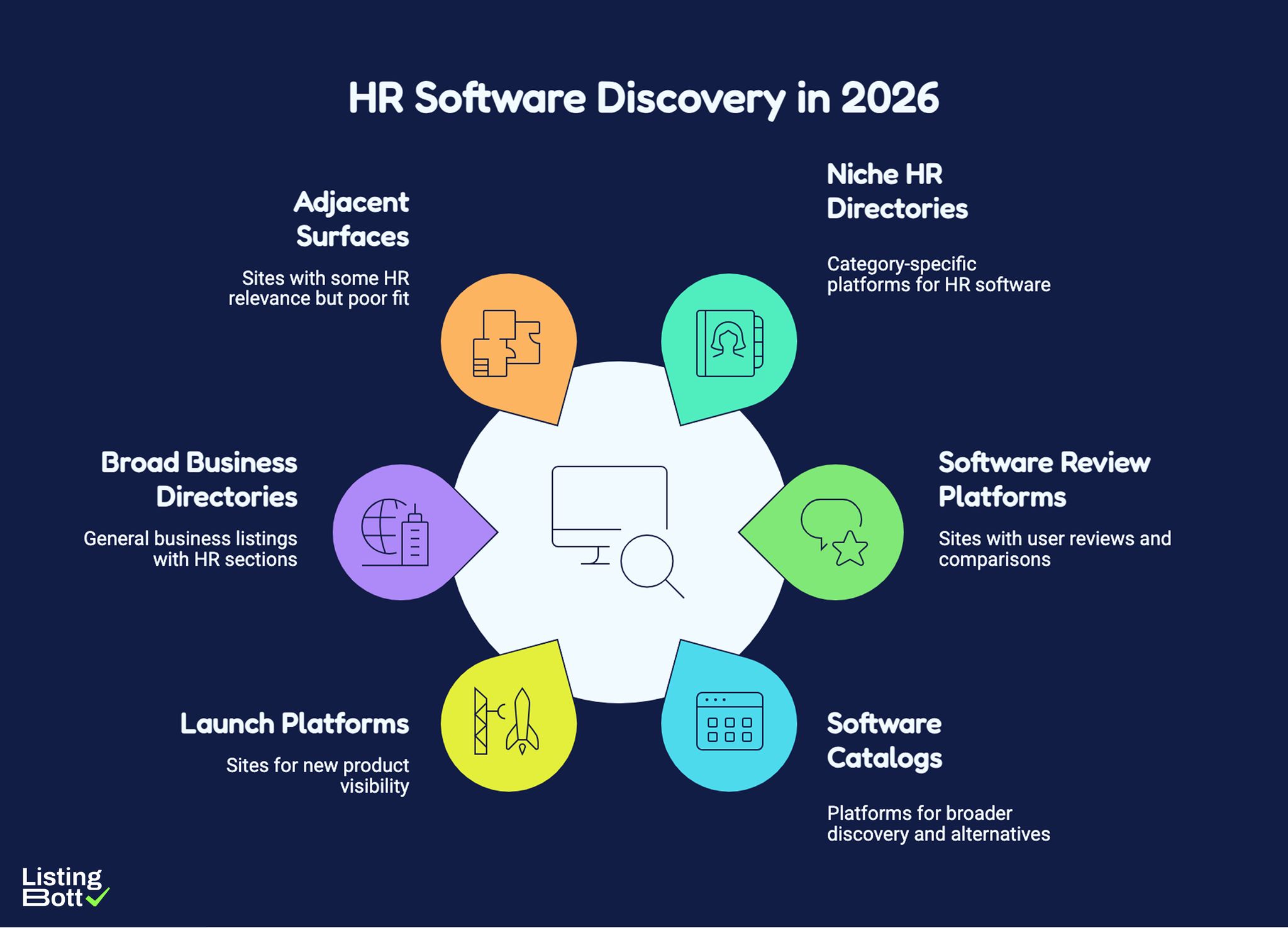
1. Niche HR vendor directories
These are the most category-specific options. Examples include HRMSWorld and SHRM Vendor Directory.
Their advantage is obvious: they speak the language of HR buyers. If your product sits in HRIS, HCM, ATS, payroll, onboarding, workforce management, or benefits, that context helps.
2. Software review platforms
These are the biggest decision-stage surfaces for many B2B software buyers. Examples include Capterra, G2, GetApp, Software Advice, and TrustRadius.
These platforms usually matter more than old-school directories because they support reviews, feature detail, comparisons, category pages, and buyer filtering.
3. Software catalogs and alternative-discovery sites
These help with broader discovery, alternatives intent, and additional SERP surface area. Examples include SaaSHub, Serchen, FinancesOnline, and AlternativeTo.
4. Launch and company-discovery platforms
These are not core HR buyer surfaces, but they can still help with visibility around newer tools. Examples include Product Hunt, BetaList, and Crunchbase.
5. Broad business directories
These include platforms such as EnrollBusiness, ClassDirectory, RelevantDirectories, and JustDirectory.
These can be supporting assets, but they should not be treated like core HR software-discovery channels.
6. Adjacent or wrong-fit surfaces
Some sites in a directory database technically match "HR & Future of Work" but are still poor fits for most HR software vendors. Examples include PIASD Job Board, Sun Community News Jobs, Online Vet Jobs, and Heavy Iron Jobs.
Those can make sense only in narrow cases, such as workforce marketplaces, recruiting networks, or niche hiring products. They are not core surfaces for most HR software brands.
HR Software Discovery in 2026
HR software directories vs software review sites
This is the distinction many vendors still get wrong.
An HR vendor directory usually helps buyers find that a company exists inside a category. A software review site helps buyers compare whether the vendor is worth shortlisting.
That means they do different jobs.
| Surface type | Main job | Strength | Limitation | Best use |
|---|---|---|---|---|
| Niche HR directory | Category discovery | Strong HR context | Often thinner review depth | Early discovery and industry credibility |
| Software review site | Shortlist evaluation | Reviews, comparisons, category filtering | More competitive profile environment | Mid-funnel and evaluation stage |
| Software catalog / alternatives site | Broader discovery | More SERP reach and alternatives intent | Often lighter buyer depth | Supplemental visibility |
| Broad business directory | Additional citation layer | Easy inclusion and breadth | Weak HR buyer intent | Supporting layer only |
| Niche job board / adjacent listing site | Very narrow matching audience | Useful in edge cases | Usually wrong fit for HR software | Only for specialized recruiting products |
For most HR vendors, the winning setup is not one or the other. It is a stack:
- niche HR credibility,
- mainstream review-platform presence,
- selective supporting discovery sites,
- and a clear decision about what to skip.
Comparison table: the best platforms for HR software vendors
The table below focuses on the strongest shortlist options first, not every possible listing surface.
The same buyer-intent filtering issue shows up in our legal Software Directories Review Sites 2026 guide, which is useful as a cross-vertical comparison.
The same buyer-intent filtering issue shows up in our real Estate Software Directories and Companies 2026 guide, which is useful as a cross-vertical comparison.
For a broader supporting-directory layer beyond this niche, see our best Business Listing Sites guide.
For a broader supporting-directory layer beyond this niche, see our business Directories for SEO 2026 guide.
| Platform | Type | Best for | Why it matters | Watch-out |
|---|---|---|---|---|
| Capterra | Review platform | SMB and mid-market HR buyers comparing tools | Strong category pages, buyer filtering, and review-driven evaluation | Needs a complete profile and active review strategy |
| G2 | Review platform | Social proof and shortlist evaluation | Very visible in software-intent SERPs and comparison behavior | Competitive category pages make weak profiles disappear |
| SHRM Vendor Directory | Niche HR directory | HR practitioner visibility and category trust | Strong HR audience alignment and industry relevance | Less comparison depth than large review sites |
| HRMSWorld | Niche HR directory | HCM, HRIS, payroll, workforce, and related vendors | High category relevance and vertical fit | More limited buyer signals than review-first platforms |
| GetApp | Review / comparison platform | Mid-market and software-evaluation stage | Good category structure and comparison intent | Can overlap heavily with other Gartner-owned surfaces |
| Software Advice | Review / advisory platform | Buyers comparing fit and options | Strong for practical software-selection journeys | Less of a brand-building surface than G2 |
| TrustRadius | Review platform | Deeper validation before shortlist decisions | Stronger long-form review context | Not every HR subcategory has equal depth |
| SaaSHub | Software directory / catalog | Alternative discovery and supporting visibility | Useful for alternatives and catalog-style discovery | Buyer intent is weaker than on major review sites |
| FinancesOnline | Software comparison / editorial platform | Additional comparison-layer visibility | Helpful supplemental surface for software research journeys | Editorial-style pages vary in practical buyer depth |
| Serchen | Software directory | Extra software-category visibility | Adds another relevant software-discovery surface | Secondary priority for most HR vendors |
| AlternativeTo | Alternatives platform | Replacement and switcher intent | Useful when buyers are actively comparing alternatives | Not ideal as a primary HR discovery channel |
| Product Hunt | Launch / discovery platform | Newer HR tools and early awareness | Can help with visibility and brand discovery | Weak substitute for category-review coverage |
Best options by buyer stage
The right HR software listing strategy changes depending on where the buyer is in the process.
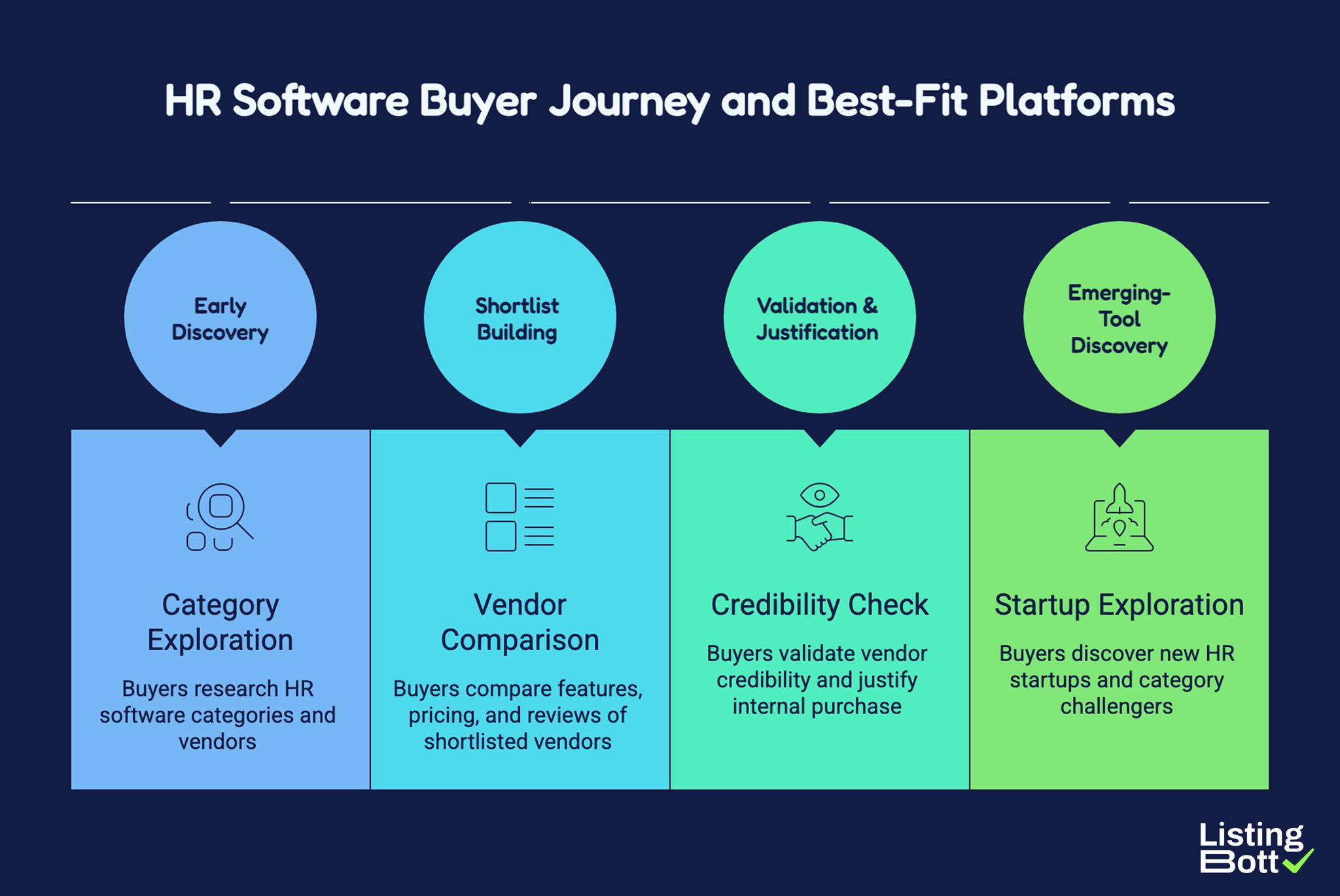
Stage 1: Early discovery
At this stage, buyers are still trying to understand the category, not only compare vendors.
Best-fit platforms:
- SHRM Vendor Directory
- HRMSWorld
- Capterra
- SaaSHub
- FinancesOnline
Why these matter:
- they help buyers enter the category,
- they expose the vendor to searchers who are still learning what kind of tool they need,
- and they create context around the product type.
If your software sits across multiple categories, this is the stage where category discipline matters most. A vendor that calls itself HRIS, HCM, payroll, ATS, and workforce planning software all at once usually creates more confusion than clarity.
Stage 2: Shortlist building
This is where real vendor comparison starts.
Best-fit platforms:
This is usually the highest-value stage because the buyer is no longer casually browsing. They are comparing features, use cases, integrations, pricing posture, implementation support, and review patterns.
For HR software, this is also where the old Capterra distinction still matters in practice: some buyers are searching for core HR systems, while others need more strategic HR software such as talent, performance, or workforce planning tools. If your category positioning is vague, review platforms will not fix that problem for you.
Stage 3: Validation and internal justification
At this stage, buyers are pressure-testing whether the vendor is credible.
Best-fit platforms:
What helps here:
- consistent positioning,
- realistic implementation messaging,
- category precision,
- and reviews that match the audience you claim to serve.
Stage 4: Emerging-tool discovery
This stage matters most for newer HR startups and category challengers.
Best-fit platforms:
These surfaces can help new HR tools get discovered, but they should not replace major review coverage. A startup can get attention on Product Hunt and still remain almost invisible in real HR software evaluation searches.
HR Software Buyer Journey and Best-Fit Platforms
Other listing surfaces from our database: keep, test, or downgrade
This is where many teams overspend effort.
Good supporting surfaces
These are worth testing after the core shortlist is covered:
How to think about them:
- Slashdot is more useful if the HR product has a technical or developer-facing component.
- Clutch can matter if the company sells implementation-heavy HR services alongside software.
- EnrollBusiness, ClassDirectory, RelevantDirectories, and JustDirectory are supporting discovery or citation-style surfaces, not core HR buyer destinations.
Usually low-priority for pure HR software
These should stay out of the main allocation unless a very specific business model justifies them:
Those examples are helpful because they show the difference between category tagging and real buyer fit. A database may place them loosely near future-of-work or recruiting themes, but that does not mean they deserve space in a serious HR software visibility strategy.
How HR software vendors should prepare listings
The quality of the profile usually matters more than the number of surfaces.
After the shortlist is built, our online Listing Management Automation guide explains how to publish, QA, and maintain listings at scale.
A good HR software listing package should include:
- one clear primary category,
- one short positioning line,
- one longer description tuned to the buying problem,
- a realistic feature summary,
- integrations,
- screenshots,
- pricing posture if possible,
- and implementation/support context.
The most important preparation steps
1. Pick the primary category before you write copy
Do not try to be everything at once. If you sell an HRIS, say that clearly. If you are really an ATS or payroll platform, lead with that.
Typical categories where HR vendors often blur the message:
- HRIS
- HCM
- ATS
- payroll
- benefits administration
- onboarding
- performance management
- workforce management
- people analytics
2. Match each profile to buyer language
A weak profile says, "all-in-one HR solution for modern teams." A strong profile says what team it is for, what problem it solves, and where it fits inside the HR stack.
3. Show implementation reality
Many HR buyers care about support, onboarding, migration, admin complexity, and integrations almost as much as features.
That means your profile should not only explain the software. It should also reduce uncertainty around rollout.
4. Keep naming and positioning consistent
If one profile says "workforce planning platform," another says "HR automation suite," and another says "recruiting dashboard," buyers and crawlers both get a fuzzy picture.
5. Prioritize review generation on the platforms that matter most
For most HR vendors, that means building depth on the biggest review platforms first before expanding the long tail.
Common mistakes
The most common failure is not absence. It is scattered presence.
Mistake 1: Treating all directories as equal
They are not. A profile on G2 or Capterra does not play the same role as a listing on ClassDirectory or JustDirectory.
Mistake 2: Using generic copy everywhere
If the same shallow paragraph is pasted into every platform, the vendor loses the chance to clarify category fit and use case.
Mistake 3: Ignoring the difference between discovery and evaluation
A niche HR directory can help buyers discover the vendor. A review platform helps them decide whether the vendor belongs on the shortlist.
Both matter, but for different reasons.
Mistake 4: Chasing broad visibility before core HR fit
It is usually smarter to get strong coverage on vertical HR surfaces and major review platforms before expanding into broad business directories.
Mistake 5: Listing on adjacent sites that do not match the buying motion
That is why a niche job board or random broad directory often adds work without adding meaningful HR buyer intent.
How ListingBott fits
ListingBott is most useful once you already know your category positioning and want a cleaner submission workflow.
If your team wants help executing the shortlist, compare ListingBott’s managed submission workflow after reviewing the relevant targets.
What ListingBott does
ListingBott helps companies submit their website or product to multiple directories through a structured execution flow:
- collect company data through a client form,
- prepare a list of directories,
- request approval,
- publish within scope,
- deliver a report showing submitted and pending items.
When it is a good fit
ListingBott makes the most sense when:
- your team has clean company and product data,
- you want repeatable execution across multiple relevant surfaces,
- you want approval before submissions go live,
- and you want reporting instead of a vague done-for-you claim.
What it does not promise
ListingBott does not promise guaranteed rankings, guaranteed traffic by a specific date, guaranteed indexing speed, or a blanket DR increase for every project.
That is important because HR software vendors usually do not need bigger promises. They need a controlled workflow, better listing coverage, and fewer execution gaps.
A practical rollout plan for HR software vendors
If you want a simple operating model, use this one.
Phase 1: Secure the core shortlist
Start with:
Phase 2: Add supporting software-discovery layers
Then expand into:
- SaaSHub
- FinancesOnline
- Serchen
- AlternativeTo
- Product Hunt
- BetaList
- Crunchbase
Phase 3: Add broad-support directories selectively
Use broad directories only after the core stack is in place:
That sequencing usually produces a stronger result than spreading effort evenly across every available site.
For a broader view of supporting directories, this companion guide on best business listing sites is a useful next read. If you want the workflow side of the problem after building the shortlist, online listing management automation is the best next step.
FAQ
What is an HR software directory?
An HR software directory is any surface that helps buyers discover HR vendors by category, use case, or comparison intent. In 2026 that includes niche HR vendor directories, software review platforms, software catalogs, and a smaller supporting layer of broad directory sites.
Should HR software vendors prioritize review sites or HR-specific directories?
Usually both, but not equally. Review sites such as G2, Capterra, GetApp, Software Advice, and TrustRadius are stronger for shortlist evaluation. HR-specific directories such as SHRM and HRMSWorld are stronger for vertical relevance and early discovery.
Are broad business directories worth it for HR software companies?
Sometimes, but usually as a secondary layer only. Broad business directories can support reach and citation-style coverage, but they are rarely the highest-intent surfaces for HR software buyers.
For a related perspective on HR software discovery and workforce tooling, see our How Logistics Companies Can Manage Their Workforce With Integrated Payroll and HR Services.
Are job boards and recruiting sites good places to list HR software?
Only in narrow cases. If the product itself is a niche job board, workforce marketplace, or recruiting-specific platform, those sites may help. For most HR software vendors, they are adjacent or wrong-fit rather than core channels.
Can Product Hunt replace G2 or Capterra for a new HR startup?
No. Product Hunt can help with launch awareness, but it is not a substitute for major software review and comparison platforms when buyers start evaluating real options.
Does ListingBott offer an Enterprise plan?
No. Based on current ListingBott guidance, there is no Enterprise plan.