Quick answer
The best legal software directory strategy in 2026 is not the same thing as "getting listed in legal directories." Legal-tech vendors need to separate software-buyer discovery from attorney-finder visibility.
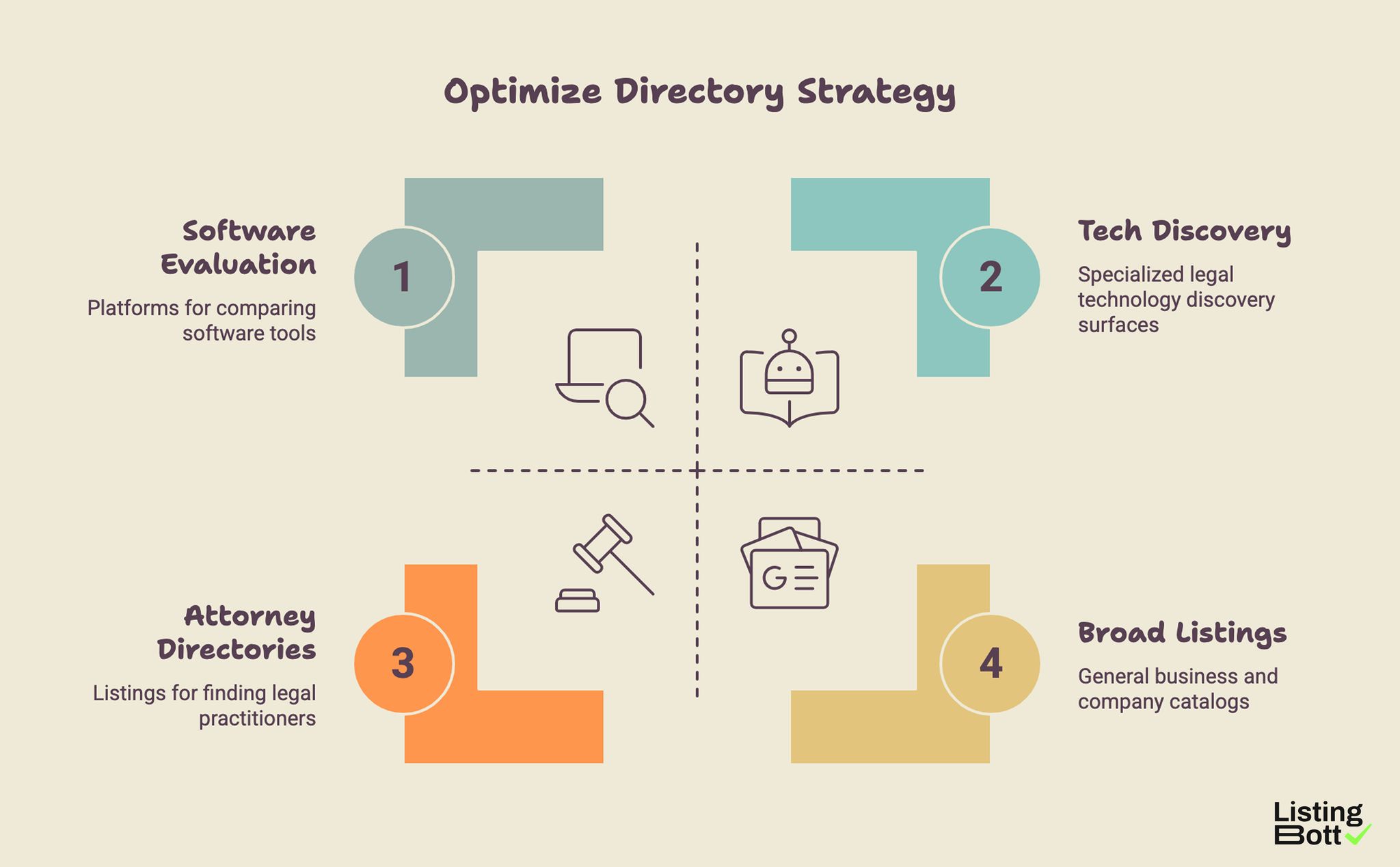
For most legal software companies, the best mix includes:
- legal-tech discovery surfaces such as LawNext Legal Technology Directory, Legaltech Hub, and Appvizer Legal,
- software evaluation platforms such as TrustRadius, Software Advice, GetApp, G2, and Capterra,
- a secondary layer of software catalogs, company-discovery platforms, and broad business listings,
- a clear decision about which attorney directories are useful only as contrast examples, not as the center of the strategy.
That distinction matters because a law firm searching for software is not doing the same job as a consumer searching for a lawyer. If your page, listing, or SEO strategy confuses those intents, you can win visibility in the wrong market and still lose qualified demand.
If your team already knows legal-tech visibility matters but does not want to manage every listing manually, ListingBott can help structure the execution flow: collect company data, prepare a target list, get approval, publish, and report what went live versus what still needs attention.
Optimize Directory Strategy
sbb-itb-8e44301
Methodology
This page is built for legal-tech vendors, not for consumers trying to find attorneys.
The recommendations below are based on four inputs:
- current 2026 Google results around legal software directory and close variants,
- legal-tech research surfaces currently shaping category discovery,
- ListingBott's internal directory database,
- practical vendor-side criteria such as buyer intent quality, profile depth, workflow fit, and category precision.
Each platform is evaluated with five questions:
- Does it attract software-evaluation intent or consumer legal-services intent?
- Can a legal-tech vendor present enough category and workflow detail?
- Does the platform help with discovery, shortlist comparison, or vendor validation?
- Is the audience relevant to law firms, in-house teams, or compliance buyers?
- Is the maintenance cost justified by the likely quality of visibility?
That is why this article does not rank every legal-themed listing site equally. Some belong in the main shortlist. Some are useful as secondary software-discovery layers. Some mainly illustrate what legal-tech vendors should avoid.
Components of a legal Software Directory
What counts as a legal software directory in 2026
In 2026, a legal software directory is not just a page that lists companies with a legal category tag.
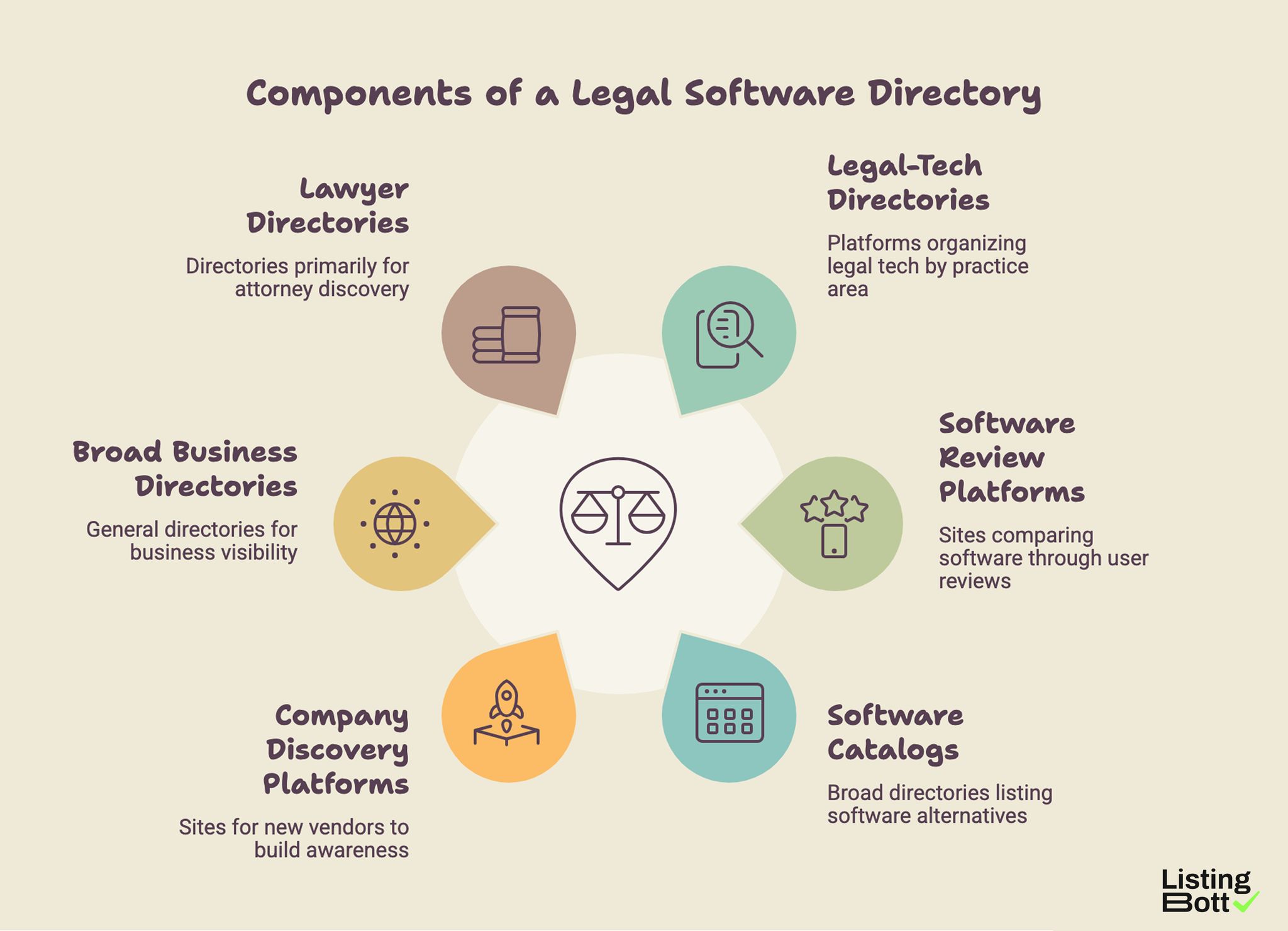
For vendor discovery, the phrase now covers multiple surface types.
1. Legal-tech directories and research hubs
These are the closest match to real legal software discovery. Examples include LawNext Legal Technology Directory and Legaltech Hub.
These surfaces matter because they organize legal tech by practice area, workflow, and software type. That is a much better fit for legal-tech buyers than a generic legal list.
2. Software review and comparison platforms
These remain essential because software buyers still compare products through mainstream review ecosystems. Examples include G2, Capterra, GetApp, Software Advice, and TrustRadius.
These platforms usually matter more than classic directories because they support reviews, category comparisons, feature detail, and buyer-stage filtering.
3. Software catalogs and alternatives sites
These broaden discovery and support alternatives intent. Examples include SaaSHub, Serchen, FinancesOnline, and AlternativeTo.
4. Company-discovery and launch platforms
These are rarely the center of a legal-tech strategy, but they can help newer vendors build awareness. Examples include Product Hunt, BetaList, and Crunchbase.
5. Broad business directories
These include EnrollBusiness and ClassDirectory.
They can support broader visibility, but they do not usually carry the same buyer intent as legal-tech-specific or software-review platforms.
6. Lawyer and attorney directories
These include Justia Lawyers, Avvo, LawyerLegion, LawLink, Legal Services Link, and LegalListings.us.
For a related perspective on legal-sector acquisition and law-firm product positioning, see our Sell Content Online: Legal Considerations and Best Practices.
These are real legal directories, but they are not the same thing as legal software directories. They are primarily built for attorney discovery, not software selection.
That difference is the foundation of this entire page.
Legal software directories vs lawyer directories
This is the main identity problem the page has to solve.
For a step-by-step companion on legal-sector acquisition and law-firm product positioning, see our Open Source Case Management Software: A Comprehensive Guide.
A legal software directory helps law firms, in-house counsel, operations teams, or compliance buyers discover and compare technology. A lawyer directory helps clients find legal professionals.
Those are different search jobs, different audiences, and different buyer signals.
| Surface type | Main user | Main job | Strength | Limitation | Best use |
|---|---|---|---|---|---|
| Legal-tech directory | Law firms, in-house teams, legal ops | Discover software by workflow or category | High legal-tech relevance | Often smaller audience than major review sites | Early discovery and category fit |
| Software review site | Software buyers and evaluators | Compare products before shortlist decisions | Reviews, feature depth, category structure | More competitive vendor environment | Mid-funnel evaluation |
| Software catalog / alternatives site | Buyers exploring options | Find replacements or broader choices | Good for alternatives intent | Lighter legal-specific context | Supplemental visibility |
| Broad business directory | General web users and crawlers | General company discovery | Easy inclusion | Weak legal-tech intent | Secondary support only |
| Lawyer directory | Consumers looking for attorneys | Find a lawyer or law firm | Strong for attorney discovery | Wrong audience for most software vendors | Usually wrong fit for legal-tech SEO |
That is why a legal-tech vendor should not treat Justia or Avvo as substitutes for LawNext, G2, or Capterra.
Comparison table: the best platforms for legal-tech vendors
The main shortlist should focus on platforms that help software buyers, not only legal consumers.
The same buyer-intent filtering issue shows up in our HR Software Directories and Review Sites 2026 guide, which is useful as a cross-vertical comparison.
The same buyer-intent filtering issue shows up in our real Estate Software Directories and Companies 2026 guide, which is useful as a cross-vertical comparison.
For a broader supporting-directory layer beyond this niche, see our best Business Listing Sites guide.
For a broader supporting-directory layer beyond this niche, see our business Directories for SEO 2026 guide.
| Platform | Type | Best for | Why it matters | Watch-out |
|---|---|---|---|---|
| LawNext Legal Technology Directory | Legal-tech directory | Category-specific legal-tech discovery | Strong practice-area and software-type organization | Smaller scale than major review ecosystems |
| Legaltech Hub | Legal-tech research hub | Buyers researching legal-tech categories and vendors | Strong legal-tech context and category depth | Not every vendor will get equal visibility without strong positioning |
| Appvizer Legal | Legal software guide / category surface | Legal category explanation and software research | Strong editorial framing around workflow and feature fit | More guide-like than review-driven |
| TrustRadius | Review platform | Deeper validation and proof | Helpful for detailed review context | Category depth varies by legal-tech segment |
| Software Advice | Review / advisory platform | Buyers trying to narrow the field | Good decision-stage intent | Less legal-tech-specific context than vertical hubs |
| GetApp | Review / comparison platform | Mid-funnel software comparisons | Useful for practical vendor evaluation | Can overlap with other general review surfaces |
| G2 | Review platform | Validation and shortlist comparison | Strong software-buyer intent and comparison behavior | Weak legal positioning gets buried fast |
| Capterra | Review platform | SMB and mid-market legal software evaluation | Strong category pages and buyer filtering | Requires a serious profile and review strategy |
| SaaSHub | Software catalog | Alternative discovery and supporting visibility | Useful for broader software reach | Lower buyer intent than top review platforms |
| Serchen | Software directory | Supplemental category visibility | Another software-relevant surface | Secondary priority for most legal-tech vendors |
| FinancesOnline | Software editorial / comparison platform | Additional comparison-layer discovery | Useful for research-stage visibility | Less legal-specific buyer context |
| Product Hunt | Launch platform | Newer legal-tech products | Useful for awareness and early momentum | Not a replacement for review and legal-tech directory coverage |
Best options by legal-tech category
Best options by legal-tech category
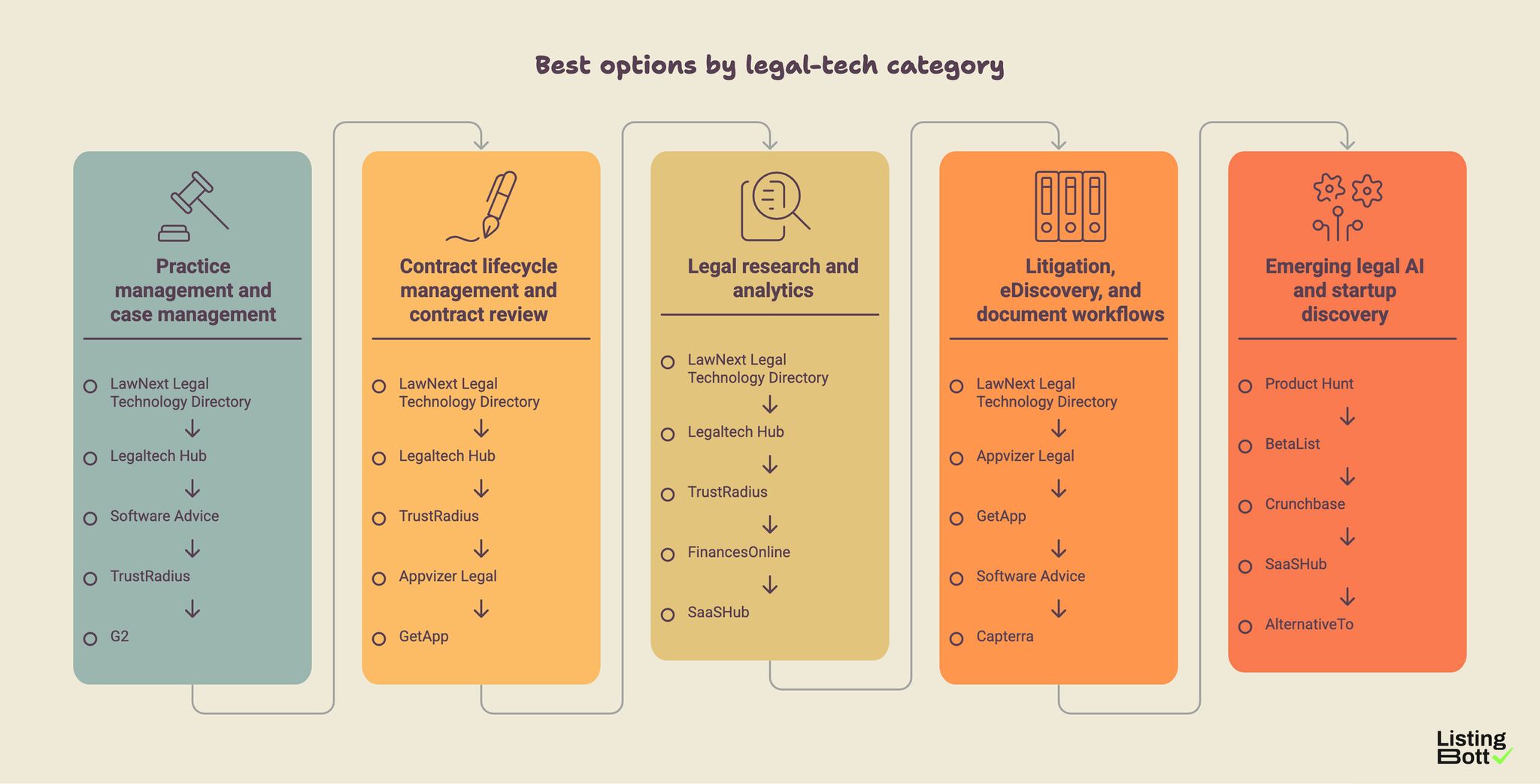
Legal software is too segmented for one generic shortlist to feel credible.
Practice management and case management
Best-fit surfaces:
Why these work:
- buyers often need category clarity,
- practice-area context matters,
- and software review depth becomes important fast.
Contract lifecycle management and contract review
Best-fit surfaces:
This segment also reflects a big 2026 shift: AI is now a real evaluation layer. Buyers are increasingly comparing contract review, automation, NLP, analytics, workflow customization, and explainability, not just basic feature lists.
Legal research and analytics
Best-fit surfaces:
For this segment, credibility and workflow fit matter more than hype. Buyers want to understand how the product supports research, data quality, trust, and integration into actual legal work.
Litigation, eDiscovery, and document workflows
Best-fit surfaces:
In these categories, workflow specificity is especially important. A vague listing will usually underperform because buyers need to understand document handling, collaboration, evidence flow, security, and process depth.
Emerging legal AI and startup discovery
Best-fit surfaces:
These surfaces are useful for awareness, but they should not become the whole strategy. A legal AI tool can win early attention on Product Hunt and still miss serious legal-tech buying conversations if it has weak coverage on vertical and review-driven platforms.
Other listing surfaces from our database: keep, test, or downgrade
This is where the internal database becomes especially useful.
Good secondary software-discovery surfaces
These can help after the core legal-tech stack is already covered:
How to treat them:
- Slashdot is more helpful when the product has a technical, security, or developer-adjacent angle.
- Clutch matters more if the company mixes software with legal implementation, consulting, or service-heavy delivery.
- Crunchbase, Product Hunt, and BetaList are useful for discovery and brand visibility, not for replacing legal-tech buyer research surfaces.
- EnrollBusiness and ClassDirectory are supporting listings, not core legal-tech channels.
Adjacent legal directories that are usually wrong-fit
These are the directories that create confusion if they become the center of the plan:
Why they are usually wrong-fit:
- they attract consumers or lawyers looking for professional profiles,
- not software buyers comparing legal-tech workflows,
- and they rarely help a legal-tech company communicate category depth, integrations, security posture, or AI workflow value.
That does not mean they are fake directories. It means they solve a different problem.
How legal software vendors should prepare listings
The profile quality usually matters more than the number of platforms.
A strong legal-tech listing package should include:
- one clear product category,
- a short positioning statement,
- a longer description tied to workflow use cases,
- feature summaries,
- integrations,
- pricing posture if appropriate,
- implementation or onboarding detail,
- security and confidentiality signals,
- and proof such as reviews, known use cases, or category-specific context.
After the shortlist is built, our online Listing Management Automation guide explains how to publish, QA, and maintain listings at scale.
The most important preparation steps
1. Lead with the right category
Do not call the same product a legal research platform, contract management system, compliance suite, and legal AI co-pilot everywhere at once.
Common legal-tech categories that need clearer separation:
- legal research
- practice management
- case management
- contract lifecycle management
- contract review
- document management
- eDiscovery
- compliance / policy / entity management
- analytics
- legal AI workflow tools
2. Match the listing to the legal workflow
A weak profile says, "all-in-one legal platform for modern firms." A strong profile says what type of team it serves, what workflow it improves, and what kind of legal work it supports.
3. Show security and confidentiality signals
Legal buyers care about confidentiality, data handling, permissions, auditability, and workflow trust. If the listing ignores that, the vendor looks shallow even when the product is strong.
4. Explain integrations and modularity
Many legal-tech purchases depend on how the tool fits with document systems, contract repositories, knowledge workflows, or internal compliance processes.
5. Use AI carefully
AI is now a real decision factor, especially in research, contract analysis, and automation. But buyers do not want generic AI claims. They want workflow-specific value, explainability, and realistic output expectations.
Common mistakes
The biggest legal-tech SEO mistake is wrong-intent visibility.
Mistake 1: Treating lawyer directories as software directories
This is the main one. A legal-tech company can spend time filling out attorney-directory profiles and still gain almost nothing in actual software-buying visibility.
Mistake 2: Publishing vague category positioning
If the vendor cannot say whether it is legal research, contract automation, practice management, or document workflow software, the listings will stay fuzzy everywhere.
Mistake 3: Ignoring category depth
Legal-tech is too segmented for shallow discovery pages. Buyers expect category fit, workflow specificity, and trust signals.
Mistake 4: Letting AI become empty hype
AI matters, but it only helps if it is connected to real legal workflows such as contract review, research, drafting support, or automation.
Mistake 5: Expanding to broad listings before securing core coverage
It is usually smarter to build depth on legal-tech and major review surfaces first, then add broad discovery layers later.
How ListingBott fits
ListingBott is most useful once the legal-tech vendor already understands its category and needs a cleaner listing workflow.
What ListingBott does
ListingBott helps companies submit their website or product to multiple directories through a structured execution flow:
- collect company data through a client form,
- prepare a list of directories,
- request approval,
- publish within scope,
- deliver a report showing submitted and pending items.
When it is a good fit
ListingBott makes the most sense when:
- the category positioning is clear,
- the team wants repeatable submission execution,
- approval before publishing matters,
- and reporting quality is more important than vague volume promises.
What it does not promise
ListingBott does not promise guaranteed rankings, guaranteed traffic by a specific date, guaranteed indexing speed, or a blanket DR increase for every project.
That is especially important in legal tech, where buyers care about credibility and fit more than noisy submission counts.
A practical rollout plan for legal-tech vendors
A good rollout usually works in three phases.
Phase 1: Secure core legal-tech discovery
Start with:
Phase 2: Add supporting software-discovery surfaces
Then expand into:
Phase 3: Use broad and contrast surfaces selectively
Only after the main stack is working should you test broader or lower-intent layers such as:
- EnrollBusiness
- ClassDirectory
- selected supporting platforms from the broader best business listing sites ecosystem,
- and selected options from this wider guide to best online business directories.
What should not sit in the center of the strategy:
If you want the workflow side of the problem after the shortlist is built, online listing management automation is the best next step.
FAQ
What is a legal software directory?
A legal software directory is a discovery surface that helps law firms, in-house teams, legal ops, or compliance buyers find and compare legal technology vendors. In 2026 that includes legal-tech directories, software review platforms, software catalogs, and selected business-listing surfaces.
Is a lawyer directory the same thing as a legal software directory?
No. A lawyer directory is usually designed for people looking for attorneys or law firms. A legal software directory is designed for software discovery and vendor comparison.
Should legal-tech vendors prioritize vertical legal-tech platforms or mainstream review sites?
Usually both. Vertical legal-tech platforms are stronger for category context and workflow alignment. Mainstream review platforms are stronger for shortlist comparison and buyer validation.
Are attorney directories ever useful for legal software companies?
Usually only as edge-case visibility or brand-support layers, not as the main channel. For most legal-tech vendors they create the wrong-intent problem rather than solving demand capture.
Is AI now part of legal software evaluation?
Yes. In 2026, buyers increasingly evaluate legal AI around workflow fit, automation quality, transparency, integration, and explainability, not just novelty.
Does ListingBott offer an Enterprise plan?
No. Based on current ListingBott guidance, there is no Enterprise plan.