Table of Contents
- Why this Keyword Matters in 2026
- Step-by-Step Implementation Checklist
- Common Mistakes when Building a US Directory List
- 90-Day Operating Plan for Directory Quality
- How to Adapt the Same Framework by Business Model
- FAQ
sbb-itb-8e44301
Quick Answer
If you are trying to choose top business directories in USA, the winning strategy is not to submit to every directory you can find. A smaller, better-qualified set usually produces cleaner profiles, fewer correction cycles, and stronger long-term value.
In 2026, teams that get better results usually do four things well:
- select channels by audience and profile quality standards,
- launch in controlled waves instead of one large batch,
- track data consistency and correction speed after launch,
- keep only directories that stay useful after the first 60-90 days.
That is especially important when your goal includes business directories for seo outcomes. Directory work becomes low quality when channel fit and maintenance discipline are missing.
Why this Keyword Matters in 2026
Search behavior in the U.S. keeps fragmenting across multiple platforms, map ecosystems, niche review sites, and AI-assisted discovery experiences. Because of that, companies now ask practical questions such as:
- Which directories help visibility and trust in real buying journeys?
- Which directories create more maintenance load than value?
- How do we build a reliable seo directory list without bloating operations?
The answer is no longer a giant static spreadsheet. It is an operating model.
When teams treat directory submission as a one-time task, they often see four problems:
- profile drift (name, address, phone, URL mismatches over time),
- duplicate records that are expensive to clean up,
- weak channel relevance for the actual customer segment,
- unclear attribution for what to keep, pause, or improve.
A better model keeps local business directory listings aligned with business goals and makes local business listing management sustainable.
The USA-FIT Scorecard for Selecting Directories
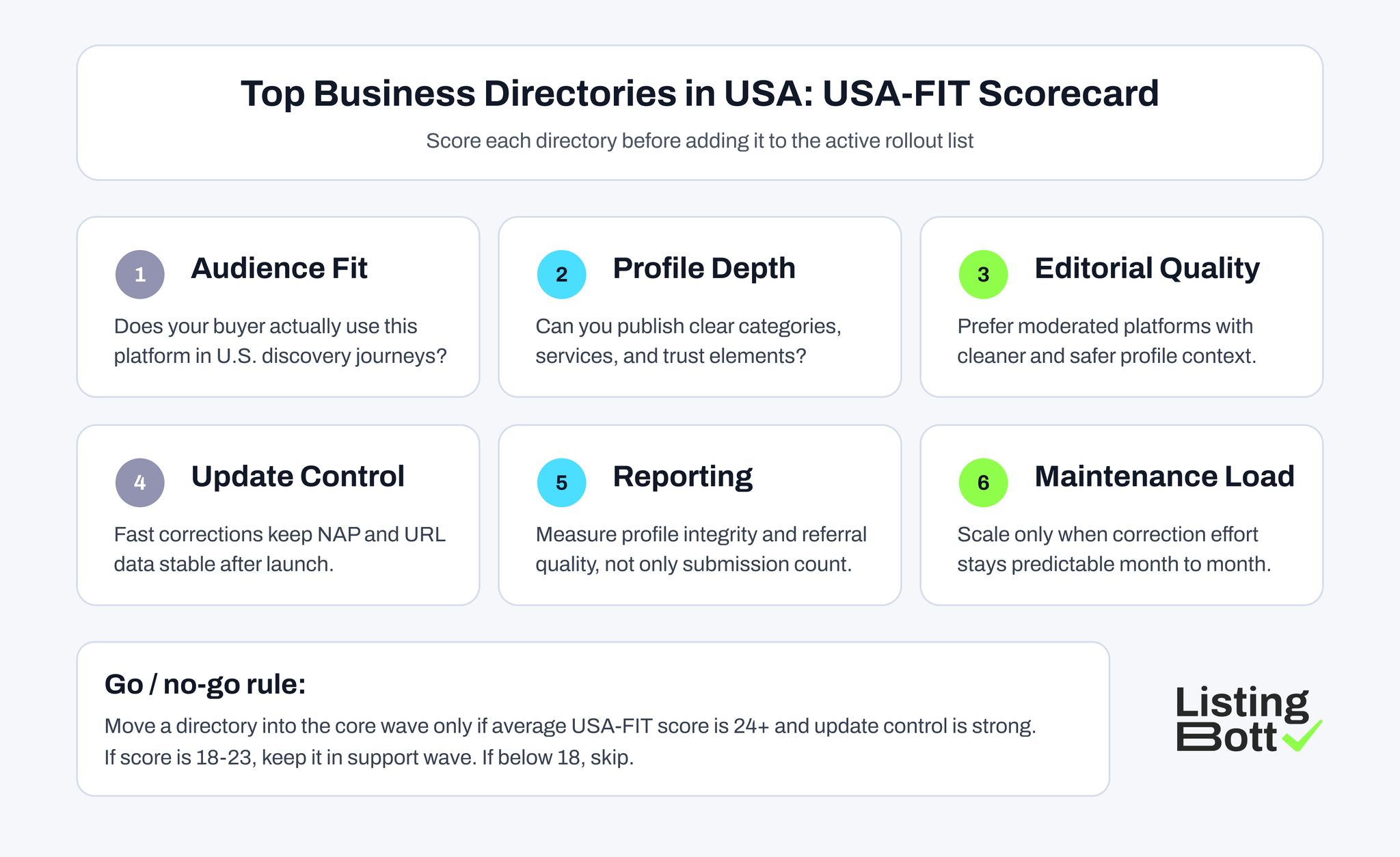
Use this six-factor scorecard before adding any platform to your active list. Score each factor from 1 to 5.
| Factor | What to evaluate | Why it matters | Score (1-5) |
| Audience fit | Does your buyer actually use this platform? | better intent alignment and conversion potential | 1-5 |
| Profile depth | Can you publish rich business details, categories, and proof? | stronger trust and context quality | 1-5 |
| Editorial quality | Is the platform moderated and relatively clean? | reduces noise and low-quality adjacency risk | 1-5 |
| Update control | Can you update key fields and correct errors efficiently? | protects long-term consistency | 1-5 |
| Reporting potential | Can you track engagement or referral quality? | supports keep/de-prioritize decisions | 1-5 |
| Maintenance load | How much effort is needed to keep profiles correct? | avoids operational overload | 1-5 |
Suggested threshold:
- 24-30: strong candidate for core wave,
- 18-23: support wave only after core stabilizes,
- below 18: skip unless there is a niche strategic reason.
This avoids the common mistake of treating every entry in free online business directories lists as equal quality.
Top Business Directories in USA: USA-FIT Scorecard
Best-Fit Listing Platforms for Top Business Directories in USA
The table below is designed for practical rollout decisions. It is not a submit-everywhere checklist.
| Platform | URL | Why it is a best fit | Ideal company profile | Submission note |
| Google Business Profile | https://www.google.com/business/ | Core local discovery layer with high visibility impact in U.S. search journeys | local SMBs, multi-location operators, service-area businesses | keep primary category and service-area fields tightly matched to site pages |
| Apple Business Connect | https://businessconnect.apple.com/ | Strong map ecosystem coverage for Apple users and mobile discovery | retail, hospitality, local services | verify hours and attributes before publish to reduce edit churn |
| Bing Places | https://www.bingplaces.com/ | Useful secondary search ecosystem coverage and profile consistency support | SMBs diversifying discovery sources | align NAP and URL fields with canonical profile baseline |
| Yelp for Business | https://business.yelp.com/ | High user-intent discovery and review visibility in many U.S. categories | home services, restaurants, health and wellness, local providers | quality of categories, services, and media strongly affects profile performance |
| Better Business Bureau | https://www.bbb.org/get-listed | Trust-oriented profile layer, useful for credibility-sensitive categories | legal, home services, financial-adjacent and reputation-sensitive businesses | ensure business details and policy information are complete |
| Chamber of Commerce | https://www.chamberofcommerce.com/ | Broad U.S. business directory footprint with practical local visibility support | local SMBs and regional operators | use specific descriptions, not generic one-line company text |
| Manta | https://www.manta.com/ | Established directory layer that can support citation breadth when quality is controlled | small businesses and B2B local providers | review profile fields after listing goes live to catch formatting issues |
| Yellow Pages | https://www.yellowpages.com/ | Legacy but still useful U.S. directory signal for selected segments | established local businesses with clear service categories | maintain consistent business categories and contact fields |
| MerchantCircle | https://www.merchantcircle.com/ | Additional local profile exposure for businesses targeting U.S. local discovery | neighborhood-focused service businesses | keep messaging clear and avoid duplicate profile creation |
| Foursquare | https://foursquare.com/ | Useful location/discovery layer in the broader place-data ecosystem | retail and in-person service businesses | map pin and location data accuracy are critical |
How to use this platform set:
- choose 5-7 channels for core launch,
- keep the rest as optional support channels,
- add support channels only after core quality stabilizes.
Core Wave vs Support Wave: Practical Composition
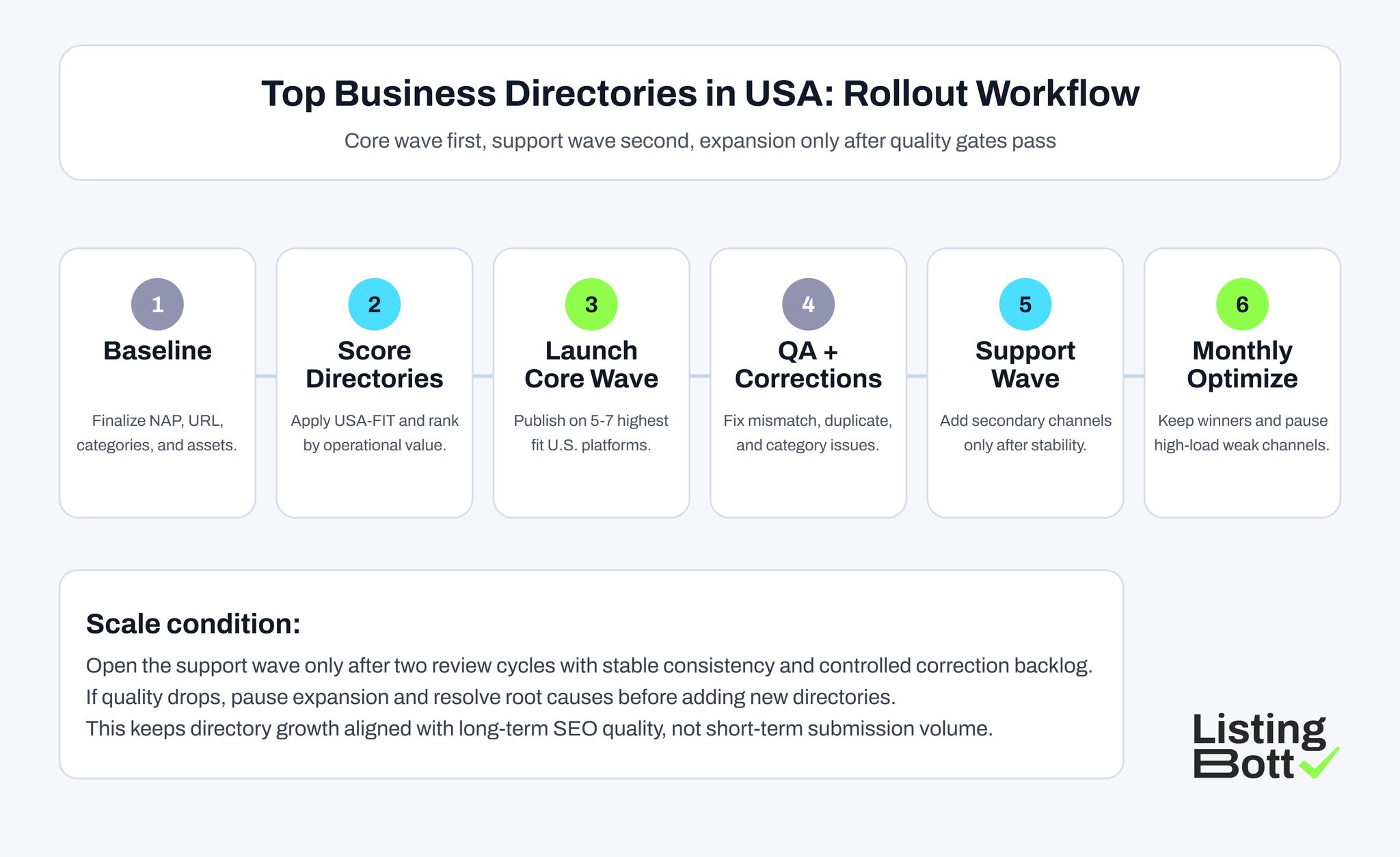
A clean rollout usually beats large volume. Start with two waves.
Core wave (first 30 days)
Pick channels that combine high audience fit, strong profile controls, and manageable maintenance load. For most U.S. SMB projects, this includes map-facing and trust-facing directories first.
Support wave (days 31-75)
Add channels from your free online directory listings research only when the core wave is stable. Stability means:
- consistency score is high,
- correction backlog is under control,
- ownership for ongoing updates is clear.
This prevents the classic expansion mistake: scale first, then clean forever.
Top Business Directories in USA: Rollout Workflow
Step-by-Step Implementation Checklist
Use this checklist to execute without losing control.
Step 1: build canonical profile baseline
Create one approved source record for:
- business name,
- address and service area rules,
- primary phone and tracking number policy,
- destination URL mapping,
- categories and service labels.
This baseline protects every platform from drift.
Step 2: score candidate platforms
Run USA-FIT scoring on each directory and rank by operational value, not just popularity. Keep your core list small.
Step 3: prepare profile assets once
Before publishing, prepare reusable assets:
- business summary variants by audience,
- short and long descriptions,
- logo and image set,
- category mapping notes,
- standard QA checklist.
Step 4: publish core wave
Launch 5-7 directories and capture:
- submission date,
- approval status,
- live URL,
- owner for corrections.
Step 5: run post-launch QA
Within 7-14 days, verify:
- NAP consistency,
- category accuracy,
- URL correctness,
- duplicate presence.
Step 6: resolve backlog before expansion
Do not open support wave until critical issues are closed.
Step 7: open support wave selectively
Add support directories only when quality gates are passed for two consecutive review cycles.
Step 8: review channel contribution monthly
Evaluate each platform with a practical board:
- profile integrity,
- correction burden,
- referral quality,
- conversion-assist signal.
Keep channels that earn their place. Pause channels that generate recurring noise.
KPI Board for US Directory Operations
To improve results, track metrics that support decisions.
| KPI | Why it matters | Healthy signal | Risk signal |
| Listing consistency rate | confirms data integrity across core channels | 95%+ and stable | repeated field mismatch |
| Duplicate listing rate | indicates profile hygiene quality | low and declining | new duplicates every cycle |
| Correction closure time | tests operational control | predictable weekly closure | aged backlog grows |
| Core-wave stability score | validates readiness to expand | stable for two cycles | high variance between cycles |
| Referral quality trend | checks channel relevance | improving engagement quality | low-intent traffic dominates |
This framework keeps business directories for seo decisions measurable rather than emotional.
Common Mistakes when Building a US Directory List
1) Turning one list into a universal template
A public seo directory list can be useful as a source, but not as your final operating plan. Every business should filter by fit and workload.
2) Publishing everywhere before QA discipline exists
Large first waves usually increase correction debt and slow progress.
3) Ignoring ownership
If nobody owns monthly corrections, consistency drops regardless of tool choice.
4) Treating free channels as zero-cost
Free online business directories still require time, QA, and update management.
5) No de-prioritization policy
If low-value channels are never paused, maintenance load keeps rising while output quality falls.
6) Rewriting profiles ad hoc across channels
When teams improvise copy by platform, messaging and category consistency often break.
7) Reporting only submission counts
Count quality outcomes, not only volume of submitted profiles.
90-Day Operating Plan for Directory Quality
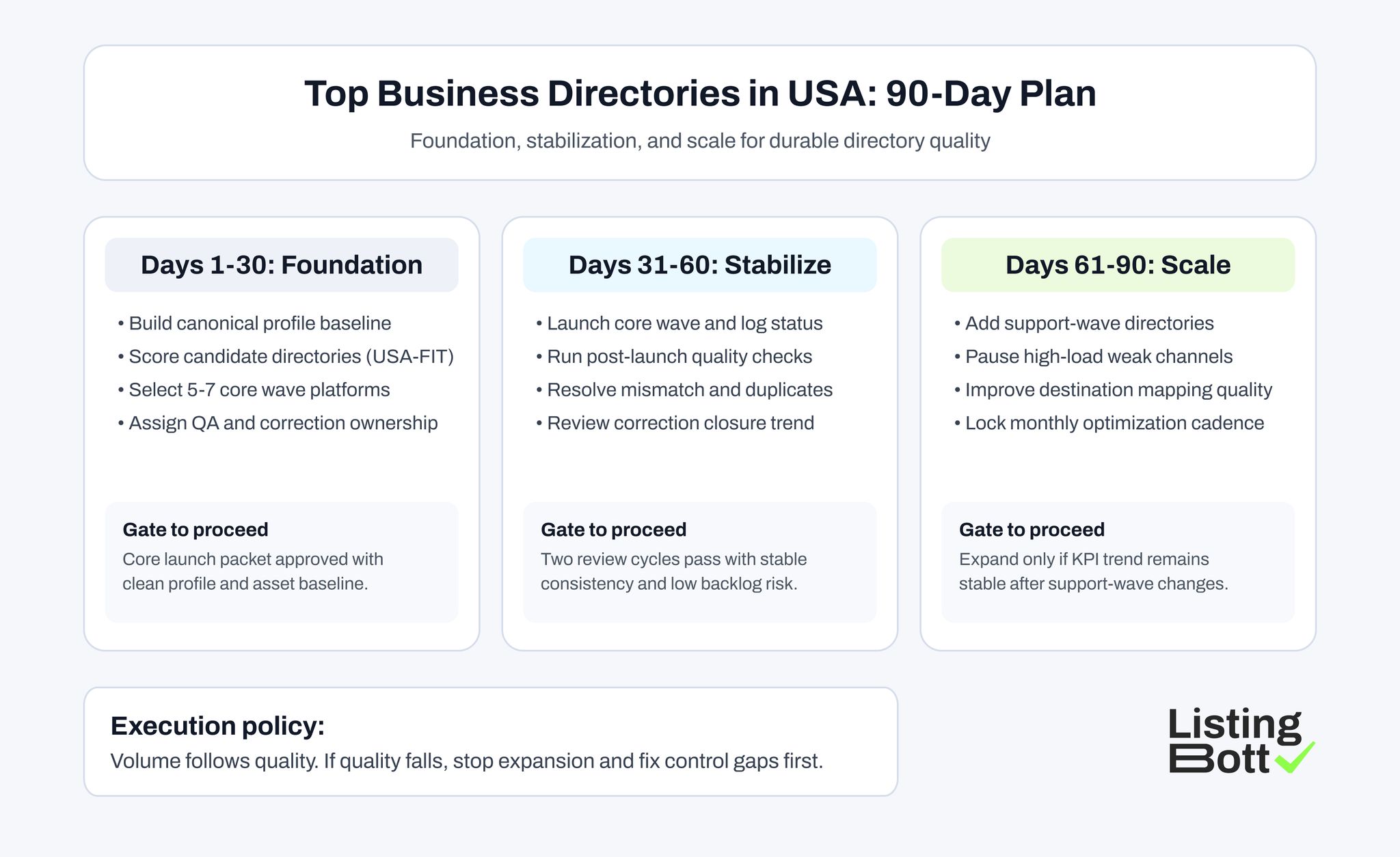
Days 1-30: foundation
- finalize canonical profile baseline,
- complete USA-FIT scoring,
- launch core wave,
- assign correction owners.
Days 31-60: stabilization
- run recurring QA checks,
- close critical inconsistencies,
- remove or merge duplicates,
- refresh weak profile fields.
Days 61-90: scale and optimize
- open support wave where justified,
- pause low-value high-load channels,
- improve destination-page mapping,
- lock monthly governance rhythm.
By day 90, you should have a working channel portfolio instead of a static directory list.
Top Business Directories in USA: 90-Day Plan
How to Adapt the Same Framework by Business Model
One strong reason this topic stays valuable is that U.S. directory needs vary by business model. The scoring model stays the same, but execution details change.
Local service businesses
For home services, clinics, and local professional services, map visibility and trust channels usually matter most. Start with map-centric and reputation-centric directories, then add support channels only if correction workload remains stable.
Multi-location retail and hospitality
For multi-location operations, consistency control matters more than raw submission volume. Group locations by complexity tier, then roll out in waves so teams can fix quality issues before they spread to all locations.
B2B and regional providers
B2B providers often need stronger category and service-page mapping to avoid low-intent traffic. In this case, a smaller list of higher-fit channels usually outperforms broad distribution.
Early-stage companies testing new markets
When a company is testing regional demand, directory execution should prioritize speed with guardrails: clean baseline, limited first wave, strict QA, and fast de-prioritization of low-value channels.
This is where teams often misuse generic lists from free online directory listings resources. A smarter plan is to filter and test channels by business model, then expand only where quality and relevance are proven.
Keep, improve, or pause: monthly decision model
Run a monthly review for each active platform and make one clear decision:
- Keep if quality is stable and referral behavior is useful.
- Improve if the channel has buyer fit but profile quality issues are fixable.
- Pause if maintenance load is high and quality/relevance remains weak after corrective cycles.
Use this simple decision matrix:
- high fit + high quality: keep and optimize,
- high fit + low quality: improve with a 30-day correction sprint,
- low fit + high quality: keep only if strategic coverage is needed,
- low fit + low quality: pause and reallocate effort.
This model protects teams from the biggest scaling trap: adding more channels while legacy quality debt is still unresolved.
Where ListingBott Fits
ListingBott helps teams execute directory publication in a structured, product-led workflow instead of a manual spreadsheet process.
Typical flow:
- onboarding details are collected,
- listing scope is confirmed,
- publication is executed,
- reporting is delivered.
Offer alignment:
- one-time payment model,
- publication to 100+ directories,
- no hidden extra fees,
- refund possible if process has not started.
Promise limits:
- no guaranteed ranking position,
- no guaranteed traffic by a specific date,
- no guaranteed indexing speed,
- no guaranteed outcomes controlled by third-party platforms.
Qualified DR statement: DR growth to 15 can be promised only when starting DR is below 15, the client-selected goal is domain growth, and the approved listing set is in place.
FAQ: Top Business Directories in USA
How many U.S. business directories should we launch first?
Most teams should start with 5-7 core directories, then expand only after quality metrics stabilize.
Are free directory sites enough for long-term SEO value?
They can support visibility, but only when channel fit, profile quality, and maintenance workflows are strong. Free access does not remove operational cost.
What is the difference between local business directory listings and citation management?
Directory listings are the published profiles themselves. Citation management is the ongoing process that keeps those profiles consistent and current.
Should one directory list work for every niche?
No. Niche fit, buyer behavior, and maintenance capacity differ by business model. Scoring and filtering are required.
Do business directories guarantee rankings?
No. Directories support entity and visibility signals, but ranking outcomes also depend on site quality, competition, and broader SEO execution.