Table of Contents
- Why this Matters in 2026
- Best-Fit Listing Platforms for SaaS Listing Management Services
- Step-by-Step Implementation Checklist
- Common Mistakes and Practical Fixes
- 90-Day Rollout Plan
- FAQ
sbb-itb-8e44301
Quick Answer
SaaS listing management services work when they combine selective channel choice, profile-quality controls, and recurring maintenance governance.
The practical model is:
- select channels by fit and quality, not by volume,
- publish complete, consistent profiles,
- verify and correct listings after launch,
- run monthly keep or de-prioritize decisions.
Most teams fail by treating listings as a one-time project. For SaaS, listing quality decays unless ownership and maintenance are built into operations.
Why this Matters in 2026
SaaS buyers now validate tools across multiple third-party sources before they trust a new vendor. Directory profiles are often part of that evaluation path, alongside review platforms and community references.
In 2026, strong business listings management supports three outcomes:
- discovery: appearing in relevant category and alternative views,
- trust: maintaining consistent, current product context across external sources,
- conversion support: routing users to the right landing paths with clear intent match.
Weak listing operations produce the opposite: stale information, mixed positioning, low-intent referrals, and wasted maintenance effort.
What SaaS Listing Management Actually Includes
A real listing management service is more than submissions. It includes:
- channel selection logic,
- profile readiness and canonical data baselines,
- controlled publication workflow,
- post-launch QA and correction handling,
- recurring maintenance and reporting.
If any of these parts are missing, the program typically drifts into low-quality output.
The CONTROL-8 Framework for SaaS Listing Management Services
Use this framework before selecting services, tools, or internal workflows.
| Dimension | Decision question | Why it matters | Score (1-5) |
| Channel fit | Are platforms aligned with your ICP and buying motion? | Filters low-value visibility | 1-5 |
| Taxonomy accuracy | Can your product be categorized precisely? | Improves relevance and conversion quality | 1-5 |
| Ownership clarity | Are roles clear for launch, QA, and reporting? | Prevents operational drift | 1-5 |
| Narrative quality | Can profiles communicate product value and proof clearly? | Supports trust and evaluation | 1-5 |
| Tracking quality | Can you measure referral quality and assist impact? | Enables evidence-based decisions | 1-5 |
| Operational load | Is monthly upkeep sustainable for your team? | Keeps program scalable | 1-5 |
| Risk controls | Are duplicates, outdated fields, and rejection loops controlled? | Protects channel quality | 1-5 |
| Lifecycle governance | Is there a recurring keep/stabilize/de-prioritize process? | Prevents portfolio bloat | 1-5 |
Threshold guidance:
- 32-40: core channels/services
- 24-31: pilot tier
- below 24: de-prioritize unless strategic reason exists
This framework keeps listings management decisions practical and measurable.
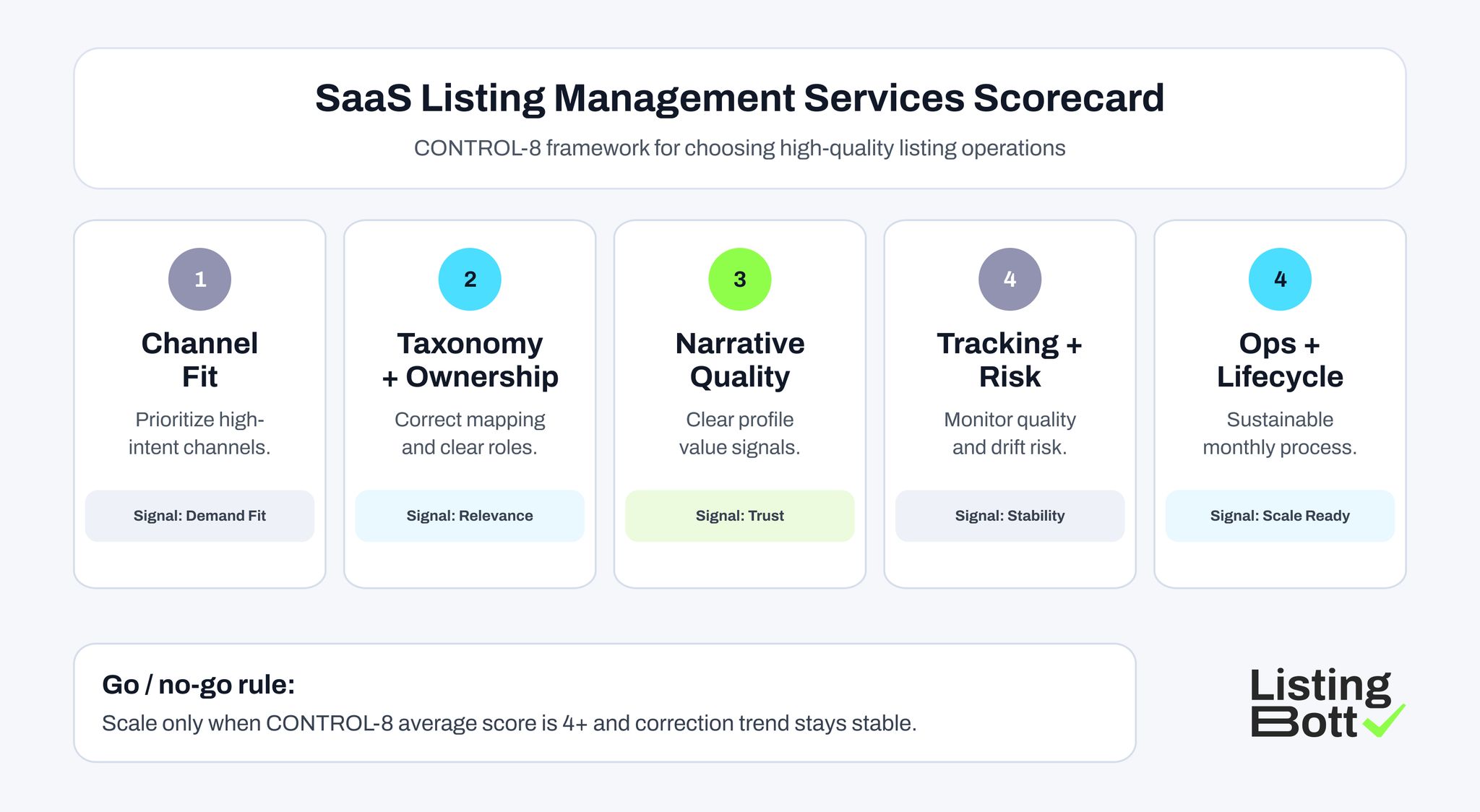
SaaS Listing Management Service Scorecard
Best-Fit Listing Platforms for SaaS Listing Management Services
Use this as a fit-based evidence block. It is not a mandatory submit-all list.
| Platform | URL | Why this is a fit | Ideal company profile | Submission note |
| Capterra | https://www.capterra.com/ | Strong software comparison and category-driven discovery behavior | SaaS with clear use-case positioning | Keep taxonomy and pricing context accurate |
| G2 | https://www.g2.com/ | Evaluation-stage buyer traffic with high trust expectations | B2B SaaS in active comparison cycles | Profile depth and proof quality are critical |
| GetApp | https://www.getapp.com/ | Useful shortlist channel for software buyers | SaaS teams optimizing mid-funnel intent | Refresh profile after major product updates |
| SaaSHub | https://www.saashub.com/ | Alternative and category discovery behavior | Product-led SaaS with competitor context | Keep differentiation language current |
| MicroSaaS Directory | https://microsaas.directory/ | Startup/SaaS discovery support channel | Early and growth-stage SaaS tools | Treat as support tier unless KPI quality proves core |
| Maze SaaS Directory | https://maze.do/saas-directory | Additional SaaS listing exposure for controlled testing | Teams running channel experiments | Validate referral quality before scaling |
| OpenHunts | https://openhunts.com/ | Launch-oriented discovery layer for product updates | SaaS teams shipping frequently | Tie listing updates to release cadence |
| Startup Stash | https://startupstash.com/ | High-volume startup/tool discovery ecosystem | SaaS products targeting founder/operator audience | Use precise category framing to avoid mismatch |
| Bro Directory | https://bro.directory/ | Support-layer listing/citation diversification | Teams expanding controlled portfolio breadth | Maintain governance to prevent stale profiles |
Practical tiering model
For most SaaS teams:
- Tier 1 core: 4-5 high-fit channels
- Tier 2 support: 2-3 channels for trust/citation diversity
- Tier 3 experiments: 1-2 channels with strict review gates
This model usually outperforms broad, unmanaged expansion.
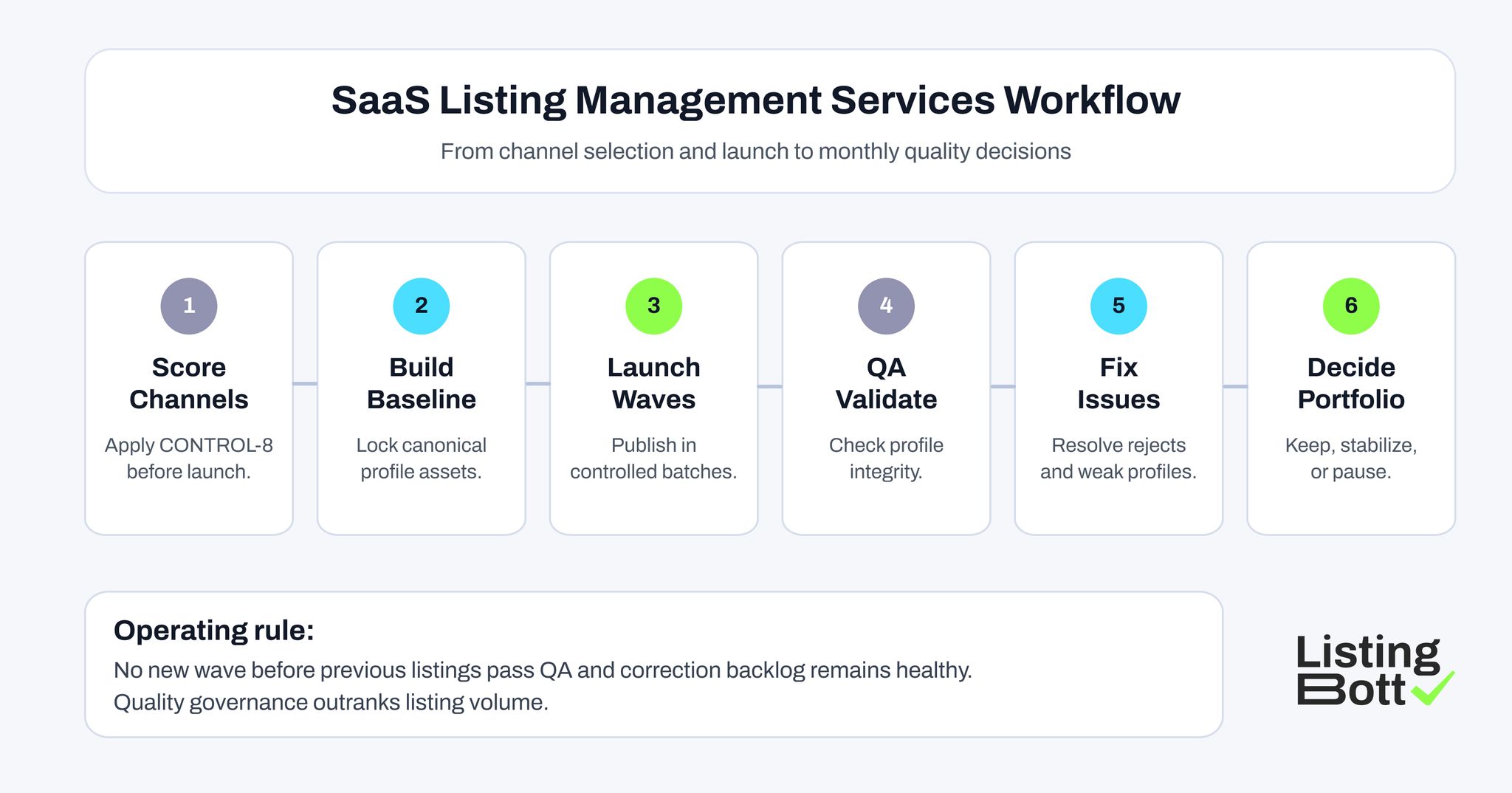
SaaS Listing Management Service Workflow
How to Choose Between Service and Tool-led Execution
Teams often compare a managed listing management service against internal tool-based execution. The better choice depends on team capacity and control requirements.
Service-led approach
Best when:
- internal bandwidth is low,
- launch speed matters,
- you want execution support with operational oversight.
Risk to watch:
- low transparency in channel selection,
- unclear correction ownership,
- weak reporting depth.
**Tool-led approach (**listing management tool workflows)
Best when:
- your team has stable SEO/revops capacity,
- you want tighter operational control,
- recurring maintenance is an internal competency.
Risk to watch:
- under-resourced QA,
- inconsistent governance between cycles,
- expansion without clear decision rules.
Hybrid approach
Many SaaS teams perform best with:
- external execution support for initial coverage,
- internal governance and performance decision-making.
This balance keeps momentum without giving up control.
Step-by-Step Implementation Checklist
Step 1: build canonical listing baseline
Create one source file including:
- official product/company naming rules,
- category and use-case mappings,
- short and long profile copy variants,
- destination URL map by intent,
- approved visual/proof assets.
Step 2: score channels with CONTROL-8
Do not submit until channels pass fit and governance thresholds.
Step 3: define role ownership
Assign:
- launch owner,
- profile-quality owner,
- QA owner,
- reporting owner.
Role clarity reduces correction latency and accountability gaps.
Step 4: launch in waves
Track every submission:
- platform,
- submission date,
- status,
- live URL,
- correction notes,
- closure date.
Step 5: run 72-hour post-launch QA
Validate live listings for:
- naming consistency,
- category accuracy,
- URL correctness,
- profile completeness,
- duplicate conflicts.
Step 6: run monthly lifecycle cycle
Each cycle includes:
- quality audit,
- correction closure,
- profile refresh after product changes,
- channel classification (keep/stabilize/de-prioritize).
This process turns local listings management and broader SaaS listing execution into a reliable system instead of ad-hoc tasks.
Where Local Listing Layers Fit for SaaS
Your keyword cluster includes local listings management, local business listing management, and local listing sites. For SaaS teams, local channels can be useful when:
- you operate regional GTM programs,
- you support local partners or service footprints,
- you need stronger business-identity consistency across local references.
For fully global SaaS motions, local layers are usually support channels, not core growth channels.
Practical mix for many teams:
- 60-70% SaaS/product directories,
- 20-30% support/citation/local consistency channels,
- 10% controlled experiments.
This keeps channel strategy aligned with commercial reality.
Pre-launch Readiness Pack for Listing Operations
Before you start any business listings management rollout, prepare a readiness pack that teams can reuse across waves.
Core data pack
- approved product and company naming variants,
- canonical URL rules and destination mapping,
- category map by channel type,
- short and long profile copy versions.
Proof pack
- screenshots and visual assets,
- feature-to-benefit bullets,
- trust elements appropriate for directory profiles.
Governance pack
- owner matrix for launch, QA, and reporting,
- correction SLA rules,
- monthly decision cadence for keep/stabilize/de-prioritize.
Why this matters
Teams that skip readiness often spend more time fixing rejected or inconsistent listings than they spend publishing high-quality ones. A compact readiness pack reduces launch errors, shortens correction loops, and makes listing management tool workflows far more reliable.
KPI Board for Listing Program Decisions
| KPI | What to track | Healthy signal | Risk signal |
| Profile integrity | % listings with no critical mismatch | 95%+ on core channels | rising inconsistency trend |
| Approval quality | acceptance stability and correction load | stable approvals | recurring rejection loops |
| Referral quality | engagement relevance by channel | stable quality trend | low-intent traffic spikes |
| Assist impact | contribution to assisted conversions | measurable support trend | flat over repeated cycles |
| Maintenance efficiency | monthly effort per active channel | predictable workload | high effort with weak value |
This KPI stack prevents vanity metrics and keeps decisions revenue-relevant.
Common Mistakes and Practical Fixes
Mistake 1: channel expansion without fit scoring
Fix:
- use CONTROL-8 before launch,
- cap wave size until quality is stable.
Mistake 2: one generic profile for all directories
Fix:
- keep canonical core data,
- adapt context language by platform intent.
Mistake 3: no correction governance
Fix:
- assign correction owner and SLA,
- track closure cycle health.
Mistake 4: measuring clicks instead of quality
Fix:
- evaluate referral relevance and assisted impact,
- de-prioritize weak channels quickly.
Mistake 5: confusing local and SaaS channel roles
Fix:
- define explicit portfolio roles per channel,
- avoid role duplication.
Provider Due-diligence Checklist
Before choosing saas listing management services, ask:
- How do you choose channels, and what scoring model is used?
- How do you prevent stale-profile drift after launch?
- What correction SLAs and ownership rules are included?
- How do you report referral quality and assist contribution?
- How do you decide keep/stabilize/de-prioritize actions each month?
If answers are vague, risk is high even if submission volume is high.
90-Day Rollout Plan
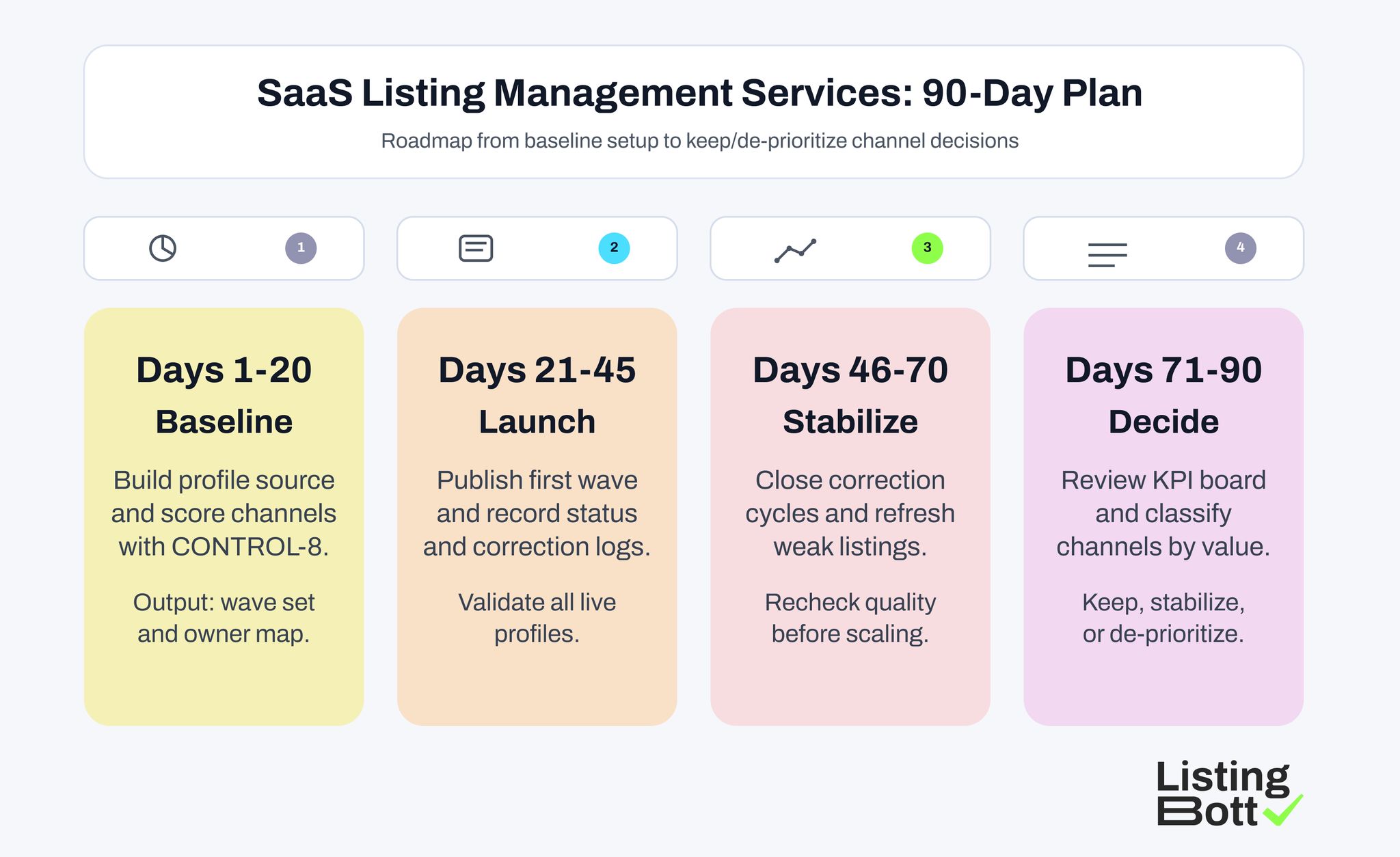
SaaS Listing Management Service: 90-Day Plan
Days 1-20: baseline and scoring
- finalize canonical profile baseline,
- score channels with CONTROL-8,
- lock first-wave set and ownership.
Days 21-45: controlled launch
- submit first-wave listings,
- capture status and correction logs,
- validate live profiles.
Days 46-70: stabilization cycle
- resolve correction backlog,
- refresh weak profiles,
- recheck quality thresholds.
Days 71-90: portfolio decisions
- review KPI board,
- tag channels (keep/stabilize/de-prioritize),
- expand only when quality is stable.
Internal Enablement for SaaS Listing Operations
Even with external support, internal enablement is still necessary. Teams should document:
- approved product description variants,
- category mapping rules by use case,
- destination URL map by listing intent,
- correction escalation owners.
This lightweight enablement pack reduces handoff errors and helps new teammates keep execution consistent. It also improves vendor coordination because every stakeholder works from the same baseline rather than ad-hoc notes. When teams skip this step, even strong tools perform poorly because inputs are inconsistent and correction ownership becomes unclear. It also shortens onboarding time for new operators joining active listing cycles.
Where ListingBott Fits
ListingBott is a tool workflow for structured directory execution and reporting.
Typical process:
- complete onboarding form,
- review and approve listing selection,
- publication runs,
- receive report with status and next steps.
Offer alignment:
- one-time payment model,
- publication to 100+ directories,
- no hidden extra fees,
- refund possible if process has not started.
Promise limits:
- no guaranteed ranking position,
- no guaranteed traffic by a specific date,
- no guaranteed indexing speed,
- no guaranteed outcomes controlled by third-party platforms.
Qualified DR statement: DR growth to 15 is promised only when starting DR is below 15, the selected goal is domain growth, and the approved directory list is in place.
FAQ: SaaS Listing Management Services
What are saas listing management services in practical terms?
They are workflows that select, publish, maintain, and optimize SaaS directory listings with governance and measurable performance controls.
How many channels should a SaaS team start with?
Most teams should start with 6-8 high-fit channels in controlled waves, then expand only after QA and KPI review.
Is a listing management tool enough without process governance?
Usually no. Tools help execution and visibility, but channel decisions and quality control still need defined operating rules.
How does local business listing management apply to SaaS?
It supports geo-specific motions and identity consistency layers, but for many SaaS teams it is a support channel rather than the core growth engine.
What is the biggest failure mode in listings management?
The biggest failure mode is lifecycle drift: profiles become outdated, corrections lag, and portfolio quality declines while maintenance cost rises.