Table of Contents
- Why SaaS Teams Still Use Submission Services in 2026
- When to Use each Submission Type
- 60-Day Rollout Plan for SaaS Submission Services
- Common Mistakes SaaS Teams Make
- FAQ
sbb-itb-8e44301
Quick Answer
SaaS directory submission services are worth using when your team needs consistent execution across multiple listing platforms and does not want growth quality to depend on manual spreadsheet tracking.
The best service setup in 2026 is not "submit everywhere." The better setup is:
- shortlist high-fit platforms,
- launch controlled submission waves,
- verify listing quality after publishing,
- measure referral quality and assisted outcomes,
- expand only when first-wave quality is stable.
This keeps directory work useful for discovery and trust without creating operational debt.
Why SaaS Teams Still Use Submission Services in 2026
A lot of SaaS teams can write content and ship product updates quickly, but still lose visibility in external discovery channels because listing execution is inconsistent.
Most listing programs fail for three practical reasons:
- no platform prioritization before submission,
- weak profile quality at publish time,
- no ownership for ongoing updates.
That is why this topic is not only an seo submission question. It is a workflow and quality-control question.
Submission services are useful when they reduce those three failure points. They are not useful when they only increase raw listing count.
What a Good Submission Service should Actually Do
Before choosing a provider, define expected scope clearly.
A strong service should cover:
- platform selection support,
- profile data normalization,
- submission execution,
- post-publish QA,
- reporting with clear next actions.
If a provider only promises one large package of article submission sites or broad directory volume without quality controls, you usually get weak channel outcomes.
The SUBMIT-9 Evaluation Model
Use this framework to compare SaaS submission services before purchase.
| Dimension | Key question | Why it matters | Score guide (1-5) |
| Segment fit | Do they understand your SaaS category and buyer type? | Prevents low-intent listings | 1 = weak fit, 5 = strong fit |
| URL targeting | Can they map each listing to the right destination page? | Improves conversion quality | 1 = generic mapping, 5 = intent mapping |
| Baseline quality | Do they require complete profile inputs before submission? | Reduces rejection/rework | 1 = loose, 5 = strict |
| Moderation handling | Can they handle approval loops and corrections? | Prevents stalled execution | 1 = unclear, 5 = clear |
| International coverage | Do they support structured engine international search submission where relevant? | Supports global SaaS reach | 1 = limited, 5 = reliable |
| Local layer support | Can they run selective local directories submission when geo intent exists? | Helps hybrid SaaS motions | 1 = no capability, 5 = strong capability |
| Citation quality | Do they preserve identity consistency for local citation submission and brand references? | Improves trust consistency | 1 = low control, 5 = high control |
| Reporting clarity | Do they report by platform quality, not just count? | Enables decisions | 1 = shallow, 5 = decision-ready |
| Update operating model | Is there a practical maintenance workflow after first publish? | Prevents profile drift | 1 = none, 5 = clear model |
Decision thresholds
- 34-45: strong provider fit
- 28-33: conditional test fit
- below 28: de-prioritize
This evaluation model helps keep buying decisions practical instead of hype-driven.
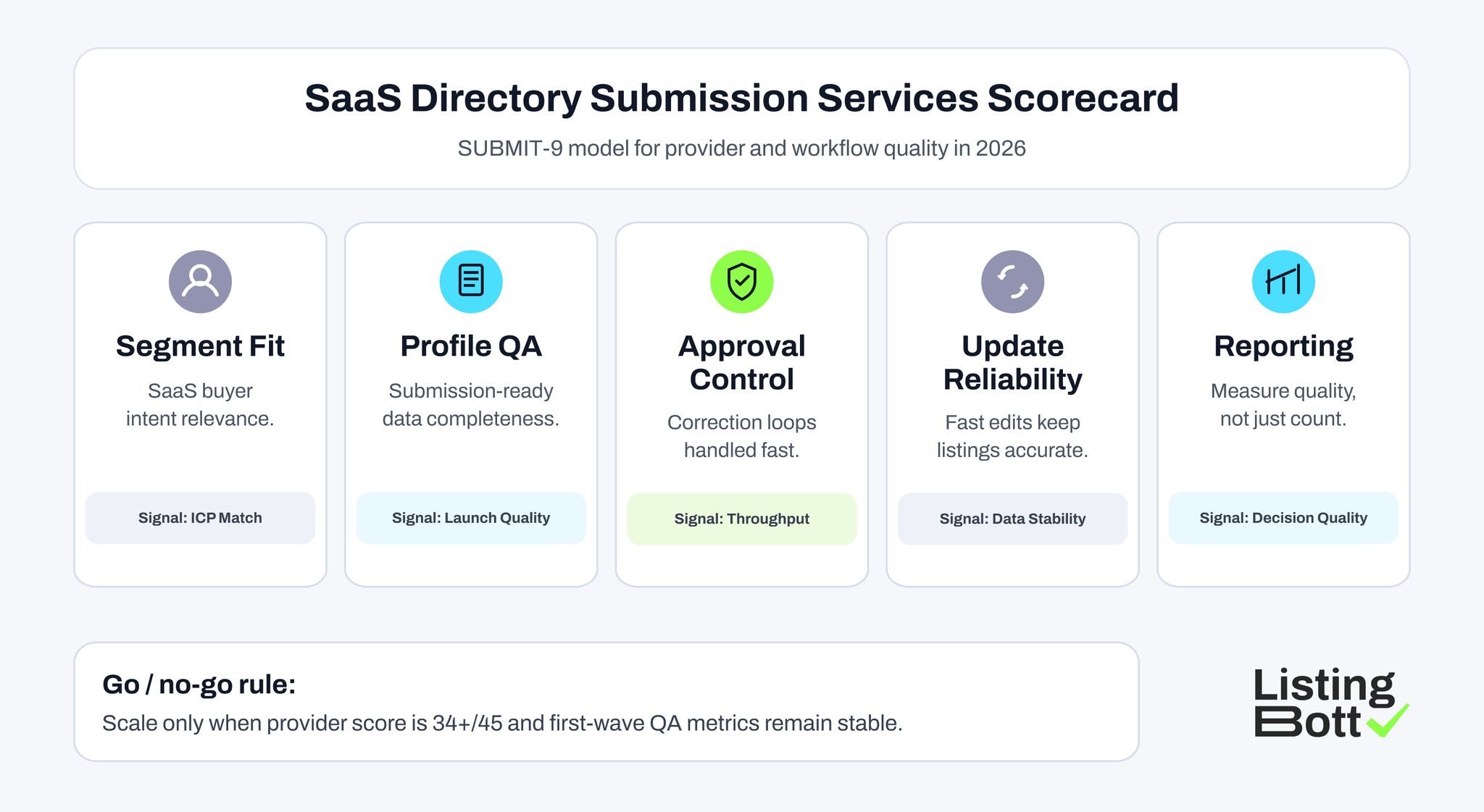
SaaS Directory Submission Services Scorecard
Best-Fit Listing Platforms for SaaS Directory Submission Services
Use this list as a practical platform pool for service design and rollout. It is not a mandatory "submit all" list.
| Platform | URL | Why it is a best fit | Ideal company profile | Submission note |
| SubmitSaaS directory set | https://submitsaas.com/directories | SaaS-focused distribution context with practical submission paths | Early and growth-stage SaaS needing structured coverage | Validate platform-level requirements before batch submission |
| OpenHunts | https://openhunts.com/ | Product discovery channel for launch and update visibility | Product-led SaaS with regular feature releases | Keep product summary concise and outcome-focused |
| FindYourSaaS | https://www.findyoursaas.com | Category-driven SaaS discovery for intent-based visitors | B2B SaaS with clear use-case categories | Category selection quality has major impact on traffic relevance |
| SaaSHub | https://www.saashub.com/ | Useful for alternatives and tool-comparison discovery behavior | SaaS with clear competitive positioning | Keep profile updates aligned with new features and messaging |
| G2 | https://www.g2.com/ | Strong trust and comparison context for software buyers | SaaS with review strategy and proof assets | Profile consistency and trust signals are critical |
| Capterra | https://www.capterra.com/ | Practical software category visibility for decision-stage buyers | Mid-funnel SaaS motions with buyer research demand | Taxonomy accuracy matters more than submission speed |
| GetApp | https://www.getapp.com/ | Useful supplemental comparison channel for software shortlists | SaaS teams building category presence | Keep pricing and positioning fields current |
| Product Hunt | https://www.producthunt.com/ | High launch visibility when coordinated with release milestones | Early-stage SaaS with active launch narrative | Works best as campaign event, not one-time passive listing |
| AlternativeTo | https://alternativeto.net/ | Alternative-focused discovery for replacement intent | SaaS competing in established categories | Distinct value proposition is required to convert traffic |
Platform Mix Recommendation
A practical first wave for most SaaS teams:
- 3 core SaaS discovery channels,
- 2 software comparison channels,
- 1 launch-focused channel,
- 1 experimental test channel.
That gives enough coverage without overloading operations.
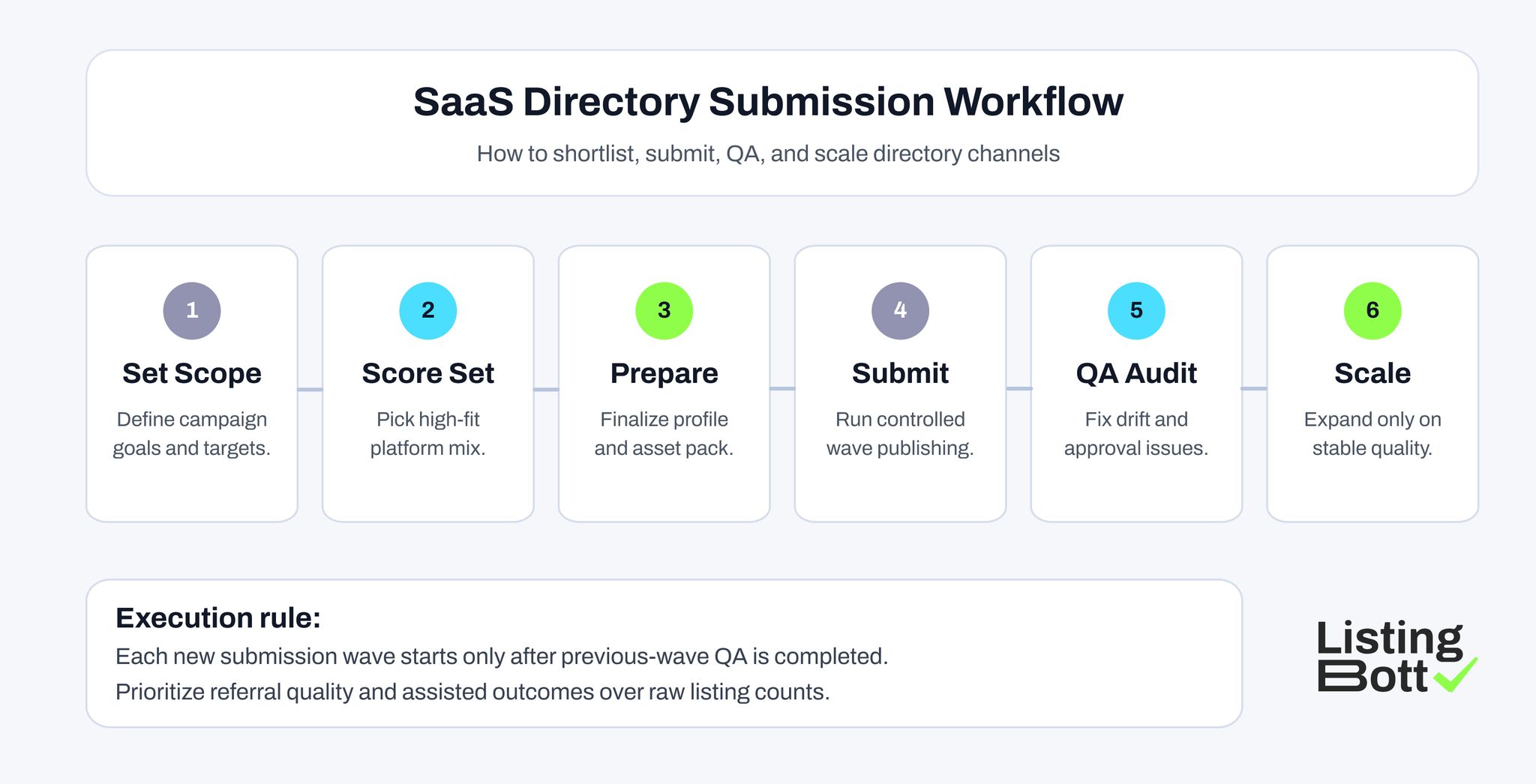
SaaS Directory Submission Workflow
When to Use each Submission Type
Not every submission type has equal value for every SaaS. Use each one intentionally.
Article submission sites
Best for:
- thought-leadership amplification,
- referral surface expansion,
- supplemental authority signals.
Risk:
- weak relevance if content and audience do not match your category.
Local directories submission
Best for:
- SaaS with local sales motion,
- hybrid local + product businesses,
- region-specific demand capture.
Risk:
- low value for purely global SaaS with no local intent layer.
Engine international search submission
Best for:
- multi-country SaaS expansion,
- regional discovery support,
- localization testing.
Risk:
- poor outcomes if localization and profile consistency are weak.
Image submission sites
Best for:
- visual-first products,
- UI-heavy categories,
- brand discoverability support.
Risk:
- low conversion value without strong destination mapping.
Local citation submission
Best for:
- identity consistency across third-party references,
- trust reinforcement,
- long-term brand accuracy.
Risk:
- operational noise if citation maintenance ownership is undefined.
Use this mix based on your funnel design, not on generic package volume.
Provider Delivery Models: What to Buy
Model A: one-off batch only
Good for:
- very small teams testing directory channel viability.
Risk:
- quality decays quickly without maintenance workflow.
Model B: batch + 30-day QA cycle
Good for:
- teams that want clean first-wave delivery.
Risk:
- still limited if no ongoing update mechanism exists.
Model C: batch + QA + maintenance process
Good for:
- teams that treat listings as recurring growth infrastructure.
Risk:
- requires tighter coordination and periodic review discipline.
Most growth-stage SaaS teams should prefer Model B or C.
60-Day Rollout Plan for SaaS Submission Services
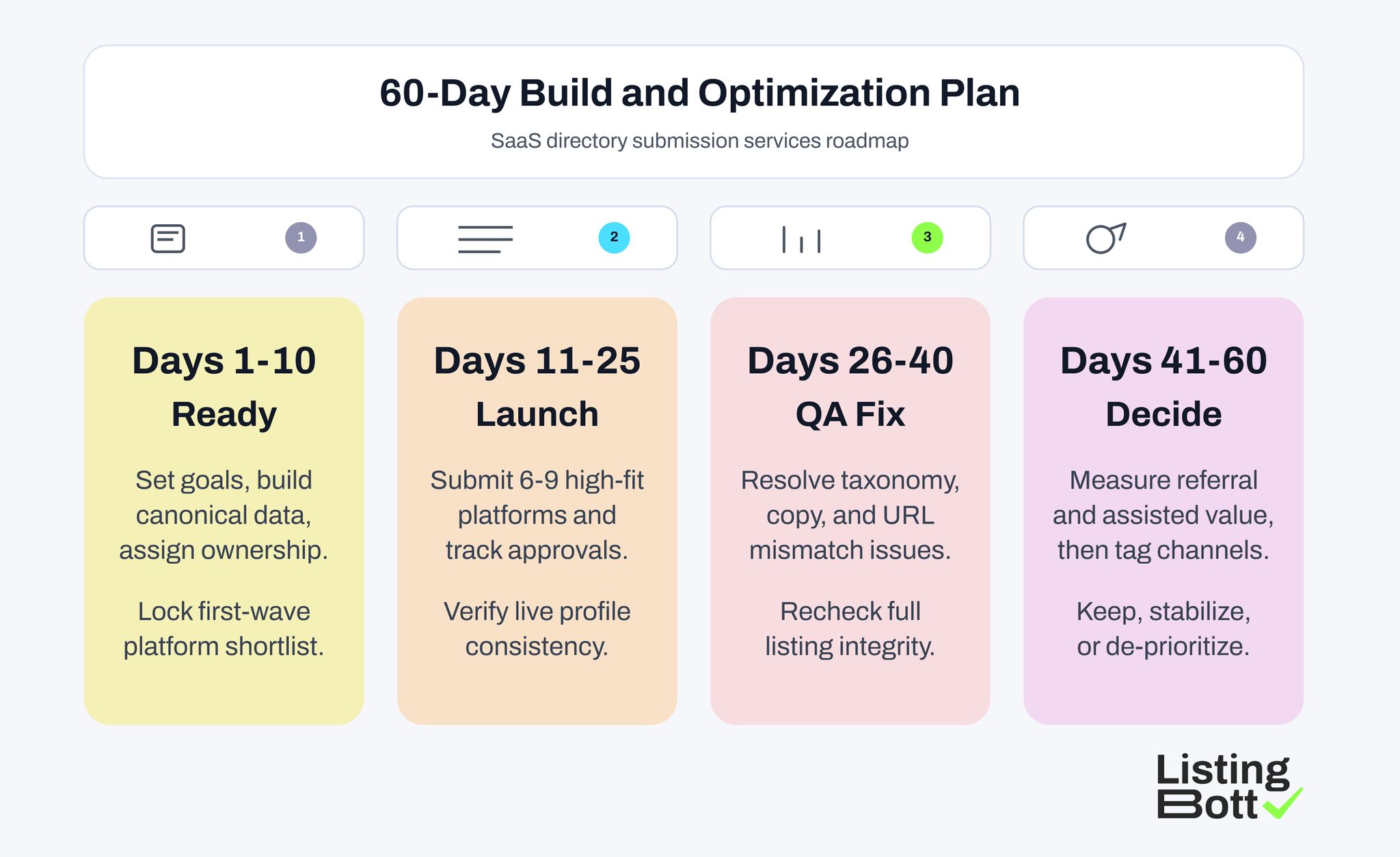
60-Day Build and Optimization Plan
Days 1-10: readiness
- Define campaign goals and target profile set.
- Prepare canonical data pack:
- product description,
- category mapping,
- pricing context,
- key URLs,
- proof elements.
- Assign owners for submission, QA, and analytics.
Days 11-25: first submission wave
- Launch 6-9 high-fit directories.
- Track approval and correction requests.
- Verify each live listing against canonical data.
Days 26-40: QA and correction cycle
- Fix taxonomy and content mismatches.
- Adjust link destinations for better intent match.
- Recheck listing consistency across all platforms.
Days 41-60: performance decision cycle
- Compare referral quality and assisted outcomes.
- Label each platform:
- keep,
- stabilize,
- de-prioritize.
- Open the second wave only if core quality is stable.
Practical QA Checklist before Paying Final Invoice
Use this checklist for any submission service.
- Were all agreed platforms actually submitted?
- Do live profiles match approved canonical data?
- Were corrections documented with resolution status?
- Are destination URLs mapped to the right funnel pages?
- Is there clear evidence of post-publish QA?
- Is reporting decision-ready (not just counts)?
If these are not clear, request corrections before expanding spend.
KPI Board for Service Evaluation
| KPI | Why it matters | Healthy trend | Risk trend |
| Approval rate | Indicates baseline submission quality | stable high pass rate | repeated rejections |
| Correction turnaround | Shows execution responsiveness | short correction windows | long unresolved queues |
| Listing consistency score | Measures data integrity | strong cross-platform match | drift after updates |
| Referral quality index | Measures audience relevance | stronger engaged traffic | volume without quality |
| Assisted conversion share | Measures business contribution | rising assisted influence | no measurable support |
| Maintenance effort per platform | Measures channel efficiency | manageable effort | high effort, weak value |
A service that cannot improve these indicators over one cycle is usually not a long-term fit.
Common Mistakes SaaS Teams Make
1) Buying by package size only
More submissions do not automatically mean more outcomes.
Fix:
- buy for fit and quality controls,
- use threshold-based platform selection.
2) Skipping destination strategy
Sending all directory traffic to one generic page weakens conversion quality.
Fix:
- map platform intent to matching destination pages.
3) Ignoring post-launch updates
Listings become outdated fast when positioning changes.
Fix:
- define maintenance ownership and review cadence.
4) Mixing global and local workflows blindly
Some teams run heavy local directories submission for products with no local demand signal.
Fix:
- use local layer only when local intent exists.
5) Treating citation work as optional cleanup
Skipping identity consistency weakens trust and can create profile conflicts.
Fix:
- include local citation submission quality checks in every wave.
Procurement Checklist for SaaS Directory Submission Services
Before signing any provider, run a short procurement check with your internal team:
- confirm who owns corrections after first publication,
- confirm what happens when listings are rejected or partially approved,
- confirm how often profile updates are included,
- confirm what reporting fields are delivered at channel level,
- confirm whether destination URL mapping is reviewed before launch.
This checklist prevents a common issue where delivery looks complete on paper but quality gaps remain in production listings. It also helps finance and growth teams align on what the service is actually buying: not just initial submissions, but ongoing profile reliability. It also gives legal and compliance stakeholders clearer language for approval because promise limits and execution scope are documented before the campaign starts.
Where ListingBott Fits
ListingBott is designed for execution consistency when teams want structured directory publishing without heavy manual operations.
Workflow:
- complete the client form,
- review and approve the directory list,
- publishing starts,
- report is delivered with status and next steps.
Offer alignment:
- one-time payment model,
- publication to 100+ directories,
- no hidden extra fees,
- refund possible if process has not started.
Promise limits:
- no guaranteed ranking position,
- no guaranteed traffic by a specific date,
- no guaranteed indexing speed,
- no guaranteed outcomes controlled by third-party platforms.
Qualified DR statement: DR growth to 15 can be promised only when starting DR is below 15, the selected goal is domain growth, and the client-approved directory list is in place.
FAQ: SaaS Directory Submission Services
What are saas directory submission services in practice?
They are operational workflows that prepare, submit, verify, and maintain SaaS listings across selected directories with reporting and QA controls.
How many platforms should we include in the first wave?
Most teams should start with 6-9 high-fit platforms, run one full QA cycle, then expand based on measured quality.
Are article submission sites enough for SaaS discovery?
Usually no. They can support visibility, but best results come from a mixed portfolio of SaaS discovery, comparison, and launch platforms.
When should we run local directories submission for SaaS?
When your funnel includes meaningful local intent, regional demand, or hybrid local-product motion.
Is engine international search submission necessary for every SaaS?
No. It is most useful for multi-country expansion where localization and regional discovery are strategic priorities.
How often should we update directory profiles?
At minimum monthly for core platforms and immediately after major product, pricing, or positioning changes.