Quick answer
Healthcare software listing services are worth using when the real problem is not "where could we appear?" but "how do we run submissions without category drift, wrong-intent placements, stale screenshots, and review-platform neglect?"
For most healthtech teams, the right first wave is operationally simple:
- lock the primary software category,
- publish to the strongest software-evaluation surfaces first,
- use healthcare-specific buyer guides as market-fit evidence,
- leave patient-facing directories out of the main rollout,
- review every live profile before expanding into the long tail.
In practice, that usually means starting with Software Advice, TrustRadius, GetApp, G2, and Capterra, while using sources such as Salesforce's medical software guide, PracticeSuite's EHR providers guide, Prezent's medical software companies guide, and Neon Health's care coordination software guide to sharpen category and workflow positioning.
That is the central difference between a good healthtech listing service and a weak one. A weak process spreads the product across any healthcare-looking surface. A strong process keeps the software in front of actual buyers and away from patient-search noise.
If your team already knows healthtech visibility matters but does not want to manage profile prep, approvals, verification, correction loops, and quarterly maintenance by hand, a structured workflow makes the campaign much easier to control.
sbb-itb-8e44301
When healthtech listing services make sense
Healthcare software listing services are useful when the challenge is operational discipline, not basic product definition.
They make sense when:
- the product category is already clear enough to submit consistently,
- the company needs stronger software-buyer visibility,
- the team wants to avoid wasting time on patient-facing or provider-finder surfaces,
- no one wants to manage profile preparation, approvals, and QA by hand,
- the company already has some listings live but the message, screenshots, or category placement are inconsistent.
They are especially useful for companies in these situations:
- EHR, EMR, or practice-management vendors trying to clean up scattered profile coverage,
- care-coordination or communications tools that need stronger workflow positioning,
- digital-health or telehealth startups launching their first serious software-comparison presence,
- healthcare operations platforms moving into more competitive review-platform environments,
- specialty workflow tools that need clearer category and buyer-language discipline.
They are usually the wrong starting point when:
- the product identity still changes every week,
- leadership expects directory volume alone to create rankings,
- the company has no review plan for review-heavy surfaces,
- the business still mixes software, provider discovery, and patient-facing language in one unclear message,
- the team cannot maintain profiles after the first wave goes live.
The biggest risk in this vertical is wrong-intent visibility. A healthtech vendor can get listed on a lot of healthcare-themed websites and still miss the people actually evaluating software.
That is why this page is different from a broader healthtech landscape guide. That kind of overview explains the ecosystem. This page explains the execution side: what to prepare, where to publish first, how to filter weak-fit surfaces, and how to keep the rollout clean. If you want the main service overview first, start with ListingBott.
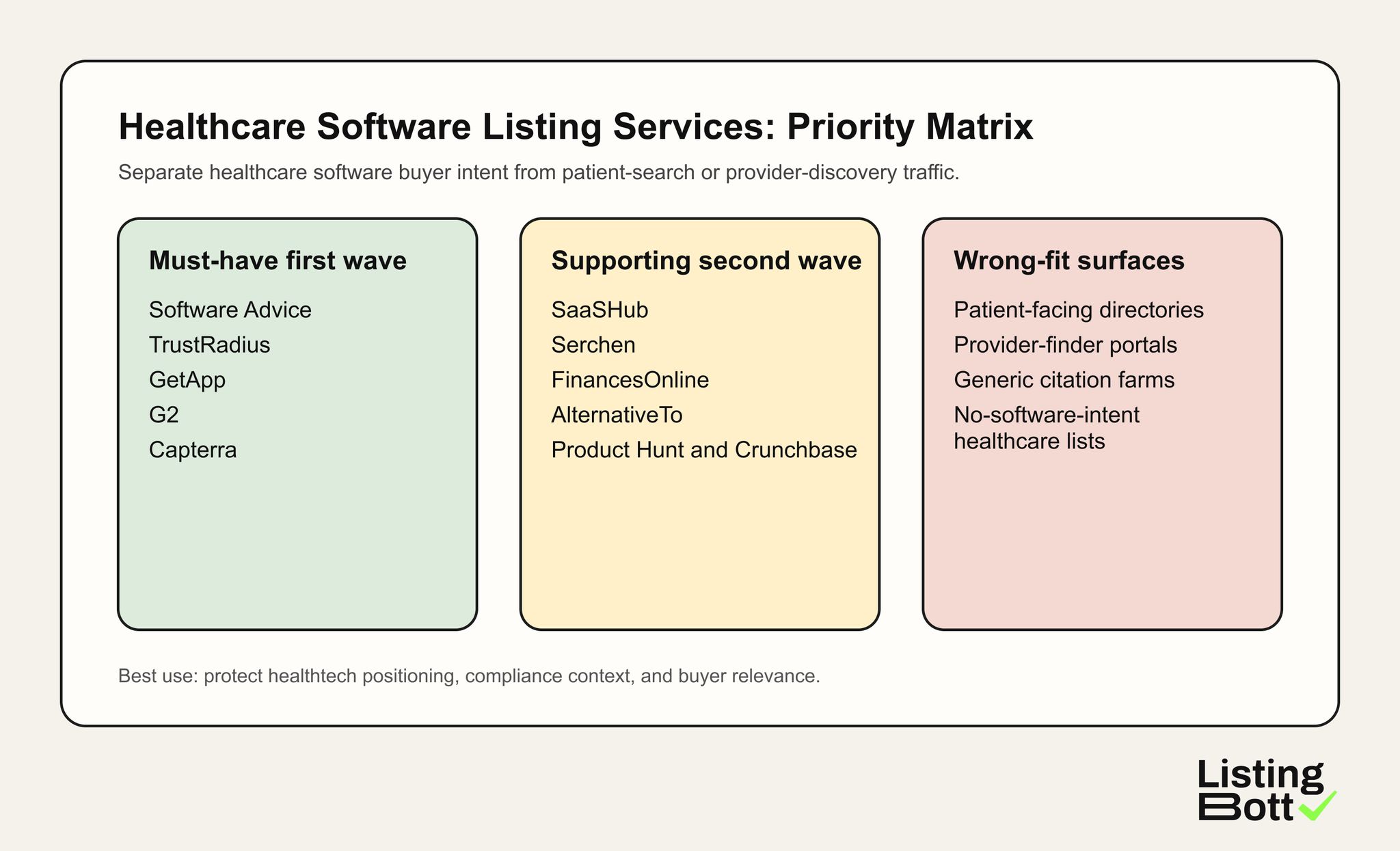
Healthcare software listing submission priority matrix showing first-wave, supporting, and wrong-fit platform groups for 2026.
What to prepare before submission
Before the first profile goes live, most healthtech vendors should create one canonical submission packet. The goal is not identical copy everywhere. The goal is one stable source of truth that can be adapted for different platforms without changing the product identity.
Core profile package
| Asset | Why it matters for healthtech | Common failure |
|---|---|---|
| Primary category | Keeps the product in the right software comparison set | Calling the same tool EHR, care platform, AI assistant, and patient-engagement suite everywhere |
| One-sentence positioning | Clarifies the product quickly for buyers | Generic "modern healthcare platform" copy |
| Long description | Explains workflow fit and buyer use case | Reusing homepage copy without adapting it to the platform |
| Feature summary | Helps shortlist-stage buyers compare correctly | Listing features without showing operational context |
| Integrations and interoperability detail | Important for clinical, billing, care, or admin workflows | Omitting systems and data flows buyers expect to see |
| Screenshots | Improves trust and clarity | Using outdated or overly generic product visuals |
| Pricing posture | Helps buyers qualify where supported | Avoiding the topic completely when the platform supports it |
| Implementation notes | Reduces uncertainty about setup and rollout | Ignoring onboarding, migration, or training complexity |
| Compliance and security context | Important in healthcare procurement | Talking only about AI or growth without trust signals |
| Review plan | Required on review-heavy platforms | Publishing to G2 or Capterra with no review support |
Category mapping has to come first
Healthtech products blur categories easily. A strong listing program starts by deciding what the product is first and what it is not.
Common category families that should not be mixed casually:
- EHR / EMR
- practice management
- care coordination
- patient engagement
- telehealth
- healthcare communications
- diagnostics and imaging
- RCM / billing
- specialty workflow tools
- healthcare AI workflow tools
If the company cannot say which of those jobs leads, the listing layer becomes inconsistent before the campaign even starts.
Buyer-language matters more than hype
Weak positioning:
- "All-in-one healthcare platform for modern providers."
Stronger positioning:
- "Care-coordination software for provider organizations that need patient-routing, communication, and follow-up workflows across multiple care teams."
Weak positioning:
- "AI-powered healthtech platform for efficiency."
Stronger positioning:
- "AI-assisted documentation and operational workflow software for healthcare teams that need faster intake, routing, and follow-up coordination."
Interoperability and implementation depth are part of the profile
Healthcare buyers often care about:
- interoperability,
- onboarding burden,
- permissions and security,
- workflow fit,
- reporting,
- migration complexity,
- and whether the software works for the care setting or operational model they actually run.
If the listing package ignores those issues, the profile looks shallow even when the product itself is strong.
How to separate software surfaces from patient-facing directories
This is the filtering step that protects the whole campaign.
A healthcare software listing service should not treat every medical-looking surface as a submission target. Some surfaces are built for software discovery. Others are built for provider discovery, clinic search, or patient navigation. They do not serve the same users or the same intent.
| Surface type | Main audience | Main job | Why it matters | What to avoid |
|---|---|---|---|---|
| Healthcare-software buyer guide | Software buyer, operator, or administrator | Understand categories and shortlist vendors | Strong workflow context | Treating editorial guides like simple open directory profiles |
| Software review platform | Software evaluator or buying team | Compare products before a shortlist decision | Strong commercial software intent | Publishing a thin profile with no review plan |
| Software catalog / alternatives site | Buyer exploring options | Support broader discovery and alternatives visibility | Useful second-wave layer | Expecting it to replace decision-stage review surfaces |
| Broad company-discovery surface | General company or brand discovery | Add visibility footprint | Easy inclusion | Weak healthcare-software intent |
| Patient-facing medical directory | Patient or care seeker | Find providers, clinics, or treatment options | Solves a different problem | Treating it as a software buying channel |
This is the practical rule: if the user is looking for doctors, clinics, specialties, or care locations, it is usually the wrong submission target for a healthcare software product.
Wrong-fit examples include:
- Vitals
- WhatClinic
- MedPages
- Health-Local
- GetCareSC
- FreeClinicDirectory
- MedicalTourism.review
- AlternativeHealthDirectory.online
Those surfaces are not automatically useless in the healthcare ecosystem. They are simply built for a different job than software evaluation.
Submission priority matrix
This matrix is built for execution. It is not a generic rankings list. The goal is to decide what belongs in the first wave, what belongs in the second wave, and what should stay out unless the business model specifically justifies it.
| Platform | Type | Why healthtech vendors use it | Profile assets that matter most | Priority level | Wrong-fit signals |
|---|---|---|---|---|---|
| Salesforce medical software guide | Healthcare-software buyer guide | Strong category framing and workflow context | Category clarity, workflow fit, business model match | Must-have as market evidence | Treating it like a simple directory profile |
| PracticeSuite EHR providers guide | Category-specific buyer guide | Useful for EHR, EMR, and practice-management evaluation context | Care-setting fit, category clarity, operational depth | Must-have as market evidence | Applying it to segments it does not match |
| Software Advice | Review / advisory platform | Strong decision-stage evaluation intent | Category precision, implementation detail, buyer-fit copy | Must-have | Copy-paste profile with weak healthcare context |
| Neon Health care coordination guide | Workflow-specific buyer guide | Helpful for care-coordination and workflow-heavy segments | Operational fit, workflow language, integration context | Situational but high-value | Treating it as broad category proof for every segment |
| TrustRadius | Review platform | Strong validation and deeper review context | Reviews, proof, implementation messaging, integrations | Must-have | No review plan or thin supporting proof |
| GetApp | Review / comparison platform | Useful for practical software comparison visibility | Screenshots, category fit, use-case clarity | Must-have | Expecting generic copy to compete well |
| Prezent medical software companies guide | Broad healthcare-software guide | Helpful for broad category framing and market context | Product summary, category clarity, segment fit | Situational but useful | Treating it like a direct vendor-controlled listing |
| G2 | Review platform | Strong software-buyer intent and comparison behavior | Review depth, screenshots, integrations, positioning | Must-have | Entering a competitive category with a shallow profile |
| Capterra | Review platform | Strong SMB and mid-market healthcare software shopping | Pricing posture, category map, screenshots | Must-have | Weak differentiation and unclear segment fit |
| SaaSHub | Software catalog | Helpful for alternatives and supporting discovery | Naming consistency, concise product summary | Situational | Treating it like a primary evaluation surface |
| FinancesOnline | Editorial / comparison surface | Supports software research visibility | Product summary, category clarity, proof points | Situational | Assuming editorial coverage works like a normal listing profile |
| Crunchbase | Company-discovery platform | Company-level visibility and supporting credibility | Consistent company positioning, links, company context | Situational | Treating it as a product-comparison destination |
How to sequence the first wave
For most healthtech vendors, a practical first wave looks like this:
-
Software Advice -
TrustRadius -
GetApp -
G2 -
Capterra -
use
Salesforce,PracticeSuite,Prezent, orNeon Healthas buyer-behavior and market-fit evidence for the category, not as interchangeable directory clones
That sequence is useful because it keeps the campaign inside software-buying environments first.
What belongs in the second wave
After the core layer is stable, most vendors can expand to:
These surfaces support broader discovery, but they rarely deserve the first allocation of effort.
What is usually low-priority or wrong-fit
These should not lead the campaign for most healthtech vendors:
- Clutch unless the company also sells implementation-heavy services,
- Slashdot unless the product is strongly technical or developer-adjacent,
- SaaSHub or Serchen before the main review layer is stable,
- patient-facing or provider-finder surfaces such as Vitals, WhatClinic, MedPages, Health-Local, GetCareSC, FreeClinicDirectory, MedicalTourism.review, and AlternativeHealthDirectory.online,
- broad directories as first-wave targets unless they serve a very specific company goal beyond software-buyer intent.
Rollout workflow
The strongest healthcare software listing services work like an operating process, not a directory blast.
Step 1: lock the category map and exclusion list
Before submission, decide:
- the primary product category,
- acceptable secondary categories,
- the target buyer type,
- the core clinical or operational workflow the product improves,
- and the surfaces that should be excluded because they attract provider-finder or patient-search intent.
This step matters because category drift happens fast in healthtech. One profile can frame the product as care coordination, another as communications software, and another as AI workflow automation with no consistent logic.
Step 2: build the master profile package
Create one canonical submission packet with:
- short description,
- long description,
- feature bullets,
- integrations,
- screenshots,
- pricing posture,
- implementation or onboarding notes,
- compliance and security context,
- official URLs,
- and company links.
The point is not to publish exactly the same copy everywhere. The point is to make every adaptation start from one source of truth.
Step 3: publish the first-wave profiles
Start with the software-buyer layer only.
For most healthtech vendors that means:
-
Software Advice -
TrustRadius -
GetApp -
G2 -
Capterra
This is where a structured online listing management automation workflow becomes useful. Once multiple profiles, approvals, verification loops, and correction steps are involved, the operational load becomes the real bottleneck.
Step 4: QA the first wave before expanding
Before moving to the second wave, check:
- was the product placed in the right category,
- do screenshots reflect the current product,
- are naming and descriptions consistent,
- does the profile match the right healthcare workflow,
- are trust, compliance, or integration signals present,
- did any surface create a duplicate or conflicting profile?
Step 5: expand carefully into secondary surfaces
After the first wave is stable, expand into:
-
SaaSHub -
Serchen -
FinancesOnline -
AlternativeTo -
Product Hunt -
BetaList -
Crunchbase - broad directories only where the business model still justifies them
Step 6: review quarterly
Healthtech categories, screenshots, integrations, and workflow language shift fast. Listings need scheduled review for:
- category accuracy,
- workflow wording,
- screenshots,
- integrations,
- trust and compliance messaging,
- review freshness,
- duplicate entries,
- and any wrong-fit surfaces that are no longer worth maintaining.
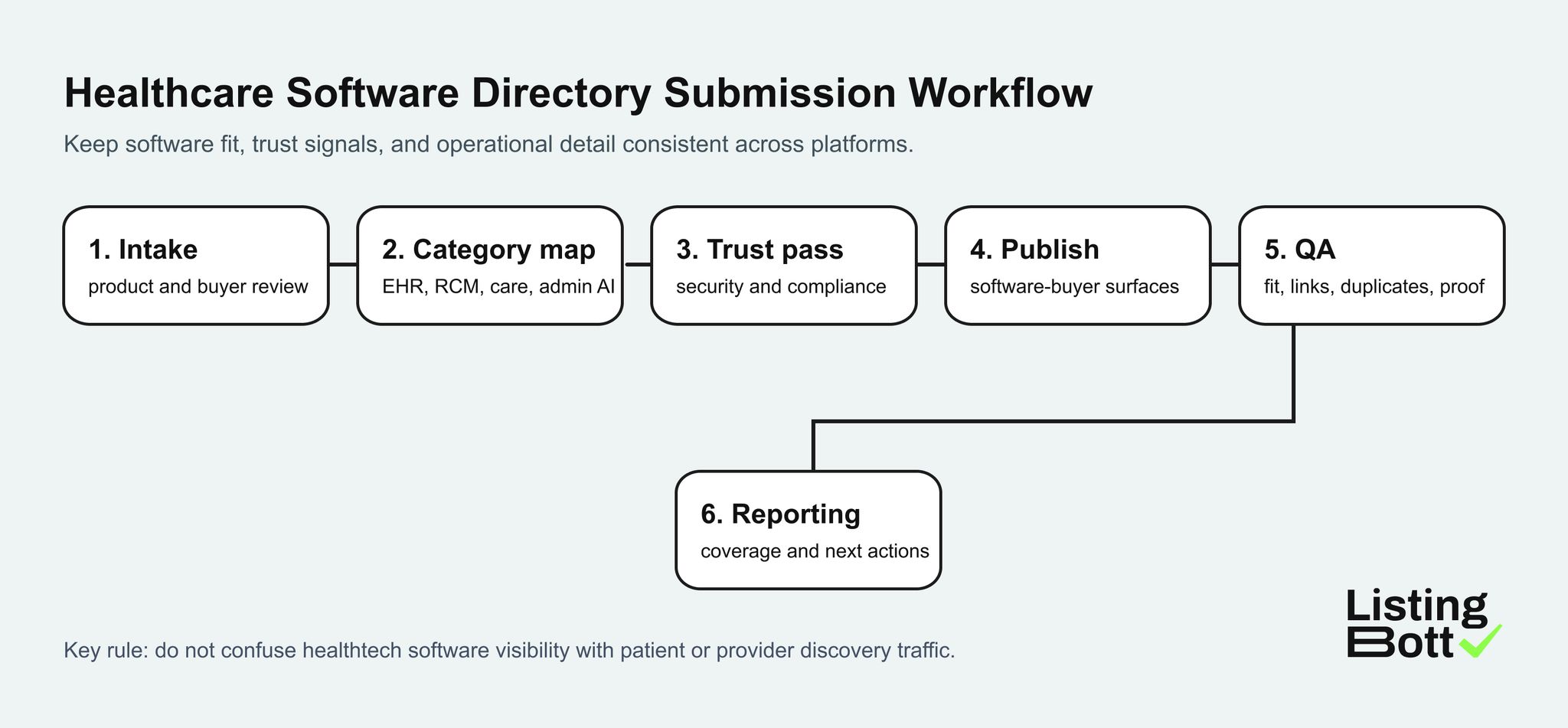
Healthcare software directory submission workflow from intake and category mapping to QA and reporting.
QA and maintenance
The submission itself is only the first half of the work. The real quality gap usually shows up after launch, when profiles drift, product visuals age, or category placement no longer matches the software.
Post-publish QA checklist
| Check | Why it matters | Fix trigger |
|---|---|---|
| Category accuracy | Keeps the product in the right software comparison set | Wrong or conflicting category placement |
| Audience fit | Prevents the campaign from drifting into patient-facing intent | Surface attracts the wrong type of user |
| Positioning consistency | Keeps the product identity stable | Descriptions vary too much across platforms |
| Workflow clarity | Helps buyers understand what the product actually does | Profile sounds too generic or too broad |
| Screenshot freshness | Supports trust and clarity | Old UI or irrelevant visuals |
| Integration detail | Helps operational buyers compare fit | Missing expected systems or data-flow context |
| Compliance and security messaging | Important in healthcare procurement | Trust signals are missing or too vague |
| Review coverage | Important on review-heavy platforms | Low or stale review depth |
| Duplicate profiles | Avoids split signals and buyer confusion | More than one inconsistent profile exists |
| Submission status | Prevents silent rollout failure | Pending or rejected entries have no follow-up |
What to review every quarter
- category and subcategory placement,
- screenshots,
- integrations,
- pricing posture,
- workflow wording,
- compliance and security copy,
- review freshness,
- duplicate entries,
- wrong-fit surfaces that are no longer worth the maintenance cost.
In healthtech, that matters because the buyer is not only checking features. They are checking whether the product fits the workflow, compliance demands, and operational model they actually run.
Common mistakes
The biggest healthtech listing mistake is wrong-intent visibility.
1. Treating medical directories as software directories
A healthtech company can get listed on healthcare-themed sites and still miss the people actually searching for software.
2. Publishing vague category positioning
If the product is described as EHR, care platform, AI assistant, patient-engagement suite, and operations tool everywhere at once, the profile layer becomes noisy fast.
3. Letting broad visibility outrun software-buyer relevance
It is easy to chase healthcare-themed surfaces that look relevant but bring weaker intent than real software-evaluation platforms.
4. Ignoring interoperability, compliance, and implementation depth
Healthcare buyers often care about integration, permissions, setup burden, auditability, and workflow fit more than abstract feature claims.
5. Expanding before the first wave is stable
Many teams move into the long tail while their core profiles still have weak copy, stale visuals, or inconsistent category placement.
6. Treating patient-facing visibility like software-buyer visibility
A provider finder, clinic directory, or care-search surface can be healthcare-relevant and still be the wrong audience for the software.
How ListingBott fits
If your healthtech team wants execution support instead of ad hoc manual submissions, ListingBott fits on the workflow side.
What ListingBott does
ListingBott helps teams submit their product or website to many directories using a structured process. The offer is operational, not a consulting-call model.
How the workflow works
- You complete the client form with company, product, and category details.
- ListingBott prepares a list of directories for your project.
- You review and approve that list.
- Publishing starts after approval.
- You receive a report showing what was submitted, what is pending, and what still needs follow-up.
Why that matters for healthtech
Healthtech vendors often need stronger control over category mapping, wrong-fit filtering, profile consistency, and rollout QA. A structured workflow helps keep the effort focused on software-buying surfaces instead of random medical visibility.
Expected results and limits
What you can reasonably expect:
- structured submission execution,
- better rollout control,
- visibility into what was submitted,
- and reporting that helps the team track what still needs action.
What should not be promised:
- guaranteed ranking position,
- guaranteed traffic by a fixed date,
- guaranteed indexing speed,
- guaranteed third-party platform outcomes.
If a campaign includes authority-growth goals, any DR commitment still has to follow the approved ListingBott conditions. For most healthtech teams, the safer expectation is process quality and visibility coverage, not blanket outcome promises.
See how directory automation works
FAQ
What should a healthtech vendor submit to first?
Usually the first wave should start with software review and evaluation platforms such as Software Advice, TrustRadius, GetApp, G2, and Capterra before broader supporting surfaces.
Do patient-facing medical directories help healthcare software SEO?
Usually not as core submission targets. They often attract provider-search or patient-discovery intent rather than software buyers.
Should EHR, care coordination, and telehealth products use the same category strategy?
No. They may share some platforms, but they should not share the same lead category. The primary category should match the product's main buying job.
Do review platforms need a different workflow from broader directories?
Yes. Review-heavy platforms need more ongoing attention because screenshots, reviews, category placement, compliance context, and product depth matter much more there.
Can healthcare software listing services guarantee rankings or traffic?
No. They can improve execution quality, profile coverage, and visibility discipline, but they cannot credibly guarantee exact rankings, exact traffic, or platform-controlled outcomes.
When should a vendor skip a platform?
Skip or delay a platform when the audience is wrong, the category fit is weak, or the team cannot support the profile properly after launch.