Quick answer
Domain Rating (DR) is a third-party metric that estimates backlink-profile strength on a 0-100 scale. It is useful for comparison and trend tracking, but it is not a direct ranking promise.
The best use of DR is operational: decide which sources are worth pursuing, which links are low quality, and whether your authority-building work is improving over time.
Teams that treat DR as a vanity target often over-prioritize quantity. Teams that treat DR as a quality signal usually make better decisions.
If you want to turn DR analysis into consistent execution, Start with ListingBott after defining your source-quality criteria.
Methodology
This framework explains DR mechanics and gives a practical way to use the metric in real SEO workflows.
1) What DR measures
DR estimates the relative authority strength of a domain's backlink profile. It is most useful for:
- benchmarking against competitors,
- checking directional growth,
- auditing whether link acquisition quality is improving.
For a related perspective on backlinks, authority metrics, and SEO improvement, see our What is Domain Rating (DR) in SEO?
2) How DR works conceptually
While each tool has proprietary implementation details, DR-style metrics generally depend on:
- number and quality of referring domains,
- authority distribution across link graph,
- diversity of source domains,
- link profile dynamics over time.
Because the scale is logarithmic-like in practice, moving from low to mid ranges is often easier than moving from high to very high ranges.
3) What DR does not capture well
DR does not fully represent:
- content relevance for your ICP,
- conversion quality,
- commercial impact of ranking changes,
- site-level technical and UX quality.
This is why DR should be paired with business and search-performance indicators.
4) Practical scorecard for using DR
Use DR together with supporting signals:
| Signal | Purpose | Review cadence |
|---|---|---|
| DR trend | Directional authority tracking | Monthly |
| Referring-domain relevance | Source-fit quality control | Weekly |
| Commercial query movement | Business page impact check | Monthly |
| Qualified traffic trend | Discovery quality validation | Monthly |
| Source-quality mix | Balance of strong vs weak sources | Weekly |
This scorecard reduces metric tunnel vision.
Practical implementation checklist
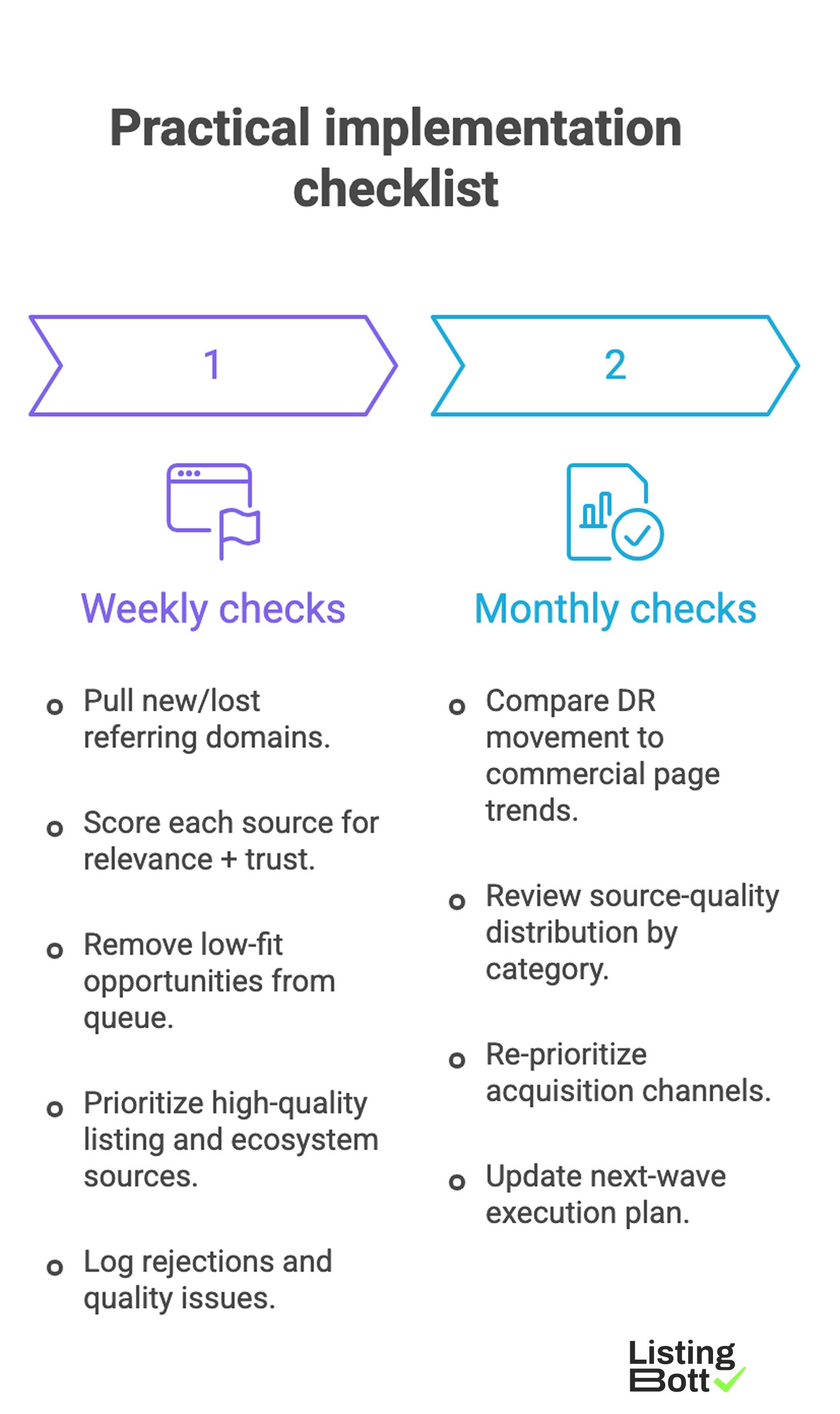
Practical Implementation Checklist
Weekly checks
- Pull new/lost referring domains.
- Score each source for relevance + trust.
- Remove low-fit opportunities from queue.
- Prioritize high-quality listing and ecosystem sources.
- Log rejections and quality issues.
Monthly checks
- Compare DR movement to commercial page trends.
- Review source-quality distribution by category.
- Re-prioritize acquisition channels.
- Update next-wave execution plan.
Examples from your categories dataset
The examples below come from Backlinks for tool our tools - Сategories.tsv (category: JustSaasListings). They are example candidates for evaluation, not universal endorsements.
| Directory example | DA | Traffic | Type |
|---|---|---|---|
| https://shipybara.com/ | 41 | 1,000.00 | Nofollow |
| https://openhunts.com/ | 29 | 1,000.00 | Dofollow |
| https://www.findyoursaas.com | 19 | 1,000.00 | Dofollow |
| https://www.go-publicly.com/ | 21 | 1,000.00 | Dofollow |
| https://findfir.st/ | 1 | 1,000.00 | Dofollow |
| https://www.listyourtool.com/ | 1 | 1,000.00 | Dofollow |
| https://open-launch.com | 38 | 7,400.00 | Nofollow |
| https://bulletin.so/ | 26 | 23,000.00 | Dofollow |
How to evaluate these examples:
- prioritize relevance and profile quality over raw DA,
- test in controlled waves,
- keep only sources that support durable outcomes.
How ListingBott solves this
A common gap between DR strategy and results is execution consistency. Teams often struggle with scattered lists, inconsistent data, and weak quality review.
ListingBott offers a one-time-payment workflow with intake, approved directory list, publication process, and report handoff. It is a tool workflow, not a call-based consulting model.
For DR-related initiatives, this helps convert analysis into repeatable actions and clearer visibility into completed work.
If your team needs structured submission execution, use a business directory submission workflow as the operational foundation.
Teams that do not want to manage this process manually can review managed directory submission service, which includes target review and final reporting.
What you get
When DR tracking is paired with controlled directory execution, teams usually get:
- cleaner source prioritization,
- fewer low-value submissions,
- better data consistency across listings,
- clearer reporting for iteration decisions.
ListingBott offer language alignment:
- one-time payment model,
- publication to 100+ directories (per current website language),
- refund possible if process has not started,
- no hidden extra fees (per current FAQ language).
For post-submission updates and consistency checks, a directory listing management tool supports ongoing maintenance.
When to use manual vs ListingBott
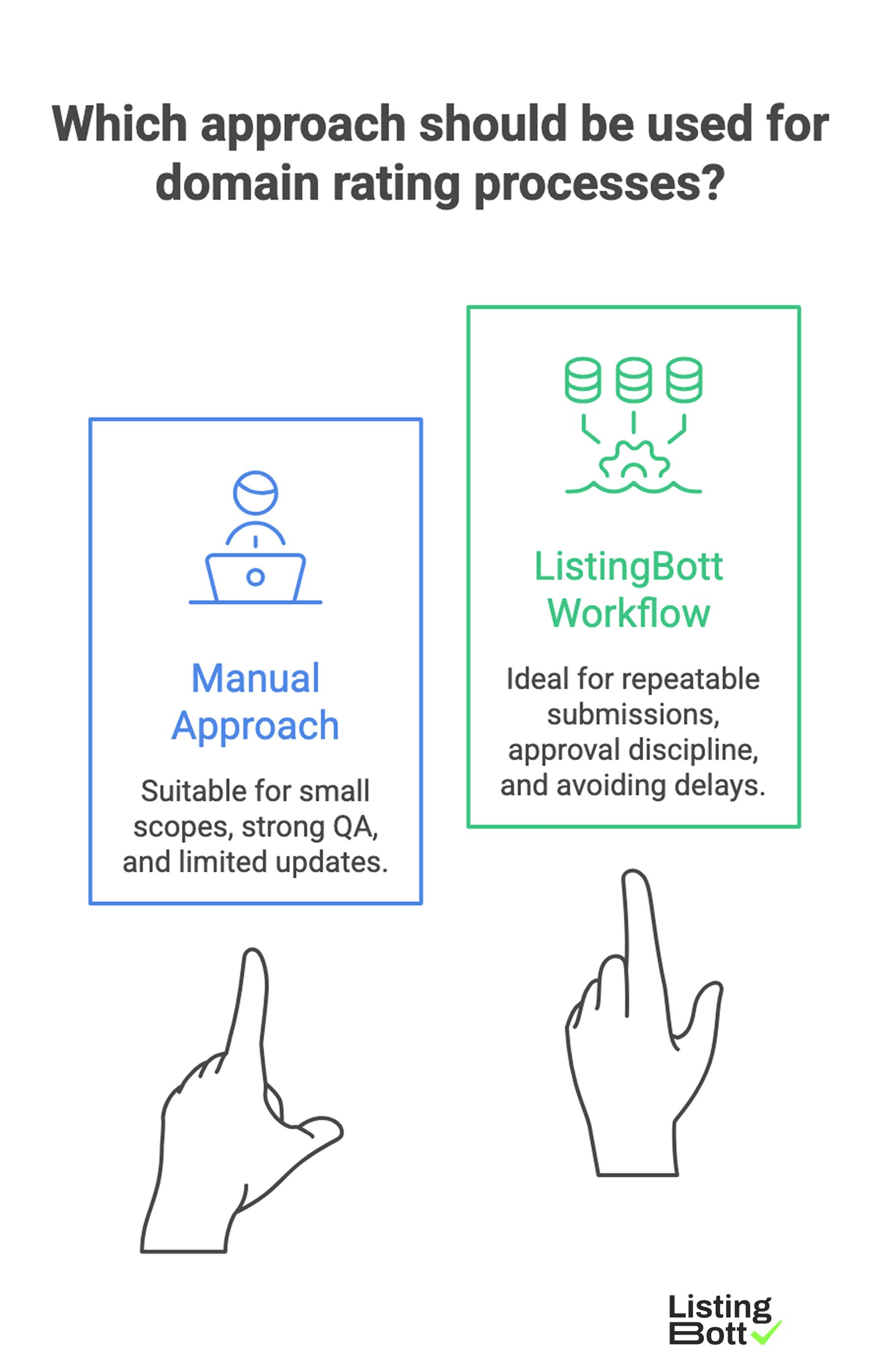
Domain Rating Process
Use manual approach when:
- scope is small,
- internal QA capacity is strong,
- update cadence is limited.
Use ListingBott workflow when:
- you need repeatable submissions across many sources,
- you need approval/reporting discipline,
- manual operations create delays and quality drift.
Boundary reminder: DR processes can support directional authority growth, but they do not create fixed-date ranking outcomes or outcomes controlled by third-party platforms.
If DR growth to 15 is discussed, the qualified condition is required: starting DR below 15, explicit domain growth goal, and client-approved directory list.
FAQ
Is Domain Rating a Google metric?
No. DR is a third-party authority metric and should be treated as comparative guidance. If you want the directory-specific link-building angle, our best Directories for Backlinks 2026 guide is the best companion read.
For a broader SEO execution layer beyond DR theory, review our high Da Directory Submission Guide for SEO guide.
If you want the directory-specific link-building angle, our SaaS Backlinks guide is the best companion read.
For the metric side of this topic, see our increase Domain Rating for SaaS explainer.
For the metric side of this topic, see our Ahrefs Domain Rating Explained explainer.
For a step-by-step companion on backlinks, authority metrics, and SEO improvement, see our How to Use Google Search Console for SEO.
Why does DR move slowly at higher levels?
Because growth is harder as authority scale increases and competition for high-quality references is stronger.
Should DR be tracked weekly or monthly?
Weekly for source-level changes, monthly for trend and business interpretation.
Can a low-DR site still rank for valuable queries?
Yes. Relevance, intent match, and page quality can still drive rankings in many cases.
Is directory submission enough to improve DR by itself?
No. It should be part of a broader quality-driven SEO and content system.