Quick answer
Ahrefs Domain Rating (DR) is a relative link-authority metric, not a direct ranking guarantee. It helps you understand the strength of a site's backlink profile compared with others in the Ahrefs index.
If you use DR correctly, it becomes a prioritization tool: where to spend outreach effort, which link sources are likely to move the needle, and how your profile quality changes over time.
If you use DR incorrectly, it becomes a vanity number that hides execution problems like weak relevance, low-quality link sources, and inconsistent listing strategy.
A practical approach is to pair DR analysis with real acquisition workflows and quality controls. For teams that need a structured process, Start with ListingBott can move directory execution from ad hoc tasks to a repeatable workflow.
Methodology
Understanding Domain Rating (DR)
This guide uses a decision-first method instead of a metric-first method. The goal is to treat DR as one input in a broader authority-building system.
1) What DR actually measures
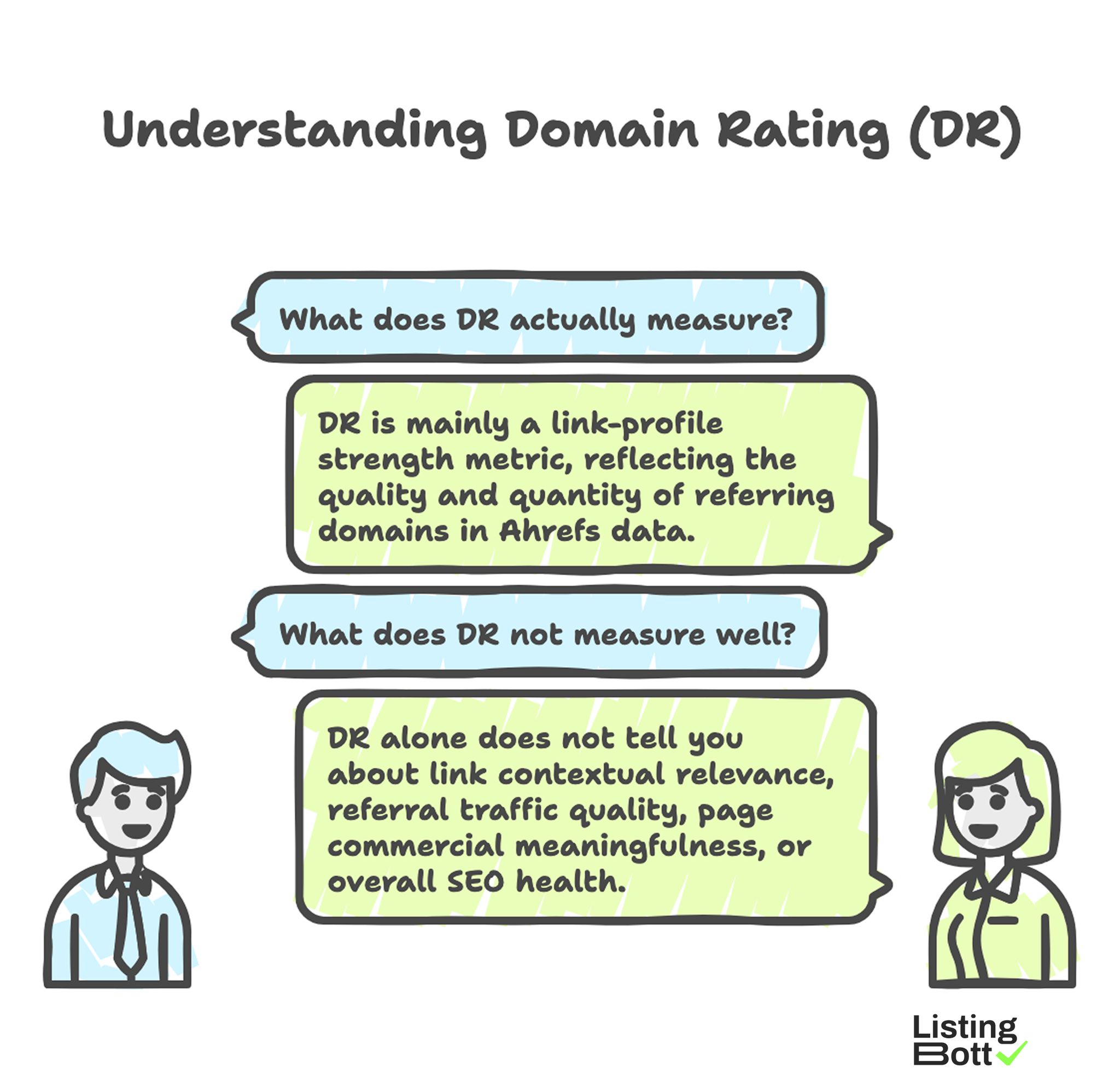
DR is mainly a link-profile strength metric. It reflects the quality and quantity signals of referring domains in Ahrefs data. For a related perspective on backlinks, authority metrics, and SEO improvement, see our What is Domain Rating (DR) in SEO?
Useful interpretation:
- DR is comparative, not absolute.
- DR movement is directional, not a daily KPI.
- DR is stronger as a trend metric than as a single-point metric.
2) What DR does not measure well
DR alone does not tell you:
- whether links are contextually relevant to your product,
- whether referral traffic quality is improving,
- whether pages linked to are commercially meaningful,
- whether your overall SEO system is healthy.
This is why teams that only chase DR can improve a score while business outcomes remain flat.
3) Practical scoring model for DR decisions
Use a weighted model when reviewing potential link/listing opportunities.
| Dimension | Weight | What to validate |
|---|---|---|
| Relevance fit | 30 | Is the source aligned with your market and category? |
| Source trust quality | 25 | Does the source show consistent editorial quality? |
| Link context quality | 20 | Is the placement meaningful and non-spammy? |
| Operational feasibility | 15 | Can you execute consistently without quality drift? |
| Measurable business support | 10 | Can this source support qualified discovery over time? |
This model prevents over-investment in high-metric but low-fit sources.
Practical implementation checklist
Use this checklist to make DR work as an operational signal instead of a vanity target.
Weekly operating loop
- Review new and lost referring domains.
- Classify each source by relevance and trust.
- Remove low-value expansion candidates from active queue.
- Prioritize quality directory and ecosystem listings.
- Log actions and compare against DR trend monthly.
Monthly review loop
- Compare DR trend with qualified traffic trend.
- Compare DR trend with ranking movement on commercial pages.
- Check whether link gains are concentrated in relevant categories.
- Rebalance effort away from low-return channels.
Real directory examples from your categories dataset
The following entries are examples from Backlinks for tool our tools - Сategories.tsv (category: JustSaasListings). These are examples for evaluation workflow, not blanket endorsements.
| Directory example | DA | Traffic | Type |
|---|---|---|---|
| https://shipybara.com/ | 41 | 1,000.00 | Nofollow |
| https://openhunts.com/ | 29 | 1,000.00 | Dofollow |
| https://www.findyoursaas.com | 19 | 1,000.00 | Dofollow |
| https://www.go-publicly.com/ | 21 | 1,000.00 | Dofollow |
| https://startupfound.com/ | 9 | 23,000.00 | Dofollow |
| https://ramen.tools/ | 53 | 17,700.00 | Dofollow |
| https://bulletin.so/ | 26 | 23,000.00 | Dofollow |
| https://peerpush.net/ | 58 | 2,900.00 | Dofollow |
How to use these examples:
- prioritize relevance and listing quality before raw DA,
- test in controlled waves,
- keep only sources that support durable quality outcomes.
How ListingBott solves this
Most teams understand DR theory but struggle with execution consistency. Listing acquisition often breaks down due to fragmented spreadsheets, inconsistent profile quality, and weak QA ownership.
ListingBott is a workflow tool for directory submission execution with one-time payment, approved directory list, publishing process, and report handoff. It is a tool workflow, not a call-based consulting model.
For teams trying to turn DR strategy into repeatable output, this workflow helps reduce coordination noise while keeping visibility into what was submitted and when.
If you need structured execution for link-source discovery and listing rollout, use a business directory submission workflow as the operating baseline.
Teams that do not want to manage this process manually can review managed directory submission service, which includes target review and final reporting.
What you get
When DR-oriented listing work is run with process controls, teams usually get:
- cleaner source selection decisions,
- fewer low-quality submission attempts,
- better consistency in profile data and positioning,
- clearer reporting of what changed and why.
Expected output from a disciplined workflow is not just "more listings." It is a tighter relationship between authority-building actions and business-relevant visibility signals.
Policy alignment for ListingBott-facing execution:
- one-time payment model,
- publication to 100+ directories (per current website language),
- refund possible if process has not started,
- no hidden extra fees (per current FAQ language).
For teams managing ongoing authority work after submission, pairing with a directory listing management tool keeps maintenance and corrections manageable.
When to use manual vs ListingBott
Choose the Appropriate Method for Directory Management
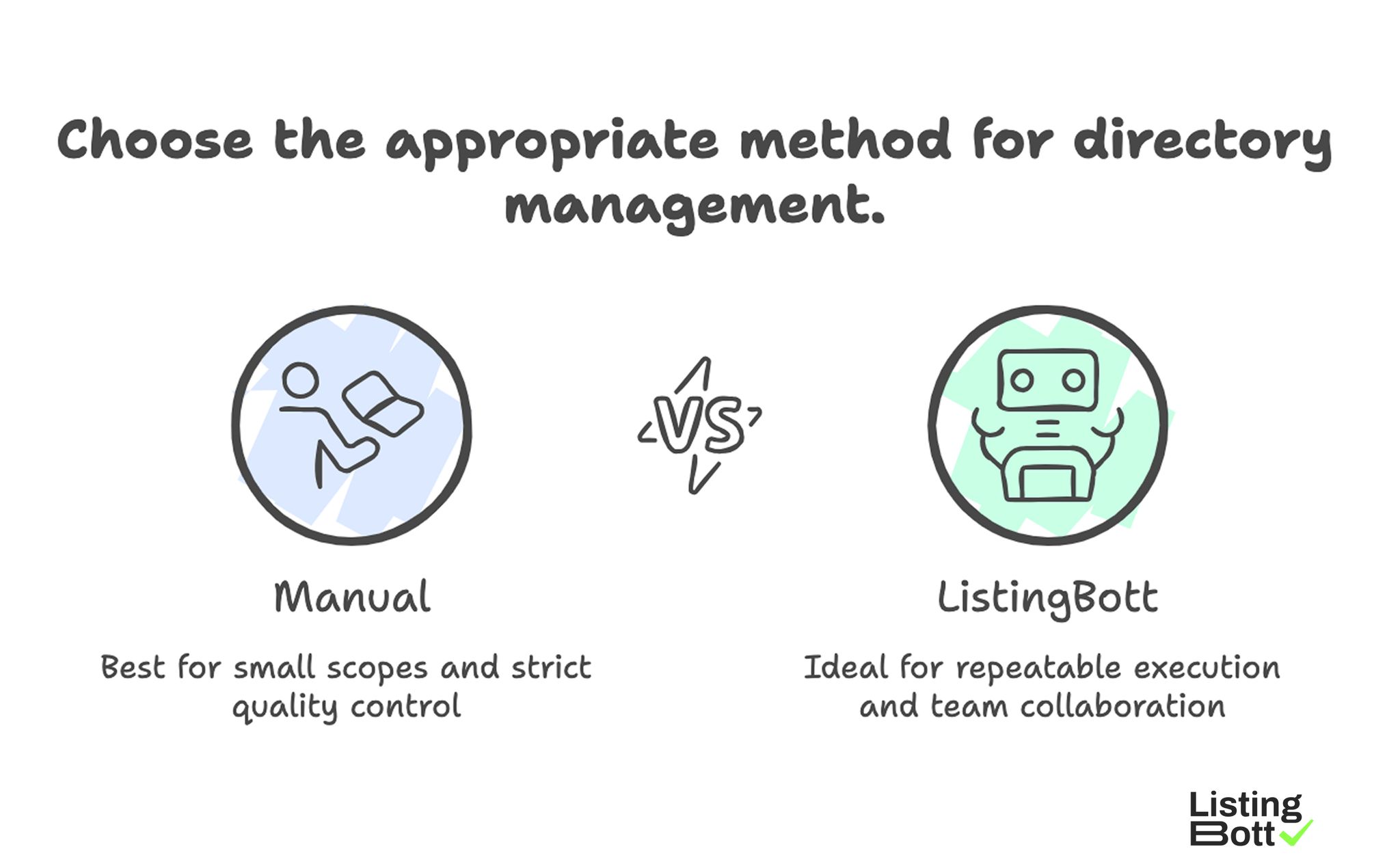
Use manual only when:
- scope is very small,
- you can maintain strict quality control internally,
- updates are infrequent.
Use ListingBott workflow when:
- you need repeatable execution across many directories,
- your team needs approval and reporting structure,
- you want less operational overhead from manual tracking.
In both cases, keep expectations grounded: authority metrics are influenced by many external factors, and outcomes are never controlled by one platform alone.
If DR growth to 15 is a project objective, apply the qualified condition explicitly: starting DR below 15, goal set to domain growth, and client-approved directory list.
FAQ: Ahrefs Domain Rating Explained
Is Ahrefs DR the same as Google authority?
No. DR is an Ahrefs metric and should be treated as a comparative third-party signal.
For a related perspective on backlinks, authority metrics, and SEO improvement, see our The Basics of SEO: How to Optimize Your Website for Search Engines.
What is a healthy way to track DR improvement?
Track monthly trend together with relevance quality, commercial keyword movement, and qualified traffic signals.
Should I prioritize high-DA sources even if relevance is low?
Usually no. High metric values without fit often create weak business outcomes.
How many directories should I submit to at once?
Use controlled waves. Expand only when quality and correction metrics stay stable.
Can DR increase by itself guarantee commercial SEO results?
No. It can support authority directionally, but outcomes depend on broader SEO and product-market factors.
If you want the directory-specific link-building angle, our best Directories for Backlinks 2026 guide is the best companion read.
For a broader SEO execution layer beyond DR theory, review our high Da Directory Submission Guide for SEO guide.
If you want the directory-specific link-building angle, our SaaS Backlinks guide is the best companion read.
For the metric side of this topic, see our increase Domain Rating for SaaS explainer.
For the metric side of this topic, see our domain Rating What It Is and How It Works explainer.