Table of Contents
- What Directories are and What They are Not
- How to Build a Working SEO Directory List
- 90-Day Rollout Plan for Directory Quality
- Common Mistakes and Practical Fixes
- FAQ
sbb-itb-8e44301
Quick Answer
Business directories for SEO still work in 2026 when they are selected and managed as a quality channel, not as a mass-submission checklist.
The winning approach for most teams is:
- pick directories by buyer intent and category fit,
- publish complete, consistent profiles,
- run post-launch quality checks,
- keep only platforms that show measurable value.
A large seo directory list can be useful for research, but publishing to every entry usually creates low-value coverage and maintenance debt.
Why this Topic Matters more Now
The role of directories has changed. They are no longer just a backlink tactic. In 2026, directories influence three practical layers:
- discovery: users find products and services directly on listing platforms,
- trust: consistent third-party profiles support credibility checks,
- entity clarity: stable references improve how search and AI systems interpret your business.
This is why execution quality matters more than volume. Ten strong listings usually outperform fifty weak or outdated ones.
What Directories are and What They are Not
Many teams mix up three concepts:
- Directories Structured platforms where a company has a profile page with category, description, links, and often reviews.
- Citations References to your business identity across the web, often with name, address, phone, or canonical brand details.
- Generic link placements Any page containing a link to your site, whether or not it is a structured directory profile.
If your team asks, what is citation in seo, the practical answer is: a citation is a consistent external reference that helps trust and entity clarity. Directories can generate citations, but not every citation is a directory listing.
The QUALITY-8 Model for Directory Selection
Use this framework before publishing to any platform.
| Criterion | Practical question | Why it matters | Score guide (1-5) |
| Intent fit | Do users on this platform match your buyer profile? | Prevents low-intent traffic | 1 = weak, 5 = strong |
| Category precision | Can you classify your business accurately? | Improves discovery quality | 1 = poor, 5 = strong |
| Profile depth | Can you publish meaningful details and proof? | Helps conversion readiness | 1 = shallow, 5 = strong |
| Editorial quality | Is there moderation or quality control? | Reduces low-trust placements | 1 = low, 5 = high |
| Update control | Can you maintain profile accuracy easily? | Prevents stale data | 1 = difficult, 5 = easy |
| Measurement access | Can you evaluate referral quality and assists? | Enables optimization | 1 = limited, 5 = clear |
| Operational fit | Can your team maintain this listing monthly? | Keeps program sustainable | 1 = weak, 5 = strong |
| Portfolio role | Does this platform fill a clear role in your stack? | Avoids duplication and noise | 1 = unclear, 5 = clear |
Practical thresholds
- 30-40: core directory set
- 24-29: test set
- below 24: de-prioritize unless strategic reason exists
This keeps the program focused and manageable.
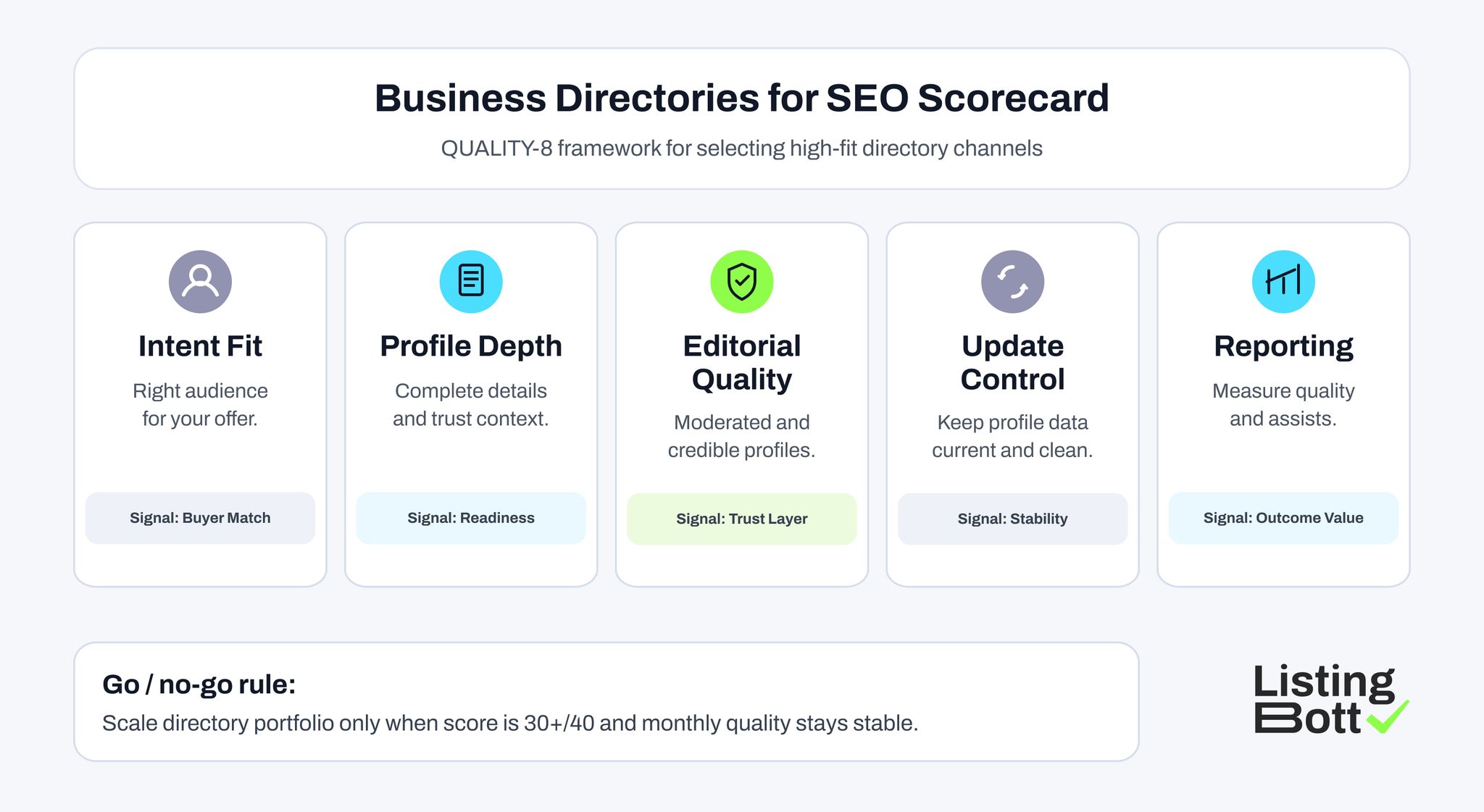
Business Directories for SEO Scorecard
Best-Ffit Listing Platforms for Business Directories for SEO
The examples below come from your local directory corpus and related references. Use them as a decision base, not a mandatory submit-all list.
| Platform | URL | Why it is a best fit | Ideal company profile | Submission note |
| Capterra | https://www.capterra.com/ | Strong software-category discovery behavior and comparison intent | SaaS and software vendors with clear category mapping | Keep taxonomy and feature framing accurate |
| G2 | https://www.g2.com/ | High trust and evaluation context for purchase-stage buyers | B2B software with review strategy | Profile depth and proof signals drive performance |
| GetApp | https://www.getapp.com/ | Useful shortlist channel for software buyers researching options | SaaS teams building mid-funnel presence | Refresh positioning after major releases |
| SaaSHub | https://www.saashub.com/ | Alternative and discovery behavior supports category-level visibility | Tools and SaaS with clear use-case differentiation | Keep comparisons and descriptions current |
| AlternativeTo | https://alternativeto.net/ | Strong replacement-intent channel for users evaluating alternatives | Products in established categories | Distinct positioning is required to convert visits |
| Startup Stash | https://startupstash.com/ | Broad startup resource discovery with practical category navigation | Early-stage and growth startups | Use precise tags to improve audience quality |
| OpenHunts | https://openhunts.com/ | Launch-oriented product discovery for active maker audiences | Product-led teams shipping updates frequently | Align listings with launch cycle timing |
| FindYourSaaS | https://www.findyoursaas.com | Category-led SaaS environment for intent-focused users | B2B SaaS with defined ICP and positioning | Category quality strongly impacts traffic relevance |
| Cybo | https://www.cybo.com/ | Broad business listing layer useful for citation and trust support | SMBs and hybrid businesses with local relevance | Treat as support channel, not primary growth driver |
How to use this platform block
A practical first-wave structure:
- 4 core platforms (highest score),
- 3 support platforms (trust/citation layer),
- 1-2 test platforms for controlled experiments.
This setup gives breadth without losing maintainability.
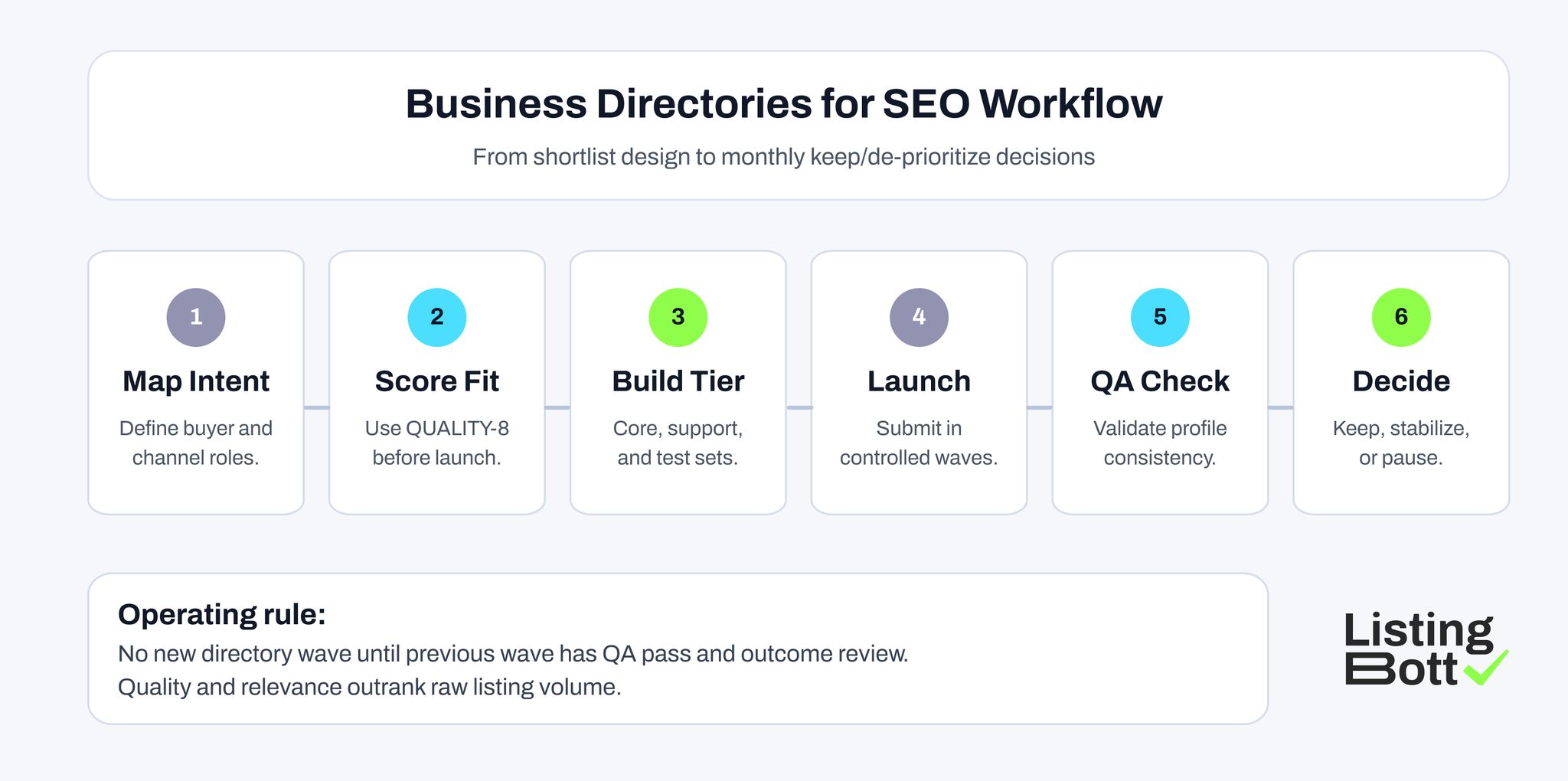
Business Directories for SEO Workflow
How to Build a Working SEO Directory List
Most teams build a list once and never upgrade it. A better process is recurring list governance.
Step 1: separate by intent class
Split platforms into:
- discovery platforms,
- comparison/review platforms,
- citation-support platforms.
Step 2: assign one role per platform
Each directory should have one clear role:
- new audience reach,
- shortlist influence,
- trust consistency.
Step 3: set keep/de-prioritize rules before launch
Define objective conditions upfront so decisions are not emotional later.
Step 4: limit first-wave scope
Cap first wave to 8-12 listings. Scale only after QA and outcome review.
Step 5: review monthly
Track quality and maintenance cost per platform.
This converts a static list into a practical operating system.
Portfolio Design by Business Type
SaaS and software
Priority:
- comparison and alternative directories,
- category-driven discovery channels.
Secondary:
- broad citation-support directories when needed.
Agencies and service businesses
Priority:
- directories where buyers actively compare providers,
- reputation/trust-heavy platforms.
If your stack includes seo tools for agencies or service-related workflows, directories should support decision-stage evaluation, not just exposure.
Local or hybrid businesses
Priority:
- relevant local directories and map ecosystems,
- consistency across local identity references.
Local seo tools can help monitor this layer, but tools do not replace profile quality and ownership.
White-label programs and partner channels
Teams using white label seo tools often run multi-client listing programs. The biggest risk is inconsistent profile governance across clients.
Use stricter intake, templated QA checks, and explicit owner assignments before scaling.
90-Day Rollout Plan for Directory Quality
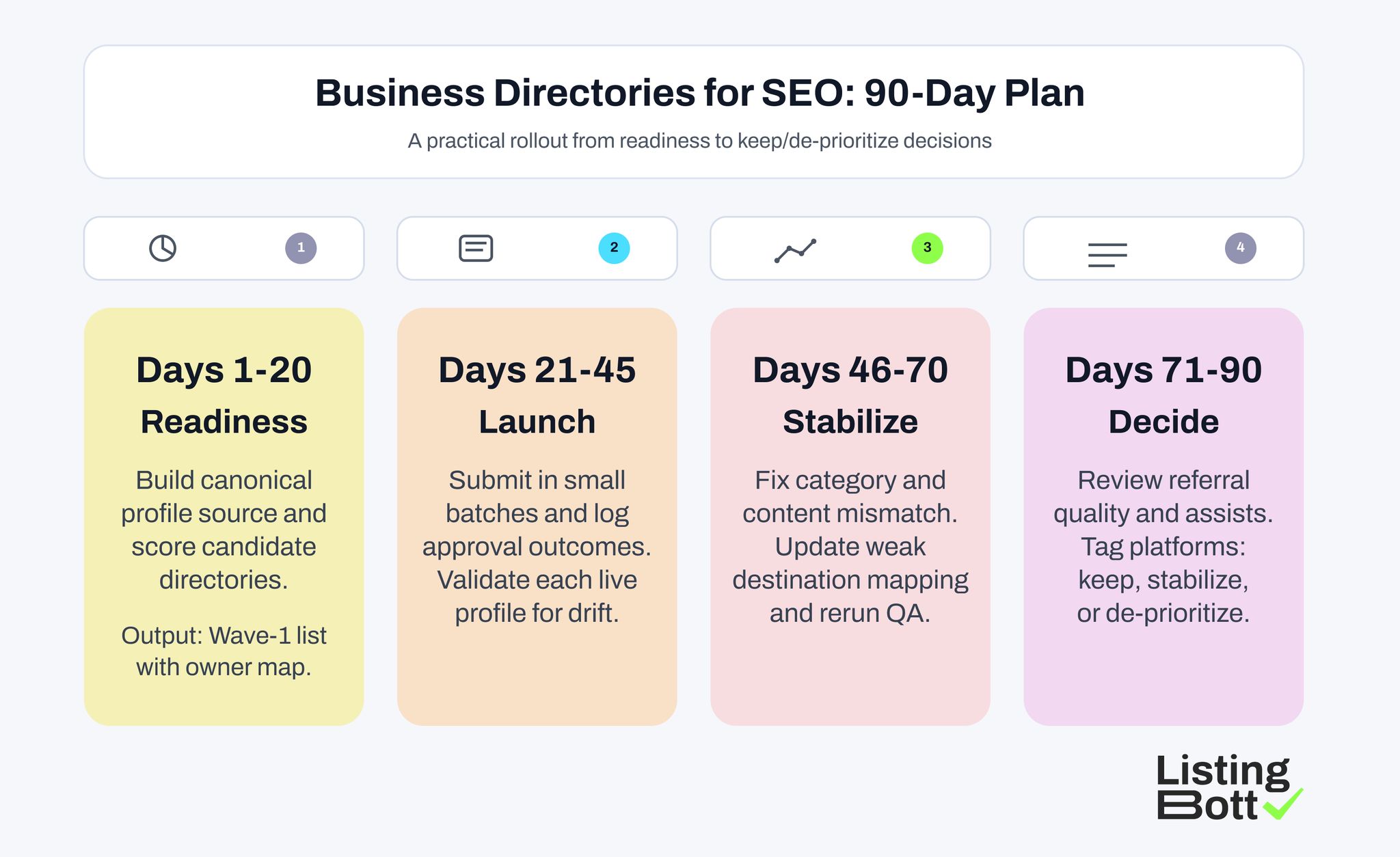
Business Directories for SEO: 90-Day Plan
Days 1-20: readiness and scoring
- Build canonical profile source:
- business name and short descriptor,
- category map,
- description variants,
- destination URL map,
- proof elements.
- Score candidate directories with QUALITY-8.
- Finalize first-wave platform set.
Days 21-45: controlled launch
- Submit in batches.
- Log approvals and rejections.
- Validate every live profile for consistency.
Days 46-70: correction and stabilization
- Fix category and content mismatches.
- Update weak destination mapping.
- Recheck listing integrity and consistency.
Days 71-90: performance decisions
- Review referral quality and assisted conversions.
- Tag platforms:
- keep,
- stabilize,
- de-prioritize.
- Expand only if core quality remains stable.
KPI Board that Actually Helps Decisions
| KPI | What it tells you | Healthy signal | Risk signal |
| Approval quality | Are submissions publish-ready? | stable acceptance rate | repeated correction loops |
| Consistency score | Is profile data aligned across platforms? | minimal critical mismatches | growing data drift |
| Referral quality | Are visitors relevant and engaged? | improving engagement depth | low-intent traffic spikes |
| Assisted conversion share | Do listings influence outcomes? | stable or rising assist impact | no measurable contribution |
| Maintenance effort | Is effort proportional to value? | manageable effort per platform | high effort with weak output |
These KPIs are stronger than raw listing count and prevent vanity reporting.
Directory Due-Diligence Checklist before Submission
Before adding any platform from an seo directory list, run a short due-diligence pass. This takes one extra hour and usually saves weeks of cleanup.
1) Verify audience reality
Do not rely on homepage claims. Check category pages, search behavior, and visible profile activity to confirm that users actually evaluate providers there.
2) Validate category structure
If your product or service cannot be mapped to a precise category, traffic quality will usually be poor. Avoid platforms where you are forced into broad, generic buckets.
3) Check profile depth limits
Confirm what fields are available:
- core description,
- feature or service details,
- media/proof blocks,
- destination URL options.
If the profile format is too shallow, the listing may support citation consistency but not conversion quality.
4) Test update process before full rollout
Create one pilot listing and test how edits are handled. If corrections take too long, scale will create compounding drift.
5) Estimate monthly maintenance cost
A platform can be high authority but still low value if upkeep is heavy and measurable outcomes stay flat. Assign expected owner time before approval.
6) Confirm measurement path
Make sure analytics can attribute meaningful behavior:
- referral engagement quality,
- assisted conversions,
- lead-source evidence in CRM.
Without a measurement path, the channel becomes a reporting blind spot.
7) Decide channel role in advance
Each platform should have one primary role: discovery, shortlist influence, or citation support. Role clarity keeps expansion disciplined.
8) Define removal criteria
Write exit conditions up front (for example: low-quality visits over two cycles or high maintenance with no assist value). This prevents portfolio bloat.
Quick Application Example
| Platform profile | Fit summary | Decision |
| Strong category alignment, moderate traffic, easy updates | Good intent and manageable operations | keep in core set |
| Broad exposure, weak category precision, slow corrections | Limited buyer quality and high upkeep | de-prioritize after test wave |
This checklist also helps teams that use seo tools for agencies and local seo tools, because tools provide signal collection, while due diligence determines whether the platform deserves ongoing effort.
Common Mistakes and Practical Fixes
Mistake 1: submit to every seo listing sites source you find
Fix:
- score and tier platforms first,
- cap launch scope.
Mistake 2: one generic description across all directories
Fix:
- keep canonical core,
- adapt category framing by platform context.
Mistake 3: no ownership after publication
Fix:
- assign specific owners for submission, QA, and analytics.
Mistake 4: no citation consistency control
Fix:
- include recurring citation checks in monthly QA.
Mistake 5: mixing unrelated channels without role clarity
Fix:
- assign each directory one explicit portfolio role.
Where ListingBott Fits
ListingBott is useful when teams want structured directory execution with less manual overhead.
Workflow:
- complete the client form,
- review and approve directory list,
- publication runs,
- report is delivered with status and next actions.
Offer alignment:
- one-time payment model,
- publication to 100+ directories,
- no hidden extra fees,
- refund possible if process has not started.
Promise limits:
- no guaranteed ranking position,
- no guaranteed traffic by a specific date,
- no guaranteed indexing speed,
- no guaranteed outcomes controlled by third-party platforms.
Qualified DR statement: DR growth to 15 is promised only when starting DR is below 15, the selected goal is domain growth, and the approved directory list is in place.
FAQ: Business Directories for SEO
What are business directories for seo in practical terms?
They are structured third-party profile platforms that can support discovery, trust, and entity consistency when managed with quality controls.
How many directories should we start with?
Most teams should start with 8-12 high-fit directories and expand only after one full QA and performance cycle.
What is citation in seo and how does it relate to directories?
A citation is a consistent external reference to your business identity. Directory profiles can create citations, but only if core data stays aligned.
Are seo listing sites always useful for traffic growth?
No. Some sites provide visibility but weak buyer quality. Keep platforms that show quality outcomes, not just impressions.
Should agencies run the same directory set for every client?
Usually no. Even with shared processes, platform mix should reflect each client’s ICP, category, and operational capacity.
How often should directory profiles be updated?
At least monthly for core platforms and immediately after major changes in positioning, pricing, or key business details.