Table of Contents
- What "Best" should Mean for Local Directory Services
- Build a Cleaner Local Directory Strategy (90-Day Path)
- Common Mistakes when Selecting Local Directory Services
- FAQ
sbb-itb-8e44301
Quick Answer
The best local directory service is not the one that promises the biggest submission count. It is the service model that keeps listing quality high, aligns with your market, and stays maintainable after launch.
In practice, a strong local directory service should do three things well:
- select relevant channels instead of submitting everywhere,
- keep listing data consistent over time,
- show measurable quality and contribution signals.
Many teams focus only on first-wave publication. Real results usually come from the maintenance system that follows publication.
Why this Decision Matters in 2026
Local visibility is no longer about being present on a single platform. Businesses now appear across maps, industry directories, and niche listing portals that influence both user trust and discovery behavior.
That is why keywords like local business directory listings, business directories for seo, and top business directories in usa remain commercially important. Teams want faster execution, but they also need quality control because low-quality submissions create profile drift, duplicate records, and correction overhead.
In 2026, the winning pattern is quality-first distribution:
- fewer channels in Wave 1,
- better profile depth in each listing,
- recurring QA and correction cycles,
- clear keep-or-de-prioritize decisions.
When you run local listings this way, directory work supports broader SEO and conversion goals instead of becoming a one-time checklist.
What "Best" should Mean for Local Directory Services
The best local directory service term is often interpreted too broadly. Clarify the exact "best" definition before selecting any service.
1) Best for market fit
Does the service prioritize channels where your target customers actually search?
2) Best for listing integrity
Can the service maintain accurate data, category alignment, and destination URLs across the selected portfolio?
3) Best for operational sustainability
Can your team maintain updates and corrections without creating monthly backlog stress?
4) Best for measurable outcomes
Can you track quality and contribution at channel level, not only total listing count?
A service that looks cheap or fast on day one can become expensive when inconsistency and correction debt appear later.
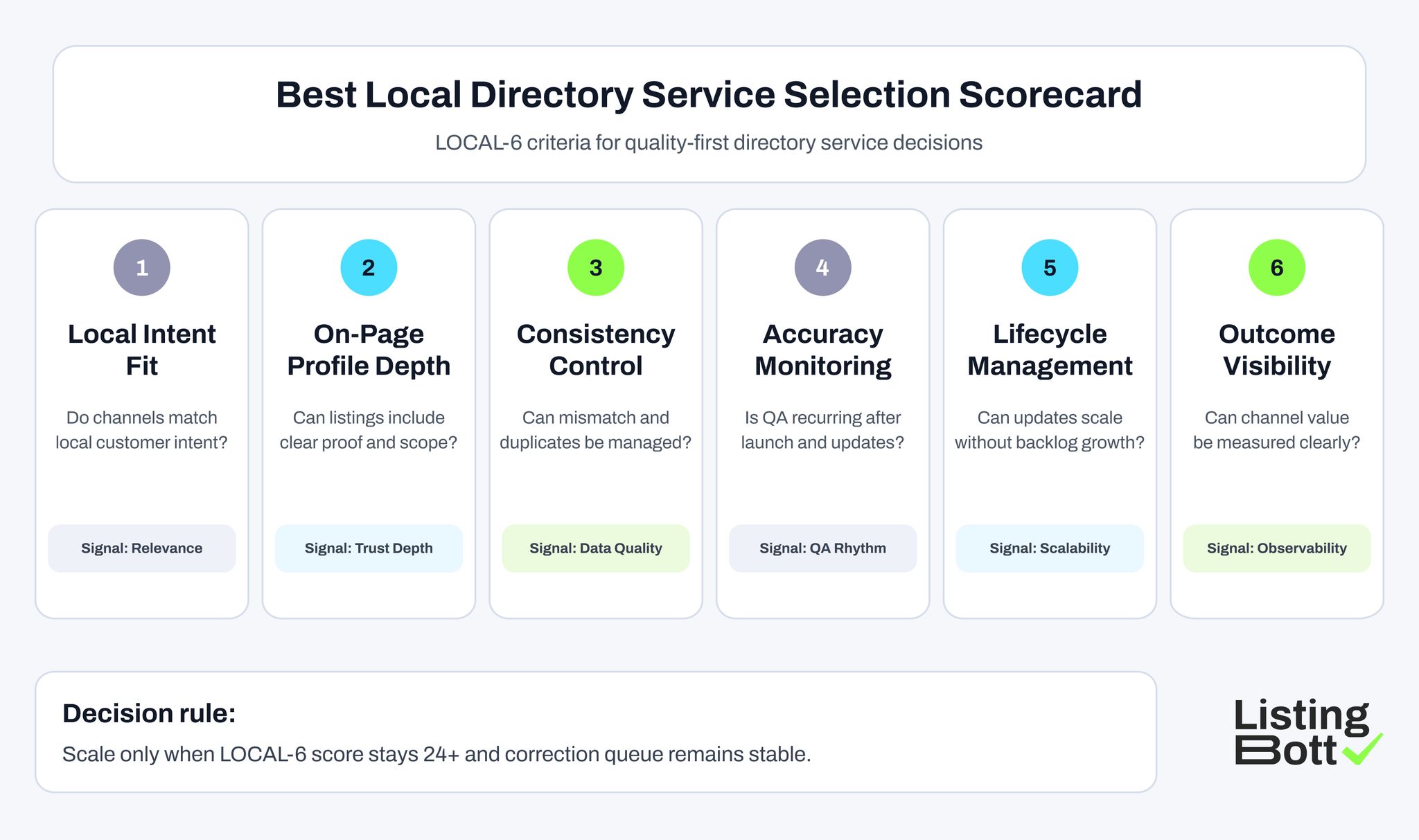
Best Local Directory Service Selection Scorecard
The LOCAL-6 Framework for Service Selection
Use this framework to evaluate any provider, process, or in-house setup.
| Dimension | Practical question | Why it matters | Scoring range |
| Local intent fit | Are channels relevant to your customer geography and category? | improves discovery quality | 1-5 |
| On-page profile depth | Can each listing include meaningful proof and context? | improves trust and conversion readiness | 1-5 |
| Consistency control | Is there a process for preventing and fixing data mismatch? | reduces drift and correction costs | 1-5 |
| Accuracy monitoring | Are QA passes scheduled and enforced after publish? | protects long-term quality | 1-5 |
| Lifecycle management | Is there an update cadence, not just a launch event? | keeps listings useful over time | 1-5 |
| Outcome visibility | Are channel-level quality and contribution metrics available? | enables keep/de-prioritize decisions | 1-5 |
Practical thresholding:
- 24-30: core service candidate,
- 18-23: pilot candidate with controls,
- below 18: de-prioritize unless there is a specific strategic reason.
This scoring model is simple enough for recurring monthly review and avoids over-indexing on vanity metrics.
Best-Fit Listing Platforms for Best Local Directory Service
This section uses platform examples found in your local research files and listing datasets. Use it as selection input, not a submit-everywhere list.
| Platform | URL | Why it is a best fit | Ideal company profile | Submission note |
| Apple Business Connect | https://businessconnect.apple.com/ | Important for map and local entity visibility in Apple ecosystem | local businesses and multi-location brands serving iOS-heavy audiences | keep NAP and category details precise before launch |
| Bing Maps | https://www.bing.com/maps/ | Supports local discovery outside Google and strengthens map-layer coverage | service businesses with US/UK traffic segments | align category and service-area fields to reduce mismatches |
| Better Business Bureau (BBB) | https://www.bbb.org/get-listed | Strong trust-oriented listing layer for credibility-sensitive categories | home services, legal, healthcare-adjacent, high-trust SMBs | approval and profile completeness quality matter more than speed |
| Chamber of Commerce | https://www.chamberofcommerce.com/ | Useful directory layer for local business discovery and baseline citation breadth | local SMBs and regional service providers | keep descriptions specific by service and location intent |
| Foursquare | https://foursquare.com/ | Practical geo-discovery and location signal support channel | retail, hospitality, on-site service operators | ensure address and opening-hours consistency from day one |
| Hotfrog | https://admin.hotfrog.com/add/index-card | Useful support channel for listing distribution breadth when quality is maintained | SMBs expanding baseline local presence | treat as support-tier channel, not primary outcome driver |
| Citysearch | http://www.citysearch.com/world | Legacy but still relevant in some local discovery paths | older local brands and service-area businesses | validate listing freshness; stale entries reduce value quickly |
| Kompass US | https://us.kompass.com/registerNewCompany/identity | Helpful B2B listing layer for category and company data presence | B2B local suppliers and service providers | maintain company category precision and profile completeness |
How to use this list:
- choose 3-5 core channels first,
- add 2-3 support channels only after QA stability,
- avoid expansion if correction queue is already growing.
Service-model Comparison: What you are Actually Buying
When people ask for a best local directory service, they are usually comparing different operating models, not just vendors.
| Model | Best for | Main risk | What to check before decision |
| Manual in-house submission | very small channel set, tight control teams | slow execution and inconsistency across contributors | owner availability, QA discipline, and update capacity |
| Freelancer-based submissions | short-term launch support | process inconsistency and weak lifecycle coverage | standardized checklist, correction ownership, reporting quality |
| Agency-managed listing service | teams wanting outsourced execution | variable quality by account manager/process maturity | scoring method, QA cadence, and channel-fit logic |
| Tool workflow + controlled process | teams needing repeatable scale with transparency | weak results if no governance on selection/QA | clear channel strategy, ownership matrix, and periodic review |
This is why a "best" choice depends on your operating context. The right model for a five-location business may be wrong for a multi-market organization.
Build a Cleaner Local Directory Strategy (90-Day Path)
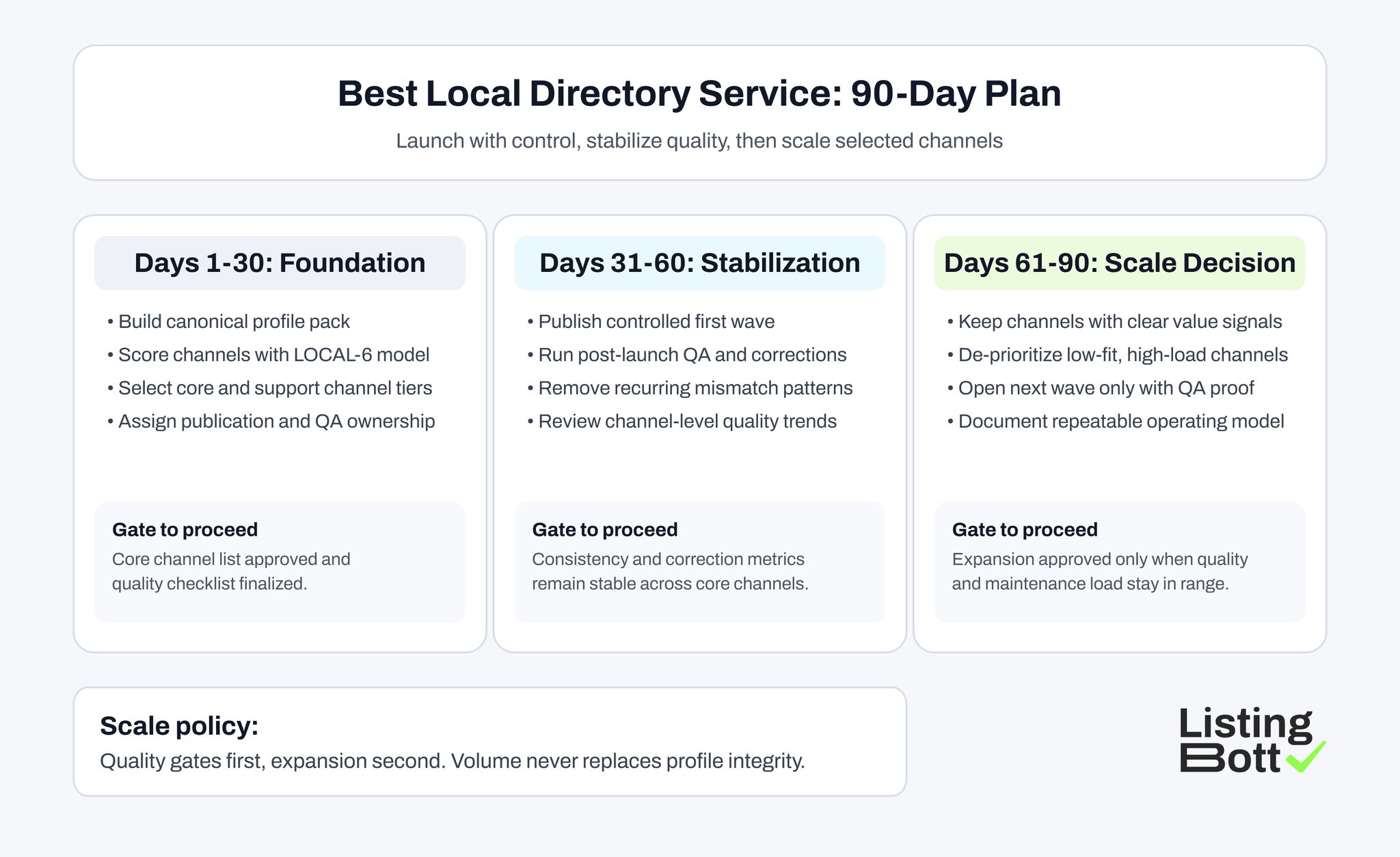
Days 1-15: baseline preparation
- define canonical business profile pack,
- align categories by service intent,
- map destination URLs by listing intent,
- score candidate channels with LOCAL-6.
Days 16-35: controlled first wave
- publish to core channel set only,
- run post-publish QA window,
- fix profile mismatch and category errors,
- lock ownership for each correction lane.
Days 36-60: stabilization
- refresh weak listings,
- close open correction backlog,
- compare channel quality trends,
- remove channels with recurring low-fit patterns.
Days 61-90: scale decision
- expand only if consistency remains high,
- keep support channels that show quality signals,
- de-prioritize channels with low contribution and high maintenance load,
- document wave decisions for repeatable execution.
This path is slower than bulk submission, but it reduces long-term waste and usually improves result clarity.
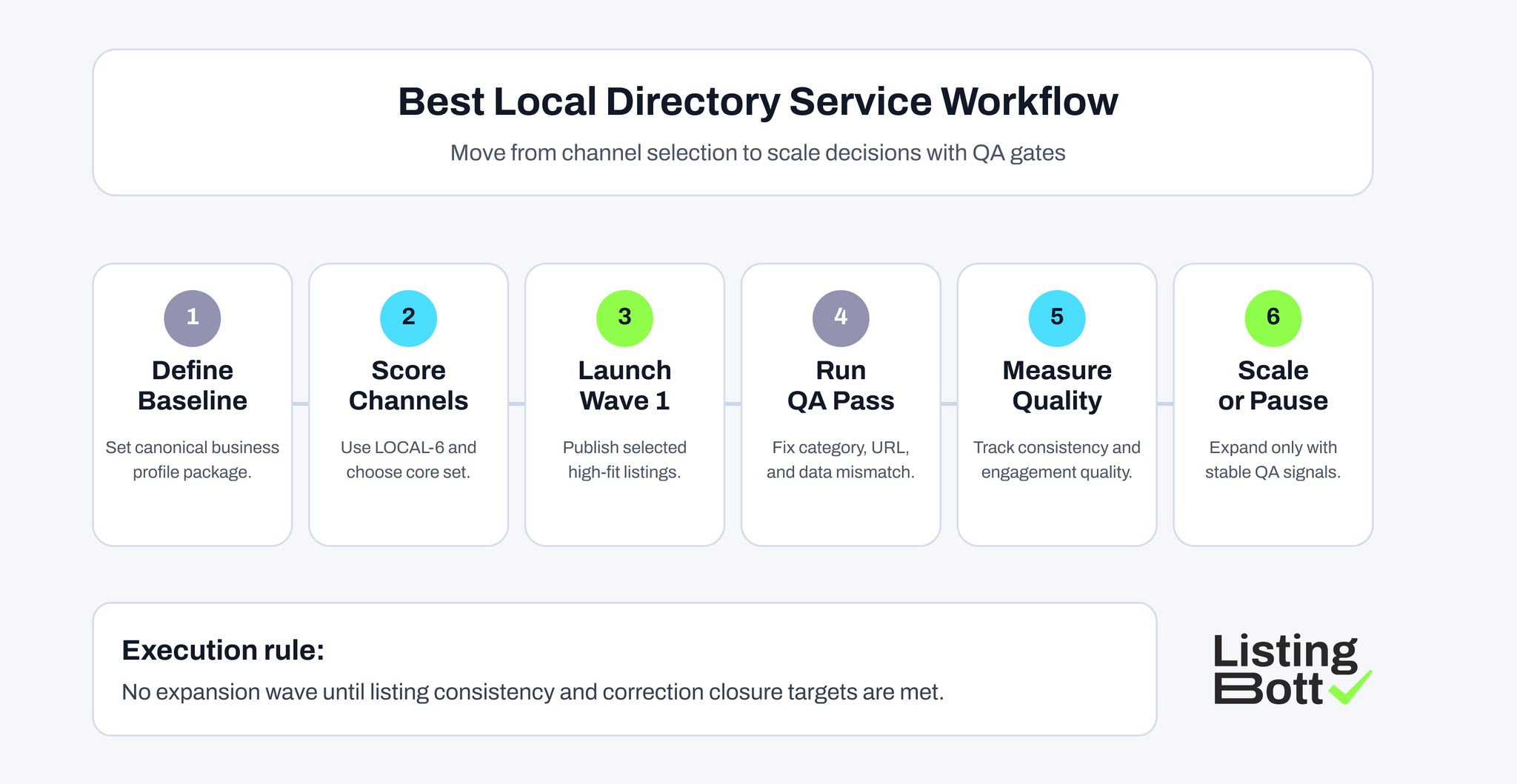
Best Local Directory Service Workflow
KPI Board for Local Directory Service Quality
A practical KPI board for local listings should be small and decision-oriented.
| KPI | Why it matters | Healthy signal | Risk signal |
| Listing consistency rate | measures profile accuracy across core channels | stable 95%+ on core channels | repeated mismatch trend |
| Correction closure time | shows operational discipline | predictable closure cycle | backlog age rising |
| Duplicate listing incidence | reveals data hygiene quality | low and declining duplicates | repeated duplicate creation |
| Referral engagement quality | indicates traffic relevance from directories | stronger engagement over time | low-intent sessions dominate |
| Maintenance load ratio | tests scalability of the operating model | stable effort for stable output | effort grows while quality stays flat |
Run this board weekly during launch month and biweekly after stability.
Common Mistakes when Selecting Local Directory Services
Mistake 1: buying by listing count alone
High-volume offers can hide low-fit channels and high correction burden. Always score channel fit first.
Mistake 2: skipping post-launch QA
Without QA, even strong channel choices can degrade into inconsistent profiles and weak user trust.
Mistake 3: no tiering between core and support channels
Treating all channels equally wastes time. Core channels need priority maintenance; support channels need stricter performance thresholds.
Mistake 4: weak destination mapping
If every listing points to one generic page, conversion quality suffers. Use intent-matched destination URLs.
Mistake 5: no lifecycle ownership
Launch-only operations create decay. Assign explicit owners for profile updates, corrections, and monthly review.
Mistake 6: mixing all outcomes into one vanity metric
Separate integrity, maintenance, and contribution metrics so you can diagnose what is working.
Best Local Directory Service
Free vs Paid Local Directory Service: Practical Choice Rules
Many teams evaluating free online business directories and free online directory listings ask the same question: should we stay free-only or pay for a managed service model?
A practical answer depends on execution maturity, not budget alone.
When free-first can work
Free-first is often suitable when:
- you have a small channel scope (for example 3-5 core platforms),
- one owner can maintain profile quality every month,
- you can run recurring QA without delays,
- your correction queue is consistently low.
In this setup, free channels can support a baseline visibility layer. But they still require process discipline. "Free" does not mean zero maintenance.
When paid or managed workflows become better
Paid or managed models become more efficient when:
- you need faster multi-channel rollout,
- multiple locations or product lines increase complexity,
- profile updates are frequent,
- internal ownership is fragmented across teams.
At this point, operational overhead usually becomes the bigger cost than listing fees. A managed workflow can reduce inconsistency and help keep recurring quality checks on schedule.
A simple decision checkpoint
Use this monthly checkpoint:
- if quality is stable and workload is manageable, keep the current model;
- if quality is unstable but workload is low, improve process controls first;
- if quality is unstable and workload is high, move to a more structured managed approach.
This checkpoint avoids overreacting to short-term fluctuations and helps teams choose based on execution reality instead of pricing assumptions.
Where ListingBott Fits
ListingBott fits the execution layer for structured directory submissions and consistency-focused workflows.
Typical flow:
- onboarding details are collected,
- channel list is reviewed and approved,
- publication runs are executed,
- reporting is shared with status visibility.
Offer alignment:
- one-time payment model,
- publication to 100+ directories,
- no hidden extra fees,
- refund possible if process has not started.
Promise limits:
- no guaranteed ranking position,
- no guaranteed traffic by a specific date,
- no guaranteed indexing speed,
- no guaranteed outcomes controlled by third-party platforms.
Qualified DR statement: DR growth to 15 can be promised only for qualified DR-goal projects where starting DR is below 15, the selected goal is domain growth, and the approved listing set is in place.
FAQ: Best Local Directory Service
What is the best local directory service for most SMB teams?
Usually the best option is a quality-controlled model that prioritizes relevant channels, listing consistency, and recurring maintenance over bulk submission counts.
Are free online business directories enough on their own?
Free online business directories can support baseline presence, but quality, relevance, and maintenance still decide whether they contribute meaningfully.
How many local business directory listings should we launch first?
Most teams should start with 3-5 core channels and a small support layer, then expand only after quality and correction metrics are stable.
Should we use one large seo directory list and submit everywhere?
No. Use seo directory list resources as input, then score channels for fit and maintainability before launch.
Do top business directories in usa guarantee ranking growth?
No directory guarantees rankings. Listings support discoverability and trust signals, but outcomes depend on broader SEO and execution quality.