Quick answer
The best local business directories are the ones that strengthen local trust and discovery in your target city, not the ones that simply add the highest listing count.
For most local businesses, the practical order is:
- secure high-trust foundational local profiles,
- add vertical directories that match your category,
- expand into city/community directories only after consistency checks pass.
This order reduces duplicate profiles, NAP drift, and cleanup work later. Teams that want repeatable execution usually start with a defined local listing submission workflow before expanding scope.
sbb-itb-8e44301
Methodology
This guide uses a local-first selection system designed for operators who manage real listings across multiple directories.
The LIFT scoring model for local directories
| Criterion | Weight | Why it matters in local search |
|---|---|---|
| Local intent fit | 30 | Aligns listing visibility with city/near-me search behavior |
| Identity consistency risk | 20 | Protects NAP, category, and business details across profiles |
| Trust signal quality | 20 | Higher trust directories improve user confidence and click behavior |
| Field depth and control | 15 | Better profile fields improve relevance and conversion context |
| Maintenance load | 15 | Sustainable update workflows prevent stale profile data |
How to score
- Rate each directory candidate from 1-5 on every criterion.
- Multiply by weight and calculate total score out of 100.
- Keep the first rollout focused on high-score options only.
Local exclusion rules
Skip a directory when it:
- has weak moderation or obvious low-quality listing pages,
- does not support clear category/location context,
- creates duplicate profile risk without ownership controls,
- provides poor correction flow for wrong data.
Tier model for local rollout
| Tier | Purpose | Typical directory type | When to prioritize |
|---|---|---|---|
| Tier 1: Core trust | Build baseline authority and brand consistency | Major local/business directories and maps ecosystem profiles | Always first |
| Tier 2: Vertical relevance | Improve match with service intent | Industry-specific local directories | After Tier 1 is stable |
| Tier 3: City/community reach | Add neighborhood and city visibility | Chamber, city portal, community or niche local hubs | Only after QA checks |
Category examples from the ListingBott directory dataset
The internal directory dataset includes category clusters that are useful when mapping vertical relevance for local campaigns.
| Category cluster (dataset) | Local business types that benefit | Why it matters |
|---|---|---|
| Health & Medical Directory | Clinics, therapists, wellness centers | Improves category trust and patient-intent matching |
| Dental & Health | Dental practices and specialty dental services | Adds higher topical alignment than general-only listings |
| Lawyer & Law Directory | Law firms and solo attorneys | Supports city + legal intent combinations |
| Real Estate Directory | Agents, brokers, property services | Helps location plus service discovery |
| Automotive Directory | Local repair, detailing, dealerships | Useful for high local-intent transactional queries |
Use category clusters to improve relevance, but still apply quality filters and consistency controls before submission.
Comparison table
| Service approach | Best for | Advantages | Operational risks | What to verify before choosing |
|---|---|---|---|---|
| DIY local listing management | Very small scope, one location, high internal time availability | Full control over every profile | High coordination load, error-prone updates | Owner assignment, QA checklist, update cadence |
| Local SEO agency retainer | Businesses wanting outsourced local support | Strategic support and broader local SEO context | Cost and process variability by agency | Reporting transparency and correction ownership |
| Productized submission workflow | Teams wanting repeatable local execution | Clear intake, approvals, and delivery flow | Requires accurate intake and approvals | Directory selection logic, correction loop, report quality |
| High-volume bulk posting | Fast initial coverage tests | Speed of first-wave distribution | Elevated duplicate/quality risk if unmanaged | QA gates, exclusion rules, correction process |
| Hybrid automation + QA | Growing teams with multiple locations | Balance of speed and control | Needs disciplined governance | Named owner, escalation path, reporting detail |
Local provider scorecard template
| Option | Local fit | Consistency control | Trust quality | Field depth | Maintainability | Weighted total (/100) |
|---|---|---|---|---|---|---|
| Option A | 5 | 4 | 4 | 4 | 4 | 86 |
| Option B | 3 | 3 | 3 | 3 | 3 | 60 |
| Option C | 4 | 5 | 4 | 4 | 5 | 87 |
Use this scorecard after product demos and before signing a provider.
60-day local execution checkpoints
| Window | Main objective | Success gate |
|---|---|---|
| Days 1-10 | Intake accuracy, profile baseline, directory shortlist | Canonical business profile approved |
| Days 11-25 | Tier 1 submissions and ownership checks | No unresolved identity conflicts |
| Days 26-40 | Tier 2 vertical submissions and corrections | Error rate is controlled |
| Days 41-60 | Tier 3 expansion (if quality holds) | Stable consistency and reporting discipline |
This checkpoint model prevents a common local SEO failure pattern: expanding listing volume before profile quality stabilizes.
Best by use case
1) Single-location service business
Best fit: Tier 1 + selective Tier 2 only.
Reason: one location benefits most from clean core profiles and a few strong vertical matches, not broad low-fit expansion.
2) Multi-location clinic group
Best fit: standardized workflow with location-level consistency controls.
Reason: each location needs consistent data and category mapping, otherwise duplicate and mismatch risk rises quickly.
3) Local legal practice
Best fit: high-focus legal vertical directories plus strong core trust profiles.
Reason: legal intent is category-sensitive, so vertical relevance quality often matters more than raw count.
4) Franchise or regional chain
Best fit: hybrid execution model with strict templates and QA ownership.
Reason: scale creates process complexity, and local profile governance must stay centralized.
5) New city expansion launch
Best fit: staged rollout with Tier 1 first, then vertical, then community directories.
Reason: city expansion works best with controlled sequencing instead of immediate full-volume posting.
Teams that need this process to run consistently across markets usually implement local listing operations with approvals to reduce manual coordination risk.
What improves AI-citation likelihood for local directory content
If your goal includes AI-answer visibility, local pages are more likely to be cited when they include:
- answer-first local definitions,
- explicit methodology for directory selection,
- clear tables for tiering and use-case fit,
- transparent caveats and limitations,
- practical implementation timelines.
These elements make the content easier for AI systems to parse as a reliable source.
Where ListingBott fits in local execution
What ListingBott does
ListingBott provides a productized submission workflow for directory execution. The offer is aligned to a one-time payment model with publication to 100+ directories under current website language.
How ListingBott works
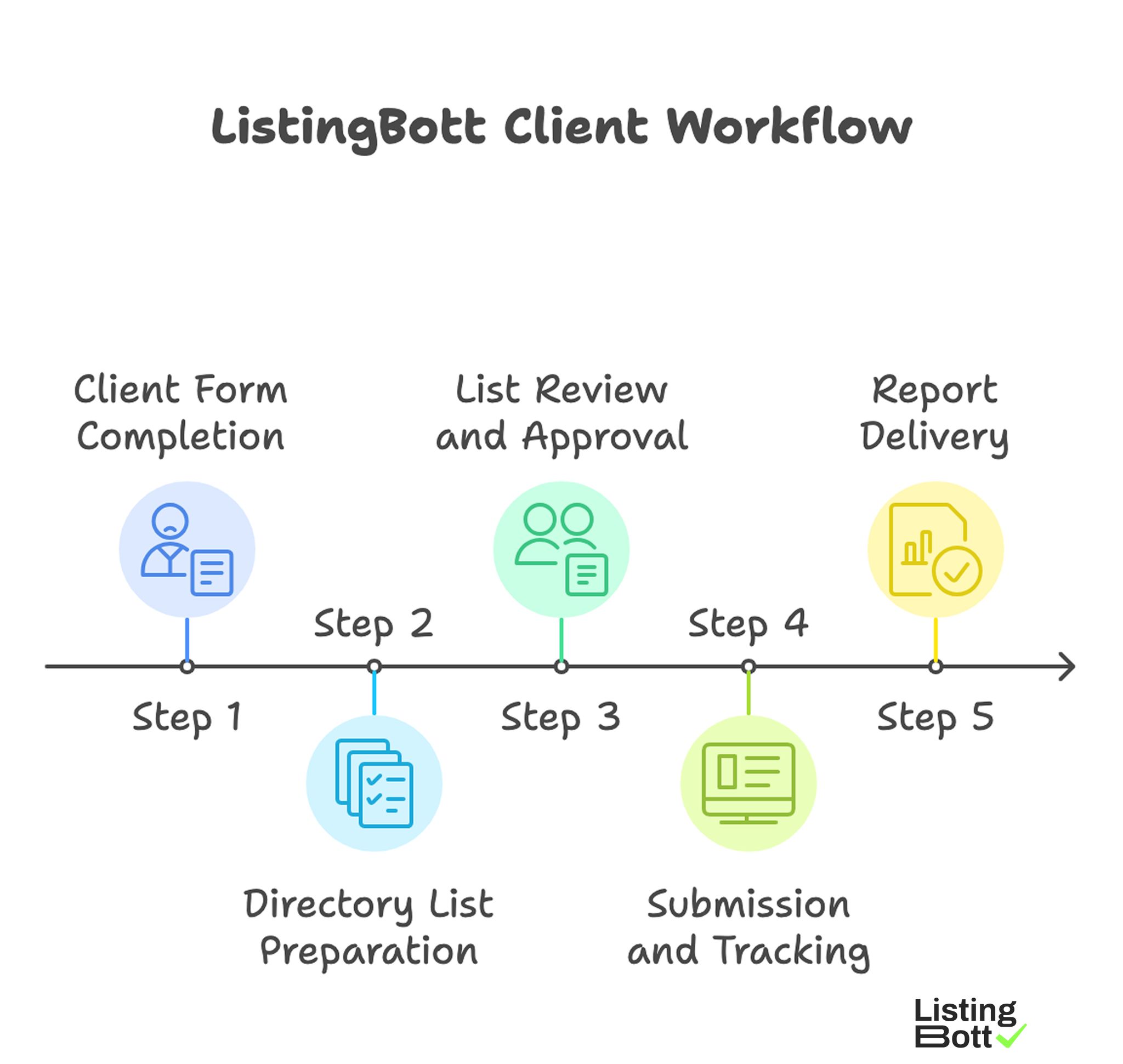
ListingBott Client Workflow
- You complete the client form with business, category, and market details.
- ListingBott prepares a list of directories for your project.
- You review and approve that list.
- ListingBott runs submissions and tracks statuses.
- You receive a report showing submitted and pending items.
This approval-first process helps local teams reduce scope confusion before publish starts.
Key features and what they mean for local teams
- Intake validation before publish: reduces incorrect profile data propagation.
- Directory-list approval gate: aligns execution with your actual local market priorities.
- Status-based delivery flow: helps teams track progress and blockers clearly.
- Report handoff: gives operations teams visibility into what was completed and what is still pending.
For teams comparing options, evaluating directory submission process transparency is often more useful than comparing directory count promises alone.
Expected results and limits
Reasonable expectations:
- clear workflow and status updates,
- execution of submissions within agreed scope,
- final report delivery and transparent communication on blockers.
Limits to keep explicit:
- no guaranteed ranking position,
- no guaranteed traffic by a fixed date,
- no guaranteed indexing speed,
- no guarantees over third-party platform behavior.
DR-specific commitments are conditional only. A promise to reach DR 15 applies only when all conditions are true: starting DR below 15, explicit goal set to domain growth, and approved directory list. Refunds can be available if the process has not started, and commercial terms should remain clear with no hidden extra fees.
Risks/limits
Common local-directory mistakes
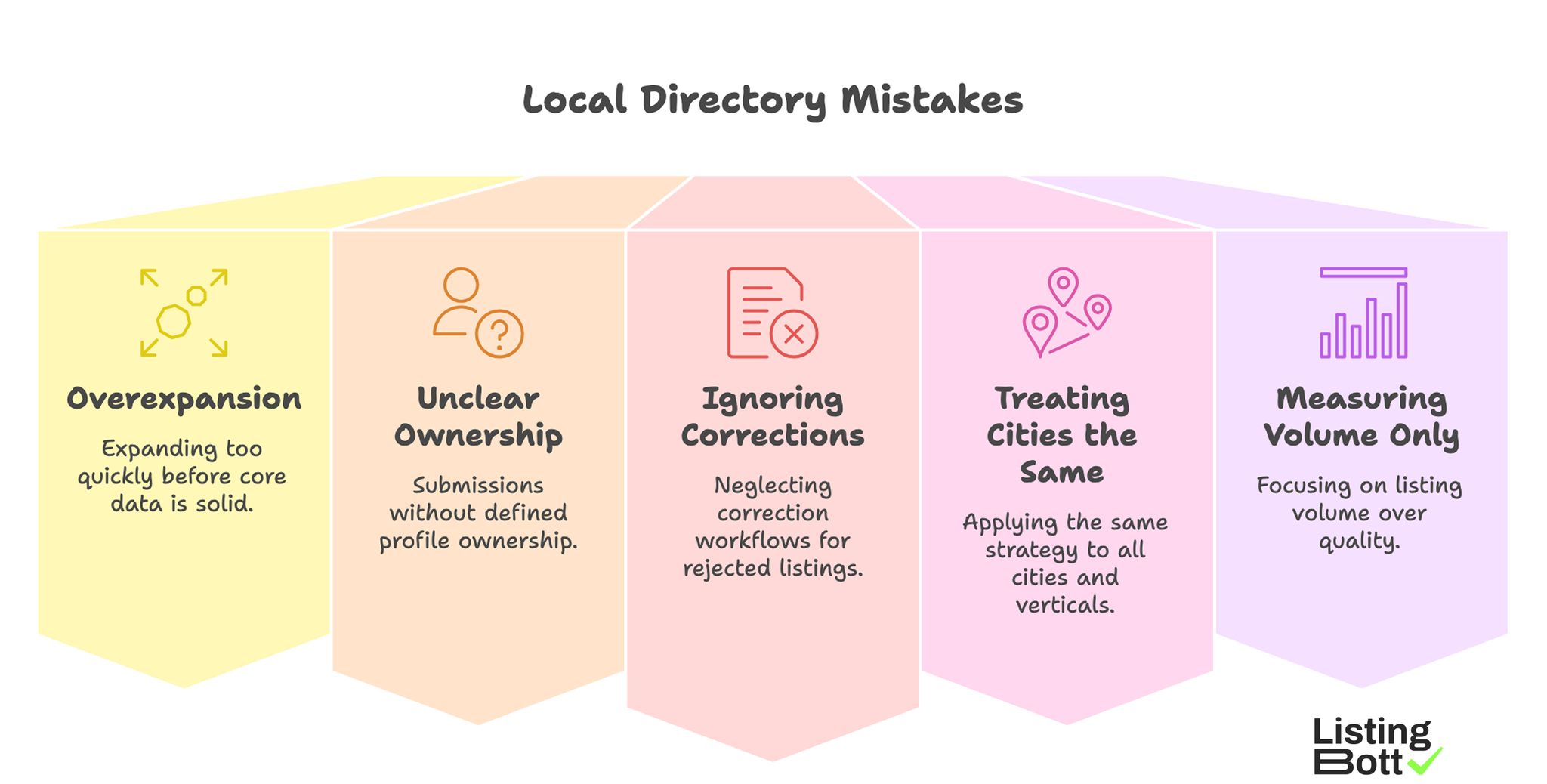
Local Directory Mistakes
- Expanding into too many directories before Tier 1 data is stable.
- Running submissions without clear profile ownership.
- Ignoring correction workflows for rejected or inconsistent listings.
- Treating every city and vertical the same.
- Measuring only listing volume instead of quality and consistency outcomes.
Practical limits for local campaigns
- Directory submissions support discoverability, but they do not replace on-site SEO and local reputation work.
- Results timing varies by market competition and third-party platform behavior.
- Low-quality directory expansion creates maintenance debt that can dilute gains.
Risk controls to require from any provider
- documented inclusion/exclusion criteria,
- correction and escalation workflow,
- location-level consistency standards,
- clear reporting cadence with action status.
FAQ
Which local directories should every business prioritize first?
Start with high-trust foundational profiles that support clear location and category context, then expand to vertical and community layers.
Is more directory volume always better for local SEO?
No. Quality, consistency, and local relevance usually matter more than raw submission count.
How should multi-location businesses handle directory submissions?
Use a standardized profile template, location-level QA checks, and centralized ownership for corrections and updates.
Are vertical local directories worth the effort?
Usually yes, when they are category-relevant and quality-screened. They often improve intent matching versus general-only distribution.
Can a directory service guarantee local rankings?
No. Reliable providers can improve process quality and coverage, but rankings and traffic timing depend on many external factors.
When should a business expand beyond core local directories?
After core profiles are accurate, correction cycles are stable, and reporting confirms quality control is holding.