Table of Contents
- Why Startup Directory Listing Services Matter in 2026
- 45-Day Implementation Plan for Startups
- Practical Templates to Reduce Execution Friction
- Common Mistakes in Startup Directory Programs
- FAQ
sbb-itb-8e44301
Quick answer
Startup directory listing services work best when you treat them as a controlled distribution channel, not a one-time growth hack.
Most startup teams lose value in two places:
- they submit to too many directories that do not match their buyer,
- they do not maintain listing quality after launch.
A practical 2026 approach is:
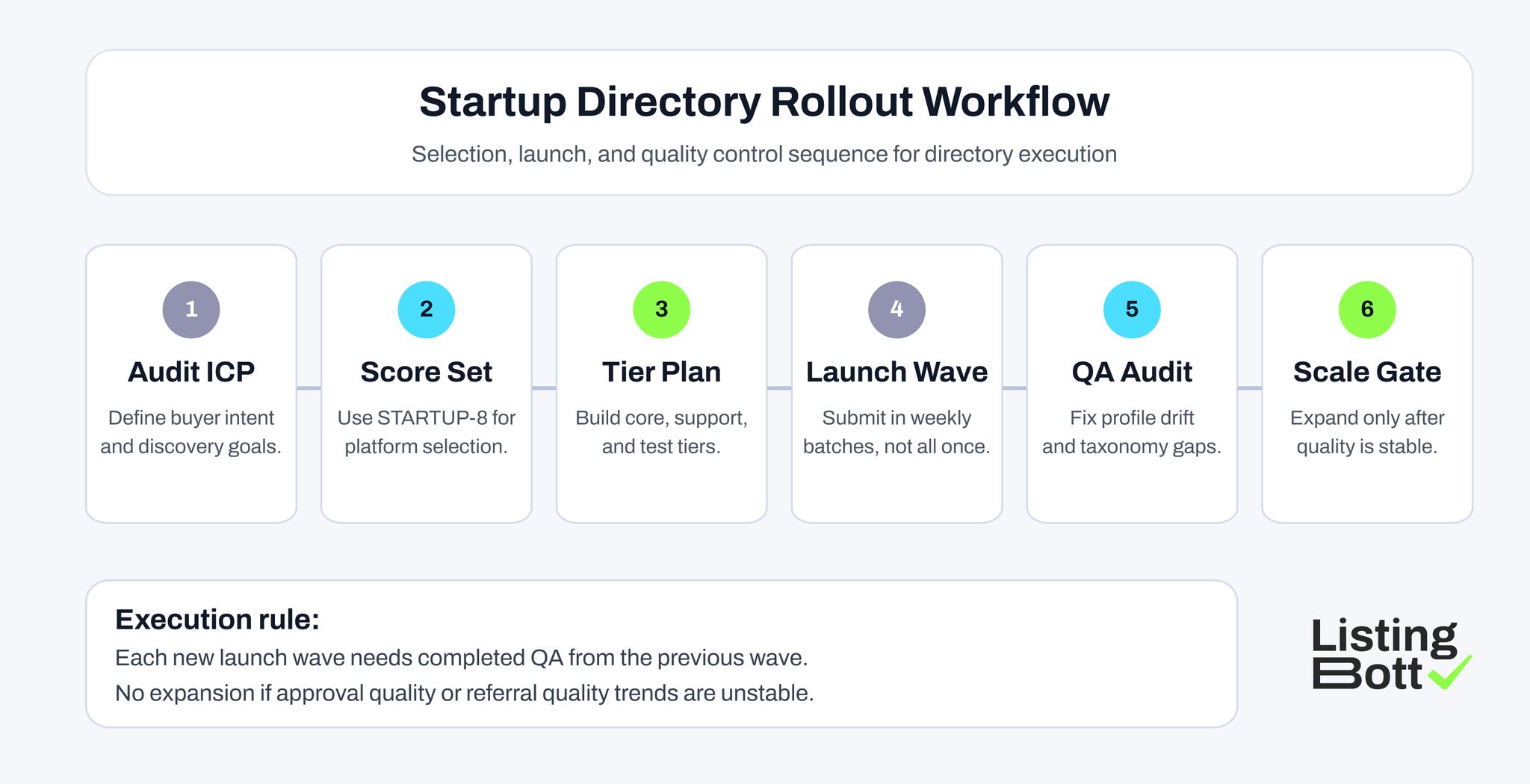
- score platforms before submission,
- launch in one measured wave,
- track approval quality and referral quality,
- scale only after the first wave is stable.
This is the same operating logic behind strong business directories for seo programs: relevance first, consistency second, scale third.
Why Startup Directory Listing Services Matter in 2026
In early-stage growth, distribution quality is usually a bigger bottleneck than content volume. Startups often publish product updates, landing pages, and launch posts, but still struggle with discoverability because they are not consistently present in the right external discovery layers.
Directory channels still matter because they do three jobs at once:
- they help users discover your product in category-driven searches,
- they reinforce entity trust when prospects validate your startup,
- they create referral and assisted-conversion touchpoints outside your owned channels.
The problem is execution noise. Many teams copy a very broad seo directory list, submit once, and move on. That usually creates profile drift, outdated positioning, and low-intent traffic.
A better model is to run directory submission like a product distribution system with clear quality gates.
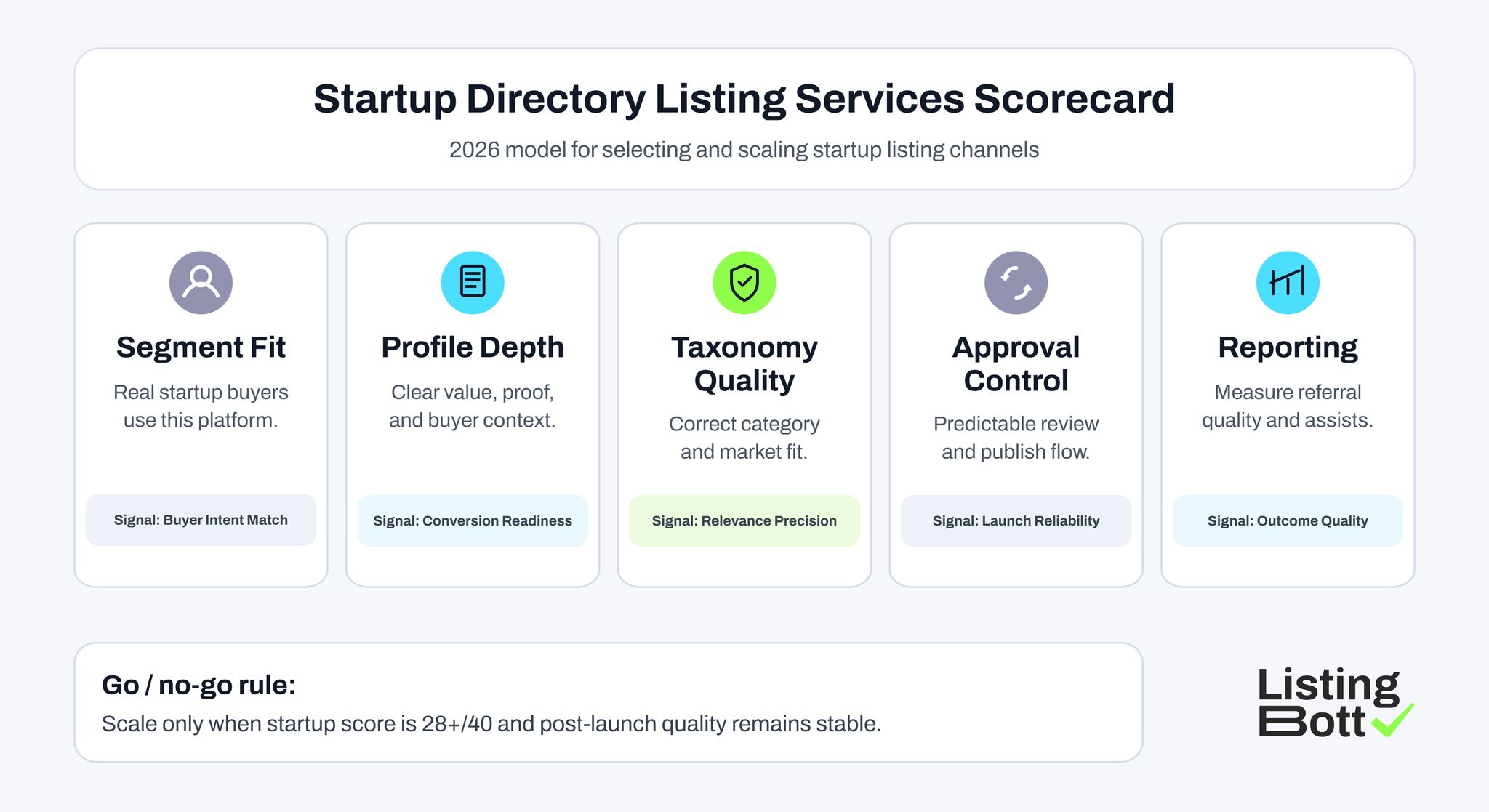
The STARTUP-8 Framework for Selecting Directory Services
Use this model before you spend on any service or internal submission sprint.
| Dimension | What to check | Why it matters | Score guide (1-5) |
| Segment fit | Does this platform attract your startup’s target buyer? | Prevents low-intent visibility | 1 = weak, 5 = strong |
| Taxonomy quality | Are categories/tags aligned with your product? | Controls discovery relevance | 1 = poor mapping, 5 = precise mapping |
| Approval predictability | Is there a clear moderation/approval flow? | Reduces timeline risk | 1 = unclear, 5 = transparent |
| Record depth | Can you publish a complete profile (problem, outcome, pricing context, proof)? | Improves conversion readiness | 1 = shallow, 5 = complete |
| Update control | Can your team update quickly without friction? | Keeps data accurate over time | 1 = slow, 5 = fast |
| Proof compatibility | Can you present social proof or product evidence? | Improves trust from cold visitors | 1 = none, 5 = strong |
| Outcome measurability | Can you track referral and assisted quality? | Enables keep/de-prioritize decisions | 1 = poor visibility, 5 = clear visibility |
| Team capacity fit | Can your team maintain this set monthly? | Prevents listing debt | 1 = unsustainable, 5 = manageable |
Practical Thresholds
- Launch now: 28+ / 40
- Test with constraints: 24-27 / 40
- De-prioritize: below 24 / 40
A startup does not need 100 listings on day one. A high-fit first wave of 8-12 can outperform much larger low-fit sets.
Startup Directory Listing Services Scorecard
Best-Fit Listing Platforms for Startup Directory Listing Services
These examples are selected from your local platform corpus and startup-reference files. The objective is not to submit everywhere, but to choose platforms that match your growth stage and buyer path.
| Platform | URL | Why it is a best fit | Ideal startup profile | Submission note |
| Startup Found | https://startupfound.com/ | Startup-focused discovery layer with product-first visibility | Early-stage SaaS and tool startups seeking initial distribution | Keep positioning concise; clarity beats long feature lists |
| Startuplist | https://startuplist.ing | Directory-style structure for startup discovery and categorization | Founders validating first repeatable acquisition channels | Category mapping quality strongly affects visibility |
| Startup Stash | https://startupstash.com/ | Well-known startup ecosystem directory context with broad discovery intent | Bootstrapped and funded startups building awareness | Choose precise category fit to avoid irrelevant traffic |
| Launching Next | https://www.launchingnext.com/ | Launch-oriented exposure that can support milestone-based visibility | Startups with regular shipping cadence | Time submissions around releases, not random dates |
| Startups.fyi | https://www.startups.fyi/ | Supports startup listing exposure with a discovery-first audience | New startups building early footprint | Keep profile data tightly consistent with website messaging |
| StartupXplore | https://startupxplore.com/ | Useful for startup visibility with investor and ecosystem context | Startups with fundraising or partnership intent | Ensure core company narrative is up to date before submit |
| TinyLaunch | https://www.tinylaunch.com/ | Product-launch style audience that can drive early adopter discovery | Indie and micro-SaaS startups | Use launch assets that clearly explain value and use case |
| ProjectHunt | https://projecthunt.me | Supports product discovery behavior around new launches | Product-led startups testing traction channels | Keep one canonical description across all launch platforms |
| BetaList | https://betalist.com/ | Useful for pre-launch or beta-stage product discovery | Startups seeking early testers and feedback loops | Best results come from clear beta value proposition and onboarding path |
How to Structure this Platform Set in Practice
A practical first allocation:
- Tier 1 (core): Startup Found, Startup Stash, StartupXplore.
- Tier 2 (launch support): Launching Next, TinyLaunch, ProjectHunt.
- Tier 3 (test/expand): Startuplist, Startups.fyi, BetaList.
This structure keeps scope realistic while preserving growth upside.
Startup Directory Rollout Workflow
Service-Model Decision: In-House, Hybrid, or Managed
Startup teams usually ask one question late: should we do this internally or use a service?
Use this decision view:
| Model | Best condition | Main risk | Best KPI lens |
| In-house only | Team has clear ownership and submission discipline | Execution delays during product sprints | approval speed + update lag |
| Hybrid (internal strategy + external execution) | Team can define priorities but needs operational leverage | Coordination gaps if workflow is unclear | quality score + referral quality |
| Managed service | Team needs fast, consistent rollout with low operational overhead | Blind scaling if platform fit is not reviewed | effort-to-outcome ratio |
For many startups, hybrid or managed execution wins because consistency is hard during rapid product cycles.
What Broad Directory Articles Usually Miss
Many listicles are useful for idea generation, but weak for execution decisions. Common gaps:
- They mix very different intents Free online business directories, review portals, investor databases, and generic listings are often combined into one giant list. That makes planning noisy.
- They skip capacity reality A 200-site list is not a strategy if your team can only maintain 15 high-quality profiles.
- They do not define keep/de-prioritize rules Without rules, teams keep low-value listings active because they were once submitted.
- They overfocus on volume metrics Raw listing count is not a performance metric. Approval quality, referral quality, and maintenance stability are better decision inputs.
- They ignore positioning consistency Startup teams iterate messaging quickly. If listings are not updated after positioning shifts, conversion quality drops.
Use broad lists as source input, not execution policy.
45-Day Implementation Plan for Startups
45-Day Build and Optimization Plan
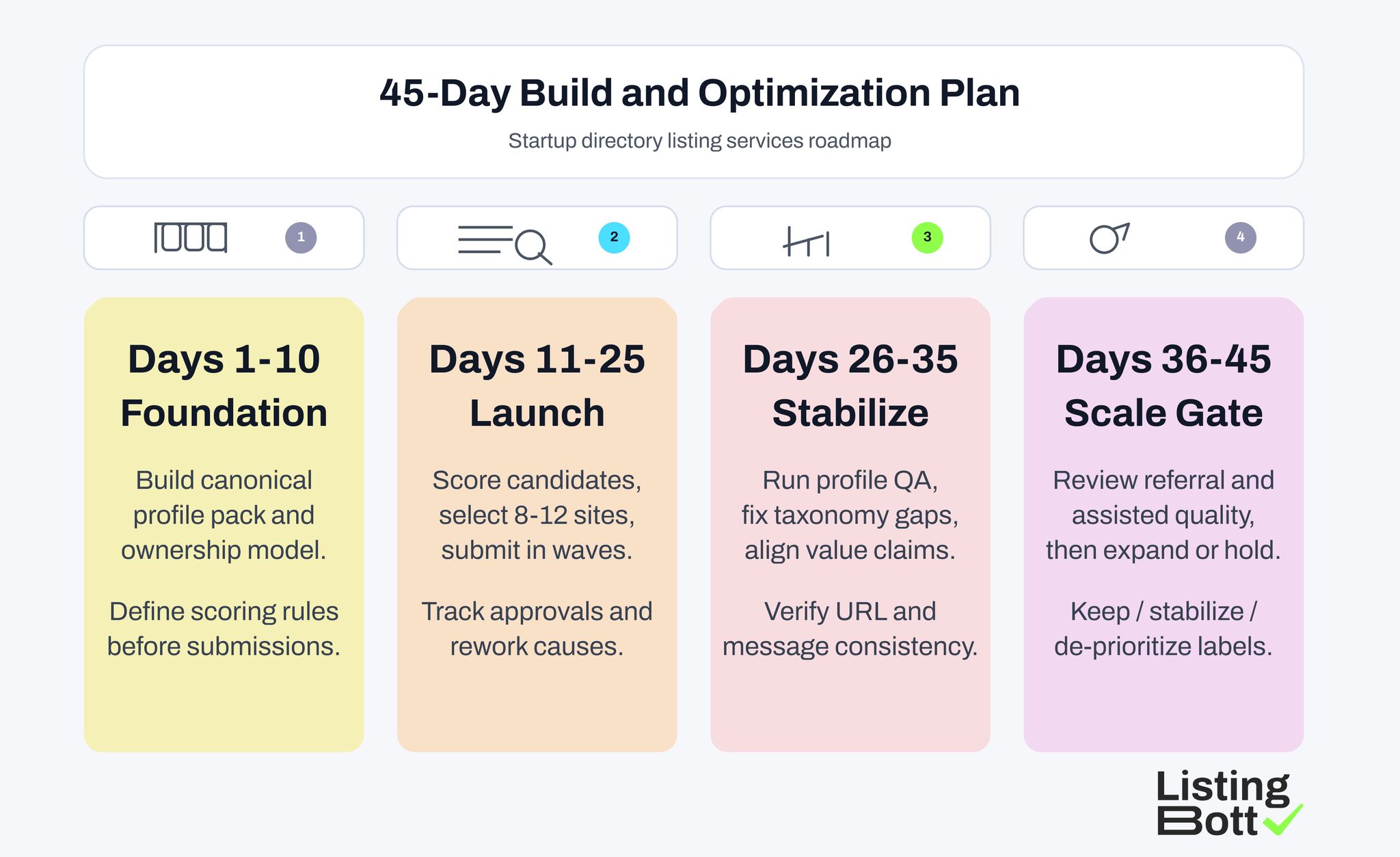
Phase 1 (Days 1-10): Foundation
- Define your canonical profile pack:
- startup name and short descriptor,
- category map,
- one core value proposition,
- proof elements (customers, case snippets, integrations, or milestones),
- destination URLs by use case.
- Set decision ownership:
- one owner for submission,
- one owner for approvals and corrections,
- one owner for KPI review.
- Build scoring sheet using STARTUP-8.
Phase 2 (Days 11-25): First wave launch
- Score candidate platforms.
- Select 8-12 directories.
- Submit in weekly batches, not all at once.
- Record approval times and correction loops.
Phase 3 (Days 26-35): QA and stabilization
- Audit every live profile for consistency.
- Fix taxonomy and profile-depth gaps.
- Validate destination URLs and CTA relevance.
Phase 4 (Days 36-45): Expansion decision
- Review referral quality and assisted outcomes.
- Apply keep/de-prioritize labels:
- keep,
- stabilize,
- de-prioritize.
- Expand only if core quality metrics remain stable across the first cycle.
KPI System for Startup Directory Execution
Treat directories as a measurable channel, not background SEO activity.
| KPI | What it tells you | Healthy signal | Risk signal |
| Approval velocity | Operational throughput | predictable approval cycles | large variance between platforms |
| First-pass acceptance rate | Submission quality | high acceptance with minimal rework | repeated corrections |
| Profile consistency rate | Data accuracy across listings | stable canonical matches | message and field drift |
| Referral quality | Visitor intent quality | engaged sessions and meaningful actions | low-engagement referral spikes |
| Assisted conversion share | Down-funnel support value | steady influence in conversion paths | no measurable contribution |
| Update turnaround time | Operational responsiveness | rapid updates after product changes | stale listings after major updates |
Keep/De-prioritize Policy
- Keep active: strong quality + manageable maintenance.
- Stabilize: mixed quality with clear improvement path.
- De-prioritize: high effort and weak buyer quality after one full cycle.
Practical Templates to Reduce Execution Friction
Template 1: Startup profile source document
Keep one source of truth with:
- one-line positioning,
- core category + backups,
- short and long description,
- proof snippets,
- website links by intent,
- update timestamp.
Rule: update source doc first, then propagate.
Template 2: Submission quality checklist
Before each submission, check:
- category fit,
- message clarity,
- destination URL relevance,
- profile completeness,
- evidence/proof fields filled.
Template 3: Monthly review board
For each directory, log:
- score change,
- referral quality,
- maintenance effort,
- final decision (keep/stabilize/de-prioritize).
This avoids emotional decisions and keeps directory operations objective.
Startup Use Cases by Growth Stage
Pre-seed / MVP stage
Primary goal:
- visibility + early feedback.
Priority actions:
- submit to a tight launch-focused set,
- optimize for profile clarity,
- track tester-quality traffic.
Seed stage
Primary goal:
- category discovery + trust reinforcement.
Priority actions:
- improve profile depth,
- align proof and positioning,
- expand only after first-wave stability.
Post-seed growth stage
Primary goal:
- scalable, consistent external footprint.
Priority actions:
- formalize update ownership,
- add KPI-based portfolio decisions,
- avoid channel bloat from low-value directories.
This is where many teams expand into local business directory listings only if local intent exists. If your startup is primarily global and product-led, keep local-only channels selective.
Common Mistakes in Startup Directory Programs
1) Treating directories as a one-time launch task
Fix:
- define monthly maintenance ownership and cadence.
2) Using one generic profile everywhere
Fix:
- keep canonical core, but adapt category and problem framing per platform context.
3) Choosing by list size, not buyer fit
Fix:
- score each platform and cap first-wave volume.
4) Ignoring U.S. intent split
If you target U.S. demand, not every global platform is equal for top business directories in usa discovery.
Fix:
- prioritize channels with relevant U.S. audience behavior,
- track assisted conversions, not just impressions.
5) No separation between free and strategic channels
Many founders overcommit to free online directory listings with no quality controls.
Fix:
- separate free channels into test tier,
- keep only those that deliver measurable quality outcomes.
Where ListingBott Fits
ListingBott is useful for startups that want structured execution without manual tracking across dozens of directory workflows.
How it works in practical terms:
- complete the client form,
- review and approve the directory list,
- publication starts,
- receive report with statuses and next steps.
Offer alignment to keep explicit:
- one-time payment model,
- publication to 100+ directories,
- no hidden extra fees,
- refund is possible if the process has not started.
Promise boundaries to keep explicit:
- no guaranteed ranking position,
- no guaranteed traffic by a specific date,
- no guaranteed indexing speed,
- no guaranteed outcomes controlled by third-party platforms.
Qualified DR statement: DR growth to 15 is only promised for qualified projects where starting DR is below 15, the selected goal is domain growth, and the client-approved directory list is in place.
FAQ: Startup Directory Listing Services
What are startup directory listing services in practice?
They are execution workflows that submit and maintain startup profiles across selected directories, with quality control and reporting.
How many directories should a startup launch first?
Most teams should start with 8-12 high-fit directories, then expand only after one full quality cycle.
Are free online business directories enough for startup growth?
They can help, but only as part of a scored and maintained portfolio. Free access alone does not guarantee useful outcomes.
How does a startup choose from a large seo directory list?
Use a scoring model that checks fit, taxonomy quality, profile depth, update control, and measurable outcomes before submitting.
Should startups prioritize local business directory listings?
Only when local demand is part of the growth model. Product-led global startups should prioritize startup and product-discovery platforms first.
What is the biggest failure pattern in directory execution?
Submission without maintenance. Listing quality drops quickly when product messaging and profile data are not updated.