Table of Contents
- Why this Matters in 2026
- Best-Fit Listing Platforms for Startup Business Listing Sites
- Step-by-Step Implementation Checklist
- Common Mistakes and Fixes
- 90-Day Rollout Plan
- FAQ
sbb-itb-8e44301
Quick Answer
Startup business listing sites still deliver value in 2026 when you treat them as a quality discovery channel, not as a mass-submission tactic.
A practical approach for founders and growth teams is:
- score directories by startup-fit intent,
- publish strong profiles with clear problem-solution framing,
- validate listing quality after launch,
- keep only channels that show measurable contribution.
Most weak outcomes come from one mistake: teams publish everywhere without portfolio logic, then accumulate outdated profiles, low-intent traffic, and correction debt.
Why this Matters in 2026
Startup buyers, investors, partners, and journalists often validate products through third-party listings before they trust an unfamiliar brand. Directory coverage now influences:
- discovery: whether your product appears in real comparison paths,
- trust: whether your profile looks credible and complete,
- entity consistency: whether search and AI systems read your business the same way across sources.
So the question is not whether listings matter. The real question is how to build a startup listing portfolio that stays clean, current, and worth maintaining.
What Startup Business Listing Sites should Do for You
A high-quality startup listing portfolio should support three goals:
- Qualified reach Place your product where early adopters and evaluators actually browse by use case.
- Positioning clarity Help users understand quickly:
- what problem you solve,
- who the product is for,
- why your approach is different.
- Conversion path support Send visitors to the right destination page (homepage, feature page, or use-case landing page) based on platform intent.
If a directory does not support these outcomes, it should not be in your core portfolio.
The LAUNCH-8 Framework for Startup Listing Decisions
Use this framework before adding any directory to your active set.
| Dimension | Decision question | Why it matters | Score (1-5) |
| Listing intent fit | Do users on this platform match startup-stage buyer intent? | Filters low-quality traffic | 1-5 |
| Audience relevance | Is the audience aligned with your ICP and category? | Improves conversion potential | 1-5 |
| Use-case taxonomy | Can you map product category/use case precisely? | Reduces mismatch visibility | 1-5 |
| Narrative depth | Can profile explain product value and proof clearly? | Supports trust and evaluation | 1-5 |
| Channel governance | Can your team update and maintain listing efficiently? | Prevents drift and stale profiles | 1-5 |
| Health/risk control | Are spam/duplicate risks manageable? | Protects portfolio quality | 1-5 |
| Outcome visibility | Can you track referral quality and assists? | Enables keep/de-prioritize decisions | 1-5 |
| Non-core support role | Does this platform add unique value vs existing channels? | Prevents redundant expansion | 1-5 |
Threshold guidance:
- 32-40: core startup listing channels
- 24-31: pilot/test channels
- below 24: keep out unless strategic reason exists
This creates discipline for teams evaluating startup listing opportunities against real outcomes.
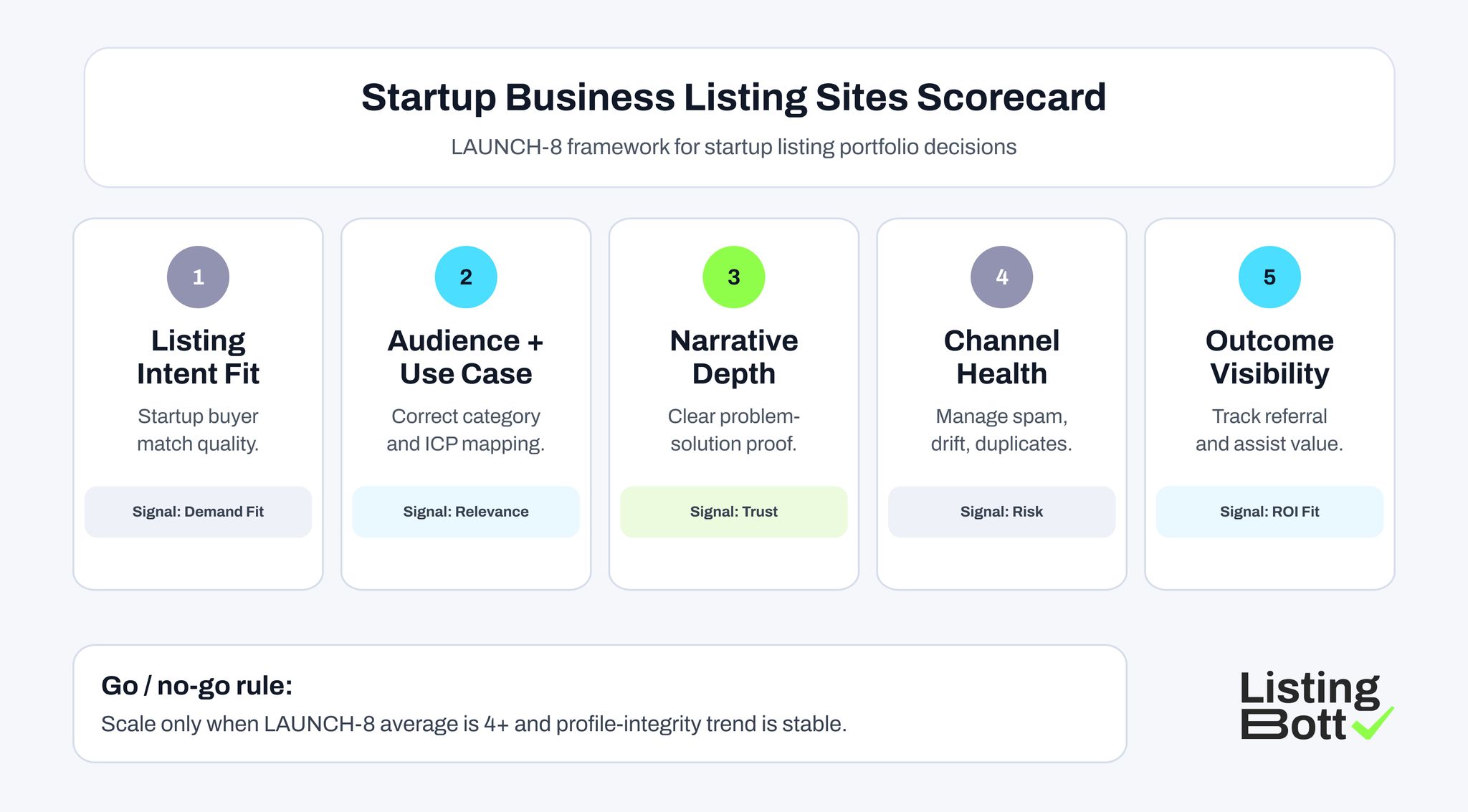
Startup Business Listing Sites Scorecard
Best-Fit Listing Platforms for Startup Business Listing Sites
Examples below are selected from your local startup listings dataset and related project references.
| Platform | URL | Why it is a fit | Ideal company profile | Submission note |
| OpenHunts | https://openhunts.com/ | Launch-oriented startup discovery context with active tool browsing behavior | Product-led startups shipping frequently | Keep launch story and feature positioning current |
| Go-Publicly | https://www.go-publicly.com/ | Startup launch visibility channel useful for early awareness | Early-stage startups with a clear first use case | Use concise value prop and sharp category mapping |
| Startup Stash | https://startupstash.com/ | High-volume startup-resource ecosystem with category browsing patterns | SaaS/startup tools targeting founders and operators | Category precision strongly influences relevance |
| TinyLaunch | https://www.tinylaunch.com/ | Practical platform for indie/startup product exposure | Bootstrapped and solo-founder products | Align profile with clear audience and pricing context |
| ProjectHunt | https://projecthunt.me/ | Discovery environment for new products and maker audiences | Startups seeking launch-stage product attention | Keep screenshots and proof blocks updated |
| Startuplist.ing | https://startuplist.ing | Startup listing channel supporting additional discovery coverage | New products building visibility footprint | Use as support tier unless quality proves core value |
| Startupfa.st | https://www.startupfa.st/ | Startup-focused listing layer for broad discovery support | Early-stage products testing channels | Validate referral quality before scaling effort |
| StartupDirs | https://startupdirs.com | Supplemental startup directory for portfolio diversification | Teams expanding controlled support channels | Maintain governance to avoid stale-profile buildup |
| StartupHub AI | https://www.startuphub.ai/ | Startup/AI crossover channel relevant to modern tool categories | AI-enabled startups with clear functional framing | Route users to intent-matched landing pages |
How to structure first-wave execution
A practical wave plan:
- Wave 1: 4 core directories (highest LAUNCH-8 scores)
- Wave 2: 2-3 support directories (citation/discovery support)
- Wave 3: 1-2 experimental channels with strict QA gates
This keeps the program scalable without turning into maintenance chaos.
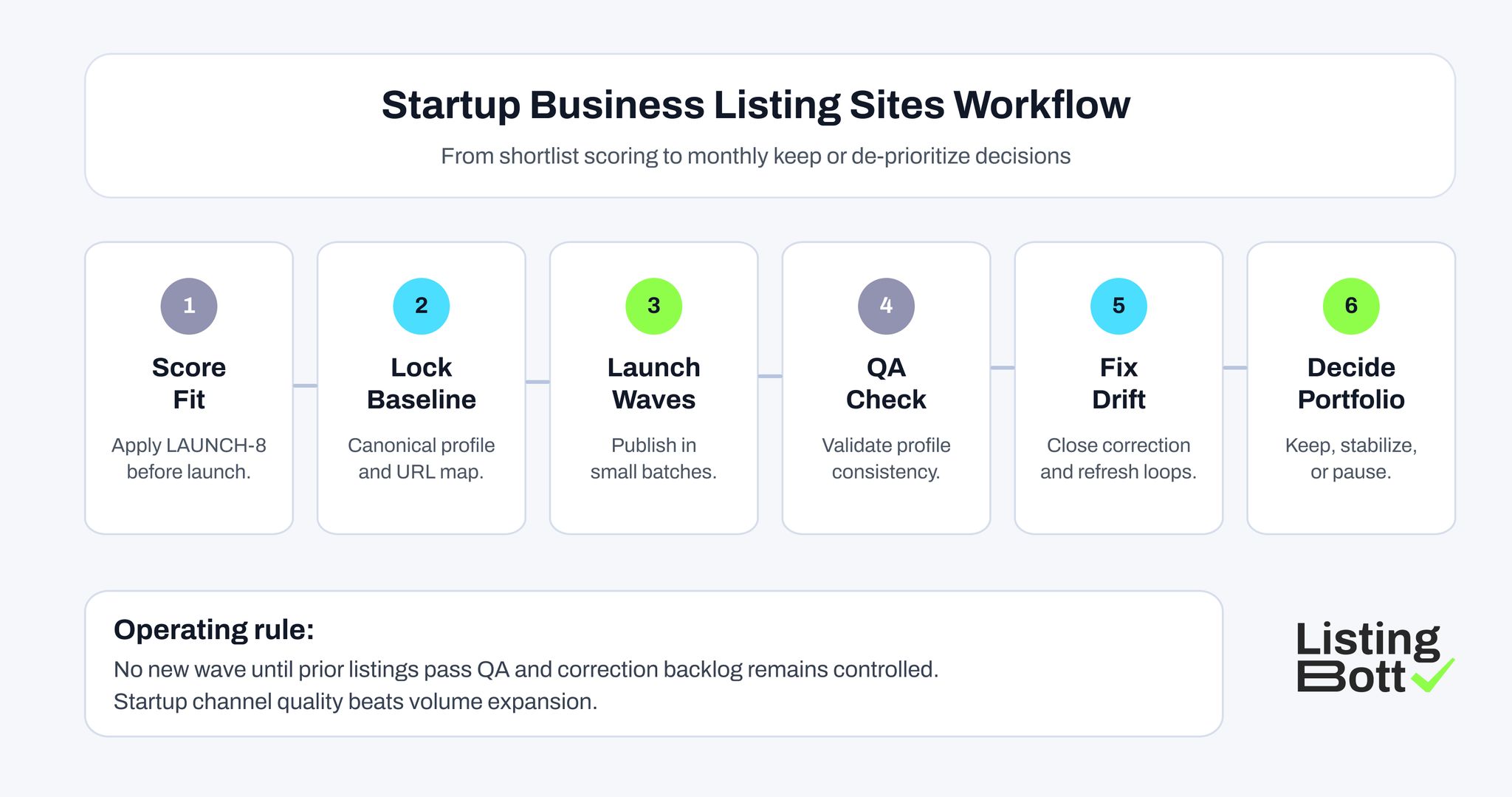
Startup Business Listing Sites Workflow
Where Local and Free Listing Layers Fit
Your additional keyword set includes local citation sites, local business listing sites, local listing sites, and free business listing sites usa. For startup teams, these can help, but only in specific scenarios.
Use local/citation layers when:
- you have geo-specific GTM motion,
- you run local partnerships or regional sales coverage,
- you need stronger business-identity consistency across external sources.
Do not use them as your primary startup growth engine
Local citation channels can support trust and entity consistency, but they rarely replace startup-native discovery channels.
Practical portfolio split for many startups
- 60-70% startup/product directories,
- 20-30% support/citation directories,
- 10% controlled experiments.
This balance usually performs better than all-in on generic free listing sites lists.
Step-by-Step Implementation Checklist
Step 1: build one canonical profile source
Include:
- product name and approved variants,
- one-sentence value proposition,
- short and long product descriptions,
- category/use-case map,
- destination URL mapping,
- proof assets (screenshots, customer context where applicable).
Step 2: pre-score candidate directories
Use LAUNCH-8 before submission. If a platform fails relevance or governance checks, do not add it yet.
Step 3: assign ownership and SLAs
Define roles:
- submission owner,
- profile-quality owner,
- QA owner,
- performance owner.
Set review cadence and correction SLA before launch.
Step 4: submit in controlled waves
Track:
- submit date,
- platform,
- profile URL,
- status,
- correction requirements,
- final publish confirmation.
Step 5: run post-launch QA within 72 hours
Check each live profile for:
- naming consistency,
- category accuracy,
- destination URL correctness,
- missing proof/context,
- duplication conflicts.
Step 6: run monthly maintenance loop
Each cycle should include:
- quality audit,
- correction closure,
- profile refresh after product changes,
- keep/stabilize/de-prioritize decisions.
This is how you protect long-term channel quality.
How to Use Article Submission Sites without Noise
Article submission sites can support visibility in some niches, but many are low-quality or weakly relevant for startup demand capture.
If you test them:
- keep them outside your core startup directory set,
- use strict quality filters,
- measure referral relevance, not just clicks,
- de-prioritize quickly if conversion assist is weak.
Treat them as optional experiments, not foundational channels.
Startup Listing Readiness Pack before Wave 1
Before launching any portfolio of startup business listing sites, prepare a compact readiness pack. This reduces rejection loops and improves listing quality in the first pass.
1) Core identity pack
Include:
- official product name and accepted variants,
- one canonical website URL policy,
- short company descriptor (1 line),
- longer profile version (80-120 words),
- clear category map by platform type.
2) Messaging pack
Prepare message versions for different contexts:
- founder/early-adopter discovery channels,
- buyer evaluation channels,
- support/local listing layers.
The core message should stay consistent, but language emphasis can change based on user intent.
3) Evidence pack
Have ready:
- product screenshots,
- proof snippets (for example: user outcomes, relevant use cases),
- feature bullets mapped to category tags.
This helps avoid thin or generic profiles on publication day.
4) Destination mapping pack
Define which page each directory should point to:
- homepage for broad startup discovery,
- feature/use-case page for intent-specific channels,
- local/contact page only for geo-driven listing contexts.
Better destination matching usually improves referral quality and conversion assist.
5) Governance pack
Document:
- owners for launch, QA, and reporting,
- correction SLA expectations,
- keep/stabilize/de-prioritize decision rules.
When this pack is created before submission, teams move faster and produce fewer corrections during stabilization.
KPI Board for Startup Listing Operations
| KPI | What to measure | Healthy signal | Risk signal |
| Profile integrity | % listings with no critical data mismatch | 95%+ on core set | rising inconsistency trend |
| Approval quality | acceptance rate and correction load | stable acceptance | repetitive rejection cycles |
| Referral quality | engagement depth from directory traffic | stable relevance | low-intent traffic spikes |
| Assist contribution | listing influence in conversion paths | visible assist trend | flat over multiple cycles |
| Maintenance efficiency | effort per active directory | predictable load | high effort, low value |
This KPI view prevents "more listings = better" thinking.
Common Mistakes and Fixes
Mistake 1: building from giant generic lists
Fix:
- score directories first,
- enforce wave limits,
- expand only after KPI validation.
Mistake 2: one generic profile across all platforms
Fix:
- keep canonical core data,
- adapt wording to platform category context.
Mistake 3: no governance after launch
Fix:
- assign clear owners,
- maintain correction and refresh cycles.
Mistake 4: over-indexing on free submissions
Fix:
- evaluate by quality and conversion assist,
- keep only channels with measurable value.
Mistake 5: mixing local and startup channels without role clarity
Fix:
- give each platform one explicit portfolio role,
- avoid duplicate channel purpose.
90-Day Rollout Plan
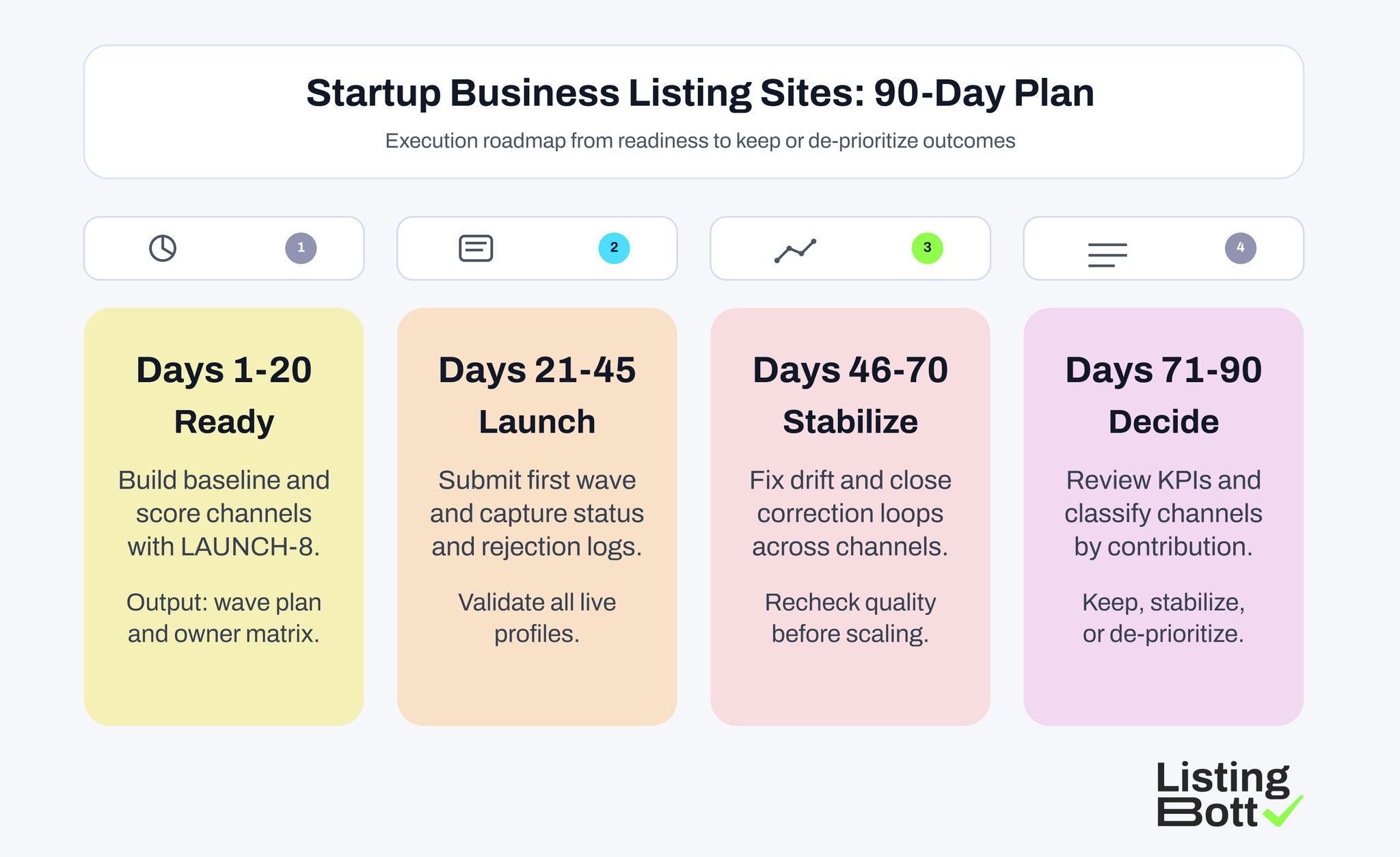
Startup Business Listing Sites: 90-Day Plan
Days 1-20: readiness and scoring
- finalize canonical profile source,
- score channels with LAUNCH-8,
- lock first-wave portfolio.
Days 21-45: controlled launch
- submit first-wave listings,
- capture status and correction logs,
- validate all live profiles.
Days 46-70: stabilization cycle
- close correction backlog,
- refresh weak profiles,
- recheck quality baselines.
Days 71-90: portfolio decisions
- review KPI board,
- classify channels (keep/stabilize/de-prioritize),
- open next wave only when quality is stable.
Startup Pacing: Avoid Channel Overload in Month One
Early startups often try to publish on too many listing channels at once. This creates coordination issues and lowers profile quality. A better pace is:
- launch a small high-fit first wave,
- close all correction items quickly,
- only then add support channels.
This pacing protects limited team capacity and helps maintain accurate positioning while product messaging is still evolving.
Where ListingBott Fits
ListingBott is a tool workflow for structured directory execution and reporting.
Typical process:
- complete onboarding form,
- review and approve listing selection,
- publication runs,
- receive report with status and next actions.
Offer alignment:
- one-time payment model,
- publication to 100+ directories,
- no hidden extra fees,
- refund possible if process has not started.
Promise limits:
- no guaranteed ranking position,
- no guaranteed traffic by a specific date,
- no guaranteed indexing speed,
- no guaranteed outcomes controlled by third-party platforms.
Qualified DR statement: DR growth to 15 is promised only when starting DR is below 15, the selected goal is domain growth, and the approved directory list is in place.
FAQ: Startup Business Listing Sites
What are startup business listing sites in practical terms?
They are third-party startup/product directories where your business profile can support discovery, trust, and conversion pathways when managed with quality controls.
How many startup directories should we launch first?
Most teams should begin with 6-8 high-fit directories in controlled waves, then expand only after QA and outcome review.
Are free business listing sites usa always worth using?
Not always. Some are useful support channels, but many add maintenance burden without meaningful conversion support.
How do local citation sites help startups?
They help with business-identity consistency and trust support, especially for geo-specific motions, but they should not replace startup-native discovery channels.
Should we use article submission sites as a core strategy?
Usually no. Treat them as optional experiments and keep only those that show clear quality and assist contribution.