Screen Charm is a macOS screen recorder made for founders, marketers, educators, and product teams that want polished videos without a complicated editing workflow. It combines screen, webcam, microphone, and system-audio capture with automatic zoom, smooth cursor movement, motion blur, backgrounds, and 4K export.
That gave Screen Charm a clear product story. The harder problem was distribution.
A young software product cannot depend on its homepage alone to explain what it is. Potential customers discover and compare tools on software marketplaces, alternatives pages, startup databases, curated product sites, and review platforms. Search engines and AI systems also use these independent pages to connect a brand with its category, features, location, and competitors.
ListingBott helped Screen Charm establish that third-party footprint during its early growth period. Public product profiles appeared across several relevant discovery environments, and founder Sergey Nazarov later credited the campaign with helping the site reach approximately Ahrefs DR 20 in its first three months.
The larger outcome needs an important qualification: Screen Charm's DR later reached 55, but ListingBott was only one contributor. Product development, the company's expanding website, organic content, mentions, and other links also played a role.
The result in brief
| Company | Screen Charm |
| Product | macOS screen recorder and video editor |
| Core audience | SaaS founders, marketers, educators, developers, and product teams |
| Starting Ahrefs DR | 4.4 in the campaign snapshot supplied to ListingBott |
| Early customer-reported result | Approximately DR 20 within three months |
| Latest supplied Ahrefs DR | 55 as of August 2026 |
| ListingBott's role | Early directory research, submission execution, progress updates, and third-party profile creation |
| Attribution boundary | The full increase to DR 55 was not caused by ListingBott alone |
Source note: the early outcome and service feedback in this story come from Sergey's public posts about ListingBott on X, SaaSHub, and AlternativeTo. The latest DR 55 reading was supplied by ListingBott's team. Ahrefs metrics can change as its index updates.
sbb-itb-8e44301
Screen Charm had a product people could understand, but a brand few sources described
Screen Charm solves a recognizable problem. Raw screen recordings often look flat: the cursor is difficult to follow, important interface details are too small, and a simple product demo can turn into a long editing project.
The app handles much of that polish automatically. It follows clicks with zoom effects, smooths cursor movement, supports webcam and audio capture, and lets users trim or refine the result in a built-in editor. Finished videos can be exported as 4K MP4 files or shared through a link. Screen Charm currently sells lifetime access for a one-time $79 payment and supports up to three Macs.
This positioning was strong enough for the homepage. It was not yet repeated across the wider web.
For an unfamiliar software brand, that gap matters. Someone searching for a Mac screen recorder may never begin with the words “Screen Charm.” They may browse Screen Studio alternatives, compare screen recorders, explore new maker tools, or ask an AI assistant which app can create a polished SaaS demo. To enter those journeys, the product needs accurate pages in the environments people already use for discovery.
The campaign created more entry points into the product
ListingBott used Screen Charm's product information to build profiles across different types of platforms. The purpose was not to repeat the same generic company record everywhere. It was to create several useful routes to the brand:
- software comparison pages for people evaluating alternatives;
- product-discovery sites for people browsing new tools;
- startup profiles that establish company context;
- maker and developer pages that reach likely users;
- business and review profiles that provide another independent brand reference.
This is the practical value of a managed directory submission service. The founder provides the product facts once, while the submission work, platform requirements, and tracking are handled as an operating process.
Sergey described the early effect directly in his public X post:
“They helped increase my product's DR from 0 to 20 by submitting it to relevant directories.”
His public wording rounds the initial DR down to zero, while ListingBott's campaign snapshot recorded 4.4. The measurements are not identical, but they describe the same stage: Screen Charm began with a very limited backlink footprint and gained strength quickly during its early distribution period.
Examples of live Screen Charm placements
The pages below are selected examples, not the complete campaign report. They show how different listings created different kinds of discovery.
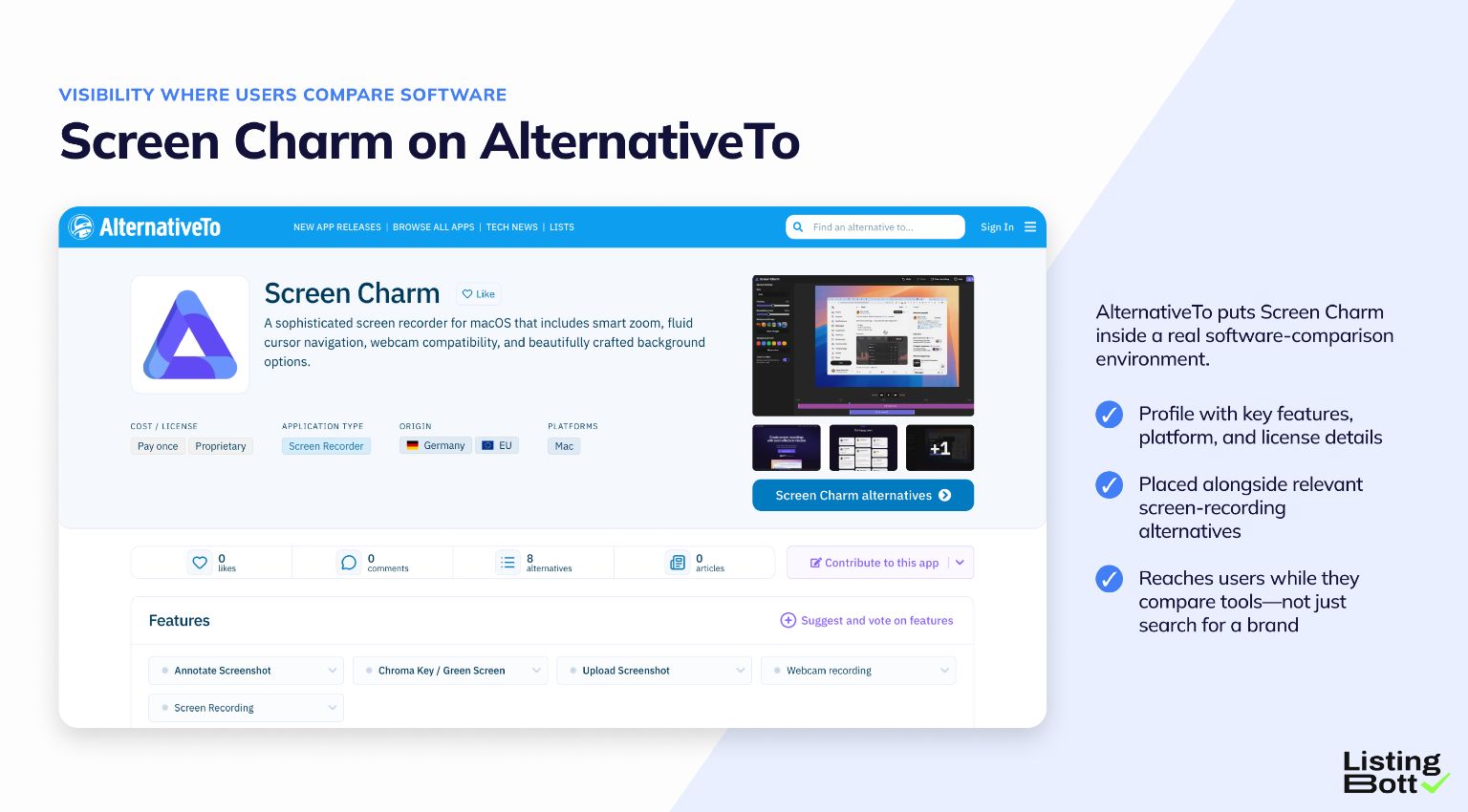
Screen Charm on AlternativeTo
AlternativeTo: placement inside a real software-comparison journey
The Screen Charm page on AlternativeTo identifies the product as a proprietary Mac screen recorder and lists features such as screen recording, webcam recording, screenshot annotation, and chroma key support.
More importantly, Screen Charm appears in an alternatives environment. The surrounding page connects it with other screen-recording products, giving users a route to discover the app while comparing tools rather than searching for the brand directly.
This is one of the strongest types of placement for software. It aligns the product with a category, a platform, a commercial model, and recognizable competitors in one structured source.
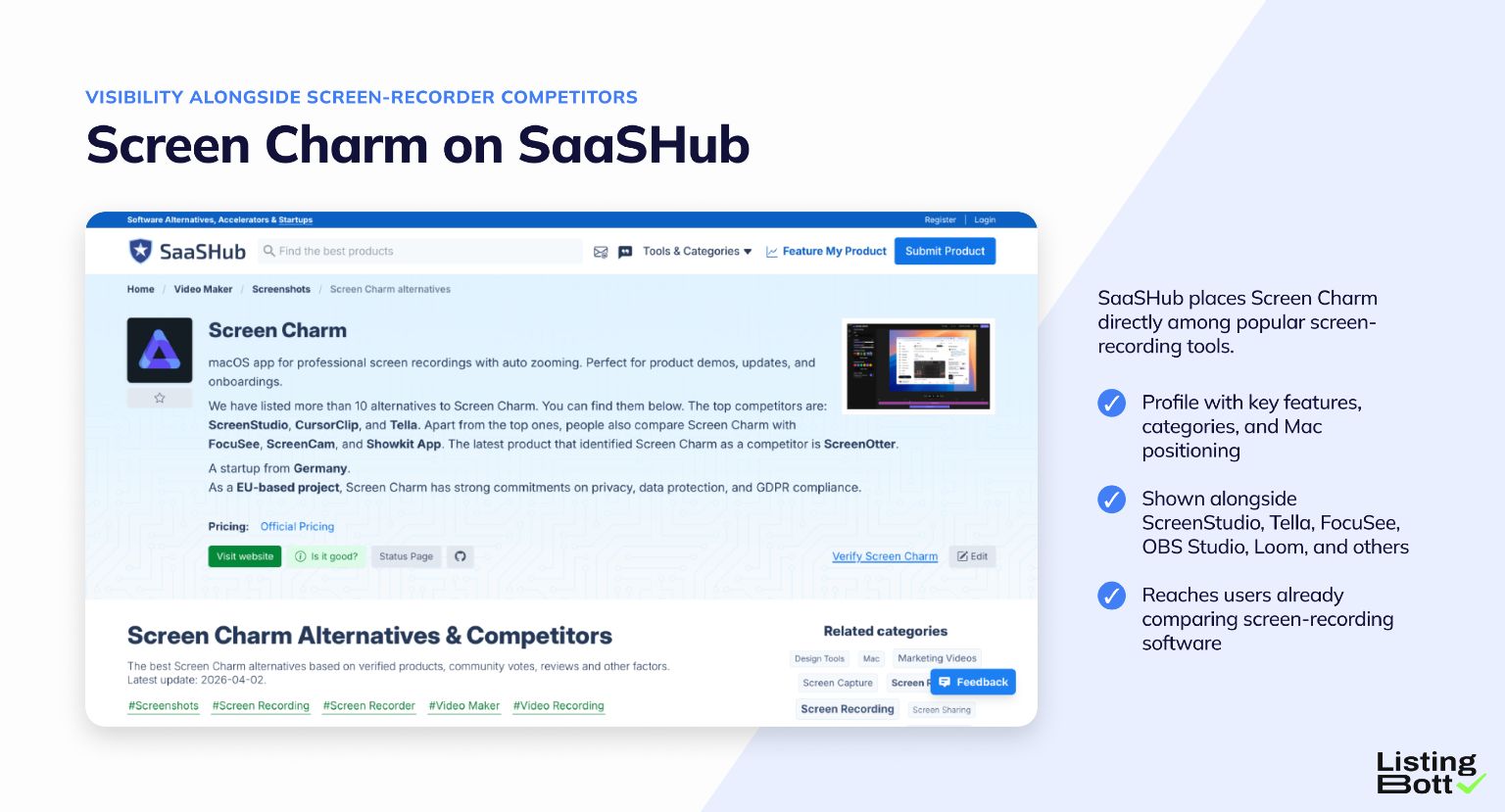
Screen Charm on SaaSHub
SaaSHub: visibility alongside direct screen-recorder competitors
SaaSHub's Screen Charm alternatives page describes the app as a macOS tool for professional recordings with auto zoom and places it alongside products such as ScreenStudio, Tella, FocuSee, OBS Studio, Loom, and other screen recorders.
That context is commercially useful. A visitor is already evaluating software, and Screen Charm becomes one of the options within the decision set. The page also connects the product with categories including screen recording, screen capture, video creation, and Mac software.
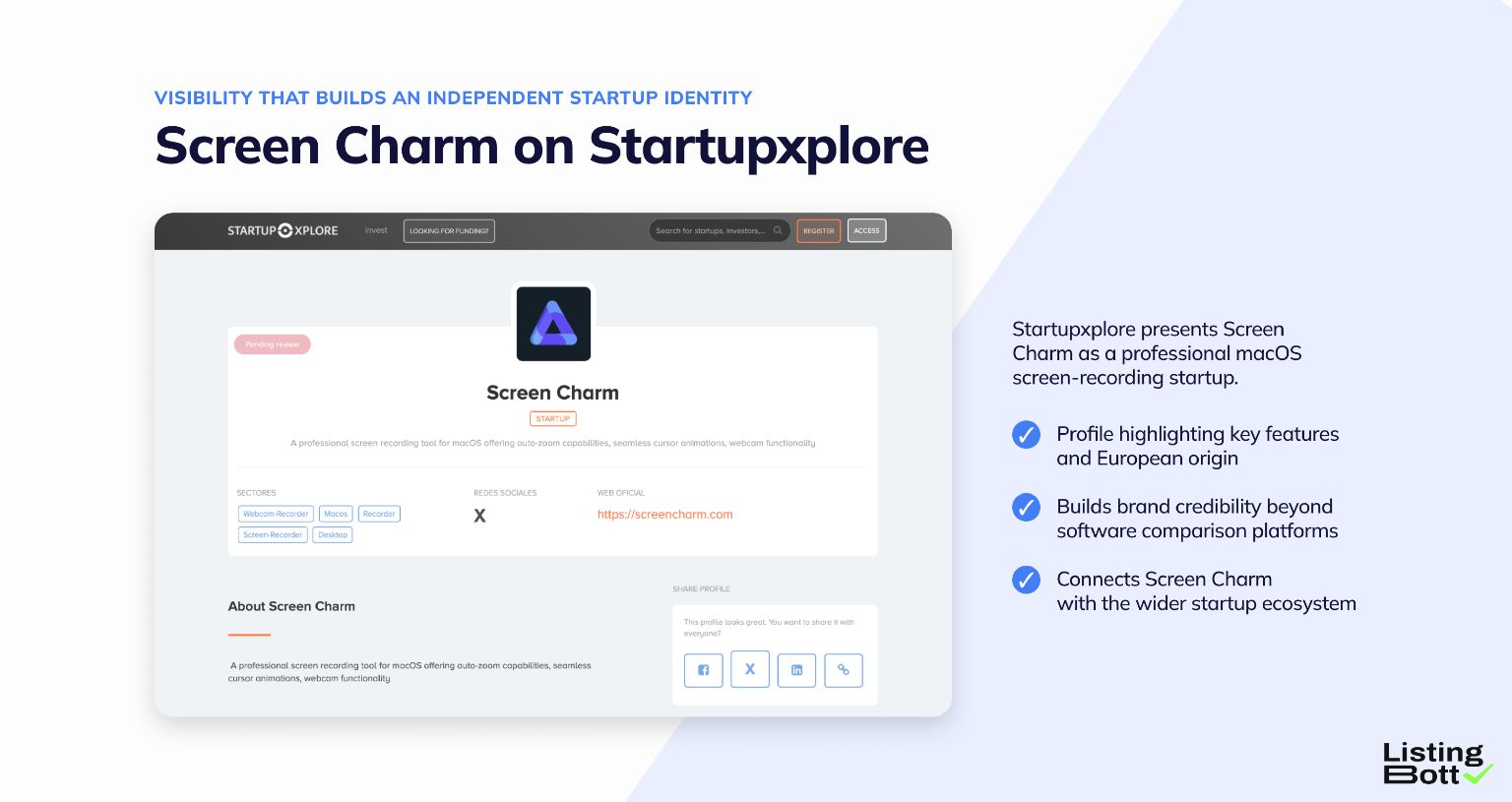
Screen Charm on Startupxplore
Startupxplore: an independent startup identity
The Screen Charm profile on Startupxplore describes it as a professional macOS screen-recording tool with auto zoom, cursor animation, and webcam functionality.
This page serves a different purpose from a comparison marketplace. It gives Screen Charm a startup identity on a third-party platform and reinforces the relationship between the brand, its product category, and its European origin.
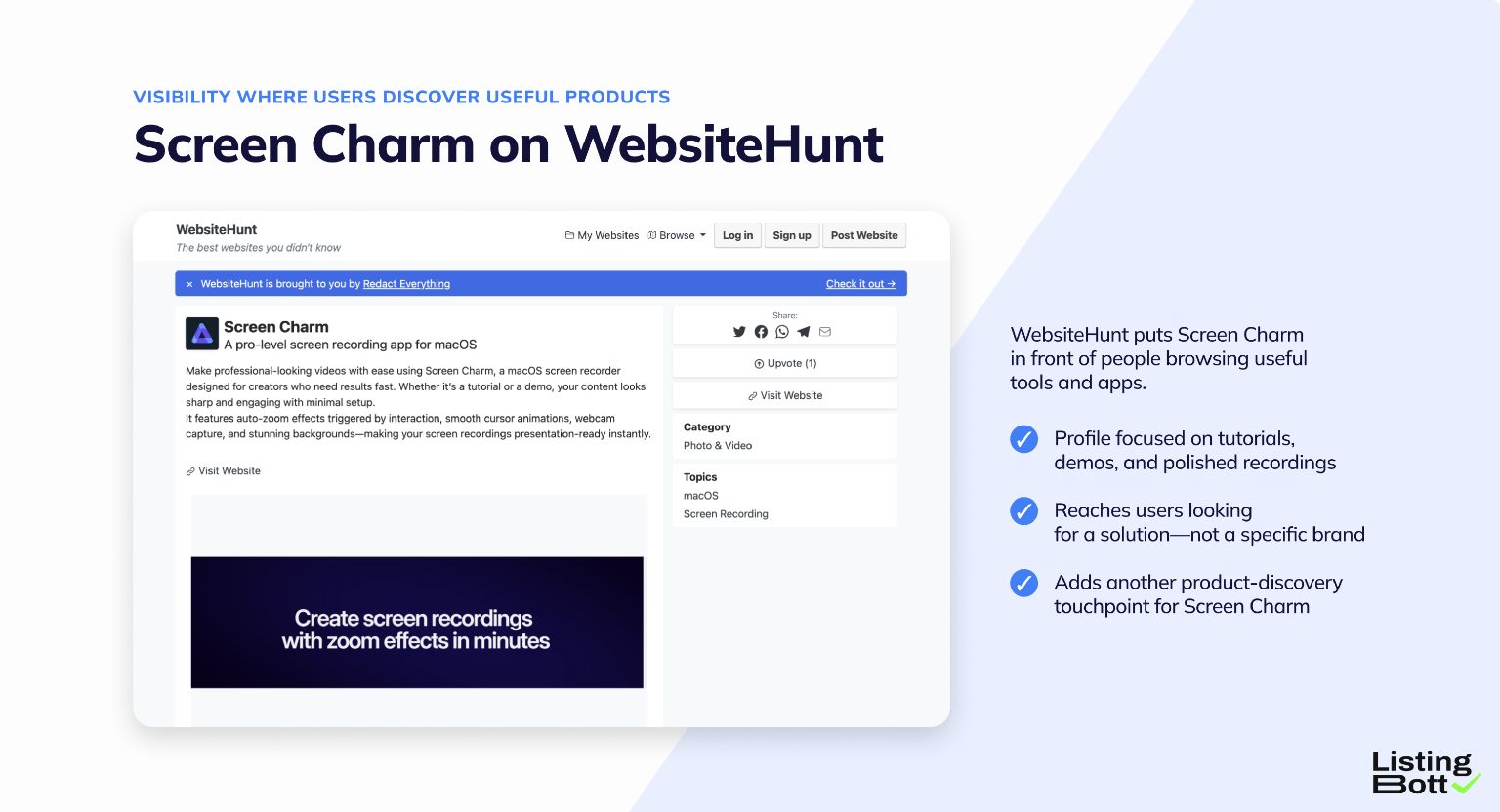
Screen Charm on WebsiteHunt
Website Hunt: discovery among people browsing useful products
Website Hunt's Screen Charm page introduces the product to people browsing websites and apps. Its description focuses on the core use cases: tutorials, demos, and polished recordings with minimal setup.
This type of placement is less about formal company verification and more about product discovery. It gives Screen Charm another chance to reach someone who is actively looking for a useful tool but may not have a specific brand in mind.
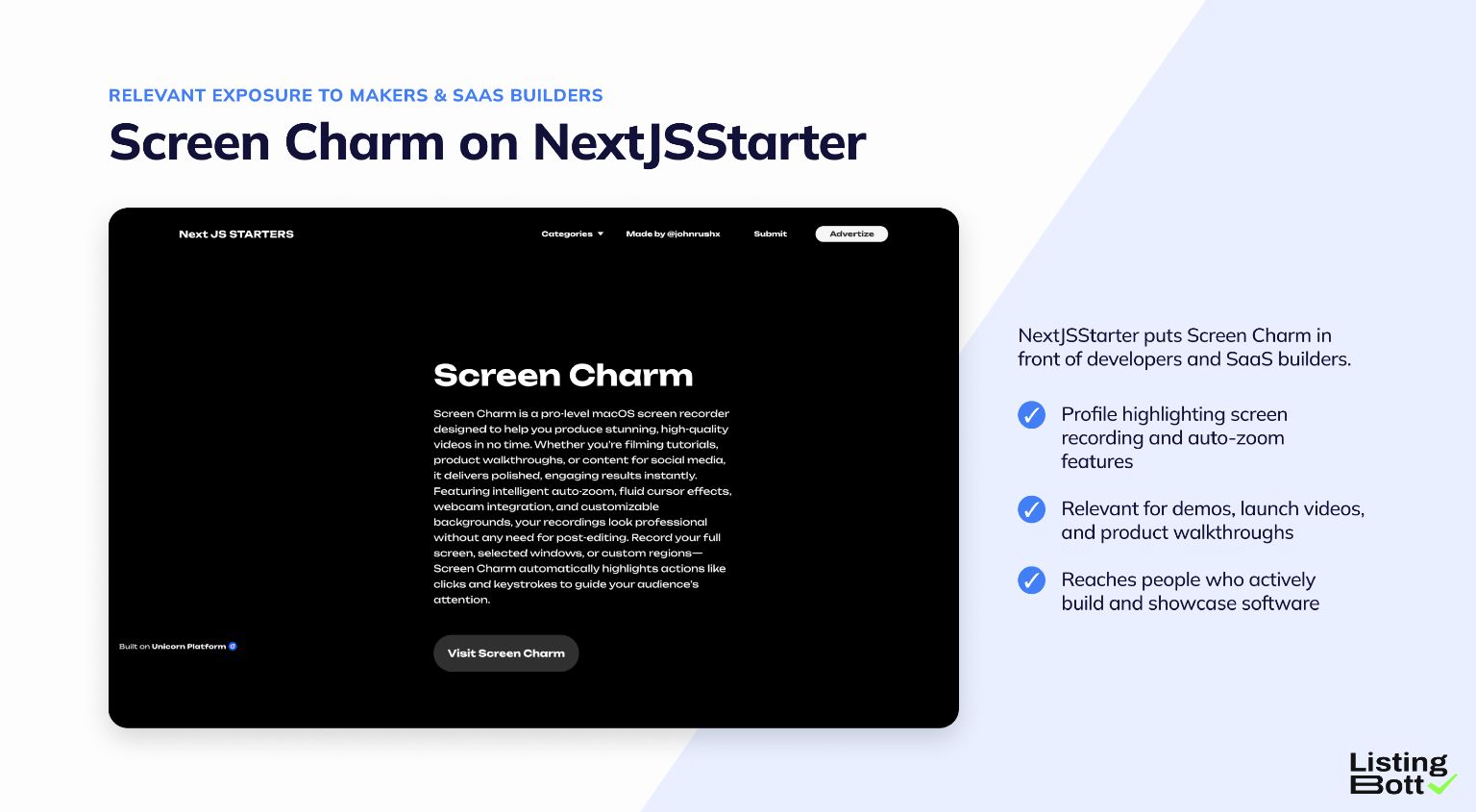
Screen Charm listing on NextJSStarter
NextJSStarter: relevant exposure to makers and SaaS builders
The Screen Charm listing on NextJSStarter explains how the app records full screens, selected windows, or custom regions and highlights interactions with automatic zoom effects.
The site's core audience includes developers and people building web products. That makes the placement more relevant than its name may initially suggest: founders and developers frequently need product demos, launch videos, documentation clips, and short walkthroughs for the software they build.
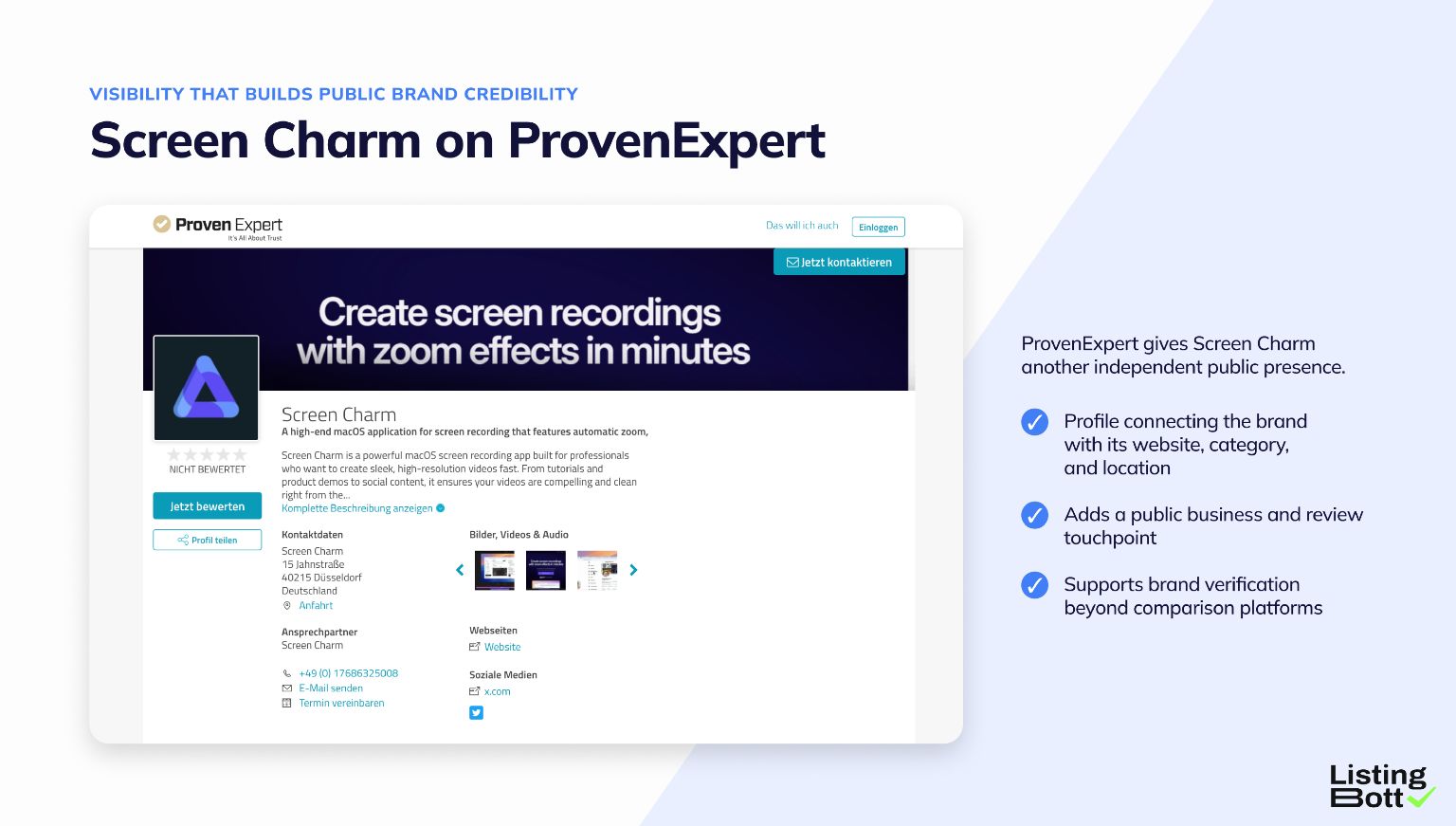
Screen Charm on ProvenExpert
ProvenExpert: another public brand-verification surface
The Screen Charm profile on ProvenExpert gives the product a public business and review presence connected with Düsseldorf. This page does not provide the same buyer-intent value as AlternativeTo or SaaSHub, and it should not be treated as equivalent.
Its role is narrower: it creates another independent page where the brand, website, category, and location can be checked. That distinction matters because a campaign should assess each profile by its actual function, not assume every listing has equal value.
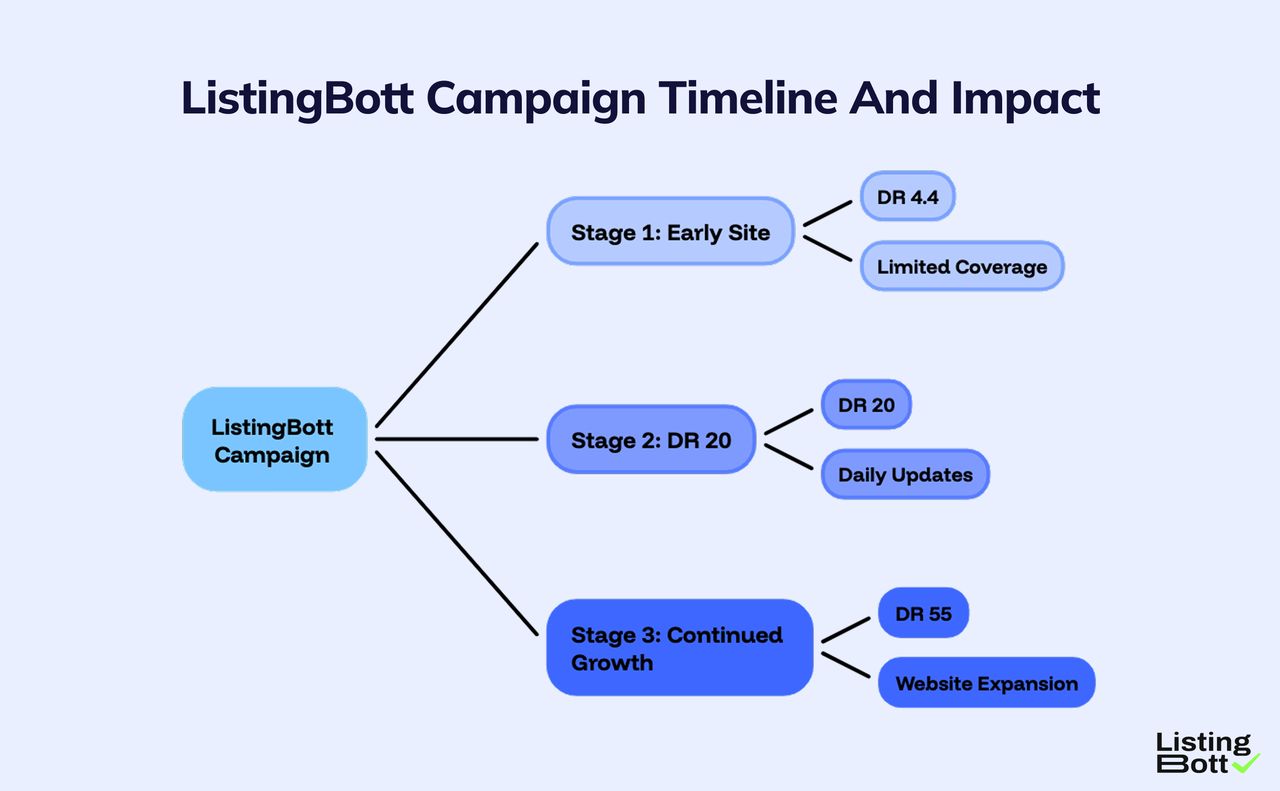
ListingBott campaign timeline and impact
What changed during and after the campaign
The cleanest way to understand the result is as a timeline rather than one oversized attribution claim.
Stage 1: an early site with a limited referring-domain footprint
ListingBott's starting Ahrefs snapshot placed Screen Charm at DR 4.4. At that point, the product had a clear offer but relatively little third-party coverage.
This is a common launch-stage imbalance. Founders invest in the application and homepage first, then discover that very few external pages explain the product or link to it.
Stage 2: approximately DR 20 within three months
Sergey publicly reported that ListingBott helped the site move from roughly zero to DR 20 in three months. On SaaSHub, he also highlighted the operating experience:
“I was kept informed of the progress every day, which I really appreciated.”
That comment matters because the deliverable was not simply a number of attempted submissions. The customer could see work progressing and receive help when setup questions appeared.
Stage 3: continued growth beyond the initial campaign
In his August 2026 X post, Sergey said the early push “made a real difference” and reported that Screen Charm had reached DR 52 while receiving solid organic traffic. The latest Ahrefs reading supplied for this case study is DR 55.
The increase from the early DR 20 milestone to DR 55 should be understood as Screen Charm's wider growth, not a delayed ListingBott result. By then the company had substantially expanded its own website with use-case pages, product comparisons, feature explanations, and supporting content. It also continued earning other links and mentions.
ListingBott helped establish the initial distribution layer. Screen Charm then built on top of it.
What ListingBott can reasonably take credit for
Case studies become less useful when every positive outcome is assigned to one vendor. For Screen Charm, the boundary is clearer.
ListingBott can reasonably take credit for:
- removing a large amount of manual directory research and submission work;
- creating public profiles on multiple live third-party domains;
- placing Screen Charm in several relevant software and startup contexts;
- contributing to new referring-domain coverage during the early campaign;
- helping the site reach the customer-reported DR 20 milestone within three months;
- keeping the customer informed while the submission work progressed.
ListingBott should not claim sole credit for:
- the later rise from DR 20 to DR 55;
- all of Screen Charm's organic traffic;
- rankings created by Screen Charm's own landing pages and articles;
- links or mentions earned through unrelated marketing activity;
- any specific revenue, customer, or AI-citation outcome that has not been measured.
This does not weaken the case. It makes the result more credible. ListingBott performed a defined part of the growth process well: early third-party distribution.
Why the placement mix mattered more than the raw count
A software launch does not need one hundred versions of the same low-context profile. It needs a balanced footprint.
- Alternative and comparison visibility: AlternativeTo and SaaSHub introduced Screen Charm within an active software-evaluation context.
- Startup identity: Startupxplore established the product as a startup and connected it with a broader company ecosystem.
- Product discovery: Website Hunt exposed the app to people browsing useful websites and tools.
- Audience relevance: NextJSStarter placed the product in front of makers who regularly create demos and walkthroughs.
- Brand verification: ProvenExpert added a separate business-profile surface tied to the company name and location.
Not every page will send measurable referral traffic, and not every link will carry the same SEO value. The strength comes from combining discovery, comparison, identity, and backlink functions instead of judging the campaign only by its largest domain metric.
That is also why SaaS teams should review startup directories worth targeting separately from broader free business listing sites. The two groups serve different search and discovery journeys.
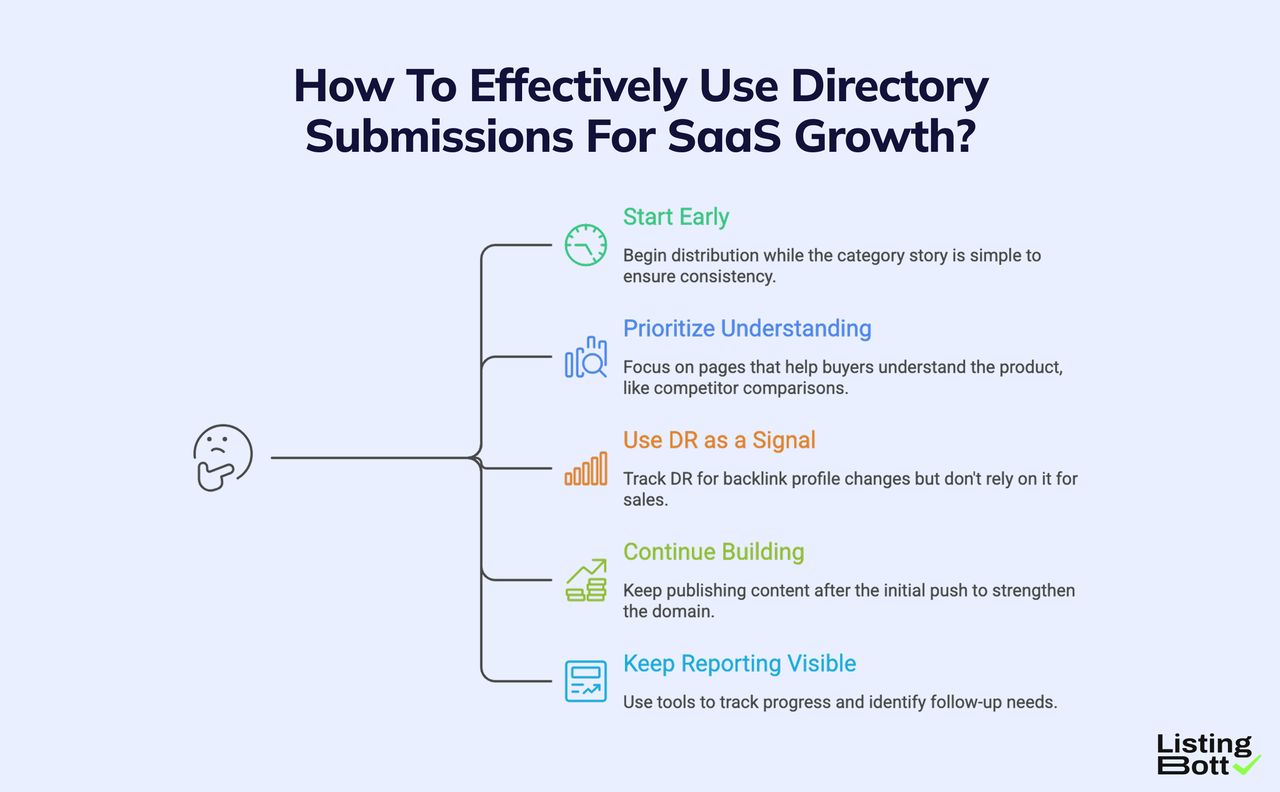
How to effectively use directory submissions for saas growth
What other software founders can learn from Screen Charm
Start distribution while the category story is still simple
Screen Charm could be described consistently: a Mac screen recorder for polished product demos, tutorials, and walkthroughs. That clarity made it easier to build accurate profiles across multiple platforms.
If a product's positioning changes every week, directory pages can quickly become inconsistent. Finalize the core category, audience, features, URL, and one-sentence description before scaling submissions.
Prioritize pages that help a buyer understand the product
The AlternativeTo and SaaSHub pages are stronger examples than a generic profile because they place Screen Charm beside competing screen recorders. Relevance and decision context usually matter more than a directory's headline authority score alone.
Treat DR as a signal, not the business outcome
DR is useful for tracking changes in a backlink profile. It is not a Google ranking factor, and it does not prove that a campaign generated sales.
Use it alongside referring domains, branded searches, referral visits, rankings for commercial pages, assisted conversions, and qualified signups. In Screen Charm's case, the public record supports a substantial backlink-profile increase and the founder's report of solid organic traffic, but it does not isolate every channel's contribution.
Continue building after the first distribution push
Directory placement worked as a foundation, not a complete SEO program. Screen Charm continued publishing pages around product demos, tutorials, SaaS teams, Mac screen recording, competitor comparisons, and specific recording features. Those pages gave the stronger domain more useful content to support.
Keep the reporting visible
Founders should know which platforms are being worked on, which profiles are live, and where follow-up is needed. A directory submission tool for SaaS launch teams is most useful when it turns that fragmented work into a reviewable process.
Early distribution that the product could build on
Screen Charm did not grow from DR 4.4 to 55 because of one tactic. It developed a stronger product, expanded its own search footprint, earned additional mentions, and kept marketing after the initial campaign.
ListingBott's contribution came earlier and was more specific. It helped turn a young macOS app into a product described across software marketplaces, startup platforms, product-discovery sites, and public profiles. The customer credits that work with helping Screen Charm reach approximately DR 20 in three months and describes it as a meaningful early boost.
For another founder at the same stage, that is the useful lesson: directory distribution will not replace product marketing or content, but it can create the external foundation those efforts need.
If your software has a clear category but too little third-party coverage, see how ListingBott handles website directory submissions.
Results vary by website, starting point, market, approved targets, and other marketing activity. ListingBott does not guarantee a particular Domain Rating, ranking, traffic level, AI citation, or number of customers.