Table of Contents
- Best-fit Listing Platforms for Marketing Agencies Directory Listing Services
- Implementation Checklist from Launch to Stable Portfolio
- Common Mistakes and Risk Controls
- 90-Day Agency Directory Plan
- FAQ
sbb-itb-8e44301
Quick Answer
Marketing agencies directory listing services produce better results when executed as a controlled pipeline, not a one-time submission sprint. Agencies that win in 2026 usually choose a smaller portfolio of high-fit directories, standardize profile quality, and scale only after they can maintain consistency.
A practical sequence is:
- define one canonical agency profile baseline,
- score directory platforms by buyer fit and editorial quality,
- launch a focused first wave,
- run recurring QA and correction cycles,
- expand only after quality gates pass.
This approach avoids the usual growth trap where submission volume rises faster than quality control.
Why Agency Directory Strategy Still Matters in 2026
Agency buyers still use external platforms to shortlist vendors, validate credibility, and compare positioning before they request a proposal. That behavior appears across niche directories, review ecosystems, and broader business discovery channels.
Because of that, profile quality in marketing directories now affects three outcomes at once:
- discoverability in buyer research journeys,
- trust during vendor comparison,
- consistency of brand and offer positioning.
Many teams keep long spreadsheets from public seo directory list resources and assume the biggest list wins. In practice, that often creates predictable problems:
- inconsistent service positioning across platforms,
- duplicated or stale profiles,
- weak destination-page mapping,
- high monthly maintenance with low business impact.
So the objective is not maximum coverage. The objective is measurable, maintainable channel quality.
The AGENCY-6 Framework for Directory Selection
Use this framework before adding any platform to your active portfolio.
| Factor | Practical question | Why it matters | Score (1-5) |
| Audience fit | Do qualified buyers for your agency model use this platform? | improves lead relevance | 1-5 |
| Niche alignment | Can your agency specialization be represented clearly? | strengthens positioning clarity | 1-5 |
| Profile depth | Can listings include services, proof, and case context? | supports trust and conversion | 1-5 |
| Editorial quality | Is platform quality curated and reasonably clean? | reduces noise and low-value exposure | 1-5 |
| Update control | Can updates and corrections be handled quickly? | protects consistency | 1-5 |
| Maintenance efficiency | Can your team sustain quality over time? | keeps operations scalable | 1-5 |
Suggested threshold:
- 24-30: core wave candidate,
- 18-23: support wave candidate,
- below 18: hold or skip.
This scoring model helps compare business directories for SEO options without defaulting to volume-first execution.
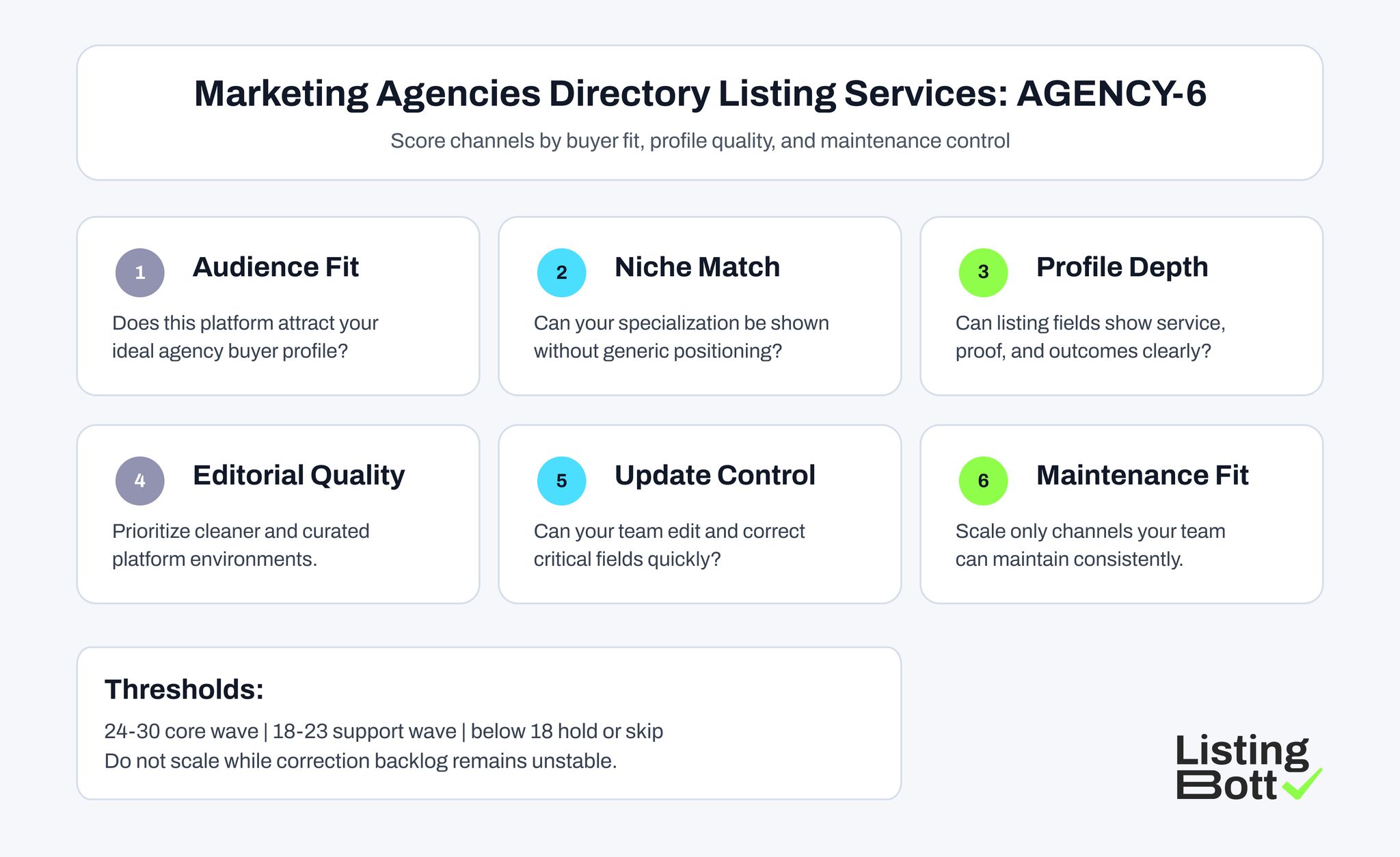
Marketing Agencies Directory Listing Services: AGENCY-6
Best-fit Listing Platforms for Marketing Agencies Directory Listing Services
This shortlist combines agency-focused and high-intent B2B discovery channels.
| Platform | URL | Why it is a best fit | Ideal company profile | Submission note |
| Clutch | https://clutch.co/ | High-intent B2B buyer discovery and comparison behavior | growth-stage agencies, specialized service firms | keep service focus and proof quality consistent |
| UpCity | https://upcity.com/ | Strong agency discovery context with category relevance | local and national digital agencies | map categories to real delivery strengths |
| DesignRush | https://www.designrush.com/ | Broad agency directory exposure with service segmentation | creative, branding, web, and performance agencies | keep portfolio examples aligned to core services |
| Agency Spotter | https://www.agencyspotter.com/ | Buyer-facing agency discovery focused on specialization | brand, content, and performance agencies | tighten positioning statement for category fit |
| Sortlist | https://www.sortlist.com/ | Vendor search ecosystem with service-based matching | regional and international agencies | maintain location and service taxonomy accuracy |
| The Manifest | https://themanifest.com/ | Practical B2B service discovery layer for agency buyers | B2B-focused marketing and dev agencies | use proof-forward descriptions and clear outcomes |
| GoodFirms | https://www.goodfirms.co/ | Strong software/service discovery context for agency credibility | agencies with technical and performance services | keep service, rates, and portfolio details current |
| Capterra | https://www.capterra.com/ | Useful when agency offers productized or software-like services | agencies with platformized delivery models | ensure service pages align with listing claims |
| G2 | https://www.g2.com/ | High-intent software and services research ecosystem | agencies tied to specific martech stacks | keep profile categories and messaging consistent |
| LinkedIn Company Page | https://www.linkedin.com/ | Critical trust layer for team and capability validation | agencies selling to B2B and enterprise buyers | keep service narrative and team signals updated |
How to use this portfolio:
- choose 5-7 channels for core wave,
- keep 3-4 channels for support wave,
- expand only when QA and correction metrics remain stable.
Core Wave Composition for Agencies
A strong first wave usually includes:
- 2-3 agency-specialized directories,
- 1-2 broad B2B comparison channels,
- 1 trust and brand-validation layer.
This gives enough diversity for discovery without creating immediate maintenance overload.
Practical core wave checklist:
- confirm one canonical agency profile source,
- define service taxonomy and messaging hierarchy,
- map each channel to a target buyer segment,
- assign owner for launch and owner for corrections,
- schedule a post-launch QA window (7-14 days).
The main benefit is operational predictability. You can scale only after you prove quality at smaller scope.
Operating Models for Agency Directory Execution
Teams choosing marketing agencies directory listing services usually compare these models.
| Model | Best for | Main risk | What to validate |
| Manual in-house workflow | small agencies with narrow channel scope | inconsistency during busy delivery periods | owner bandwidth and review discipline |
| Freelancer-led submissions | short-term launch needs | variable quality and weak lifecycle control | QA process and correction ownership |
| Agency-managed execution | teams that prefer outsourced throughput | methodology quality differs by provider | platform selection criteria and reporting depth |
| Tool-led controlled workflow | agencies scaling repeatable channel operations | weak output if governance is missing | baseline rules, QA cadence, and accountability |
For most growth-focused teams, the winning setup is not purely "fastest submissions." It is the model with the cleanest quality controls and clearest ownership.
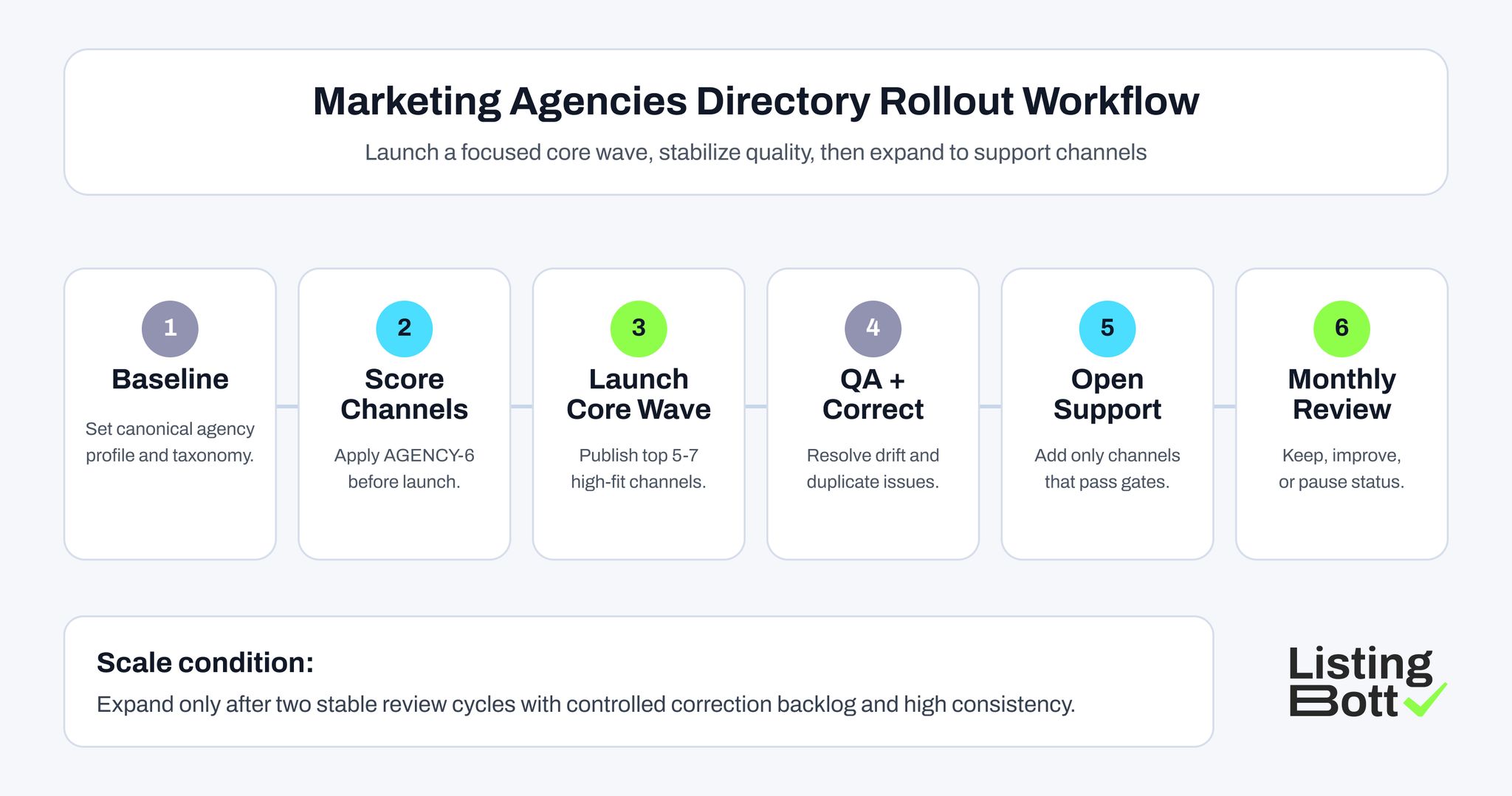
Marketing Agencies Directory Rollout Workflow
Implementation Checklist from Launch to Stable Portfolio
Step 1: build canonical agency profile pack
Include:
- short and long agency descriptions,
- service taxonomy and priority services,
- vertical specialization notes,
- proof and case-study references,
- destination URL mapping by service intent.
Step 2: score channel candidates
Apply AGENCY-6 and label each platform as:
- core,
- support,
- hold.
Step 3: prepare reusable assets
Before publishing, prepare:
- profile description variants,
- proof snippets and case callouts,
- logo and media set,
- standard QA checklist,
- update protocol.
Step 4: launch core wave
Publish to core channels and track:
- submission date,
- approval status,
- live profile URL,
- assigned owner.
Step 5: run post-launch QA
Verify:
- NAP and brand consistency,
- category alignment,
- URL mapping accuracy,
- profile completeness,
- duplicate risk.
Step 6: close critical issues first
Do not open support wave until high-impact issues are resolved.
Step 7: launch support wave selectively
Add support channels only when two consecutive review cycles stay stable.
Step 8: run monthly keep/improve/pause decisions
For each channel, decide:
- keep,
- improve with clear correction plan,
- pause and reallocate effort.
This process keeps free online business directories from turning into permanent maintenance debt.
KPI Board for Agency Directory Performance
Track outcomes that guide decisions.
| KPI | Why it matters | Healthy signal | Risk signal |
| Profile consistency rate | measures brand/data integrity | 95%+ and stable | recurring mismatch trend |
| Correction closure time | shows operational control | predictable closure cycle | aging issue backlog |
| Duplicate profile rate | reflects listing hygiene | low and declining | repeated duplicate creation |
| Channel contribution quality | indicates lead relevance and engagement quality | stable high-intent activity | low-intent visits dominate |
| Maintenance load ratio | measures scalability of effort | controlled effort per cycle | effort rising without quality gain |
This KPI board makes channel selection evidence-driven instead of opinion-driven.
Relationship to Agency Growth Stack and Tools
Directory operations should support, not replace, your broader growth stack. Teams searching for seo tools for agencies or seo tools for seo agencies often over-index on technical tooling and under-invest in profile quality operations.
A balanced setup includes:
- clear positioning framework,
- controlled directory portfolio,
- repeatable QA and correction process,
- channel-level performance review.
When these elements are aligned, directory execution contributes to trust and demand generation rather than producing maintenance drag.
Service-page Mapping that Improves Lead Quality
One overlooked driver of performance is destination mapping. Many agencies send every directory click to one generic homepage, then wonder why lead quality is inconsistent.
A better approach is to map each listing profile to the page that matches buyer intent:
- paid media-focused listings map to PPC service pages,
- SEO-focused listings map to dedicated SEO service pages,
- full-service positioning maps to a clear capabilities page with proof,
- niche vertical listings map to vertical-specific offer pages where possible.
This improves two things:
- visitors see immediate message match between directory promise and landing page content,
- qualification quality usually improves because users self-select earlier.
Practical mapping checklist:
- align platform category with target destination page topic,
- confirm destination page headline mirrors listing service framing,
- keep offer scope consistent across profile and landing page,
- review conversion path clarity on mobile and desktop,
- update mappings when service positioning changes.
Even for teams using free online business directories, this step has high leverage because it affects post-click quality without increasing submission volume.
Common Mistakes and Risk Controls
1) Volume-first directory expansion
More channels do not mean better outcomes when quality control is weak.
2) Generic positioning copied across platforms
If profile copy is too generic, buyer qualification quality usually drops.
3) No owner for corrections
Without ownership, listing quality decays quickly after the initial launch.
4) No retirement policy for weak channels
Low-value channels keep consuming time unless they are explicitly paused.
5) Reporting only launch count
Submission volume is not a reliable proxy for pipeline quality.
6) Mismatch between listing promises and landing pages
Weak destination mapping hurts trust and conversion intent.
7) Expanding support wave before core stability
This is the fastest way to create recurring operational debt.
90-Day Agency Directory Plan
Days 1-30: foundation
- build canonical profile pack,
- score channels with AGENCY-6,
- launch core wave,
- assign ownership.
Days 31-60: stabilization
- run QA cycles,
- close critical issues,
- fix duplicates,
- improve weak profiles.
Days 61-90: optimization
- open support wave if gates pass,
- pause weak channels,
- refine destination mapping,
- lock monthly governance cadence.
By day 90, the target is a clean, maintainable channel portfolio that supports agency growth goals.
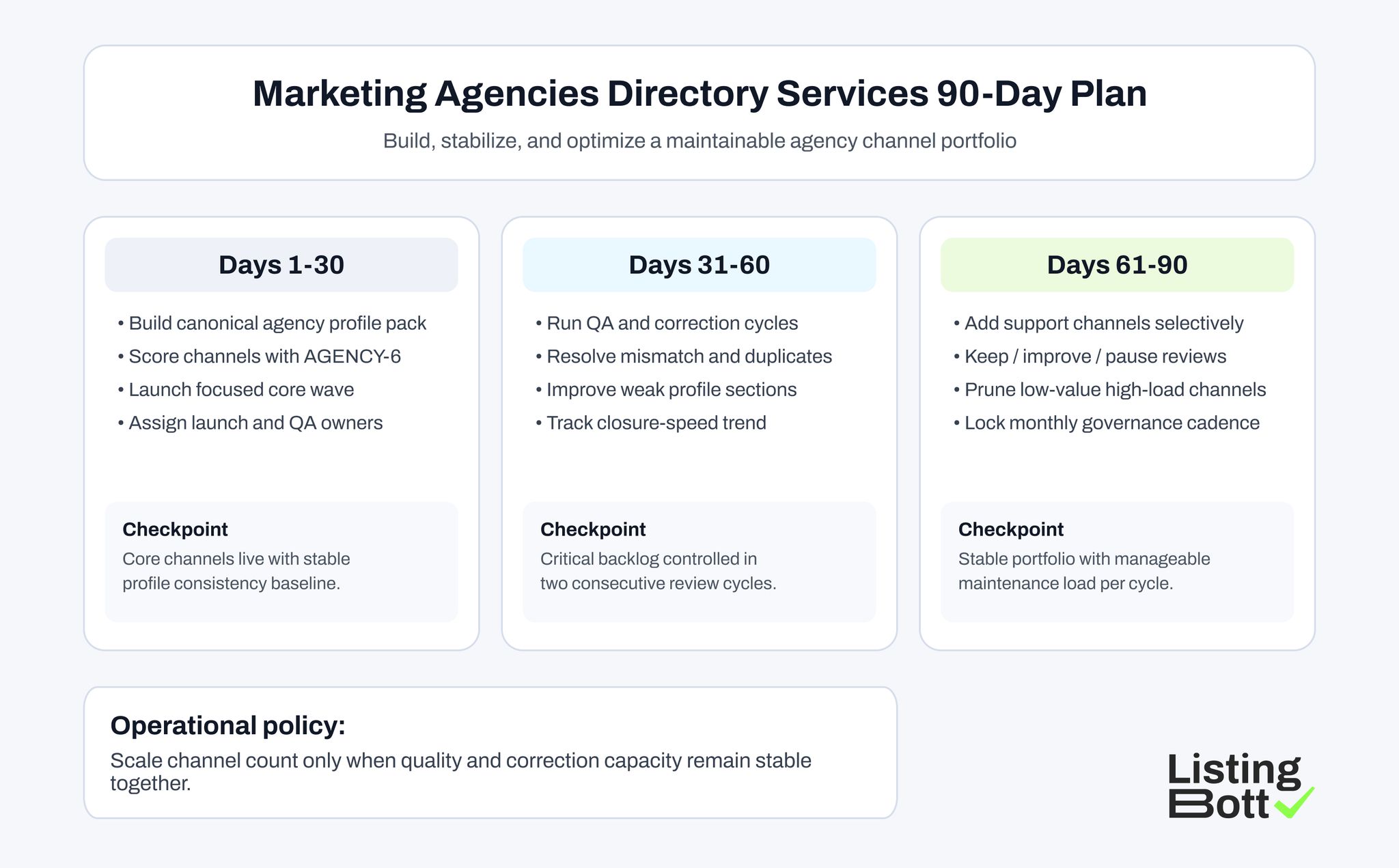
Marketing Agencies Directory Services 90-Day Plan
Where ListingBott Fits
ListingBott supports structured directory publication and reporting workflows for teams that want repeatable execution.
Typical flow:
- onboarding details are collected,
- listing scope is reviewed and approved,
- publication is executed,
- reporting is delivered.
Offer alignment:
- one-time payment model,
- publication to 100+ directories,
- no hidden extra fees,
- refund possible if process has not started.
Promise limits:
- no guaranteed ranking position,
- no guaranteed traffic by a specific date,
- no guaranteed indexing speed,
- no guaranteed outcomes controlled by third-party platforms.
Qualified DR statement: DR growth to 15 can be promised only when starting DR is below 15, the selected goal is domain growth, and the approved listing set is in place.
FAQ: Marketing Agencies Directory Listing Services
How many directories should a marketing agency start with?
Most teams should launch 5-7 high-fit channels first, then expand only after quality and correction metrics remain stable.
Are agency-specific directories better than general business directories?
They serve different roles. Agency-focused platforms improve buyer relevance, while general channels can add broader visibility if quality is controlled.
Should free directories be included in the first wave?
Only if they pass fit and maintenance checks. Free access does not remove quality-control costs.
Can directory listing services guarantee ranking outcomes?
No. Listings support visibility and trust signals, but rankings depend on broader SEO, site quality, and competition.
How often should agency listings be reviewed?
Monthly reviews are a practical baseline, with faster checks after major service, pricing, or positioning changes.