Quick answer
Local business directory submission in New Jersey requires synchronization across high-pressure and moderate-pressure operating zones. The operational risk is usually timing drift: submissions move faster than approvals, corrections, and reporting.
A practical state plan:
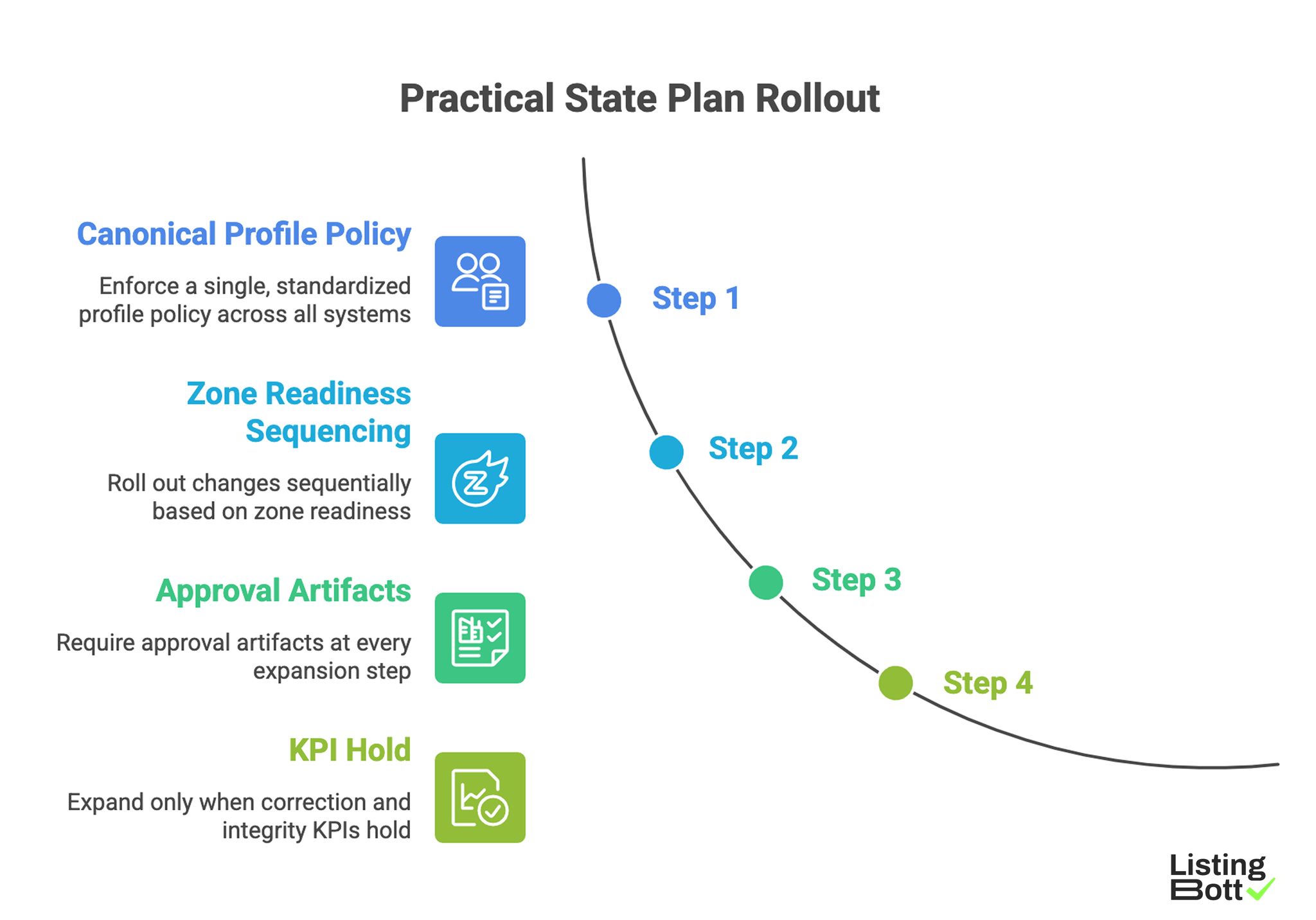
Practical State Plan Rollout
- enforce one canonical profile policy,
- sequence rollout by zone readiness,
- require approval artifacts at every expansion step,
- expand only when correction and integrity KPIs hold.
For broader U.S. planning, see Local business directory submission USA.
sbb-itb-8e44301
Methodology
This methodology is built for New Jersey operations where cross-zone timing, owner handoffs, and correction velocity determine whether scale remains stable.
The BRIDGE framework (Baseline, Routing, Integrity, Decision gates, Governance, Escalation)
| Component | Weight | Diagnostic question |
|---|---|---|
| Baseline control | 20 | Is one approved profile source enforced across all active zones? |
| Routing logic | 15 | Are rollout zones sequenced by readiness rather than deadline pressure? |
| Integrity management | 25 | Are profile mismatches detected and corrected before expansion? |
| Decision gates | 15 | Are formal artifacts required before each wave launches? |
| Governance cadence | 15 | Are reviews occurring on fixed cycles with owner accountability? |
| Escalation quality | 10 | Are critical exceptions resolved through an explicit escalation path? |
BRIDGE operating rule:
- score each component from 1-5,
-
do not expand if
Integrity managementorGovernance cadenceis below 3, - require two consecutive stable review cycles before opening a new zone.
New Jersey zone ladder
| Zone class | Typical operating profile | Launch wave | Primary target | Key risk |
|---|---|---|---|---|
| Zone A | high-change environments | 1 | set strict baseline and fix rhythm | scope growth before controls mature |
| Zone B | mixed operational intensity | 1-2 | copy baseline with low variance | ownership handoff friction |
| Zone C | distributed execution zones | 2 | maintain consistency under wider coverage | delayed correction response |
| Zone D | long-tail support zones | 3 | add breadth while controlling maintenance load | silent backlog accumulation |
Cross-zone synchronization board
| Function | Required synchronization point | Failure if missing | Countermeasure |
|---|---|---|---|
| Data policy | shared canonical source and field rules | conflicting listings and rework | weekly data-audit checkpoint |
| Scope policy | pre-launch inclusion/exclusion sign-off | unexpected scope drift mid-wave | hard gate before publish starts |
| Correction operations | SLA tracking and issue class ownership | unresolved critical tickets during expansion | SLA board + escalation clock |
| Reporting | fixed route-level status cadence | late visibility and reactive decisions | recurring weekly and biweekly reviews |
| Expansion decision | KPI-triggered go/no-go logic | calendar-led growth with unstable quality | threshold-based expansion rule |
Issue taxonomy for New Jersey execution
| Issue class | Pattern | Operational impact | Target response |
|---|---|---|---|
| Class A | minor formatting inconsistency | low, localized | batch fix in standard cycle |
| Class B | recurring profile mismatch in active zone | medium, can spread | focused correction sprint |
| Class C | systemic inconsistency across zones | high, expansion risk | freeze expansion + root-cause review |
A formal taxonomy improves decision speed and prevents underreaction to systemic quality drift.
Decision-gate artifact set
| Gate | Trigger | Required artifact | Blocker condition |
|---|---|---|---|
| Gate 1: baseline acceptance | before first wave | canonical policy + source owner table | more than one active baseline |
| Gate 2: zone approval | before each wave | approved zone list with exclusions | unapproved scope modification |
| Gate 3: quality pass | after initial zone batch | integrity/fix report by issue class | class C open issues above limit |
| Gate 4: expansion clearance | before next wave | KPI trend card + capacity review | worsening closure velocity |
84-day operational timeline
| Phase | Days | Focus | Exit criteria |
|---|---|---|---|
| Policy and ownership setup | 1-14 | baseline policy, owner matrix, escalation map | governance artifacts approved |
| First wave launch | 15-34 | run zone A with strict QA and SLA tracking | integrity and closure metrics stable |
| Stabilization sprint | 35-56 | reduce class B/C issue age and reopen rate | high-severity trend controlled |
| Controlled expansion | 57-84 | open zones B-D by gate approval | no regression after each zone addition |
Readiness scorecard before each expansion wave
| Readiness item | Verification | Pass rule |
|---|---|---|
| Baseline enforcement | audit sample across active zones | no conflicting source edits |
| Owner coverage | gate owner + escalation owner mapped | full owner map present |
| SLA health | critical issue closure trend | within threshold for two cycles |
| Reporting quality | zone-level KPI visibility | complete and up to date |
| Expansion governance | gate artifacts attached | all required artifacts present |
Comparison table
| Operating approach | Best fit | Practical advantage | Main tradeoff | New Jersey fit |
|---|---|---|---|---|
| Uniform statewide rollout | very small pilot tests | low startup complexity | high risk under cross-zone variance | Low |
| Manual segmented operations | narrow-scope teams | flexible local handling | low repeatability and heavy coordination | Medium-low |
| Managed synchronized workflow | teams needing controlled speed | predictable process flow with lower internal burden | requires transparent execution partner | Strong |
| Hybrid governance workflow | teams with internal QA leadership | strongest balance of control and velocity | depends on strict role clarity | Very strong |
Selection guidance by operating maturity
| Current maturity signal | Recommended approach | Why |
|---|---|---|
| Limited internal ops capacity | Managed synchronized workflow | keeps quality controls with lower internal overhead |
| Moderate maturity with growth pressure | Hybrid governance workflow | preserves internal oversight during expansion |
| High maturity and strong SOP | Hybrid or software-led | supports deeper internal governance |
| Repeated quality regressions | Managed pilot + governance reset | stabilizes before additional scale |
KPI board (weekly)
| KPI | Decision value | Expansion stop trigger |
|---|---|---|
| Zone integrity pass rate | quality stability by zone | sustained decline in active zone |
| Critical closure velocity | correction responsiveness | critical issues aging past SLA |
| Reopen percentage | correction durability | consistent week-over-week increase |
| Backlog pressure trend | operational debt growth | rising trend for two reviews |
| BOFU progression actions | commercial relevance | informational engagement with weak progression |
Best by use case
1) Single-location operator
Best fit: managed synchronized workflow with zone-level status clarity.
Reason: low operational overhead with explicit quality visibility.
2) Multi-location team
Best fit: hybrid governance with formal expansion gates.
Reason: scaling remains structured while owner accountability stays clear.
3) Product-led SaaS expansion
Best fit: phased wave rollout tied to readiness scorecards.
Reason: threshold-based growth reduces correction-debt risk.
4) Agency with multi-client delivery
Best fit: standardized issue taxonomy and escalation protocol.
Reason: repeatable execution and fast intervention reduce variance.
5) Programs with heavy governance needs
Best fit: approval-first operations with complete gate artifacts.
Reason: auditable decisions improve control and predictability.
For benchmark references during evaluation, compare workflow depth and execution transparency on best directory listing services and listing management software vs service.
Where ListingBott fits in New Jersey execution
What ListingBott does
ListingBott is a workflow-based directory submission tool for teams that need structured execution, approval checkpoints, and consistent reporting visibility.
How ListingBott works
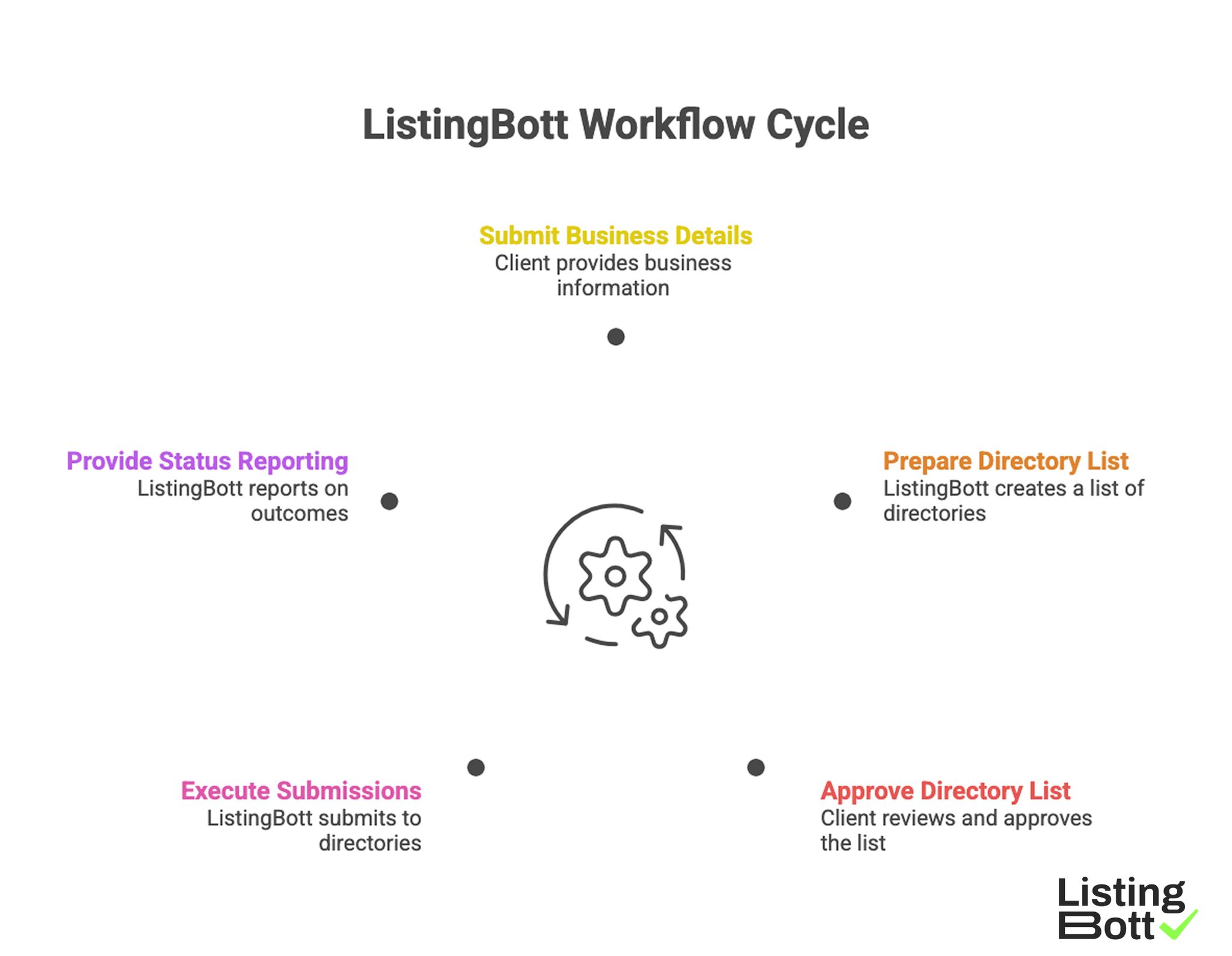
ListingBott Workflow Cycle
-
You submit business details through the
client form. -
ListingBott prepares a
list of directoriesfor your scope. - You approve the list before process launch.
- ListingBott executes submissions according to approved scope.
- ListingBott provides status reporting for completed and pending outcomes.
Key features and practical value
- Intake validation: reduces avoidable profile-data errors before launch.
- Approval checkpoint: aligns scope and expectations prior to execution.
- Workflow transparency: supports owner coordination and escalation.
- Reporting handoff: supports quality decisions before each next wave.
Teams that prioritize workflow reliability usually keep execution quality stronger than teams that optimize only for output volume.
Expected outcomes and limits
Expected outcomes:
- structured submission execution,
- clearer operational visibility,
- repeatable process for additional waves.
Limits to keep explicit:
- no guaranteed ranking position,
- no guaranteed traffic by a specific date,
- no guaranteed indexing speed,
- no guaranteed outcomes controlled by third-party platforms.
DR commitment is conditional only. A promise to reach DR 15 can apply when starting DR is below 15, the client explicitly selects domain growth, and the directory list is approved before process launch. Refunds may apply if process has not started, and public offer language remains no hidden extra fees.
Risks/limits
Common failure patterns
- Opening a new wave without gate artifacts.
- Treating all zones as operationally equal.
- Expanding while class C issues remain unresolved.
- Watching submission counts but ignoring reopen and backlog trend.
- Running escalation without named owner accountability.
Practical limits
- Directory submission supports discoverability and consistency, but it does not replace broader SEO systems.
- Timing and impact vary by competition, category, and third-party platform behavior.
- Expansion without controls can create compounding correction debt.
Minimum control layer
- wave-based gate approvals,
- SLA-bound correction ownership,
- weekly KPI review by zone,
- documented decision artifacts for every expansion step.
FAQ
Why use a synchronization model in New Jersey?
Because quality stability depends on keeping governance, corrections, and reporting aligned across active zones.
Should all zones launch at the same time?
Usually no. Launch in waves, stabilize, then expand.
Which KPI should block expansion first?
Use critical closure velocity with zone integrity pass rate.
Can directory submission guarantee rankings?
No. It supports consistency and discoverability, but rankings depend on external factors.
Is DR growth guaranteed for every project?
No. DR commitments are conditional and apply only to qualified setups.
What is the minimum governance stack?
Canonical data control, gate ownership, correction SLA, and recurring zone-level KPI review.