Quick answer
Local business directory submission in Japan works best with phased rollout, not one broad launch. Teams usually lose momentum when they expand quickly across markets before baseline consistency and correction flow are stable.
A practical Japan sequence is:
- lock one canonical profile baseline,
- launch a controlled first wave,
- close high-priority issues before widening scope,
- scale only when quality and backlog signals stay healthy.
For broader U.S. planning, see Local business directory submission USA.
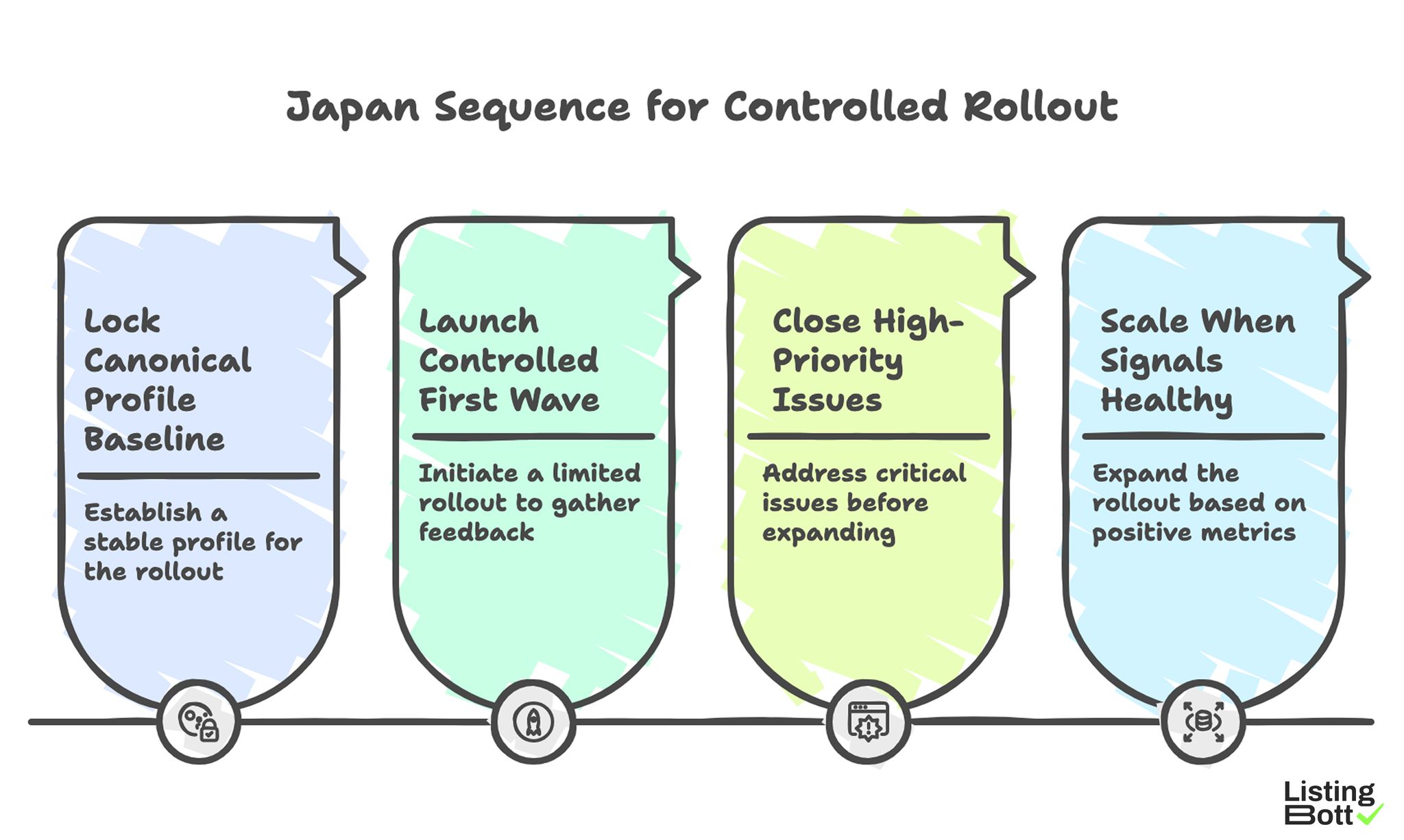
Japan Sequence for Controlled Rollout
sbb-itb-8e44301
Methodology
This page uses a Japan-specific rollout method focused on practical execution quality: baseline accuracy, controlled phase transitions, and correction capacity.
Why phased rollout works better in Japan
Japan campaigns often involve dense market clusters, strict profile consistency expectations, and high sensitivity to detail quality. Running all targets at once usually creates avoidable rework.
Common early failure patterns:
- profile data differs across source files,
- expansion starts before first-wave fixes are closed,
- ownership for corrections is unclear,
- reporting is delayed, so decisions are based on stale signals.
A phased rollout reduces these risks by linking each expansion step to measurable stability.
Japan rollout phases
| Phase | Scope focus | Objective | Common risk | Expansion condition |
|---|---|---|---|---|
| Phase 1 | controlled first-city batch | validate baseline and correction flow | conflicting profile fields from multiple sources | baseline pass trend remains stable |
| Phase 2 | core city expansion | increase footprint with controlled issue volume | queue grows faster than fixes | queue health stays within SLA |
| Phase 3 | regional scale-out | extend with repeatable process quality | reopen trend rises after scope increase | reopen trend remains stable across two cycles |
| Phase 4 | maintenance cadence | keep listing quality over time | stale updates and drift | reporting remains current and actionable |
Pre-phase checklist
| Checkpoint | What to verify | Pass condition |
|---|---|---|
| Baseline lock | one source for key profile fields | no conflicting active records |
| Scope approval | included and excluded directories confirmed | no unsanctioned scope edits |
| Ownership coverage | correction owner and backup owner assigned | complete owner map |
| Correction throughput | closure speed and queue-age trend | no rising high-severity aging trend |
| Reporting freshness | latest status and KPI snapshot available | updated before expansion decision |
First 60 days operating path
| Window | Focus | Decision at end |
|---|---|---|
| Days 1-20 | baseline lock + initial submissions | proceed to phase 2 or hold |
| Days 21-40 | correction stabilization | expand or run one more correction cycle |
| Days 41-60 | broader rollout under same standards | continue expansion or pause for reset |
Decision logic at day 60:
- expand if correction backlog is stable or decreasing,
- hold if reopen trend is rising,
- reset scope if closure speed misses target across two checks.
Practical directory prioritization in Japan campaigns
Publishing to every candidate directory at once usually creates avoidable correction debt. Better results come from priority by execution confidence.
| Priority layer | Selection logic | Why this order works |
|---|---|---|
| Layer 1 | high-trust directories with clear profile fields | cleaner early signal and lower mismatch risk |
| Layer 2 | strong local-relevance directories | increases visibility while quality remains controlled |
| Layer 3 | niche or vertical directories | useful after process stability is demonstrated |
A simple score can guide sequence decisions:
- field clarity,
- category relevance,
- verification friction,
- update visibility,
- maintenance burden.
If average score is below 3, defer that directory group to a later phase.
Data and text consistency controls
In Japan rollouts, small format or wording differences can trigger repeated corrections across records. Preventing this early reduces long-term maintenance overhead.
Practical controls:
- lock one approved master profile record,
- define approved text variants before launch,
- route profile edits through one owner queue,
- audit random records weekly for consistency.
When mismatch appears:
- confirm if it is baseline drift or one-off entry error,
- correct source data first,
- apply updates to affected records,
- verify closure before opening next phase.
Weekly dashboard signals before expansion
Before opening a new phase, validate a focused set of practical signals to avoid guess-based decisions.
| Signal | Why it matters | Hold trigger |
|---|---|---|
| Baseline pass trend | confirms data consistency is improving | decline across two checks |
| Queue aging | detects unresolved risk buildup | aging rises week over week |
| Closure speed | validates correction loop health | pace drops below target |
| Reopen trend | measures fix durability | repeated reopen increase |
| Owner capacity | prevents overloaded fix workflow | incomplete owner coverage for next phase |
If two or more hold triggers are active, keep scope fixed and stabilize corrections first.
Weekly execution cadence that supports stable growth
Teams usually perform better when rollout decisions follow a fixed weekly cadence instead of ad hoc reactions. This improves visibility and decision consistency.
A practical weekly routine:
- operations review for queue and closure progress,
- quality review for consistency and reopen trend,
- expansion decision check only when both earlier reviews are stable.
| Weekly checkpoint | Core input | Decision output |
|---|---|---|
| Queue review | queue age, closure speed, blocker count | keep scope, slow down, or hold |
| Quality review | baseline pass trend and reopen trend | continue phase or run correction sprint |
| Expansion review | latest stability trend and owner capacity | open next phase only if stable |
This cadence helps teams avoid expanding based on incomplete signals.
Common rollout scenarios and responses
| Scenario | Early signal | First response | Recovery check |
|---|---|---|---|
| Backlog acceleration | closure speed drops while issue volume rises | freeze new scope and prioritize high-severity fixes | backlog trend stabilizes for one cycle |
| Reopen spike | same issue type returns after closure | run root-cause review and tighten baseline rules | reopen trend returns to normal range |
| Scope drift | new targets appear after approval | pause additions and re-approve scope | no unsanctioned scope edits next cycle |
| Owner overload | fixes depend on one person | rebalance ownership and assign backup | SLA recovery across two checks |
Teams that prepare these responses in advance usually recover faster and avoid repeated operational mistakes.
Comparison table
| Execution approach | Best for | Strength | Tradeoff | Japan fit |
|---|---|---|---|---|
| Manual-only process | limited footprint | direct control | hard to keep stable at scale | Low |
| Software-only with internal ops | teams with mature process discipline | repeatable workflow | requires strong in-house ownership | Medium |
| Managed workflow execution | teams prioritizing stable rollout speed | lower coordination friction with clearer status | depends on provider transparency | Strong |
| Hybrid model | teams balancing control and pace | strong fit for phased expansion | requires clear role boundaries | Very strong |
When comparing options, evaluate process clarity and correction discipline, not only submission volume. Useful references: best directory listing services and listing management software vs service.
Best by use case
1) Single-location Japan business
Best fit: managed workflow with strict baseline checks.
Reason: it reduces avoidable profile mismatches during early rollout.
2) Multi-location operator
Best fit: phased rollout with explicit correction ownership.
Reason: expansion stays stable when each phase clears quality checks first.
3) Service-area business
Best fit: hybrid workflow with strict field and text consistency controls.
Reason: these profiles are sensitive to small data inconsistencies.
4) Agency managing multiple accounts
Best fit: repeatable managed process with consistent reporting cadence.
Reason: agencies need predictable operations and clear status visibility per account.
5) Team preparing wider regional expansion
Best fit: controlled Japan pilot before broader rollout.
Reason: a stable Japan baseline lowers downstream expansion risk.
Where ListingBott fits in Japan execution
What ListingBott does
ListingBott is a workflow-based directory submission tool that helps teams execute submissions with clear scope control, approval flow, and reporting visibility.
How ListingBott works
-
You submit business details through the
client form. -
ListingBott prepares a
list of directoriesfor your project. - You review and approve the list before launch.
- ListingBott executes submissions based on approved scope.
-
ListingBott delivers reporting with submitted and pending statuses.
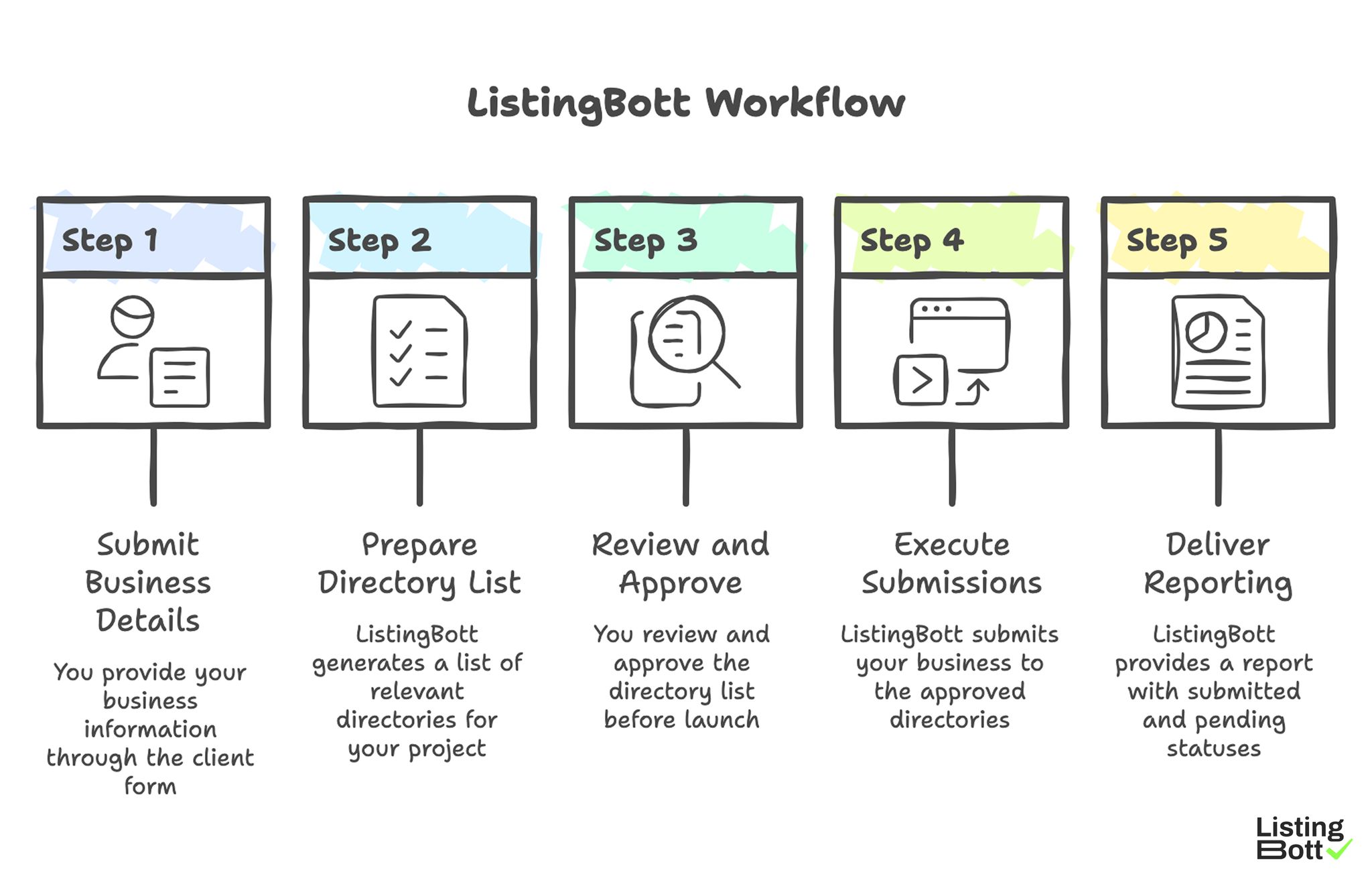
ListingBott Workflow
Key features and practical value
- Intake validation: catches avoidable profile-data issues before submissions start.
- Approval checkpoint: aligns scope and expectations before execution.
- Workflow visibility: clarifies status ownership and escalation.
- Reporting output: supports better phase decisions and maintenance planning.
Current offer alignment from project docs:
- one-time payment model,
- publication to 100+ directories,
- no hidden extra fees,
- refund can apply if process has not started.
Expected outcomes and limits
Expected outcomes:
- structured submission execution,
- clear progress visibility,
- repeatable process for phased expansion.
Limits to keep explicit:
- no guaranteed ranking position,
- no guaranteed traffic by a specific date,
- no guaranteed indexing speed,
- no guaranteed outcomes controlled by third-party platforms.
DR commitment is conditional only. A promise to reach DR 15 can apply when starting DR is below 15, the client explicitly selects domain growth, and the directory list is approved before launch.
For teams evaluating operational models, best local business directories can help prioritize where reliable execution quality matters most.
Risks/limits
Common rollout mistakes
- Expanding before first-wave corrections are closed.
- Maintaining multiple profile sources without baseline lock.
- Tracking volume while ignoring backlog trend.
- Missing explicit owner accountability for fixes.
- Continuing expansion during rising reopen cycles.
Practical limits
- Directory submission supports visibility and consistency, but does not replace full SEO strategy.
- Timing varies by category, competition, and third-party platform behavior.
- Sustainable scaling depends on correction capacity, not only market demand.
Minimum control layer
- one baseline profile standard,
- approved scope before each phase,
- named correction owner with backup,
- recurring queue and quality review.
FAQ
Should Japan rollout start broad or phased?
Phased is usually safer. A controlled first wave gives cleaner signals before wider expansion.
What is the best early KPI for expansion decisions?
Use correction backlog trend and closure speed together. If backlog grows, hold expansion.
How many directories should we start with?
Start with a controlled first batch, then expand only after quality checks pass.
Can directory submission guarantee rankings in Japan?
No. It supports consistency and discoverability, but rankings depend on factors outside direct control.
Is DR growth guaranteed by default?
No. DR commitments are conditional and apply only to qualified domain growth setups.
What must be stable before opening the next phase?
Baseline consistency, owner coverage, correction throughput, and current reporting.