Quick answer
The best HR software listing service in 2026 is not the one that promises the biggest directory count. It is the one that helps an HR vendor do four things well:
- lock the right category and positioning before submission,
- prioritize the surfaces that actual HR software buyers use,
- publish a consistent profile package across those surfaces,
- keep QA, corrections, and review-platform maintenance under control.
For most HR software vendors, the first wave should focus on a small, high-intent set: G2, Capterra, GetApp, Software Advice, TrustRadius, and at least one HR-native surface such as SHRM Vendor Directory or HRMSWorld. Supporting software catalogs and broader business directories belong later, not first.
That is the main reason HR software listing services are valuable: they turn scattered submission work into a controlled rollout. If your team already knows the category and message it wants to push but does not want to manage every profile, approval, verification, and correction loop manually, a structured workflow saves time and prevents profile drift.
sbb-itb-8e44301
When HR software listing services are worth it
HR software listing services make the most sense when the problem is operational, not conceptual.
In other words, they help after you already know what the product is and who it is for, but before your team has the time or discipline to push that message across every relevant surface.
Typical strong-fit situations:
- you are launching a new HRIS, ATS, payroll, benefits, onboarding, or workforce product,
- you already have some profiles live but the copy, categories, and screenshots are inconsistent,
- you are moving upmarket and need better positioning on high-intent review platforms,
- you have multiple modules and need one clear category map before broader distribution,
- your team wants review-platform coverage and directory coverage without managing every submission manually.
Typical wrong-timing situations:
- your website messaging is still changing every week,
- the product category is still unclear,
- no one owns review generation or profile maintenance,
- the team wants instant ranking growth from directory volume alone.
A listing service cannot fix category confusion. If one profile calls the product an HRIS, another calls it an HCM suite, and a third says it is a recruiting automation tool, the problem is not submission speed. The problem is message discipline.
That is why this page is different from a broader discovery article like HR software directories and review sites. The question here is not "what platforms exist?" The question is "what should an HR vendor submit to first, with what assets, and in what order?"
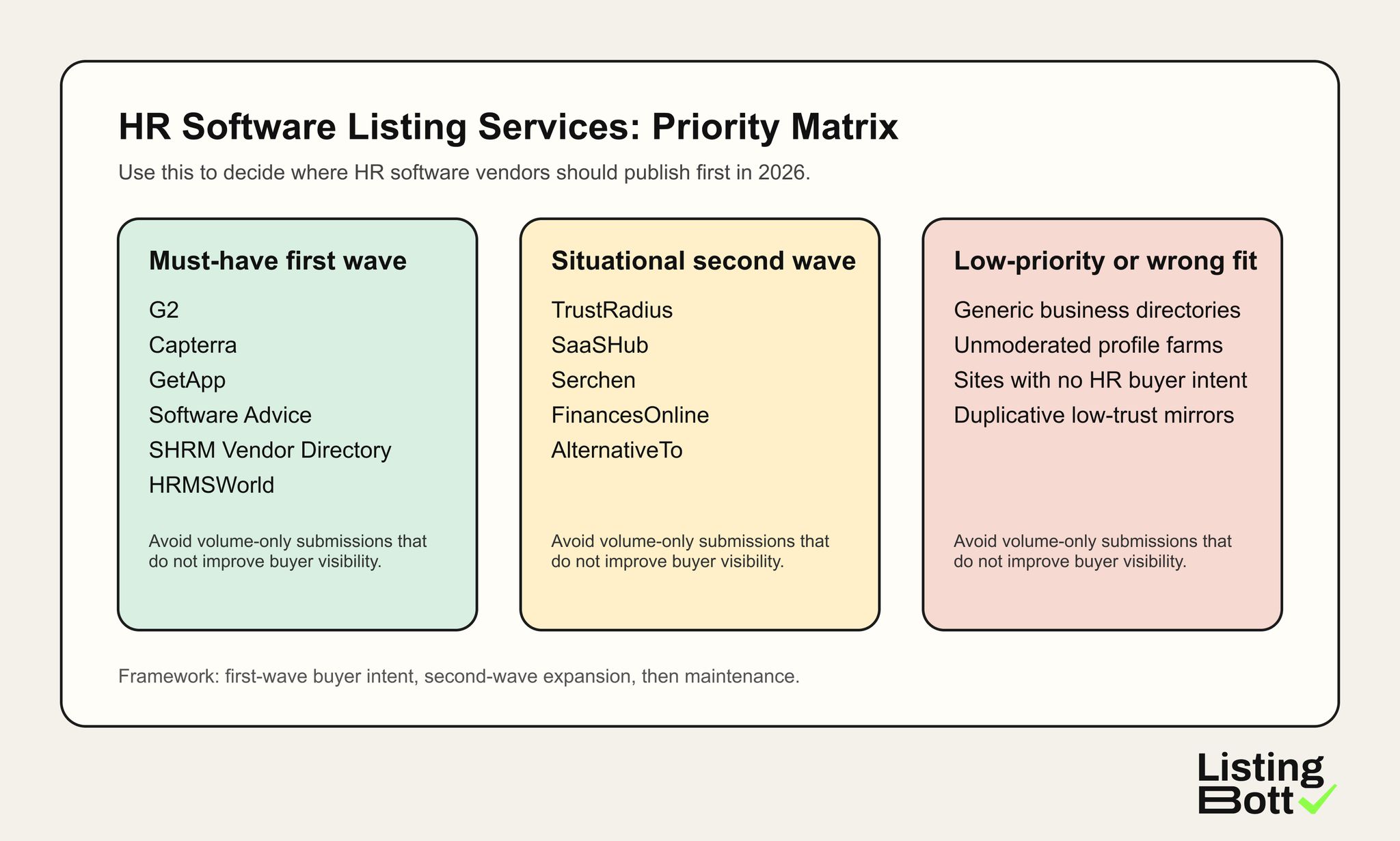
HR software listing submission priority matrix showing must-have, situational, and low-priority platforms for 2026.
What to prepare before submission
The fastest way to waste a listing campaign is to start publishing before the profile package is stable.
Most HR vendors should build one master submission packet before the first profile goes live. That packet should make category, audience, product scope, and implementation reality obvious.
Minimum profile assets
| Asset | Why it matters | Common mistake |
|---|---|---|
| Primary category | Helps platforms place the product correctly | Trying to rank in too many categories at once |
| One-sentence positioning | Clarifies the product in seconds | Generic "all-in-one HR solution" language |
| Long description | Gives category and buyer context | Copying homepage marketing text without adapting it |
| Feature summary | Helps evaluation-stage buyers | Listing every feature equally without showing fit |
| Integrations | Reduces implementation uncertainty | Omitting HRIS, payroll, ATS, SSO, or API details |
| Screenshots | Improves trust and profile completeness | Using outdated product shots |
| Pricing posture | Helps qualify interest | Avoiding the topic entirely when the platform supports it |
| Support / implementation notes | Important in HR buying decisions | Talking only about features, not rollout |
| Social and company links | Adds trust and discovery context | Using inconsistent or broken links |
| Review plan | Critical on review-heavy surfaces | Publishing to review sites with no review strategy |
Category discipline matters more in HR than many teams expect
HR software is not one clean bucket. Buyers think in narrower jobs:
- HRIS
- HCM
- applicant tracking
- payroll
- benefits administration
- onboarding
- workforce management
- employee engagement
- performance management
- people analytics
If your team cannot say which of those jobs the product leads with, the listing service will end up distributing vague messaging at scale.
What a strong positioning line looks like
Weak:
- "Modern HR solution for growing companies."
Stronger:
- "HRIS for multi-location SMB teams that need employee records, onboarding, and time-off workflows in one system."
Weak:
- "Recruiting and talent platform for modern teams."
Stronger:
- "Applicant tracking and hiring workflow software for lean recruiting teams that need structured interview pipelines and approval routing."
The difference is practical. Better category clarity improves both buyer understanding and platform fit.
How to choose the right HR software surfaces
Not every listing surface deserves first-wave effort.
The simplest way to choose is to separate the market into five buckets.
1. Core review platforms
These are usually the highest-priority submission targets because they influence shortlist evaluation:
These surfaces matter when buyers already know they need software and are comparing options seriously.
2. HR-native discovery surfaces
These are not always as review-heavy, but they give stronger category relevance:
These are useful when the vendor wants stronger alignment with HR-specific discovery behavior instead of generic software traffic alone.
3. Supporting software catalogs
These help with broader discovery and alternatives intent:
These are usually second-wave surfaces after the main review coverage is in place.
4. Launch and company-discovery surfaces
These are useful for newer tools, not as core substitutes:
These can support awareness, but they should not replace serious category coverage.
5. Supporting or low-priority business directories
These can add breadth, but they are not where most HR software buyers validate vendors:
- EnrollBusiness
- ClassDirectory
- RelevantDirectories
- JustDirectory
- Clutch
- Slashdot
They make sense only after the higher-intent surfaces are already covered well.
Surfaces most HR software vendors should treat cautiously
Some database entries may look loosely relevant but still attract the wrong audience:
Those are edge-case fits at best, usually for recruiting networks or niche labor-market products rather than mainstream HR software.
Submission priority matrix
This matrix is built for execution, not for generic platform ranking.
| Platform | Type | Why HR vendors use it | Profile assets that matter most | Priority level | Wrong-fit signals |
|---|---|---|---|---|---|
| G2 | Review platform | Strong shortlist and credibility signal | Category precision, screenshots, integrations, reviews | Must-have | No review plan, vague category, weak profile depth |
| SHRM Vendor Directory | HR-native directory | Vertical relevance and HR practitioner context | Clear HR category, implementation notes, vendor description | Must-have | Product is too generic or not truly HR-facing |
| Capterra | Review platform | Strong SMB and mid-market software evaluation presence | Feature summary, pricing posture, use cases, reviews | Must-have | Thin copy, unclear target market, outdated screenshots |
| Software Advice | Review / advisory platform | Practical evaluation-stage visibility | Buyer-fit copy, implementation context, category alignment | Must-have | Treating it as a copy-paste duplicate of other profiles |
| HRMSWorld | HR-native directory | Supports category relevance for HR buyers | Category clarity, vendor summary, product focus | Must-have | Product does not map cleanly to HR software categories |
| GetApp | Review / comparison platform | Useful for structured software comparisons | Screenshots, feature breakdown, category fit | Must-have | No differentiation from Capterra/G2 copy |
| TrustRadius | Review platform | Helpful for deeper validation and buyer trust | Review depth, enterprise context, implementation reality | Situational | No realistic review acquisition path |
| SaaSHub | Software catalog | Alternatives visibility and supporting discovery | Product summary, alternatives framing, consistent naming | Situational | Expecting it to behave like a review giant |
| Serchen | Software directory | Additional software-category reach | Category tagging, concise feature copy | Situational | Using it before higher-intent review platforms |
| FinancesOnline | Editorial / comparison surface | Extra discovery in software research paths | Product summary, proof points, category clarity | Situational | Treating editorial coverage as a controllable submission channel |
| AlternativeTo | Alternatives platform | Useful for switcher intent | Naming consistency, competitive positioning | Situational | Product has no clear replacement or alternatives story |
| Product Hunt | Launch / discovery platform | Awareness for newer HR tools | Launch-ready copy, screenshots, concise pitch | Situational | Expecting sustained review-style demand from it |
How to use the matrix
For most HR vendors, a sensible first wave is:
-
G2 -
Capterra -
GetApp -
Software Advice -
one or both of
SHRM Vendor DirectoryandHRMSWorld
Then expand to:
-
TrustRadius -
SaaSHub -
Serchen -
FinancesOnline -
AlternativeTo
Finally, use Product Hunt, BetaList, Crunchbase, or broader directories only if the product stage or brand goals justify them.
That sequence matters because listing services fail when they chase easy volume before hard-fit platforms.
Rollout workflow
The best HR software listing services behave like an operating process, not a directory blast.
Step 1: lock the category map
Before any submission starts, decide:
- primary category,
- supporting categories,
- target company size,
- target buyer role,
- core implementation story.
This step prevents one product from being framed as payroll software on one platform, HRIS on another, and recruiting software on a third without a reason.
Step 2: build the master profile package
Prepare the canonical text and asset set:
- short description,
- long description,
- feature bullets,
- integrations,
- screenshots,
- support and onboarding notes,
- official URLs,
- social and company links.
The goal is not identical copy everywhere. The goal is one consistent source of truth that can be adapted to each platform.
Step 3: publish the first-wave profiles
Start with the highest-intent surfaces only.
For most HR vendors that means:
-
G2 -
Capterra -
GetApp -
Software Advice -
SHRM Vendor Directory -
HRMSWorld
This is the point where a structured online listing management automation workflow becomes useful, because the job is no longer just writing a profile. It is coordinating the approvals, verification loops, and status tracking that follow.
Step 4: run QA before expansion
Do not immediately move to every secondary directory.
Check first:
- was the product placed in the right category,
- are screenshots current,
- are links working,
- is the profile naming consistent,
- do descriptions reflect the right buyer problem,
- did any submission create duplicate or conflicting entries?
Step 5: activate review-heavy surfaces properly
Review platforms need more than presence. They need usable depth.
If the company publishes to G2 or Capterra with no plan for reviews, incomplete screenshots, and weak buyer-fit copy, the profile exists but does not compete well.
Step 6: expand to secondary surfaces
Only after the first wave is stable should the campaign expand to:
-
TrustRadius -
SaaSHub -
Serchen -
FinancesOnline -
AlternativeTo -
launch and supporting surfaces such as
Product Hunt,BetaList, andCrunchbase
Step 7: review quarterly
HR software categories, screenshots, and positioning drift over time. That means the work is not finished at submission. It needs scheduled review.
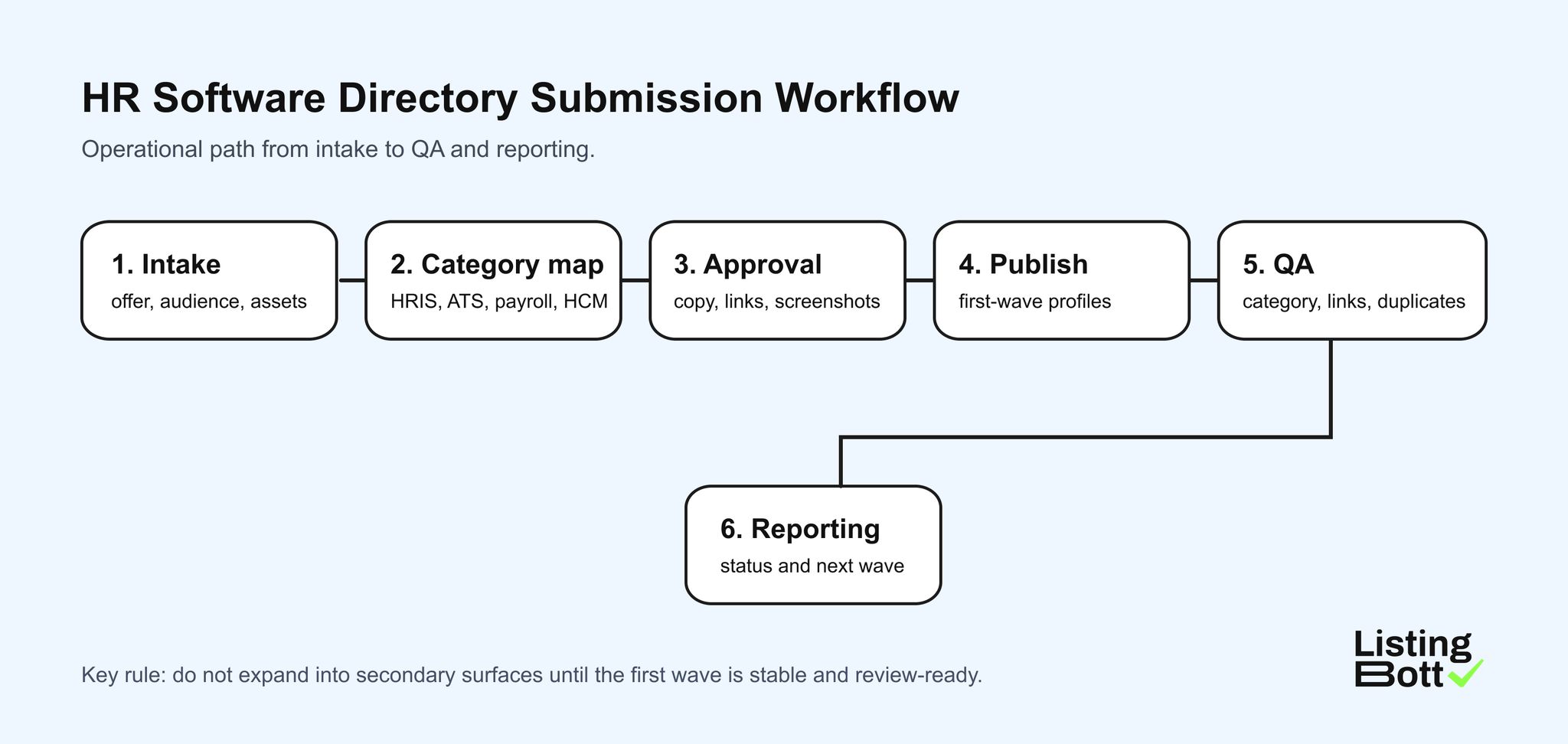
HR software directory submission workflow from profile preparation to QA and reporting.
QA and maintenance
The operational difference between a strong listing campaign and a weak one is usually maintenance discipline.
Post-publish QA checklist
| Check | Why it matters | Fix trigger |
|---|---|---|
| Category accuracy | Keeps the product in the right comparison set | Wrong category or too many conflicting categories |
| Naming consistency | Improves trust and avoids profile drift | Brand or product name varies by platform |
| Description clarity | Helps buyers understand the actual use case | Description is generic or feature-bloated |
| Screenshot freshness | Supports profile credibility | Old UI or irrelevant visuals |
| Link validity | Prevents dead-end clicks | Broken site, pricing, or demo links |
| Review coverage | Important on review-led platforms | Review count too low or review mix looks stale |
| Duplicate profiles | Avoids diluted signals and confusion | More than one inconsistent profile appears |
| Pending / rejected status | Keeps rollout from silently stalling | Submission is incomplete with no follow-up |
What to revisit every quarter
- category fit,
- integrations list,
- pricing posture,
- screenshots,
- implementation messaging,
- new modules or renamed products,
- review freshness on the most important platforms.
For HR software, this matters because the buyer is not only checking features. They are looking for implementation confidence, support quality, and organizational fit.
Common mistakes
The same failures show up again and again in HR software listing work.
1. Expanding before the first wave is stable
Teams often submit to broad business directories too early and leave the main review platforms half-finished.
2. Reusing generic copy everywhere
The same vague paragraph across G2, Capterra, SaaSHub, and SHRM Vendor Directory usually underperforms because those surfaces do not serve the same buyer stage.
3. Treating editorial evidence like a direct submission target
Surfaces such as FinancesOnline can support visibility, but they should not be managed exactly like open directory profiles.
4. Ignoring implementation messaging
HR buyers often care about onboarding, support, integrations, migration, and admin burden. A feature-only profile leaves out those decision factors.
5. Using the wrong-fit long tail
Broad or adjacent entries such as EnrollBusiness, ClassDirectory, or job-board-style platforms should not shape the first-wave strategy for a serious HR software brand.
6. Expecting listing services to guarantee outcomes they do not control
No credible listing service can guarantee exact rankings, exact traffic by date, or third-party platform outcomes. The valuable promise is controlled execution, visibility coverage, and reporting.
How ListingBott fits
If your HR software team wants a structured submission workflow rather than ad hoc manual work, ListingBott fits on the execution side.
If your team wants help executing the shortlist, compare managed directory submission service for launch teams after reviewing the relevant targets.
What ListingBott does
ListingBott helps teams submit their product or website to many directories using a structured process. The value is not a consulting-call model. The value is operational execution.
How the workflow works
- You complete the client form with product, category, and company details.
- ListingBott prepares a list of directories for the project.
- You review and approve that list.
- Publishing starts after approval.
- You receive a report showing what was submitted, what is pending, and what may still need follow-up.
Why that matters for HR software
HR software listings often fail because category mapping, review-platform depth, and verification steps are not handled consistently. A structured process helps keep the first wave focused, the profile package aligned, and the reporting understandable.
Expected results and limits
What you can reasonably expect:
- structured submission execution,
- clearer rollout control,
- status visibility,
- a report that shows what moved live and what still needs attention.
What should not be promised:
- guaranteed ranking position,
- guaranteed traffic by a fixed date,
- guaranteed indexing speed,
- guaranteed third-party outcomes.
If a project is built around authority growth goals, any DR commitment has to stay conditional and follow the approved ListingBott rules. For most teams, the safer expectation is process quality, not blanket outcome promises.
See how directory automation works
FAQ
What should an HR software vendor submit to first?
Usually the first wave should start with high-intent review platforms and at least one HR-native surface. For most vendors that means G2, Capterra, GetApp, Software Advice, and either SHRM Vendor Directory or HRMSWorld before moving into broader supporting surfaces.
How many platforms belong in the first wave?
Usually five to seven high-priority surfaces are enough for the first wave. The goal is to stabilize the best channels before expanding into the long tail.
Should ATS, payroll, and HRIS products use the same category strategy?
No. They may share some listing surfaces, but they should not share the same category framing. The lead category should reflect the product's primary buying job.
Do review sites need a different workflow from classic directories?
Yes. Review-heavy platforms need more ongoing attention because profile depth, review freshness, screenshots, and category placement matter more there than on thin directory sites.
Can HR software listing services guarantee rankings or traffic?
No. A strong service can improve execution quality, profile coverage, and reporting, but it cannot credibly guarantee exact rankings, exact traffic, or platform-controlled outcomes.
When should a vendor skip a platform?
Skip or delay a platform when the audience is wrong, the category fit is weak, or the team cannot support the profile properly after it goes live.