Table of Contents
- What "Free" Actually Means in Local Listing Strategy
- Free Directory Listings vs Related SEO Channels
- 60-Day Free-Listings Rollout Plan
- Common Mistakes with Free Business Listing Sites in the USA
- FAQ
sbb-itb-8e44301
Quick Answer
The best approach to free business listing sites usa is not to submit to every available platform. A better approach is to select high-fit channels, publish accurate profiles, and maintain them with recurring QA.
In 2026, free listing programs work when teams treat them as an operating system, not a one-time marketing task. That means:
- choosing channels by market relevance,
- enforcing profile consistency,
- measuring quality and contribution over time.
If you skip those controls, free channels often create expensive cleanup work later.
Why Free Listing Channels still Matter in 2026
Even with modern AI search and richer SERP experiences, local and directory references still support three useful layers:
- discoverability in external search/filter environments,
- trust through consistent business identity signals,
- broader presence beyond your own website.
That is why keyword research still contains related clusters such as local citation sites, seo listing sites, and nap listing sites.
Free channels are attractive because they reduce direct media cost. But they are not maintenance-free. The hidden cost is operational complexity: profile updates, category mismatches, duplicate records, and stale information.
Teams that manage this complexity well can get real value from free distribution. Teams that ignore it usually get noisy visibility and weak performance signals.
What "Free" Actually Means in Local Listing Strategy
A lot of businesses interpret free listings as "no cost." In practice, free usually means:
- no upfront listing fee,
- but real internal cost in setup, verification, QA, and updates.
This distinction matters. If your team has low process capacity, free channels can become higher-cost than expected.
A practical way to evaluate free channels is to track two cost types:
- Cash cost: fees for listing placement or upgrades.
- Operational cost: time required to launch, correct, and maintain listing quality.
When operational cost grows faster than quality outcomes, you need tighter channel selection, not more submissions.
The USA-Fit Framework for Selecting Free Listing Sites
Use this framework before adding any new platform from a free business listing sites usa list.
| Dimension | Practical question | Why it matters | Score (1-5) |
| USA intent relevance | Does the channel attract US-focused local buyers? | improves visit quality | 1-5 |
| Structured profile depth | Can listings include enough business context and proof? | improves trust and conversion readiness | 1-5 |
| NAP control | Can you maintain consistent name/address/phone data? | reduces mismatch risk | 1-5 |
| Approval and update reliability | Is profile editing predictable after publish? | prevents stale records | 1-5 |
| Discovery potential | Can users find listings through search and categories? | improves external visibility | 1-5 |
| Maintenance load | Can your team sustain updates across selected channels? | protects long-term quality | 1-5 |
| Outcome clarity | Can you track contribution at channel level? | supports keep/de-prioritize decisions | 1-5 |
Scoring guidance:
- 28-35: core free channels
- 22-27: support channels
- below 22: experimental only
The key is to keep core channels small and maintain them well before expanding.
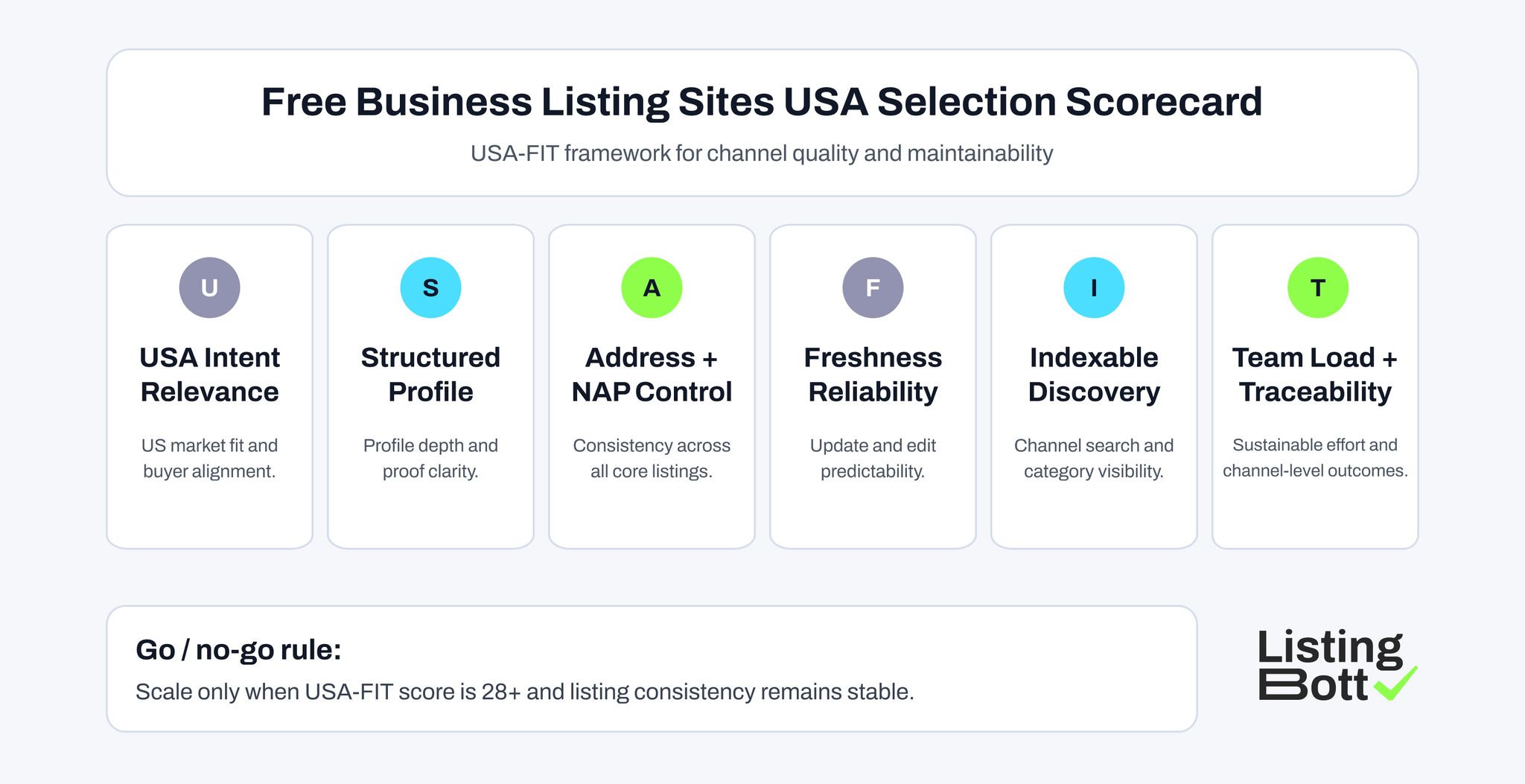
Free Business Listing Sites USA Selection Scorecard
Best-Fit Listing Platforms for Free Business Listing Sites USA
The list below uses platform references from your local research material and should be treated as a quality-priority shortlist, not a mass-submission instruction.
| Platform | URL | Why it is a best fit | Ideal company profile | Submission note |
| Apple Business Connect | https://businessconnect.apple.com/ | Strong local presence layer for Apple ecosystem and map discovery | local storefronts and service-area businesses with US focus | verify core business data before publishing to reduce correction loops |
| Bing Maps | https://www.bing.com/maps/ | Supports map-based discovery outside Google and broadens search-surface coverage | SMBs targeting diversified search traffic | align categories and service areas with website pages |
| Better Business Bureau (BBB) | https://www.bbb.org/get-listed | Trust-heavy listing environment useful for credibility-sensitive categories | home services, legal, healthcare-adjacent providers | completeness and trust signals matter more than submission speed |
| Chamber of Commerce | https://www.chamberofcommerce.com/ | Practical channel for baseline local business visibility in US market | local SMBs and regional operators | keep descriptions specific and location-consistent |
| Foursquare | https://foursquare.com/ | Useful location and discovery support channel with map relevance | hospitality, retail, in-person service businesses | maintain hours and address data to avoid user frustration |
| Hotfrog | https://admin.hotfrog.com/add/index-card | Good support-tier directory for broader citation footprint | SMBs building initial visibility layers | treat as support channel and monitor quality after launch |
| Citysearch | http://www.citysearch.com/world | Legacy directory with niche local discovery use in some segments | established local businesses with long operating history | stale profiles reduce value quickly; recurring QA is required |
| US City | https://uscity.net/ | Additional support-layer local directory option from your source set | small local businesses adding citation diversity | enforce NAP consistency and category alignment |
| EZlocal | https://ezlocal.com/ | Helpful support channel for local profile presence and citation breadth | local service providers and single-location SMBs | check destination URLs and contact fields after publish |
How to use this platform set:
- choose 4-6 as core channels,
- choose 2-3 as support channels,
- avoid adding more channels until consistency metrics are stable.
Free Directory Listings vs Related SEO Channels
Businesses often combine multiple keyword intents in one plan. That can work, but only if each channel type has a clear role.
1) Free listings and local citations
Local citation sites and directory channels should support entity consistency and visibility.
2) Search-engine submission workflows
Search engine submissions sites are not the same as local listing channels. They focus on indexing control and diagnostics, not directory profile discovery.
3) Content and publishing channels
Article submission sites can support broader content distribution but should not replace local business profile channels.
4) Visual content channels
Image submission sites may help content visibility in some verticals, but they are usually secondary to core local listing quality.
5) NAP-focused control layer
Nap listing sites matter only when name, address, and phone records are accurate and synchronized. Inconsistent NAP data weakens trust and creates avoidable correction work.
The strongest programs separate these channel types and measure them independently.
60-Day Free-Listings Rollout Plan
Days 1-10: baseline setup
- define one canonical business profile template,
- map service categories to real customer intent,
- prepare approved copy variants for different listing formats,
- set ownership for publication and QA.
Days 11-20: first-wave publication
- launch on 4-6 core free channels,
- capture status in one tracker,
- verify all URLs, NAP fields, and core profile details.
Days 21-30: QA and correction cycle
- run structured QA review on live listings,
- fix profile mismatches and category errors,
- remove duplicate or conflicting entries,
- confirm consistency baseline before expansion.
Days 31-45: support-channel expansion
- open 2-3 support channels,
- monitor new correction load,
- pause expansion if backlog starts rising.
Days 46-60: performance decision
- keep channels with strong quality and signal clarity,
- de-prioritize channels with low value and high maintenance cost,
- define next wave only if quality KPIs remain stable.
This sequence is intentionally controlled. It improves quality and reduces downstream cleanup effort.
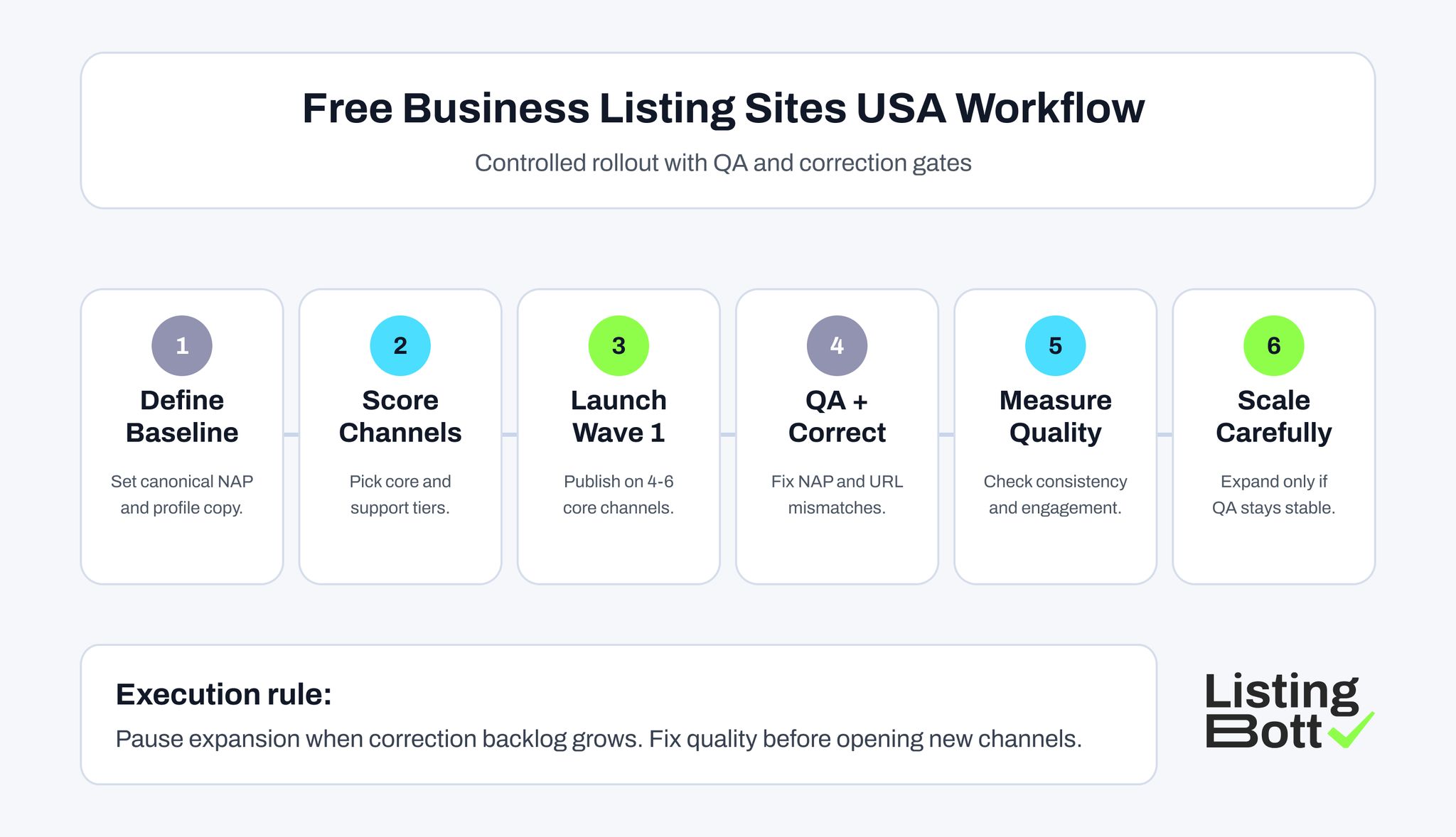
Free Business Listing Sites USA Workflow
KPI Board for Free Listing Channel Quality
Track a compact KPI board instead of raw listing volume.
| KPI | Why it matters | Healthy signal | Risk signal |
| Listing consistency rate | protects profile reliability | 95%+ on core channels | frequent data mismatch |
| QA closure velocity | measures correction discipline | predictable closure window | growing aged backlog |
| Duplicate listing rate | indicates data hygiene | low and declining duplicates | repeated duplicate creation |
| Referral engagement quality | shows channel relevance | stronger engagement trend | low-intent sessions dominate |
| Maintenance load ratio | tests scalability | stable effort for stable output | effort rises while quality is flat |
This board gives better decisions than counting total submissions.
Common Mistakes with Free Business Listing Sites in the USA
Mistake 1: submitting to huge unfiltered lists
Fix:
- rank channels by USA-FIT score,
- keep first wave small,
- expand only after QA stability.
Mistake 2: no NAP governance
Fix:
- lock one canonical NAP baseline,
- run verification before every wave,
- assign correction ownership.
Mistake 3: confusing indexing tools with listings
Fix:
- run search-engine submission workflows separately,
- keep listing metrics and indexing metrics in different dashboards.
Mistake 4: weak destination mapping
Fix:
- map listing links to intent-matched pages,
- avoid sending every channel to one generic page.
Mistake 5: launch-only operations
Fix:
- schedule recurring maintenance cycles,
- include quality review and channel pruning in monthly operations.
Mistake 6: over-prioritizing "free" over "fit"
Fix:
- include operational effort in your channel decisions,
- keep channels that are both manageable and outcome-relevant.
Free vs Paid Decision Checkpoint for USA Programs
You can keep a free-first strategy as long as quality and workload remain balanced.
A practical monthly checkpoint:
- If quality is stable and update load is manageable, continue free-first.
- If quality is unstable but scope is small, tighten process controls.
- If quality is unstable and scope is large, move to a structured managed workflow.
This avoids false tradeoffs. The goal is not "free at all costs." The goal is reliable visibility with sustainable operations.
Adapting Free Listing Strategy by Niche
Different niches should not run the same listing mix, even within the USA.
Practical examples:
- home services: prioritize trust-heavy channels and strict NAP control because call intent is high and bad data causes immediate lead loss;
- healthcare-adjacent businesses: prioritize profile accuracy, category precision, and compliance-safe wording;
- B2B local services: prioritize directories where company context and service scope can be explained clearly, not only map visibility;
- retail and hospitality: prioritize channels where hours, location, and contact updates can be changed quickly.
This niche adaptation step improves channel quality and reduces unnecessary maintenance load. It also helps avoid generic "top 100" lists that do not reflect your actual buyers.
Update Cadence for Free Listing Portfolios
Free channels often fail when updates are treated as optional. A simple cadence works better:
- weekly checks during first 30 days after launch,
- biweekly checks for stable core channels,
- monthly deep review for support channels.
Using this cadence keeps records accurate without overwhelming your team. It also makes it easier to detect recurring platform issues early, before they turn into backlog and duplicated corrections.
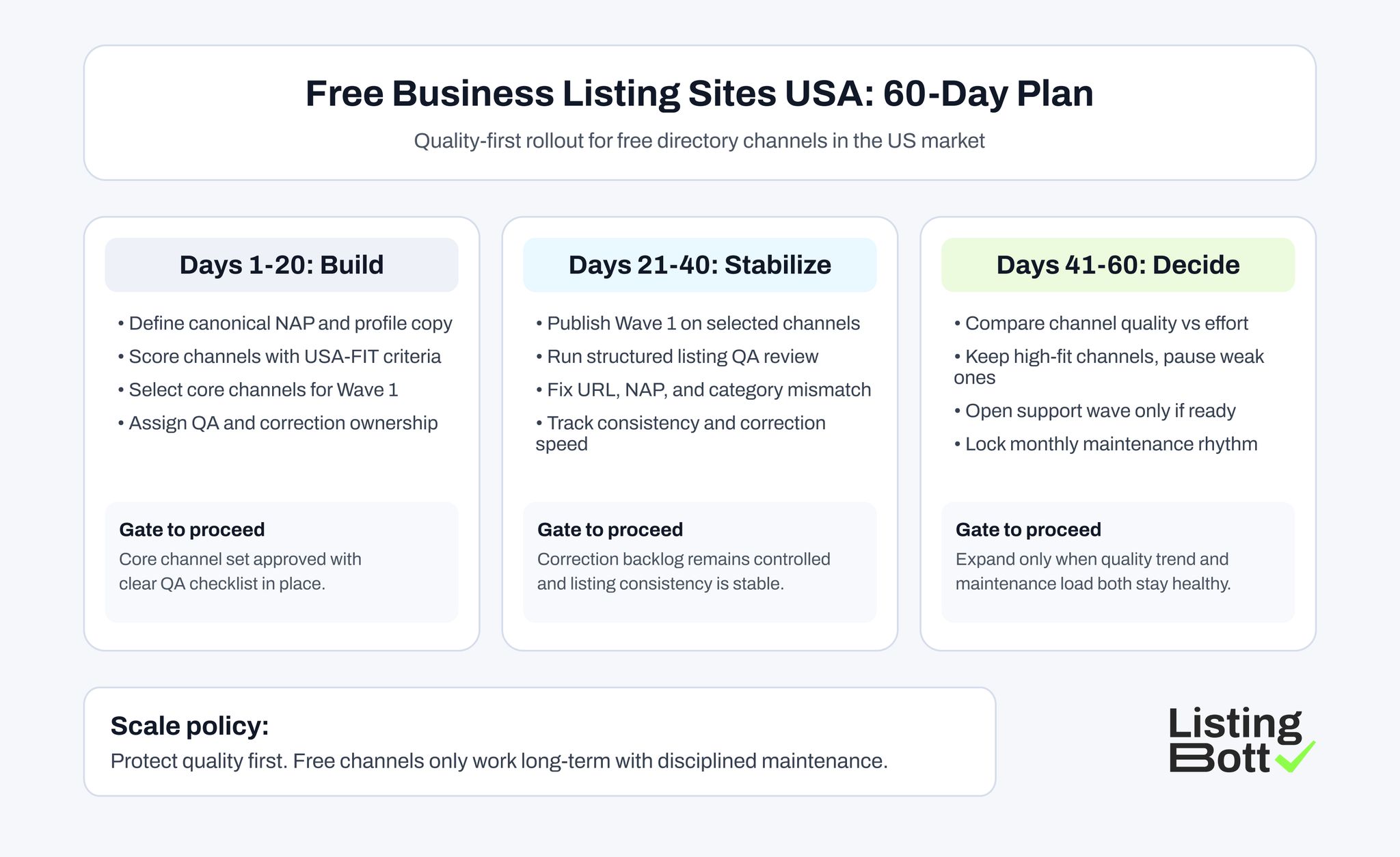
Free Business Listing Sites USA: 60-Day Plan
Where ListingBott Fits
ListingBott supports the structured execution side of directory submissions.
Typical flow:
- onboarding details are captured,
- listing scope is reviewed and approved,
- publication is executed,
- reporting is shared with status visibility.
Offer alignment:
- one-time payment model,
- publication to 100+ directories,
- no hidden extra fees,
- refund possible if process has not started.
Promise limits:
- no guaranteed ranking position,
- no guaranteed traffic by a specific date,
- no guaranteed indexing speed,
- no guaranteed outcomes controlled by third-party platforms.
Qualified DR statement: DR growth to 15 can be promised only for qualified DR-goal projects where the starting DR is below 15, the selected goal is domain growth, and the approved listing set is in place.
FAQ: Free Business Listing Sites USA
Are free business listing sites USA still worth it in 2026?
Yes, when channels are selected by fit and maintained with recurring QA. Free listings can support discoverability and trust, but only with quality controls.
How many free listing channels should we start with?
Most teams should start with 4-6 core channels and add support channels only after consistency metrics are stable.
Should we combine free listings with search engine submissions sites?
Yes, but as separate workflows. Search-engine submissions support indexing and diagnostics; local listings support profile visibility.
Do free online business directories guarantee SEO growth?
No. They can support broader SEO outcomes, but results still depend on content quality, technical health, and ongoing execution quality.
Are nap listing sites still relevant?
Yes. NAP consistency remains important for trust and local entity reliability, especially across multiple directory channels.