Table of Contents
- Edtech Channel Architecture by Growth Model
- Implementation Checklist
- Edtech-specific Risk Controls
- Common Mistakes
- 90-Day Edtech Listing Plan
- FAQ
sbb-itb-8e44301
Quick Answer
Edtech startups usually get stronger results from directory publishing when they prioritize audience fit and profile trust quality over raw submission count. In 2026, the most effective teams run directory execution as an ongoing operating process: select high-fit channels, validate profile quality fast, and scale only when maintenance capacity is stable.
A practical sequence is:
- define one canonical edtech profile baseline,
- score channels before submission,
- launch a controlled core wave,
- run recurring QA and correction loops,
- expand only after quality signals remain stable.
This approach is more reliable than mass submission because edtech products often evolve quickly across curriculum, pricing, audience segment, and delivery model. Without governance, listings become inconsistent and trust drops during evaluation.
Why Directory Strategy is Different for Edtech in 2026
Edtech buyers evaluate differently from many other categories. Decision paths usually involve trust checks by multiple stakeholders: teachers, administrators, parents, operations teams, or training managers. That means discovery channels are not only traffic sources. They also act as validation surfaces.
When edtech listings are weak, teams typically see four recurring issues:
- category mismatch between directory profile and product positioning,
- outdated claims about curriculum scope, integrations, or certifications,
- low-quality routing from listings to irrelevant landing pages,
- growing correction backlog that delays expansion.
This is why a simple seo directory list is not enough for serious outcomes. Edtech teams need channel scoring, ownership rules, and repeatable QA cycles so profile trust can keep pace with product changes.
Many teams also combine high-intent category directories with broad local business directory listings for region-specific programs, tutoring centers, or hybrid classroom products. That can work well, but only when each track is measured separately.
The EDU-SIGNAL6 Framework
Use this framework to evaluate edtech startups directory listing services before publishing.
| Factor | Practical question | Why it matters | Score (1-5) |
| Audience fit | Does the platform attract users evaluating education tools or services? | improves relevance | 1-5 |
| Intent quality | Are users near trial, demo, enrollment, or procurement intent? | improves conversion quality | 1-5 |
| Program clarity support | Can listings clearly communicate curriculum or product outcomes? | improves qualification | 1-5 |
| Trust context | Can the profile include proof signals and support details? | reduces decision friction | 1-5 |
| Update control | Can your team fix inaccuracies quickly? | reduces drift risk | 1-5 |
| Maintenance load | Can this channel be sustained without quality debt? | protects scalability | 1-5 |
Scoring thresholds:
- 24-30: core wave,
- 18-23: support wave,
- below 18: hold or skip.
This model helps teams make evidence-based decisions around business directories for seo instead of expanding channels by habit.
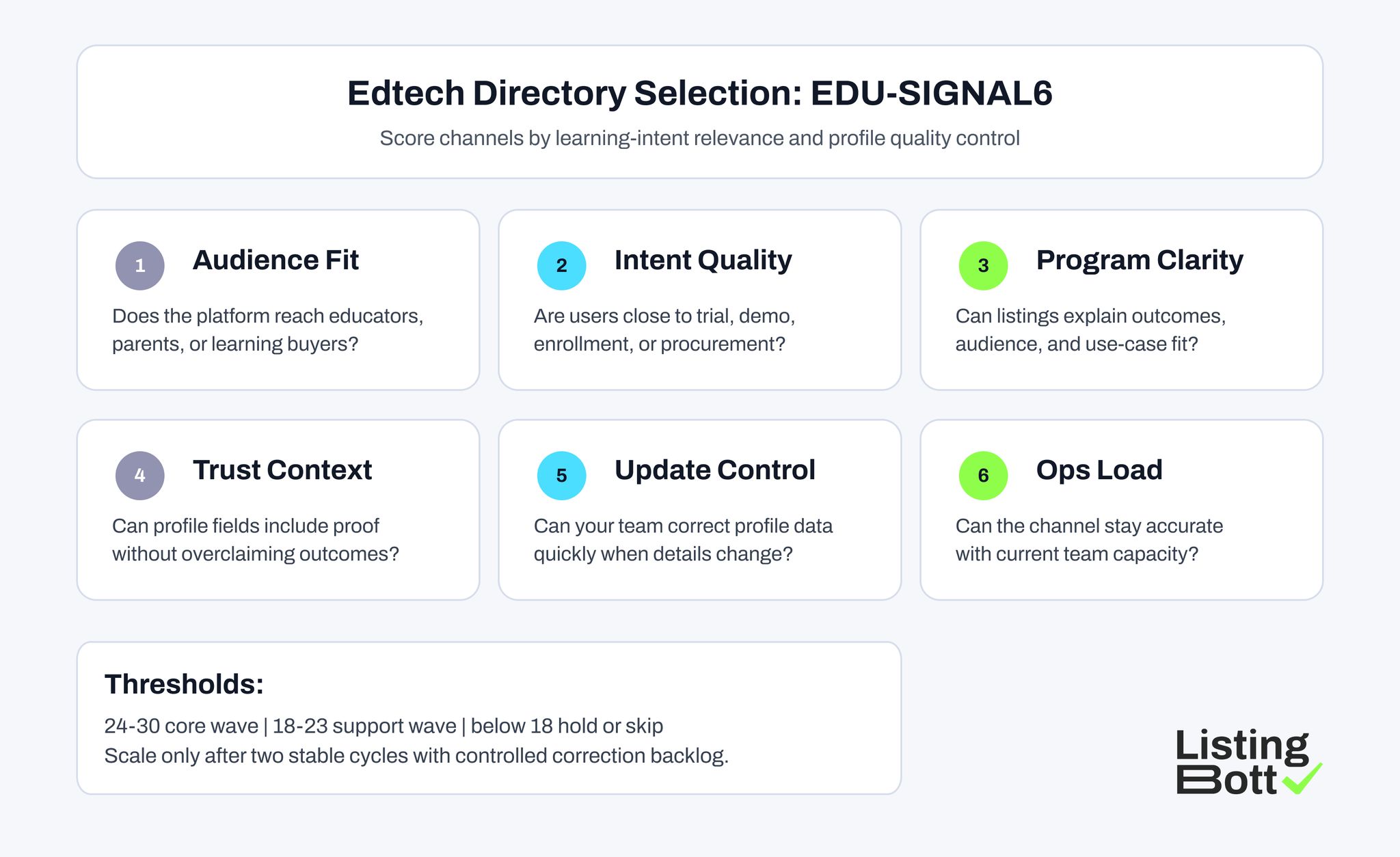
Edtech Directory Selection: EDU-SIGNAL6
Best-fit Listing Platforms for Edtech Startups Directory Listing Services
The table below combines edtech-focused platforms with broader discovery channels that are commonly used in educational buying journeys.
| Platform | URL | Why it is a best fit | Ideal company profile | Submission note |
| Education Startup Fame | https://educationstartupfame.com/ | Education-specific context helps niche relevance | early-stage edtech products | keep segment and use-case description specific |
| EducationStake | https://www.educationstake.com/ | Useful for education-focused visibility and audience alignment | founders validating early education demand | prioritize concise value statement and category fit |
| GT Scholars Learning Directory | https://gtscholars.org/learning-directory | Learning-directory context can support trust-oriented discovery | tutoring, enrichment, and student-support tools | keep audience type and outcomes clear |
| Education Directory Australia | https://www.educationdirectory.com.au | Category relevance for education-market discovery | edtech providers with Australia strategy | use region-aligned messaging and landing pages |
| Google Business Profile | https://www.google.com/business/ | Critical local and branded discovery layer | edtech brands with local footprints or hybrid services | keep NAP and service details consistent |
| Bing Places for Business | https://www.bingplaces.com/ | Useful secondary discovery and citation coverage | education providers targeting broader search distribution | map categories and URLs carefully |
| Yelp for Business | https://biz.yelp.com/ | Strong review and trust layer for decision validation | tutoring centers, training providers, local education brands | monitor profile consistency and reviews |
| MerchantCircle | https://www.merchantcircle.com/ | Supports local discovery and supplemental visibility | SMB edtech and regional education services | treat as support channel with QA controls |
| Brownbook | https://www.brownbook.net/ | Additional citation and entity-consistency signal | education startups improving profile footprint | run duplicate checks after each wave |
| Hotfrog | https://www.hotfrog.com/ | Broad directory support for incremental reach | teams testing support-wave expansion | keep expectations realistic and quality-first |
How to use this set:
- launch with 5-6 core channels,
- keep the rest as support candidates,
- expand only after two stable quality cycles.
This keeps execution focused and prevents low-quality scale from consuming team bandwidth.
Edtech Channel Architecture by Growth Model
Model A: Student/parent direct acquisition
Recommended channel mix:
- local trust-heavy channels,
- review-enabled platforms,
- education-specific directories.
Goal: improve confidence and reduce selection friction.
Model B: School or institutional procurement
Recommended channel mix:
- education-focused directories,
- business profile channels with strong completeness,
- selective broad business directories.
Goal: improve qualification and profile credibility before formal evaluation.
Model C: B2B workforce learning products
Recommended channel mix:
- business-facing directories,
- category and trust channels,
- controlled local track where region matters.
Goal: capture high-intent evaluation traffic while keeping messaging consistent across enterprise and SMB buyers.
This segmentation helps avoid one universal playbook. It also clarifies when to prioritize top business directories in usa versus education-focused channels.
Implementation Checklist
Step 1: define canonical edtech profile pack
Include:
- short and long product description,
- audience and grade/segment mapping,
- program outcomes and positioning statements,
- support and proof assets,
- destination URL map by intent.
Step 2: score candidate channels
Apply EDU-SIGNAL6 and classify each platform as core, support, or hold.
Step 3: map destinations by user intent
Do not send all listings to one page. Use:
- program pages for curriculum intent,
- solution pages for role-specific intent,
- localized pages for region-specific demand.
Step 4: prepare reusable listing assets
Before launch, prepare:
- platform-adapted profile copy,
- screenshots/logo variations,
- FAQ snippets,
- proof elements,
- QA checklist.
Step 5: launch core wave
Record submission data:
- platform,
- submission date,
- approval status,
- live profile URL,
- assigned owner.
Step 6: run first QA cycle
Validate:
- profile consistency,
- category alignment,
- URL correctness,
- duplicate risk,
- completeness level.
Step 7: close critical issues first
No support-wave expansion while high-impact mismatches remain unresolved.
Step 8: open support wave selectively
Add new channels only after two stable review cycles with manageable correction load.
Step 9: monthly keep/improve/pause review
Evaluate channels by:
- quality trend,
- correction burden,
- intent relevance,
- contribution potential.
This flow turns free online business directories into controlled assets rather than unmanaged backlog.
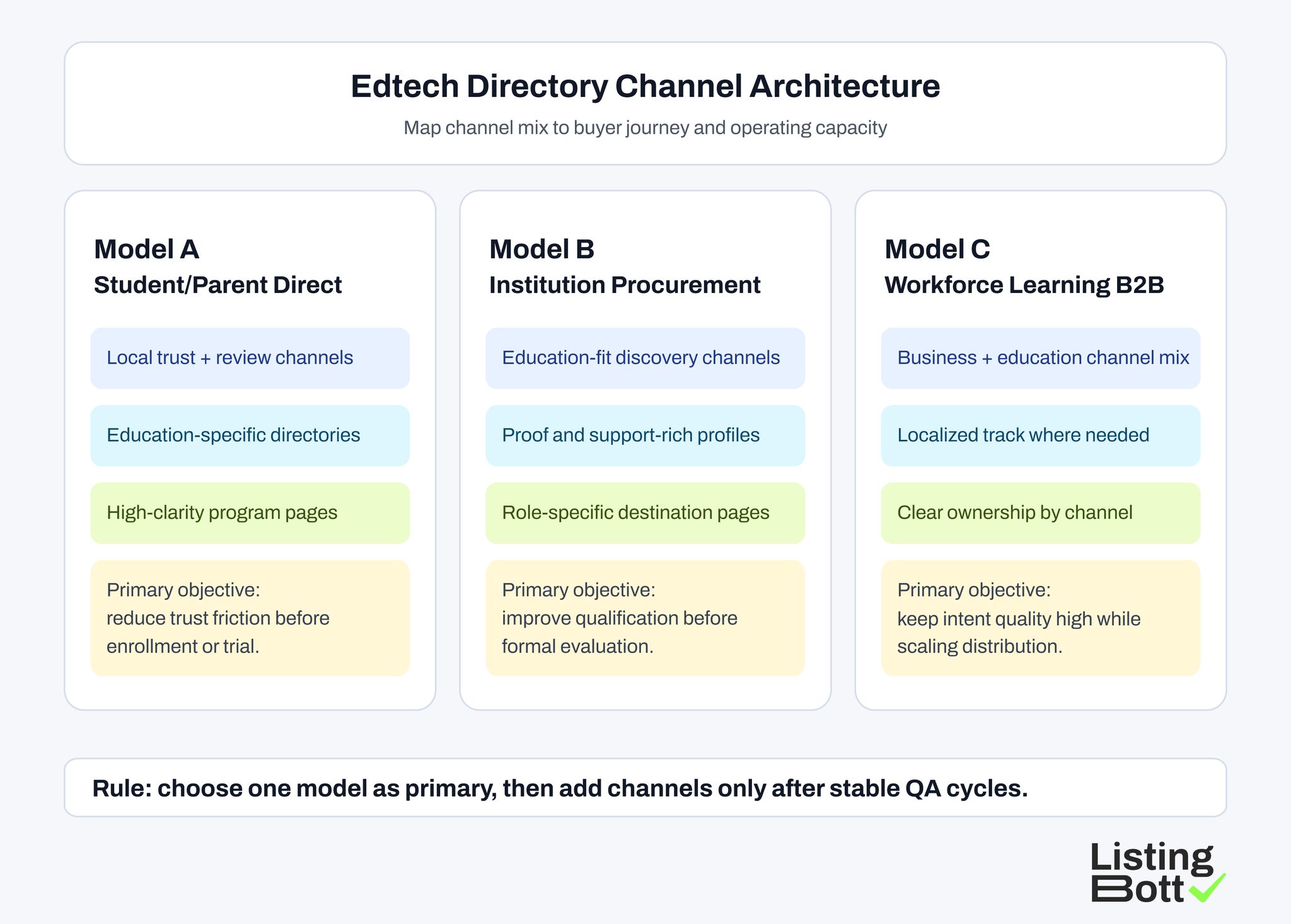
Edtech Directory Channel Architecture
KPI Board for Edtech Listing Operations
Use a decision-ready KPI board so teams can scale safely.
| KPI | Why it matters | Healthy signal | Risk signal |
| Consistency rate | confirms profile data integrity | stable 95%+ | repeated field mismatch |
| Correction closure speed | measures operational control | predictable closure window | aging issue backlog |
| Duplicate profile rate | tracks listing hygiene | low and declining | recurring duplicates |
| Intent-quality share | tests discovery relevance | sustained high-intent visits | high bounce, low relevance |
| Maintenance load ratio | protects scalability | stable effort per cycle | rising effort without quality gain |
This board is especially useful when teams compare performance across free online directory listings and higher-intent channels.
Keep/Improve/Pause Scenarios for Edtech Teams
Most teams understand the framework but still struggle with monthly decisions. The easiest way to reduce confusion is to use scenario-based rules.
Scenario 1: high traffic, low relevance
If a channel sends traffic but intent-quality share is low for two consecutive cycles, treat that channel as a candidate for pause. High session count without qualified evaluation behavior usually means the listing context is not aligned with your audience.
Action sequence:
- check category mapping and profile copy once,
- verify destination URL intent match,
- if quality does not recover in the next cycle, pause channel.
Scenario 2: low traffic, high quality
Some channels produce smaller volume but strong engagement and conversion-assisted behavior. These often deserve a keep decision even when volume appears modest.
Action sequence:
- keep the channel active,
- improve profile depth and proof quality,
- monitor consistency and correction speed to protect performance.
Scenario 3: frequent corrections, stable intent
If a channel has good intent fit but generates frequent correction tasks, classify it as improve rather than pause. The issue may be operational readiness, not channel value.
Action sequence:
- assign a clear owner,
- tighten profile update cadence,
- standardize reusable listing assets.
Scenario 4: duplicated profiles after expansion
If duplicate rate rises after opening support wave, pause additional expansion immediately and run cleanup before continuing.
Action sequence:
- close duplicate backlog,
- restore baseline consistency,
- reopen expansion only after two stable review cycles.
Using these scenarios makes monthly decisions faster and reduces subjective debates across marketing and operations teams.
Edtech-specific Risk Controls
1) Program-claim consistency
Keep claims aligned across all profiles when curriculum or product scope changes.
2) Audience-label accuracy
If the audience changes (K-12, higher-ed, workforce), update categories and descriptions quickly.
3) Compliance-safe wording
Avoid overclaiming outcomes. Keep learning impact statements factual and supportable.
4) URL-to-intent mapping control
Each platform should route users to the most relevant destination page.
5) Duplicate suppression routine
Run duplicate scans after each wave and major brand updates.
6) Expansion gate
Require two stable cycles before adding channels.
7) Channel retirement rule
Pause channels with high operational load and weak contribution quality.
These controls help teams scale visibility without sacrificing trust quality.
When to Combine Local and Non-Local Tracks
Many edtech startups have mixed demand: some users search nationally, others search by city or region. Running both tracks can work, but only when reporting and ownership are split.
Use local track when:
- programs are tied to location,
- there are local landing pages,
- operational delivery varies by region.
Use non-local track when:
- product is primarily online,
- demand is category-driven,
- centralized messaging can be maintained globally.
Practical reporting split:
- local track: consistency and geo-intent KPIs,
- non-local track: qualification and engagement KPIs,
- monthly decisions per track,
- shared quality standards across both tracks.
This approach keeps growth manageable and improves decision clarity for each channel type.
Common Mistakes
1) Expanding before baseline quality is stable
Early scale amplifies existing inconsistencies.
2) Using generic profile copy everywhere
Edtech segments differ; one message does not fit all audiences.
3) Tracking only submission counts
Launch count alone does not indicate useful discovery quality.
4) Ignoring correction ownership
Without clear ownership, profile quality decays quickly.
5) Keeping weak channels forever
Low-value channels create ongoing maintenance drag.
6) Mixing local and national metrics
Blended reporting hides which track is actually effective.
7) Over-relying on one channel type
A balanced portfolio is usually more resilient than single-channel dependence.
90-Day Edtech Listing Plan
Days 1-30: foundation
- finalize canonical profile pack,
- score channels with EDU-SIGNAL6,
- launch core wave,
- assign correction and QA owners.
Days 31-60: stabilization
- run QA cycles,
- close high-impact mismatches,
- remove duplicates,
- improve low-depth profiles.
Days 61-90: optimization
- open support wave if gates pass,
- pause low-value channels,
- refine destination mapping,
- lock monthly KPI review cadence.
By day 90, the target is a sustainable listing system that supports growth without quality decay.
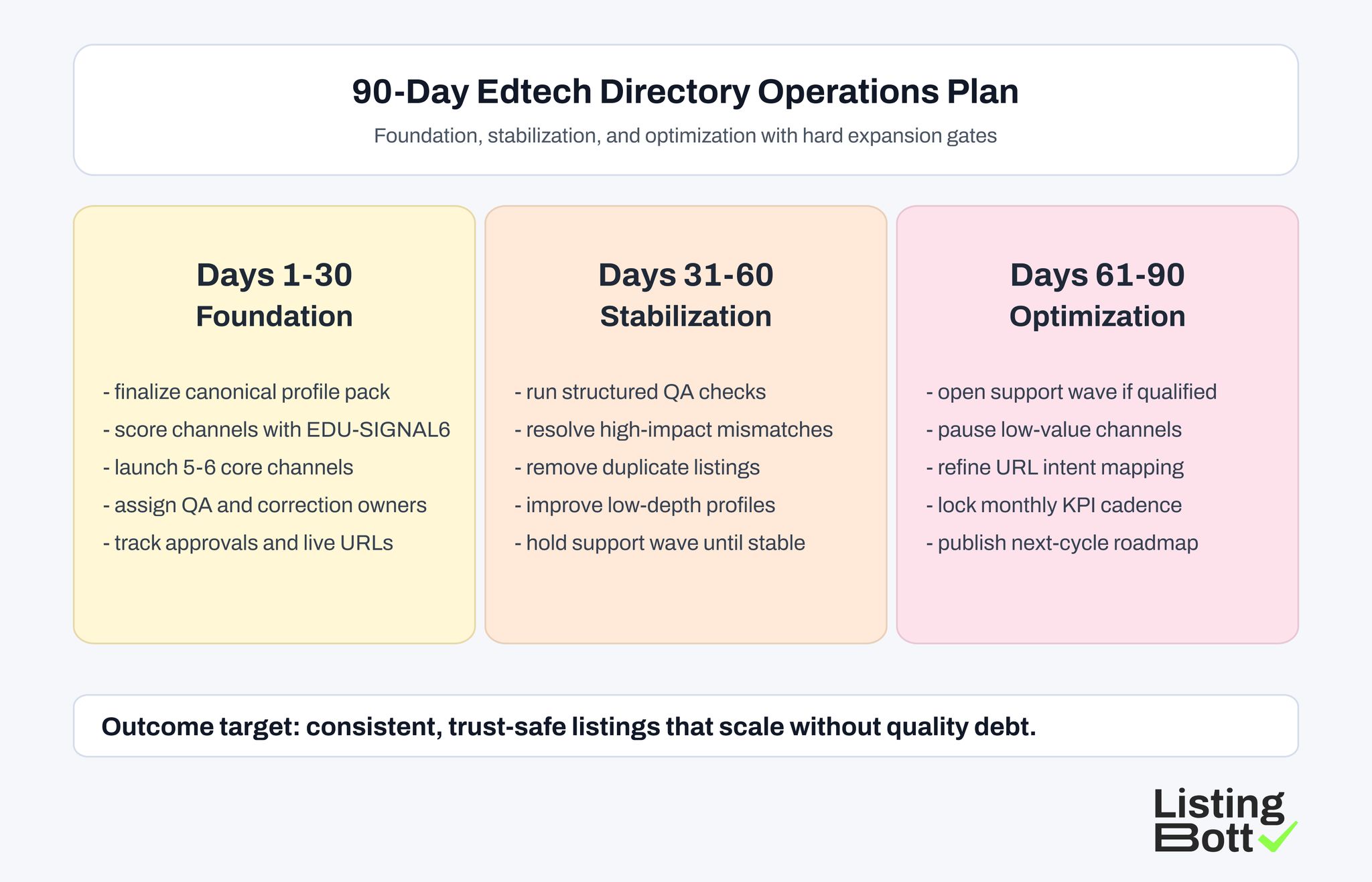
90-Day Edtech Directory Operations Plan
Where ListingBott Fits
ListingBott helps teams execute directory publication with repeatable process control and reporting visibility.
Typical flow:
- onboarding details are collected,
- listing scope is approved,
- publication is executed,
- reporting is delivered.
Offer alignment:
- one-time payment model,
- publication to 100+ directories,
- no hidden extra fees,
- refund possible if process has not started.
Promise limits:
- no guaranteed ranking position,
- no guaranteed traffic by a specific date,
- no guaranteed indexing speed,
- no guaranteed outcomes controlled by third-party platforms.
Qualified DR statement: DR growth to 15 can be promised only when starting DR is below 15, the selected goal is domain growth, and the approved listing set is in place.
FAQ: Edtech Startups Directory Listing Services
How many directories should an edtech startup launch first?
Most teams should start with 5-6 high-fit channels and expand only after quality and correction metrics stabilize.
Are free channels useful for edtech distribution?
They can be useful as support channels if profile quality and maintenance cadence are controlled.
Should edtech listings point only to homepage?
No. Destination pages should match user intent, segment, and program context.
How often should directory profiles be reviewed?
Monthly review is a practical baseline, with faster updates after product or program changes.
Can directory listings guarantee SEO results?
No. Listings support visibility and trust signals, but outcomes depend on broader SEO and market conditions.