Table of Contents
- The ECOM-RATE Framework
- Channel Architecture by Ecommerce Model
- Implementation Checklist
- Common Mistakes
- 90-Day Ecommerce Listing Plan
- FAQ
sbb-itb-8e44301
Quick Answer
Ecommerce brands get better outcomes from directory distribution when they run it as a quality-controlled growth channel, not a one-time blast. In 2026, the highest-performing teams use a focused portfolio of business directories, protect profile consistency, and expand only after each wave is stable.
A practical operating sequence is:
- define one canonical brand profile,
- score platforms before submission,
- launch a controlled core wave,
- run correction and QA cycles,
- scale only when maintenance load remains healthy.
This approach works better than volume-first publishing because ecommerce offers, logistics, and positioning change quickly. If listings are not governed, old shipping details, outdated category labels, and inconsistent brand claims accumulate fast.
Why this Matters for Ecommerce in 2026
Ecommerce discovery is no longer linear. Buyers move between search, comparison pages, map surfaces, review platforms, social proof checks, and marketplace-style directory pages before they convert. That behavior makes listing quality part of conversion quality, not only SEO hygiene.
When ecommerce directory execution is weak, teams usually see the same pattern:
- product positioning differs by platform,
- category placement is inconsistent,
- outdated links send users to wrong pages,
- operations spend more time fixing drift than scaling visibility.
This is where many teams over-trust a generic seo directory list. A list can be useful for ideation, but publishing decisions should still be made with fit scoring, ownership rules, and monthly quality controls.
For ecommerce, this is especially important because customer trust is sensitive to detail accuracy. Listing mismatches around shipping regions, returns, pricing context, or product type reduce intent quality even when traffic volume looks healthy.
The ECOM-RATE Framework
Use this model to evaluate ecommerce brands directory listing services before execution.
| Factor | Practical question | Why it matters | Score (1-5) |
| Buyer intent fit | Are users on this platform close to research or purchase intent? | improves conversion quality | 1-5 |
| Profile depth support | Can the listing show value proposition, category fit, and trust proof? | improves qualification | 1-5 |
| Data consistency control | Can core profile fields be updated quickly and reliably? | reduces drift risk | 1-5 |
| Editorial quality | Is the platform reasonably curated and usable? | protects brand context | 1-5 |
| Local relevance option | Can this channel support local business directory listings where needed? | supports geo use cases | 1-5 |
| Maintenance effort | Can this channel be maintained with current team capacity? | protects scalability | 1-5 |
Scoring thresholds:
- 24-30: core channel set,
- 18-23: support channel set,
- below 18: hold or remove.
The core idea is simple: keep only channels you can maintain with quality. Strong business directories for seo performance is usually a byproduct of consistency and relevance, not aggressive submission count.
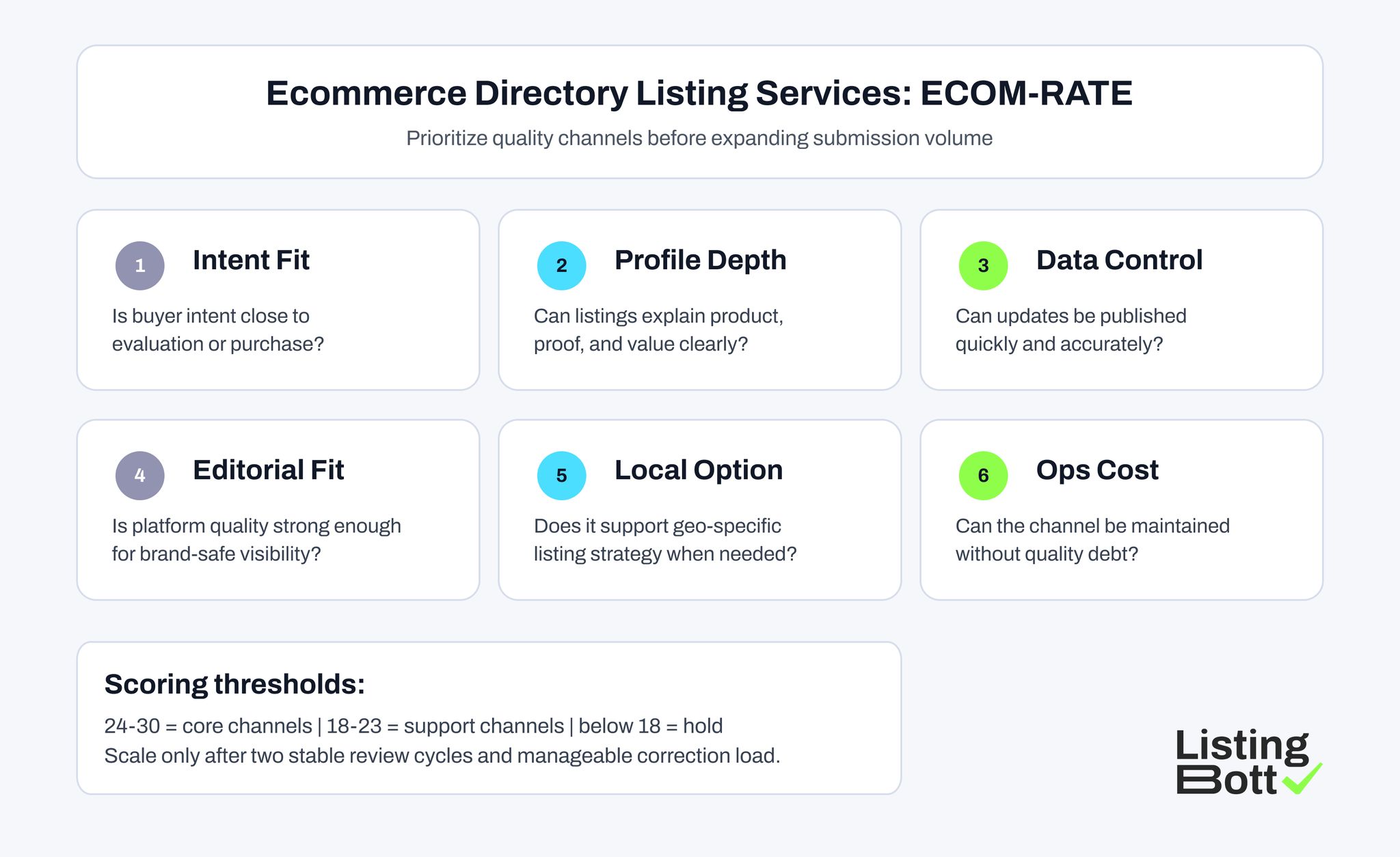
Ecommerce Directory Listing Services: ECOM-RATE
Best-fit Listing Platforms for Ecommerce Brands Directory Listing Services
The right mix usually combines trust-heavy profiles, local discovery layers, and broad business directories.
| Platform | URL | Why it is a best fit | Ideal company profile | Submission note |
| Google Business Profile | https://www.google.com/business/ | Strong visibility in local and branded discovery paths | ecommerce brands with pickup, showroom, or regional presence | keep hours, region, and URL mapping updated |
| Apple Business Connect | https://businessconnect.apple.com/ | Important for Apple Maps ecosystem visibility | DTC brands with location-specific demand | verify category and contact data carefully |
| Bing Places | https://www.bingplaces.com/ | Useful secondary discovery channel with manageable upkeep | ecommerce teams covering multiple regions | align NAP and destination URLs to primary profile |
| Yelp for Business | https://biz.yelp.com/ | High trust impact for buyers validating business legitimacy | ecommerce brands with service or local support layers | monitor review-response process and profile accuracy |
| Better Business Bureau | https://www.bbb.org/ | Trust and legitimacy signal for risk-sensitive buyers | established ecommerce businesses | keep compliance-facing business details consistent |
| Trustpilot | https://www.trustpilot.com/ | Strong proof layer during mid-funnel evaluation | growth-stage ecommerce brands | align review strategy with support operations |
| MerchantCircle | https://www.merchantcircle.com/ | Supplemental listing visibility in local business ecosystems | SMB ecommerce with regional targeting | maintain consistent descriptions and category mapping |
| Hotfrog | https://www.hotfrog.com/ | Broad directory footprint across multiple verticals | brands testing support-wave coverage | treat as support channel, not primary channel |
| Foursquare for Business | https://business.foursquare.com/ | Useful location and business data layer integration | brands with physical touchpoints | keep business data synchronized with primary source |
| Brownbook | https://www.brownbook.net/ | Additional profile and citation layer for brand entities | ecommerce brands building entity consistency | use strict QA and monitor duplicates |
How to apply this set:
- choose 5-6 platforms for wave one,
- keep 3-4 as support channels,
- add new channels only after quality gates pass.
This avoids the common mistake of publishing to many free online business directories before core governance is stable.
Channel Architecture by Ecommerce Model
Different ecommerce models need different listing mixes.
DTC consumer brand
Recommended mix:
- trust and review platforms,
- local discovery channels,
- selected broad directories.
Priority goal: reinforce brand legitimacy and reduce purchase anxiety during external validation.
B2B ecommerce catalog
Recommended mix:
- business-focused directories,
- category-driven profile platforms,
- high-intent channel pages that support qualification.
Priority goal: improve fit quality rather than broad discovery volume.
Multi-region ecommerce operator
Recommended mix:
- primary profile platforms with update control,
- geo-track directories for key markets,
- support channels only where localized pages are ready.
Priority goal: preserve consistency across regions and avoid operational drift.
This segmentation helps teams avoid one generic plan for all catalog structures. It also improves decisions about when to use top business directories in usa versus region-specific channels.
Implementation Checklist
Step 1: create canonical ecommerce profile pack
Define one source that includes:
- short and long brand description,
- category and use-case mapping,
- shipping/region notes,
- trust and proof elements,
- URL map by intent.
Step 2: score channels with ECOM-RATE
Classify each channel as core, support, or hold.
Step 3: map listing destinations by intent
Do not route every platform to homepage. Use:
- collection pages for broad category intent,
- specific landing pages for niche intent,
- trust pages for proof-heavy environments.
Step 4: prepare reusable assets
Before submission, prepare:
- profile copy variants,
- logos and screenshots,
- FAQ snippets,
- support contact references,
- QA checklist.
Step 5: launch core wave
Record:
- submission date,
- platform status,
- live URL,
- owner.
Step 6: run first QA cycle
Validate:
- field consistency,
- category accuracy,
- link accuracy,
- duplicate status,
- profile completeness.
Step 7: close high-impact mismatches
No support wave until critical issues are closed.
Step 8: open support wave with limits
Add support channels only when two consecutive review cycles are stable.
Step 9: monthly keep/improve/pause review
Use objective criteria:
- quality trend,
- correction effort,
- intent fit,
- contribution potential.
This process supports scalable execution across both local business directory listings and broader non-local channels.
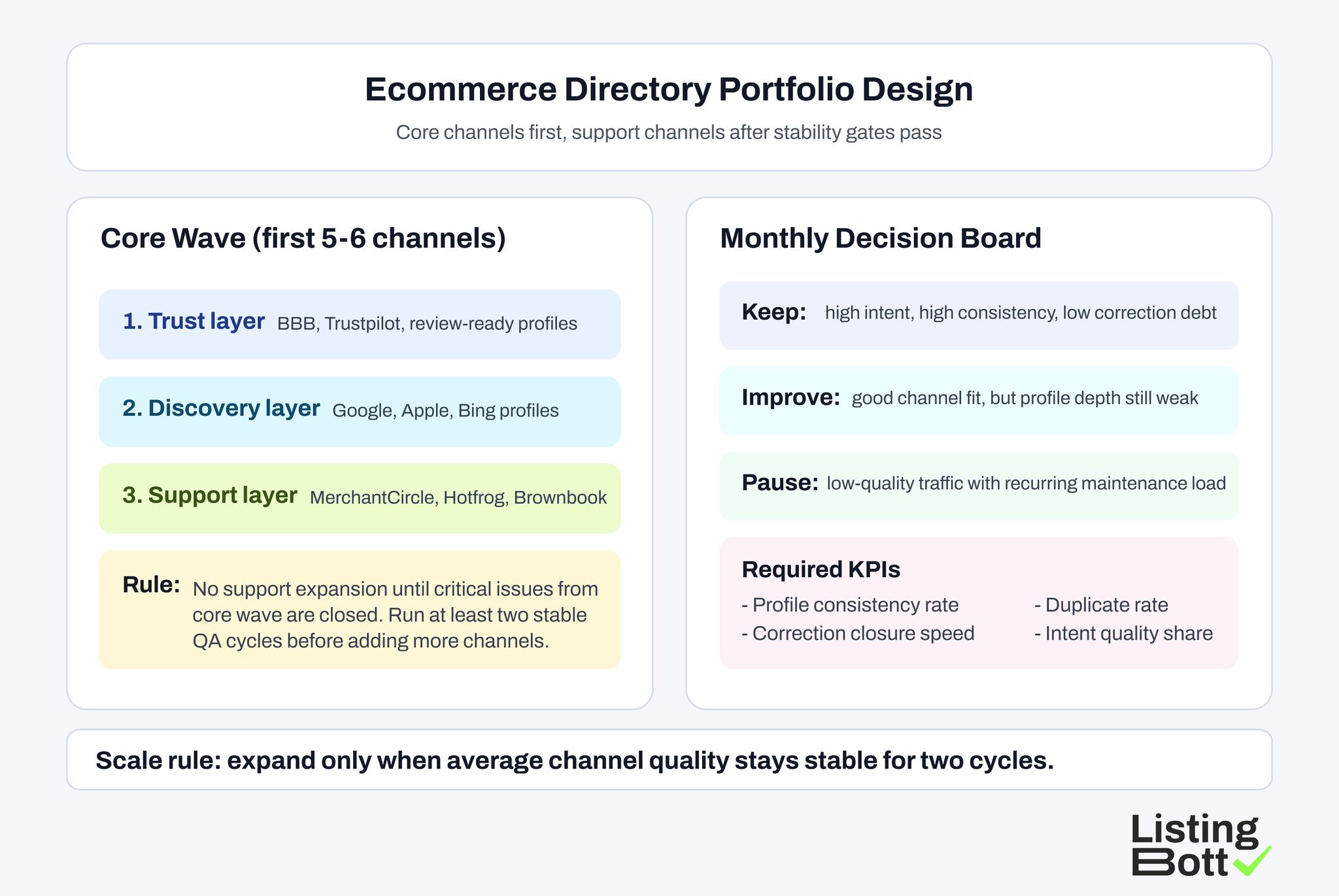
Ecommerce Directory Portfolio Design
KPI Board for Ecommerce Listing Operations
Use an operational KPI board that supports decisions, not vanity reporting.
| KPI | Why it matters | Healthy signal | Risk signal |
| Profile consistency rate | tracks data integrity across platforms | stable 95%+ | recurring mismatch pattern |
| Correction closure speed | measures operational responsiveness | predictable closure windows | growing aged backlog |
| Duplicate profile rate | reflects listing hygiene | low and declining | repeated duplicate creation |
| Intent-quality share | checks whether traffic is relevant | strong engaged sessions | low-intent traffic dominates |
| Maintenance load ratio | protects scalability | stable team effort per cycle | rising effort with flat quality |
Teams that rely only on launch counts cannot distinguish productive channels from expensive channels. KPI-driven operations solve that.
Risk Controls Specific to Ecommerce Brands
1) Offer freshness control
Promotions and shipping terms change frequently. Build a refresh routine to prevent stale claims across profiles.
2) Category alignment control
Misclassified listings create low-fit traffic. Review category mapping quarterly.
3) URL mapping control
Each listing should point to a destination page that matches user intent.
4) Proof consistency control
Trust signals should match live site messaging and policy pages.
5) Duplicate suppression routine
Run duplicate checks after each wave and after major brand naming updates.
6) Expansion gate
Require two stable cycles before adding more channels.
7) Channel retirement rule
Pause channels with high maintenance load and weak quality contribution.
These controls keep ecommerce listing programs sustainable even when teams expand into free online directory listings for incremental reach.
Operational Ownership Model for Ecommerce Teams
Directory execution is often treated as a side task, which is why quality declines after the first wave. A lightweight ownership model keeps the program usable without adding heavy process.
Recommended role split:
- profile owner: controls canonical business data and category definitions,
- publishing owner: manages submissions and approval tracking,
- QA owner: validates consistency, links, and duplicates after launch,
- reporting owner: updates KPI board and runs keep/improve/pause reviews.
If one person covers multiple roles, that is still fine. What matters is explicit accountability for each decision point.
Minimum Evidence Packet for each Wave
Before launching a new wave, store one shared packet with:
- approved profile baseline,
- selected channels with ECOM-RATE scores,
- destination URL map,
- owner assignments,
- QA checklist and review dates.
This packet reduces rework during monthly reviews and makes onboarding easier when new team members join the listing workflow.
Weekly and Monthly Cadence
Use a simple cadence:
- weekly: process corrections, update status, close critical mismatches,
- monthly: evaluate channel quality and decide keep/improve/pause.
Teams using this cadence usually avoid the “launch now, fix later” cycle that turns directory work into technical debt.
When to Use Local Tracks vs Broad Directory Tracks
Not every ecommerce brand should run both tracks at the same time.
Use a local track when:
- there are region-specific landing pages,
- fulfillment or service depends on location,
- search intent includes city/state terms.
Use a broad track when:
- demand is not location-bound,
- category discovery is primary,
- centralized maintenance capacity is limited.
If you run both tracks, separate reporting is essential. Mixing signals hides which channels truly support qualified outcomes.
A practical split:
- local track = profile consistency + geo relevance KPIs,
- broad track = intent fit + contribution quality KPIs,
- monthly decision review per track,
- clear ownership per track.
This is how teams turn an initial seo directory list into a controlled operating system instead of an unmanaged submission backlog.
Common Mistakes
1) Publishing to too many channels too early
Coverage grows faster than maintenance capacity.
2) Treating all directories as equal
Platform fit varies significantly by buyer behavior and business model.
3) Reusing one generic profile everywhere
Intent context differs, so quality drops when copy is not adapted.
4) Ignoring correction speed
Slow fixes create compounding trust and conversion losses.
5) Running support channels before core stability
Support channels amplify drift when core operations are unstable.
6) Reporting only traffic volume
Volume without relevance can hide declining channel quality.
7) Never pruning low-value channels
Without retirement criteria, operations become harder each quarter.
90-Day Ecommerce Listing Plan
Days 1-30: foundation
- finalize canonical profile pack,
- score candidate channels,
- launch core wave,
- set QA ownership and cadence.
Days 31-60: stabilization
- run QA cycles,
- close high-impact mismatches,
- reduce duplicates,
- improve weak profile sections.
Days 61-90: optimization
- open support wave if gates pass,
- prune weak channels,
- refine destination mapping,
- lock monthly KPI reviews.
By day 90, the objective is a stable visibility system that can be maintained without quality decay.
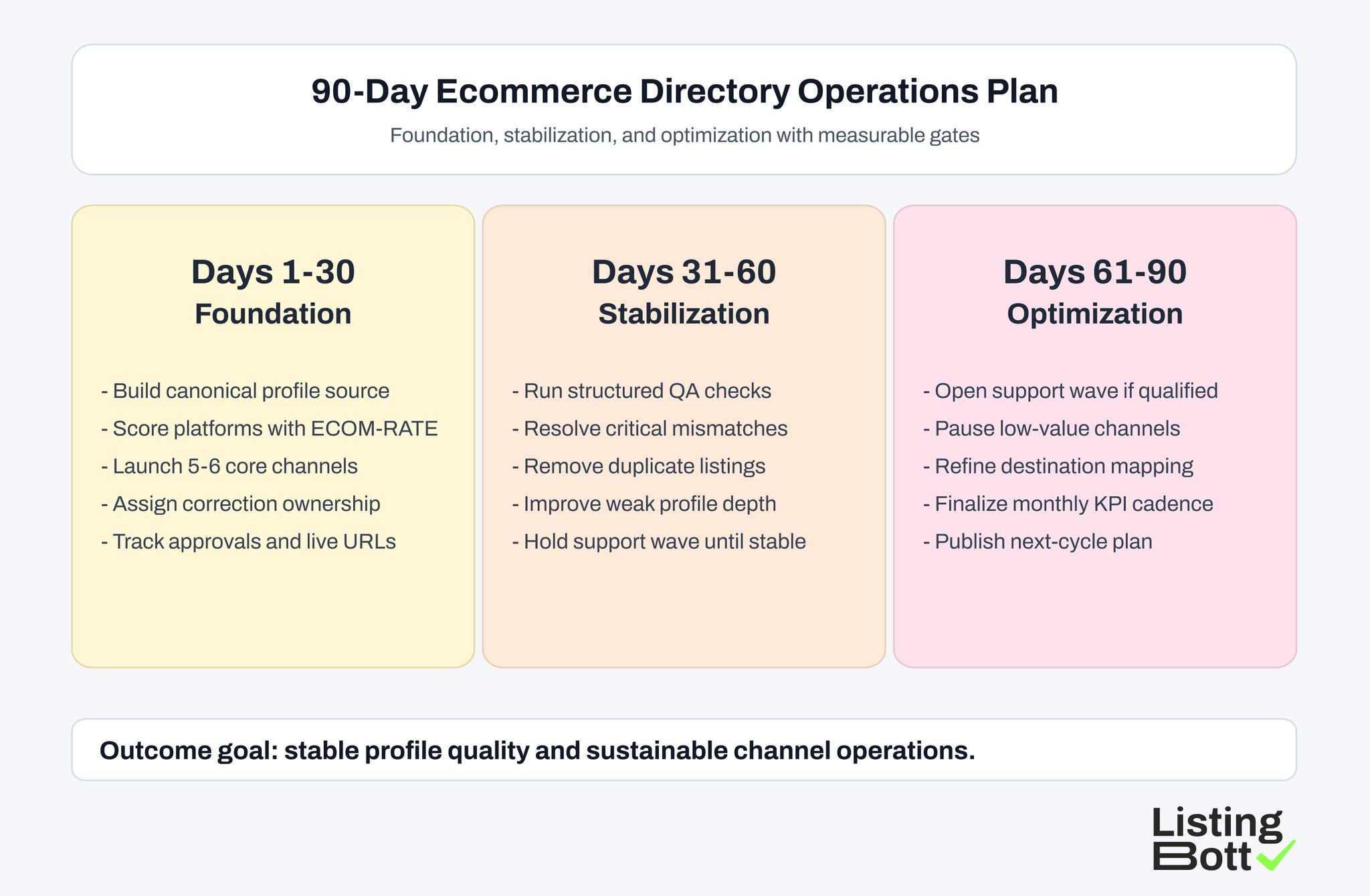
90-Day Ecommerce Directory Operation Plan
Where ListingBott Fits
ListingBott helps teams execute directory publication with repeatable process control and reporting clarity.
Typical flow:
- onboarding details are collected,
- listing scope is approved,
- publication is executed,
- reporting is delivered.
Offer alignment:
- one-time payment model,
- publication to 100+ directories,
- no hidden extra fees,
- refund possible if process has not started.
Promise limits:
- no guaranteed ranking position,
- no guaranteed traffic by a specific date,
- no guaranteed indexing speed,
- no guaranteed outcomes controlled by third-party platforms.
Qualified DR statement: DR growth to 15 can be promised only when starting DR is below 15, the selected goal is domain growth, and the approved listing set is in place.
FAQ: Ecommerce Brands Directory Listing Services
How many platforms should an ecommerce brand launch first?
Most ecommerce teams should launch 5-6 high-fit channels in the first wave, then expand only after quality and maintenance metrics stabilize.
Are free directories useful for ecommerce brands?
They can be useful as support channels, but only when profile quality and correction cadence can be maintained.
Should every listing point to homepage?
No. Destination pages should match user intent by platform and query context.
How often should ecommerce listings be reviewed?
Monthly review is a strong baseline, with faster updates after pricing, shipping, or offer changes.
Can directory listings guarantee SEO performance?
No. Listings support trust and discovery signals, but outcomes depend on broader SEO and market conditions.