Table of Contents
- Directory Categories Startups should Separate
- A Practical Portfolio Design by Startup Stage
- 90-Day Rollout Plan for Directory Quality
- Common Mistakes when Choosing Startup Directories
- FAQ
sbb-itb-8e44301
Quick answer
The best startup directories for seo are not the directories with the largest raw list size. They are the directories that match your buyer intent, allow high-quality profiles, and can be maintained consistently after launch.
For most startups in 2026, a useful first portfolio is:
- 3-4 high-intent startup discovery directories,
- 2-3 software/review directories with clear category mapping,
- 1-2 launch-community channels for early traction and feedback.
This approach outperforms bulk submission because it improves profile quality and makes performance measurable. A broad seo directory list can still be useful, but only as research input, not as execution policy.
Why this Keyword is Hard in Practice
Most articles about startup directories focus on "top 50" or "100+" lists. That is useful for brainstorming, but not enough for execution.
The real challenge is operational:
- Which directories actually fit your startup stage?
- Which ones support your product category well?
- Which ones can your team maintain without creating profile drift?
The answer changes by company type. A bootstrapped devtool startup, a B2B workflow SaaS, and a consumer app may all use different directory sets even if they are all working on business directories for seo.
In 2026, the teams winning this channel usually do three things well:
- they select fewer directories with stronger fit,
- they maintain profile consistency after each product or messaging update,
- they treat directories as a measurable growth layer, not just "SEO chores."
What "Best" should Mean in 2026
For this topic, "best" should not mean biggest domain or highest vanity metric alone. It should mean best fit for your goals and execution capacity.
Use this definition:
- best = high fit + manageable operations + measurable outcomes.
If one directory brings lower traffic but higher conversion quality with less maintenance overhead, it can be a better choice than a larger but noisy platform.
That is especially true for startups with lean teams. You usually do not have spare cycles to manage 40 low-value profiles.
Directory Categories Startups should Separate
Before ranking platforms, segment them by job-to-be-done.
1) Startup discovery directories
These are built around startup/product discovery behavior.
Typical use:
- initial awareness,
- discovery from early adopters,
- exposure in founder/product communities.
2) Software comparison/review directories
These are closer to purchase-intent behavior.
Typical use:
- category-level comparison,
- buyer validation,
- trust and shortlist support.
3) Launch feed platforms
These are useful when your startup has regular shipping milestones.
Typical use:
- periodic launch visibility,
- feature-release amplification,
- short-cycle traffic bursts.
4) General local/industry directories
These can support trust and citation consistency in selected cases.
Typical use:
- local-intent demand,
- brand validation layers,
- specific vertical relevance.
This is where the distinction between seo local business listings and startup-discovery platforms matters. If your demand is global and product-led, local-only channels should be selective, not dominant.
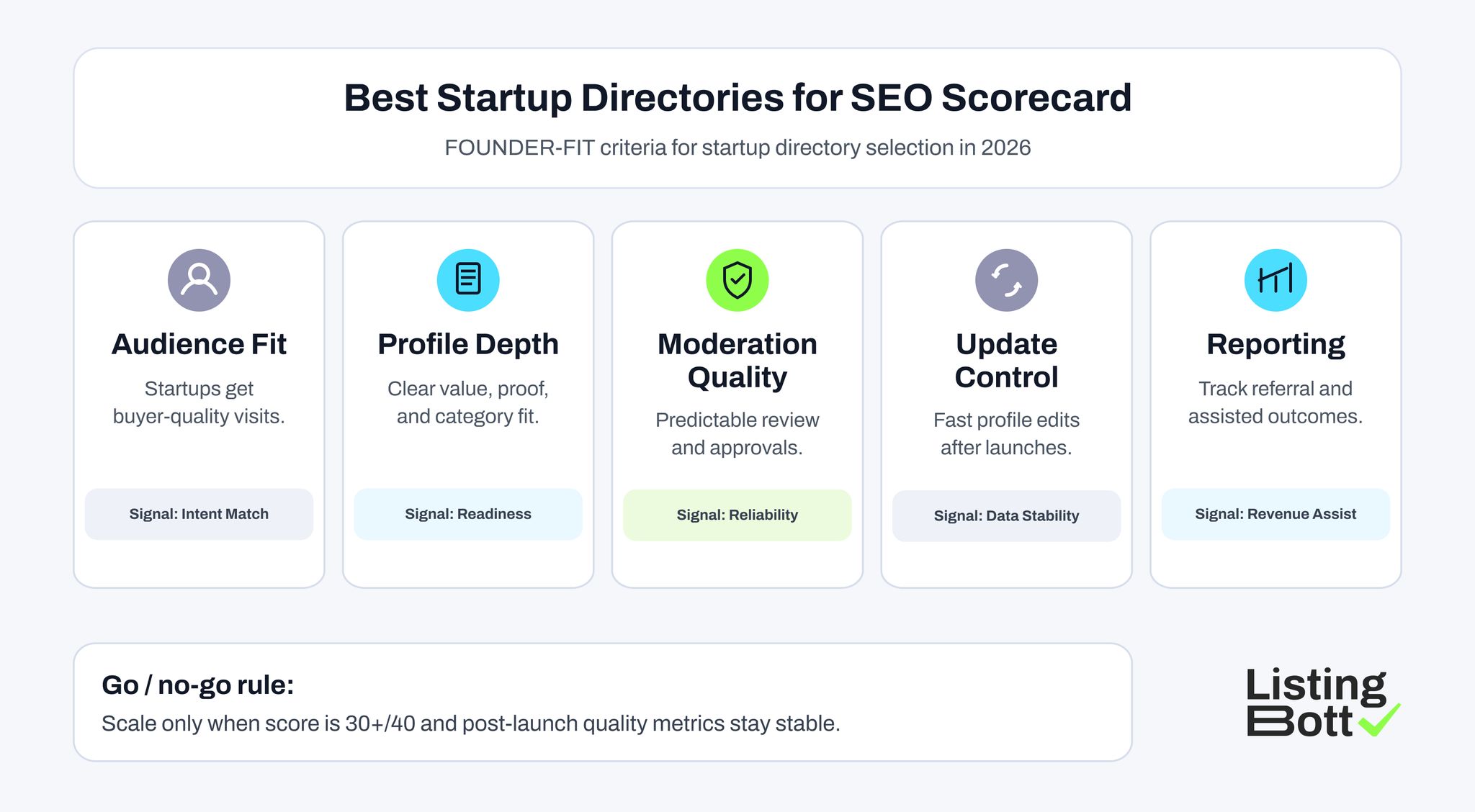
The FOUNDER-FIT Score for Ranking Startup Directories
Use this scoring model to choose the best startup directories instead of relying on generic lists.
| Criterion | What to evaluate | Why it matters | Score (1-5) |
| Audience intent | Are users actively looking for products like yours? | Directly influences referral quality | 1 = weak, 5 = strong |
| Category precision | Can you map your product to accurate categories? | Controls relevance and discovery quality | 1 = poor, 5 = strong |
| Profile depth | Can you add enough product context and proof? | Impacts conversion readiness | 1 = shallow, 5 = rich |
| Moderation quality | Is approval/review flow clear and stable? | Reduces wasted execution cycles | 1 = unclear, 5 = clear |
| Update flexibility | Can you update quickly after changes? | Prevents stale positioning | 1 = slow, 5 = fast |
| Trust compatibility | Does this directory support credibility signals? | Improves buyer confidence | 1 = weak, 5 = strong |
| Outcome visibility | Can you measure referral and assisted value? | Enables keep/de-prioritize decisions | 1 = low, 5 = clear |
| Team capacity fit | Can your team maintain this platform monthly? | Prevents operational debt | 1 = hard, 5 = manageable |
Working thresholds
- 30-40: priority rollout set
- 24-29: test tier
-
below 24: de-prioritize unless there is a strategic reason
Best Startup Directories for SEO Scorecard
Best-Fit Listing Platforms for Best Startup Directories for SEO
The list below is based on your local startup directory corpus and example references. Use it as a decision table, not a mandatory submission checklist.
| Platform | URL | Why it is a best fit | Ideal startup profile | Submission note |
| Startup Stash | https://startupstash.com/ | Strong startup-resource and discovery context for category exploration | Early and growth-stage startups building discoverability | Use precise category mapping to avoid irrelevant discovery |
| Startup Found | https://startupfound.com/ | Startup-focused discovery environment with practical product visibility | SaaS and tool startups seeking early awareness | Keep profile narrative concise and outcome-oriented |
| Startups.fyi | https://www.startups.fyi/ | Useful startup showcase channel for visibility and validation | Founders testing positioning and early traction | Keep value proposition and problem statement aligned with website copy |
| Startuplist | https://startuplist.ing | Structured listing format for startup discovery journeys | Lean startup teams with clear category fit | Category and tag accuracy heavily affect usefulness |
| Launching Next | https://www.launchingnext.com/ | Supports launch-driven visibility cycles | Startups shipping meaningful releases regularly | Time submissions around launch milestones, not random dates |
| TinyLaunch | https://www.tinylaunch.com/ | Discovery channel with startup/product audience behavior | Indie and micro-SaaS teams | Update listings after major feature or positioning changes |
| ProjectHunt | https://projecthunt.me | Product discovery path for launch-stage products | Product-led startups looking for early adopter traffic | Keep one canonical description to avoid message drift |
| Open-Launch | https://open-launch.com | Useful for repeated launch exposure and visibility bursts | Teams with frequent product updates | Track quality outcomes, not just traffic spikes |
| Product Hunt | https://www.producthunt.com/ | High awareness potential in maker/early adopter communities | Products with compelling launch stories and clear onboarding | Prepare launch assets and post-launch follow-up in advance |
| BetaList | https://betalist.com/ | Strong fit for pre-launch and beta-stage discovery | Startups seeking early testers and feedback | Works best with clear beta scope and onboarding pathway |
Practical Notes on this List
- This is not a universal top-10 for every startup.
- Your best set depends on stage, audience, and category.
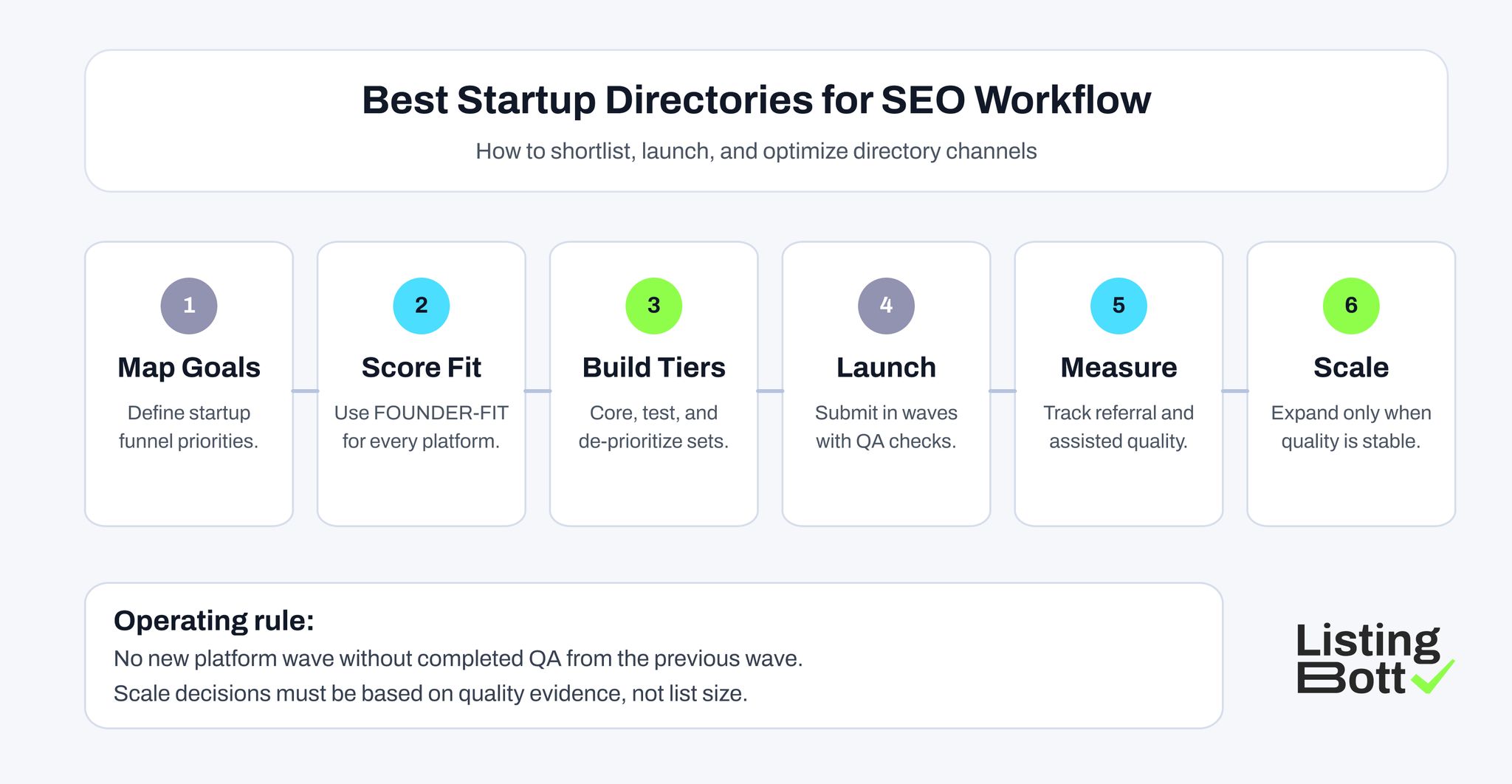
- Start with 8-12, then expand based on evidence.
If you are using this as an seo business directory strategy, keep the portfolio balanced between discovery platforms and high-intent software directories.
Best Startup Directories for SEO Workflow
A Practical Portfolio Design by Startup Stage
Pre-seed / MVP
Focus:
- rapid discovery,
- feedback quality,
- low operational burden.
Suggested portfolio:
- 4 startup discovery platforms,
- 2 launch-feed platforms,
- 1-2 trust-support directories.
Seed stage
Focus:
- category credibility,
- discovery quality,
- assisted pipeline influence.
Suggested portfolio:
- 3 startup discovery platforms,
- 3 software/review platforms,
- 2 launch platforms,
- 1 selective local or industry listing if relevant.
Growth stage
Focus:
- channel efficiency,
- consistency governance,
- sustained quality outcomes.
Suggested portfolio:
- 4-5 proven performers (core),
- 2-3 experimental platforms (test),
- monthly keep/de-prioritize review cycle.
This keeps scope manageable and prevents listing sprawl.
90-Day Rollout Plan for Directory Quality
90-Day Startup Directory Plan
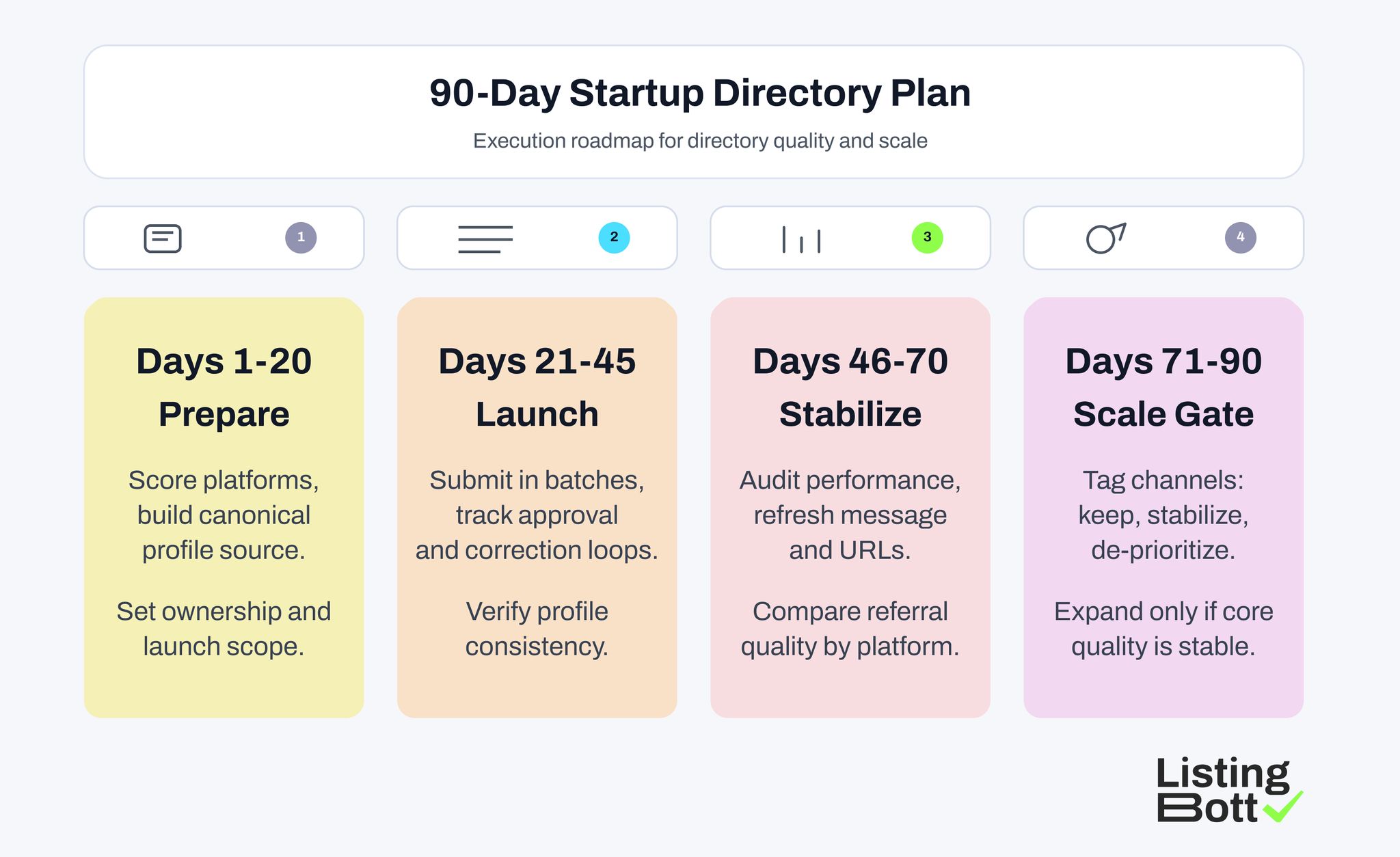
Days 1-20: selection and preparation
- Score candidate directories with FOUNDER-FIT.
- Build canonical profile source sheet.
- Define owner for submissions and updates.
- Finalize first-wave list (8-12 platforms).
Days 21-45: first-wave launch
- Submit in controlled batches.
- Track approvals and correction loops.
- Verify live profiles against canonical source.
- Fix category mismatches immediately.
Days 46-70: quality stabilization
- Audit consistency across all live listings.
- Refresh outdated positioning and links.
- Compare referral quality per platform.
- Identify weak channels for stabilization or removal.
Days 71-90: scale decision
- Tag every platform: keep, stabilize, de-prioritize.
- Add 2-3 new test platforms only if core set is stable.
- Document performance changes and operational cost.
KPI Stack for Startup Directory Programs
Use this KPI set to avoid vanity reporting.
| KPI | Why it matters | Healthy trend | Risk trend |
| Approval cycle time | Measures operational predictability | stable or improving | high variance and delays |
| First-pass acceptance | Measures submission quality | increasing acceptance | repeated rework |
| Profile consistency rate | Measures data reliability | high consistency | frequent drift |
| Referral engagement quality | Measures intent match | steady engagement depth | thin low-intent traffic |
| Assisted conversion influence | Measures real business support | stable influence in journey | no measurable assist |
| Maintenance hours per platform | Measures channel efficiency | controlled effort | rising effort with weak returns |
Common Mistakes when Choosing Startup Directories
1) Treating every list as equally trustworthy
A broad list can include outdated, low-fit, or low-quality options.
Fix:
- score each platform,
- require minimum threshold,
- run small test waves.
2) Confusing traffic spikes with strategic value
A short launch spike does not always translate into useful outcomes.
Fix:
- evaluate referral quality and assisted conversions,
- compare outcomes over one full cycle.
3) Ignoring maintenance after launch
Profiles that are not updated become misleading and underperform.
Fix:
- assign ownership,
- schedule monthly consistency audits,
- run event-based updates after product changes.
4) Over-indexing on one directory type
All startup discovery, no buyer-intent directories, creates imbalance.
Fix:
- mix discovery, review, and launch channels based on your funnel goals.
5) Using unrelated secondary keywords unnaturally
Some teams force terms like seo tools for agencies into startup-directory content in a way that reduces quality.
Fix:
- only use secondary terms when context supports them,
- prioritize reader clarity over exact-match repetition.
6) Misunderstanding citation logic
Teams often ask, what is citation in seo, then treat citations as only local business entries.
Fix:
- treat citations as consistent external references to your business identity,
- keep company details aligned across startup, review, and relevant local channels.
Advanced Decision Layer: Keep, Stabilize, De-prioritize
At the end of each monthly cycle, evaluate each platform with three labels.
Keep
Use when:
- referral quality is strong,
- profile maintenance is manageable,
- channel supports real pipeline movement.
Stabilize
Use when:
- potential exists,
- quality is inconsistent,
- targeted fixes can improve outcomes.
De-prioritize
Use when:
- operational cost remains high,
- buyer quality stays weak,
- corrections consume more effort than value.
This rule protects startups from accumulating low-value channel debt.
How this Compares with Classic Local Directory Playbooks
If your startup has local demand components, classic local directories can still help. But for purely digital products, startup and software directories should usually be the core.
Practical rule:
- local-first startup: include selected local channels early,
- global product-first startup: prioritize startup/software discovery channels first,
- hybrid business: use both, but with explicit capacity limits.
That balance is where business directories for seo becomes a practical system rather than a generic checklist.
Where ListingBott Fits
ListingBott helps teams execute directory distribution with more consistency and less manual tracking.
Execution flow:
- complete the client form,
- review and approve directory list,
- publishing starts,
- receive report with status and next steps.
Offer alignment from current product guidance:
- one-time payment model,
- publication to 100+ directories,
- no hidden extra fees,
- refund possible if process has not started.
Promise limits:
- no guaranteed ranking position,
- no guaranteed traffic by specific date,
- no guaranteed indexing speed,
- no guaranteed outcomes controlled by third-party platforms.
Qualified DR statement: DR growth to 15 is promised only for qualified projects where starting DR is below 15, the campaign goal is domain growth, and the client-approved directory list is in place.
FAQ: Best Startup Directories for SEO
What are the best startup directories for seo in 2026?
The best directories are those with strong buyer fit, accurate category structure, profile depth, and manageable maintenance. A smaller high-fit portfolio usually outperforms mass submissions.
How many startup directories should we launch first?
Most teams should start with 8-12 platforms in one controlled wave, then scale based on quality evidence.
Should we use a single seo directory list and submit everywhere?
No. Use list resources for discovery, then score each platform for fit and expected outcomes before submission.
Are seo local business listings required for all startups?
No. They are most useful when local intent matters. Global product-led startups should prioritize startup and software discovery channels first.
Is Product Hunt enough for startup SEO visibility?
Usually no. It can be strong for launch visibility, but most teams need a diversified portfolio for sustained discovery and trust.
How often should we update startup directory profiles?
At minimum monthly for core platforms, plus immediate updates after major product, positioning, or pricing changes.