Table of Contents
- A Practical 2026 Decision Framework
- Step-by-Step Execution Checklist (First 60 Days)
- Common Mistakes with Search Engine Submission Programs
- FAQ
sbb-itb-8e44301
Quick Answer
If you are looking for the best search engine submissions sites, the practical answer is this: use official search engine webmaster portals for indexing control, and use selected business directories for discovery and citation support.
A lot of teams still mix these two tasks into one checklist. That creates confusion because search engine submission and directory listing solve different problems:
- search engine submission helps engines find, crawl, and understand your pages,
- directory listing helps people and external systems discover your business profile.
So your 2026 workflow should not be “submit everywhere.” It should be “submit intentionally by objective.”
Why this Still Matters in 2026
Search engines no longer require manual URL submission for every page the way older SEO playbooks described it. But submission systems are still relevant for specific cases:
- new websites with low discovery signals,
- important page launches that should be crawled quickly,
- crawl/index troubleshooting,
- international rollouts where not all engines behave the same.
At the same time, directory presence remains useful for visibility, trust, and entity reinforcement. That is why many keyword sets still include variants like search engine submission sites lists and search engine submission sites list, even when people are also looking for directory resources.
The key is not to treat these keywords as a single action.
You need two layers:
- Indexing layer for search engines.
- Distribution layer for directory platforms.
When these layers are separated and measured independently, teams make better decisions and avoid low-quality bulk submissions.
Search Engine Submission vs Directory Submission
The web directory vs search engine distinction appears in research for a reason. People often assume both channels are interchangeable. They are not.
| Dimension | Search engine submission | Directory submission |
| Primary objective | indexing and crawl discovery | referral discovery and profile trust |
| Main platform type | webmaster/search console tools | business/product directory platforms |
| Typical signal | indexed pages, crawl health, coverage | profile quality, referral quality, citation consistency |
| Control model | technical validation and sitemaps | profile copy, category fit, listing maintenance |
| Common failure | assuming submission = ranking | assuming more listings = better outcomes |
Practical interpretation:
- submit to search engines to reduce crawl uncertainty,
- submit to directories to improve external presence,
- do not expect one layer to replace the other.
That separation alone improves reporting quality and helps prevent unrealistic expectations.
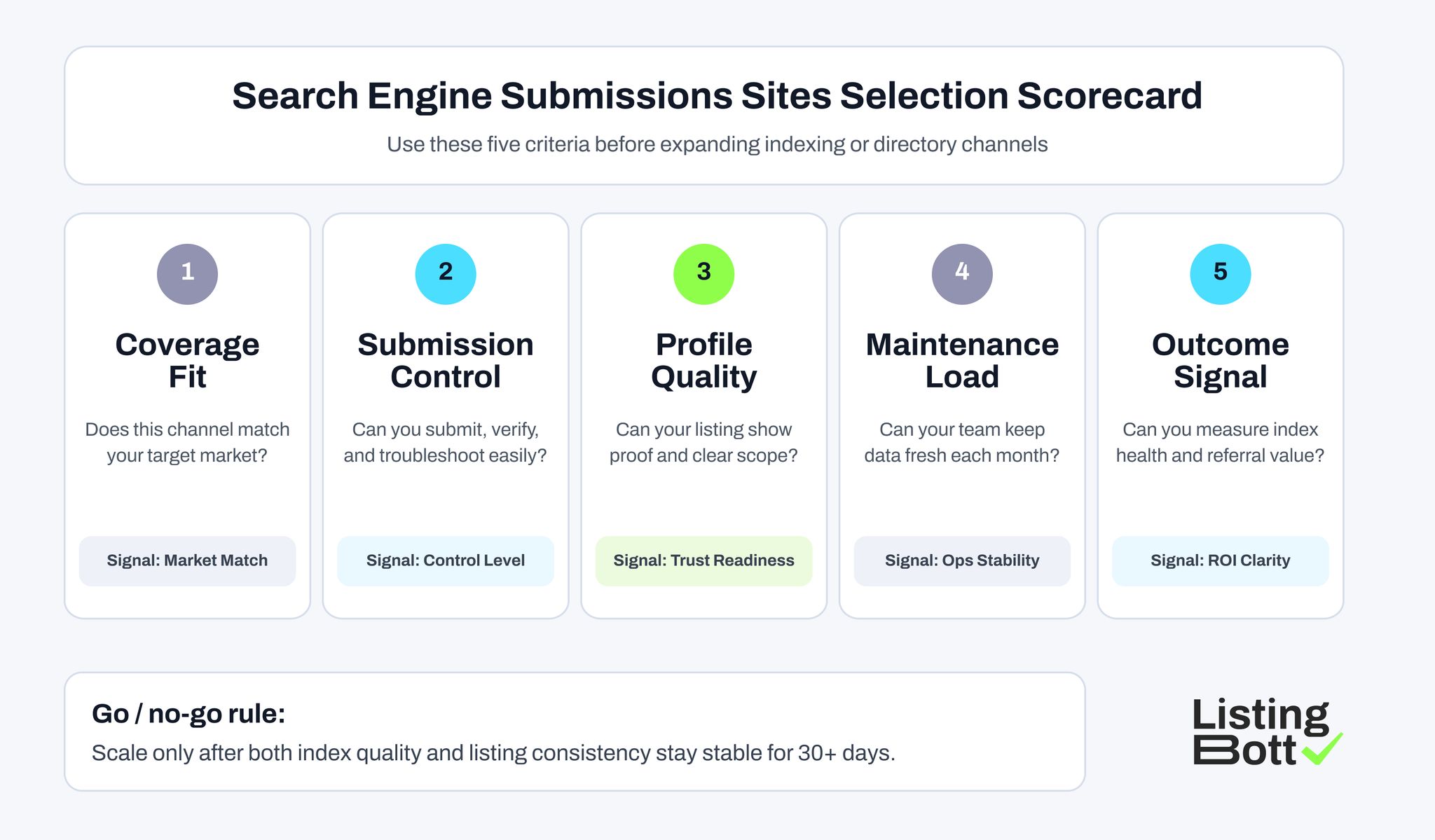
Search Engine Submission Sites Selection Scorecard
A Practical 2026 Decision Framework
Use this framework before you build any search engine submission sites list workflow.
Step 1: classify your objective
Pick one dominant objective first:
- launch indexing,
- recovery and troubleshooting,
- international engine coverage,
- external profile distribution.
If you start with all objectives at once, your team will overload early and quality will drop.
Step 2: separate mandatory and optional platforms
Mandatory for most teams:
- Google Search Console,
- Bing Webmaster Tools.
Optional, depending on market and audience:
- Yandex Webmaster,
- Baidu Search Resource Platform,
- Naver Search Advisor,
- directory distribution tools.
Step 3: define a quality threshold
Every selected platform should pass three checks:
- clear operational value,
- manageable maintenance effort,
- measurable output.
If a platform cannot pass all three, keep it in an experiment bucket, not core workflow.
Step 4: assign ownership by layer
- technical SEO owner for indexing layer,
- growth/content owner for directory layer,
- one QA owner for consistency checks.
This reduces handoff gaps and keeps execution predictable.
Step 5: launch in waves
Wave planning works better than one-time bulk execution:
- Wave 1: mandatory indexing systems + 3-5 high-fit directories,
- Wave 2: additional international engines and support directories,
- Wave 3: only channels that passed quality and referral checks.
Best-Fit Listing Platforms for Search Engine Submissions Sites
The table below combines official submission channels and practical distribution channels. This is not a “submit to all” list; it is a selection framework.
| Platform | URL | Why it is a best fit | Ideal company profile | Submission note |
| Google Search Console | https://search.google.com/search-console/about | Core platform for index coverage, sitemap monitoring, and crawl diagnostics in Google ecosystem | all websites targeting Google traffic | connect verified property, submit sitemap, monitor coverage and manual issues |
| Bing Webmaster Tools | https://www.bing.com/webmasters/about | Essential indexing and health layer for Bing and related distribution surfaces | all websites with English-speaking or broad international audience | submit sitemap and review crawl/index status after major releases |
| Yandex Webmaster | https://webmaster.yandex.com/ | Important for teams with Eastern Europe/CIS demand and Yandex visibility goals | companies with regional market targets in Yandex-active geos | use dedicated regional signals and monitor indexing by language/market |
| Baidu Search Resource Platform | https://ziyuan.baidu.com/ | Needed for teams that must support China-oriented discovery paths | companies localizing content for Chinese-language audiences | account and verification flow is stricter, so run as a planned project |
| Naver Search Advisor | https://searchadvisor.naver.com/ | Useful where Korean market visibility is relevant | brands with Korea-focused audience and localized pages | validate crawl/index behavior on localized sections, not only homepage |
| SubmitSaaS | https://submitsaas.com/ | Practical support layer for controlled directory distribution and profile consistency | SaaS teams that need faster multi-directory operations | treat as distribution support, not substitute for search engine indexing tools |
| Capterra | https://www.capterra.com/ | Strong comparison-intent directory exposure for software buyers | B2B SaaS companies with clear use-case positioning | keep profile depth high (pricing, categories, feature clarity) |
| G2 | https://www.g2.com/ | High-intent software evaluation channel and strong trust layer | SaaS teams with established product-market fit and review readiness | review operations should be ongoing; stale profiles underperform quickly |
How to apply this table:
- start with the first two platforms as non-negotiable technical layer,
- choose 2-4 distribution channels by audience fit,
- expand only after quality metrics remain stable for 30-60 days.
Building a Clean Search Engine Submission Sites List for UK Workflow
If your team is UK-focused, avoid generic global checklists that ignore local realities.
A practical UK-first configuration:
- Core indexing: Google Search Console + Bing Webmaster Tools.
- Directory visibility: relevant UK and international business directories with real buyer activity.
- Consistency controls: recurring profile update schedule and ownership.
- Outcome tracking: index health and referral quality tracked separately.
Why this works:
- UK visibility is still heavily Google-led, but Bing traffic can be meaningful depending on audience segment.
- Business directories can support trust and referral quality, but only if profiles are complete and maintained.
What to avoid in UK workflows:
- publishing to large low-fit lists with no ongoing maintenance,
- mixing technical index KPIs with directory referral KPIs in one score,
- assuming that “submitted” means “ranked.”
Engine International Search Submission: Where Teams Go Wrong
The keyword variant engine international search submission reflects a real operational challenge: international teams over-expand before they stabilize quality.
Common failure pattern:
- team opens too many engines and directories at once,
- localization and technical standards vary across markets,
- correction backlog grows,
- performance reporting becomes unreliable.
A better international sequence:
- stabilize two core engines first,
- add one additional market-specific engine at a time,
- add regional directory channels only where local demand exists,
- enforce one canonical profile baseline across all channels.
This sequence prevents operational debt and protects data quality.
Step-by-Step Execution Checklist (First 60 Days)
Days 1-10: setup and validation
- verify all needed properties in search engine webmaster tools,
- submit XML sitemaps,
- validate robots/canonical consistency,
- define ownership by channel.
Days 11-20: first distribution wave
- publish to 3-5 high-fit directories,
- use one canonical profile pack (name, description, category, destination URL),
- capture submission status in one tracker.
Days 21-30: QA pass
- check index coverage changes for key page groups,
- verify live directory profile consistency,
- fix category and URL mismatches,
- remove duplicate or conflicting listings.
Days 31-45: optimization pass
- refine profile descriptions by user intent,
- adjust destination URLs by channel type,
- improve weak listings with missing proof fields,
- close all open corrections before expansion.
Days 46-60: scaling decision
- keep channels with quality and measurable contribution,
- de-prioritize channels with high maintenance and weak returns,
- open next wave only if QA and KPI thresholds remain stable.
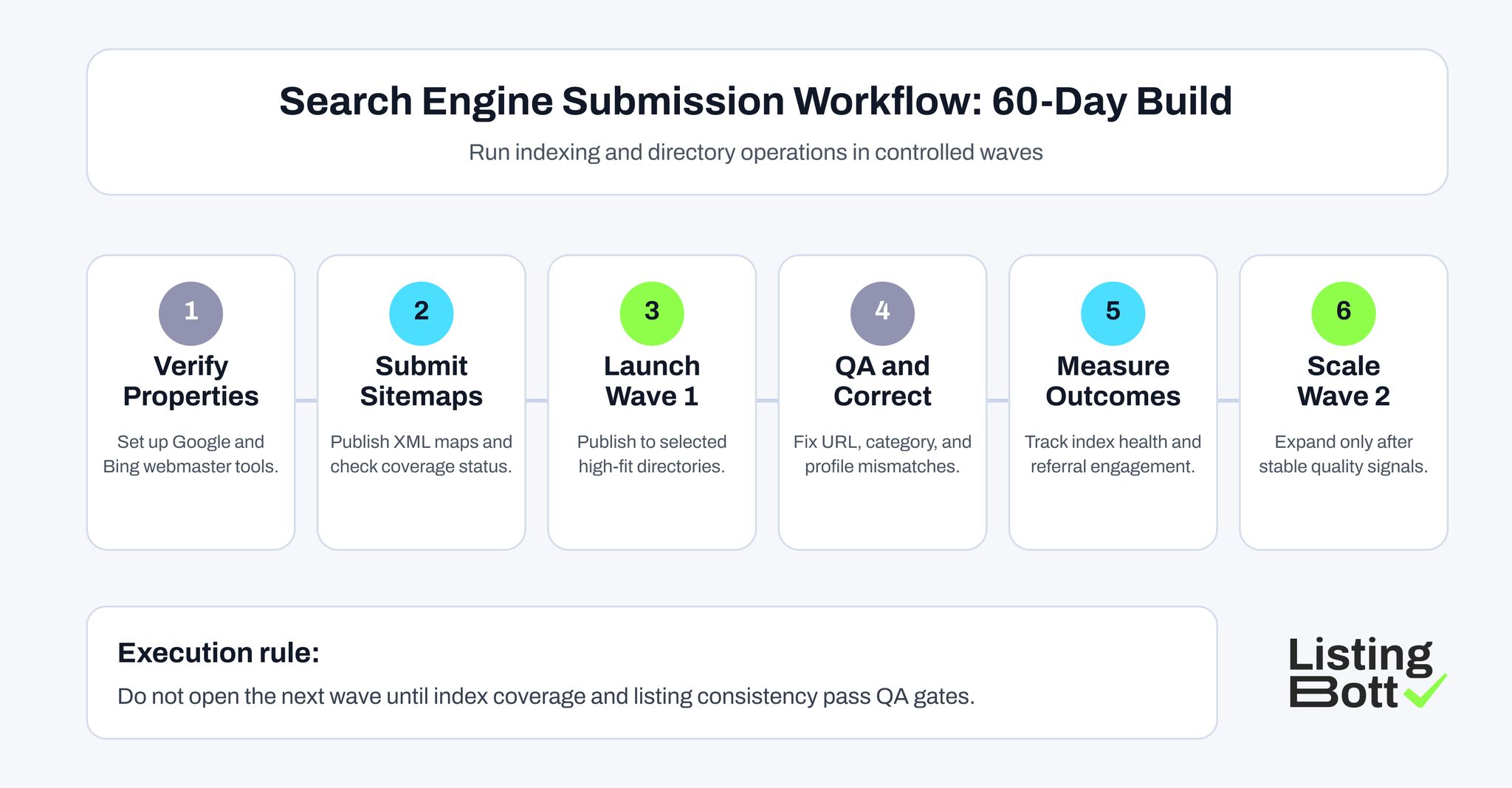
Search Engine Submission Workflow: 60-Day Build
KPI Board you Can Actually Use
You do not need 30 metrics to manage this program. A compact board is enough.
| KPI | Layer | Why it matters | Healthy trend |
| Valid indexed page ratio | indexing | confirms crawl and indexing quality | gradually improving/stable on priority pages |
| Sitemap processing status | indexing | detects discovery and parsing issues early | low errors, fast updates after releases |
| Listing consistency score | directory | protects profile trust and entity clarity | 95%+ consistency on core channels |
| Correction closure time | directory | indicates execution discipline | stable and predictable closure cycle |
| Referral engagement quality | directory | shows whether listed channels attract relevant users | stronger engagement over time |
Review cadence:
- weekly for the first month,
- biweekly after stability,
- immediate review after major site or product releases.
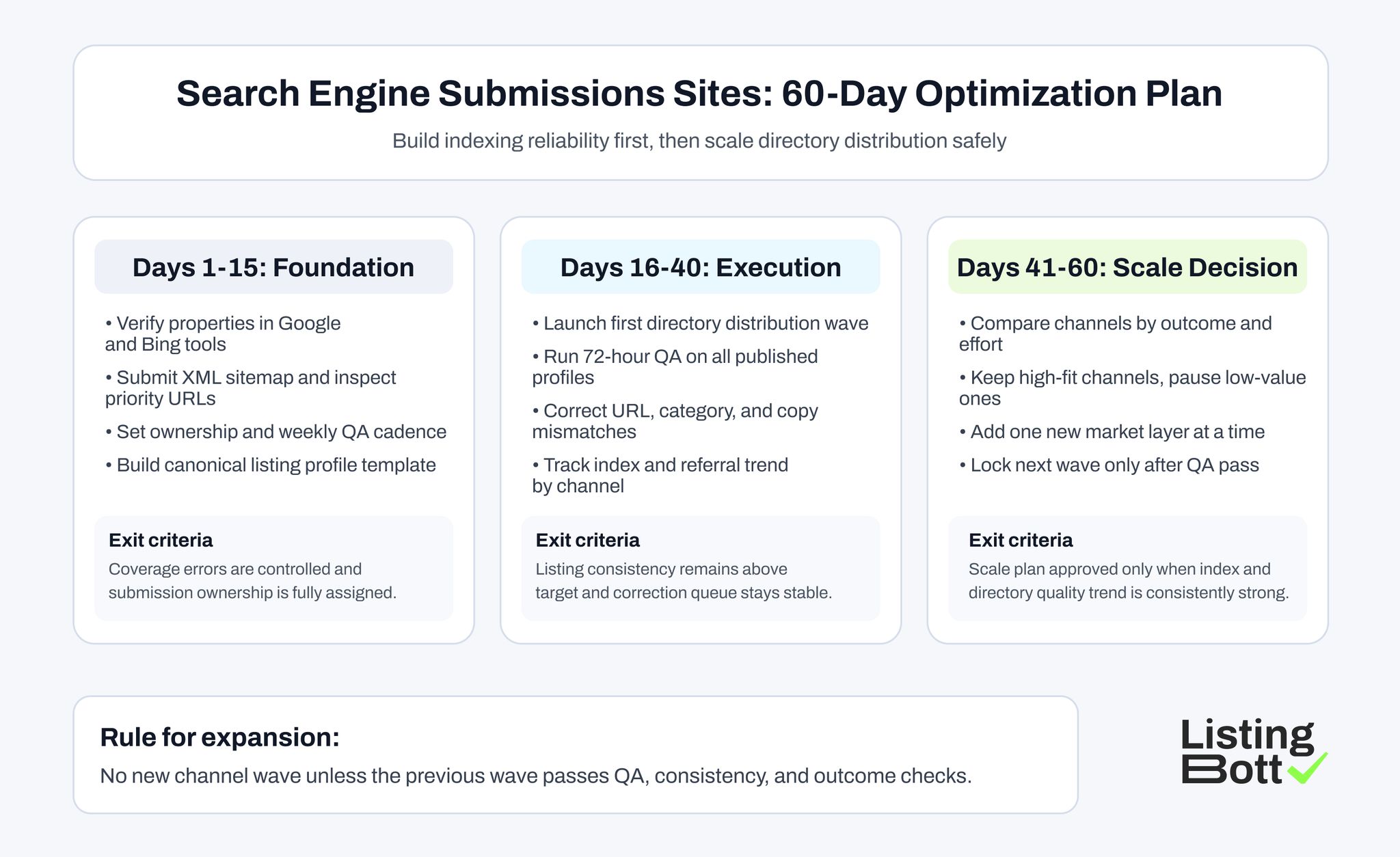
Search Engine Submission Sites
Common Mistakes with Search Engine Submission Programs
1) Treating submission as ranking strategy
Submission improves discoverability and diagnostics. It does not guarantee rank positions. Rankings still depend on content quality, technical health, authority, and competition.
2) Building huge unfiltered lists
Large search engine submission sites lists often mix outdated and low-value targets. Curated lists with role-based channel selection perform better and are easier to maintain.
3) Skipping maintenance after first wave
Profiles and index status drift over time. If there is no maintenance loop, data quality degrades and reporting becomes noisy.
4) Using one destination URL for every channel
Different channels have different user intent. Mapping all channels to one page reduces relevance and conversion readiness.
5) No separation between technical and growth KPIs
If indexing and directory outcomes are blended in one metric, teams cannot diagnose what is working and what needs correction.
6) Copying competitor channel lists without fit scoring
A competitor’s channel mix may not match your ICP, market, or offer maturity. Score fit first, then decide.
Where ListingBott Fits
ListingBott fits the directory-distribution layer of this workflow.
What ListingBott helps with:
- structured publication workflows across directories,
- process visibility and reporting,
- consistency controls that reduce manual submission overhead.
How the process works:
- onboarding details are collected,
- listing selection is reviewed and approved,
- publication run is executed,
- reporting is delivered with status visibility.
Offer alignment:
- one-time payment model,
- publication to 100+ directories,
- no hidden extra fees,
- refund possible if process has not started.
Promise limits:
- no guaranteed ranking position,
- no guaranteed traffic by a specific date,
- no guaranteed indexing speed,
- no guaranteed outcomes controlled by third-party platforms.
Qualified DR statement: DR growth to 15 can be promised only for qualified DR-goal projects where the starting DR is below 15, the selected campaign goal is domain growth, and the approved listing set is in place.
FAQ: Search Engine Submissions Sites
What are search engine submissions sites in 2026?
They are mainly official webmaster portals used to submit sitemaps, monitor indexing, and diagnose crawl issues. They are different from business directories.
Do I still need manual submission if search engines can discover links automatically?
Yes, for important launches and diagnostics. Submission tools provide control and visibility that passive discovery alone cannot guarantee.
How many platforms should I include in the first wave?
Start with two core search engine platforms and 3-5 high-fit directory channels. Expand only after QA and KPI stability.
Is a search engine submission sites list enough for SEO growth?
No. It supports discovery and indexing operations, but SEO growth still depends on technical quality, content relevance, authority, and conversion-focused execution.
How should I handle web directory vs search engine strategy?
Run them as separate layers with separate metrics. Search engines for index health; directories for profile visibility and referral quality.