Table of Contents
- Why this Matters in 2026
- 30-day Implementation Checklist
- Common Mistakes in SaaS Listing Execution
- 90-Day KPI Board for Directory Execution
- FAQ
sbb-itb-8e44301
Quick Answer
SaaS directory listing services work when they prioritize fit and quality, not raw submission volume.
In 2026, teams get better outcomes by treating listings as a structured acquisition and trust layer: choose relevant platforms, keep profile data consistent, and measure commercial impact after each submission wave.
If your current approach is "submit everywhere and hope," you will usually get noisy coverage and weak conversion signals. A better model is:
- define the exact buyer profile you want to attract,
- select directories where those buyers actually compare tools,
- submit in controlled waves,
- optimize based on referral quality and conversion assist.
Why this Matters in 2026
Directory listings are no longer just a backlink play. In 2026, they influence three layers at once:
- discovery by buyers who browse curated software lists,
- trust from consistent profile coverage across credible sources,
- citation potential in AI-assisted answer environments that reference comparison pages and platform profiles.
This is why saas directory listing services should be evaluated like a distribution channel, not a one-time SEO task.
Teams also need to separate useful targets from vanity targets. Many lists promise exposure, but only a subset delivers meaningful visibility for qualified SaaS traffic. That is why planning around business directories for seo and conversion relevance together is more effective than chasing random placement counts.
How to Evaluate SaaS Directory Listing Services
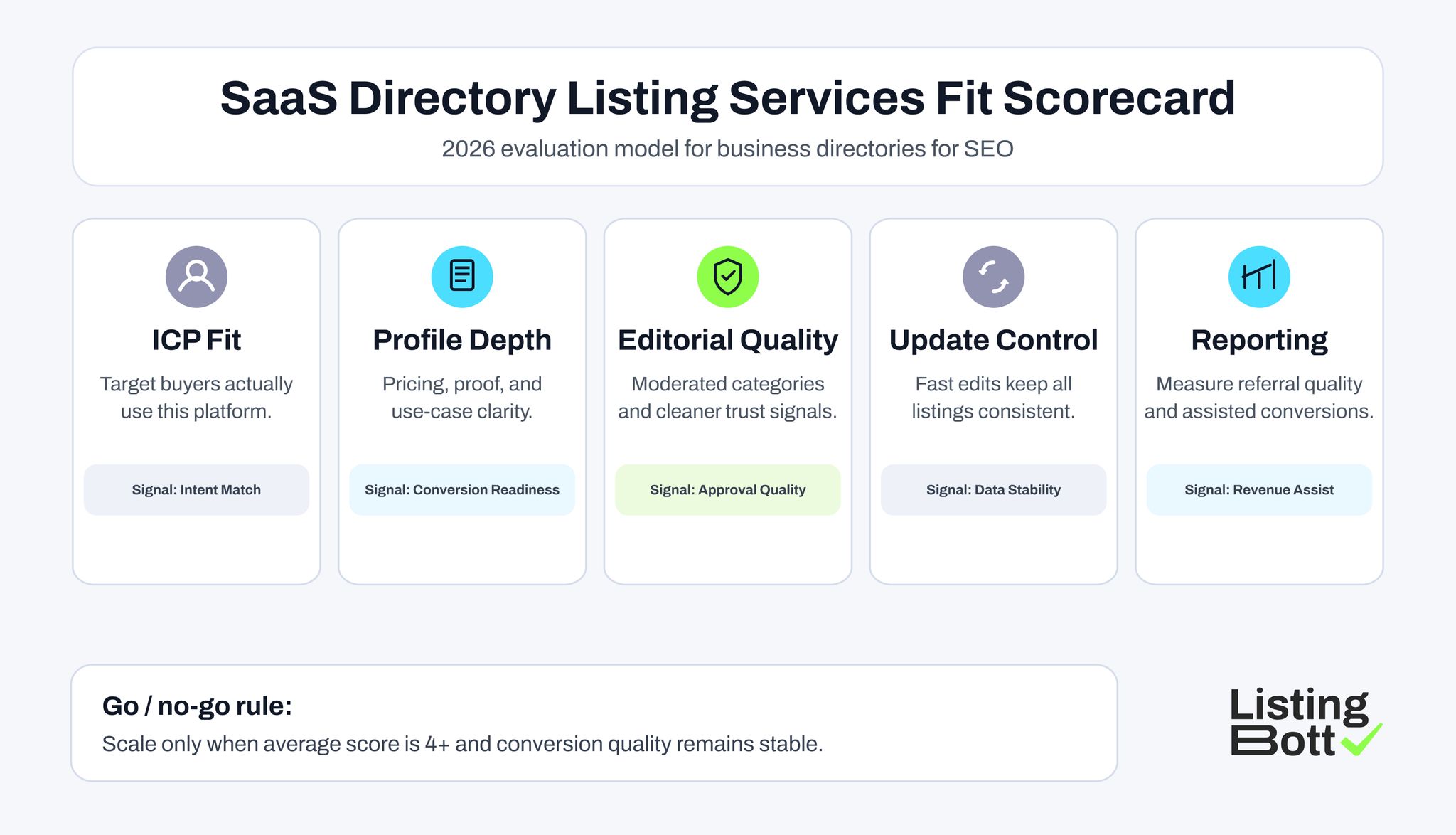
SaaS Directory Listing Services Fit Scorecard
Use this simple scoring model before choosing any service or workflow.
| Criterion | Why it matters | Practical check |
| ICP fit | Prevents irrelevant traffic | Does the platform attract SaaS buyers in your segment? |
| Profile depth | Improves conversion quality | Can you add pricing, use cases, screenshots, and proof points? |
| Editorial quality | Reduces low-value exposure | Is there moderation, category structure, or clear submission criteria? |
| Update control | Keeps listings accurate | Can you revise key fields without delays? |
| Reporting | Enables optimization | Can you map submissions to traffic and assisted conversions? |
A service that cannot explain these five areas clearly is usually high-risk, even if it promises broad directory count.
Best-Fit Listing Platforms for SaaS Directory Listing Services
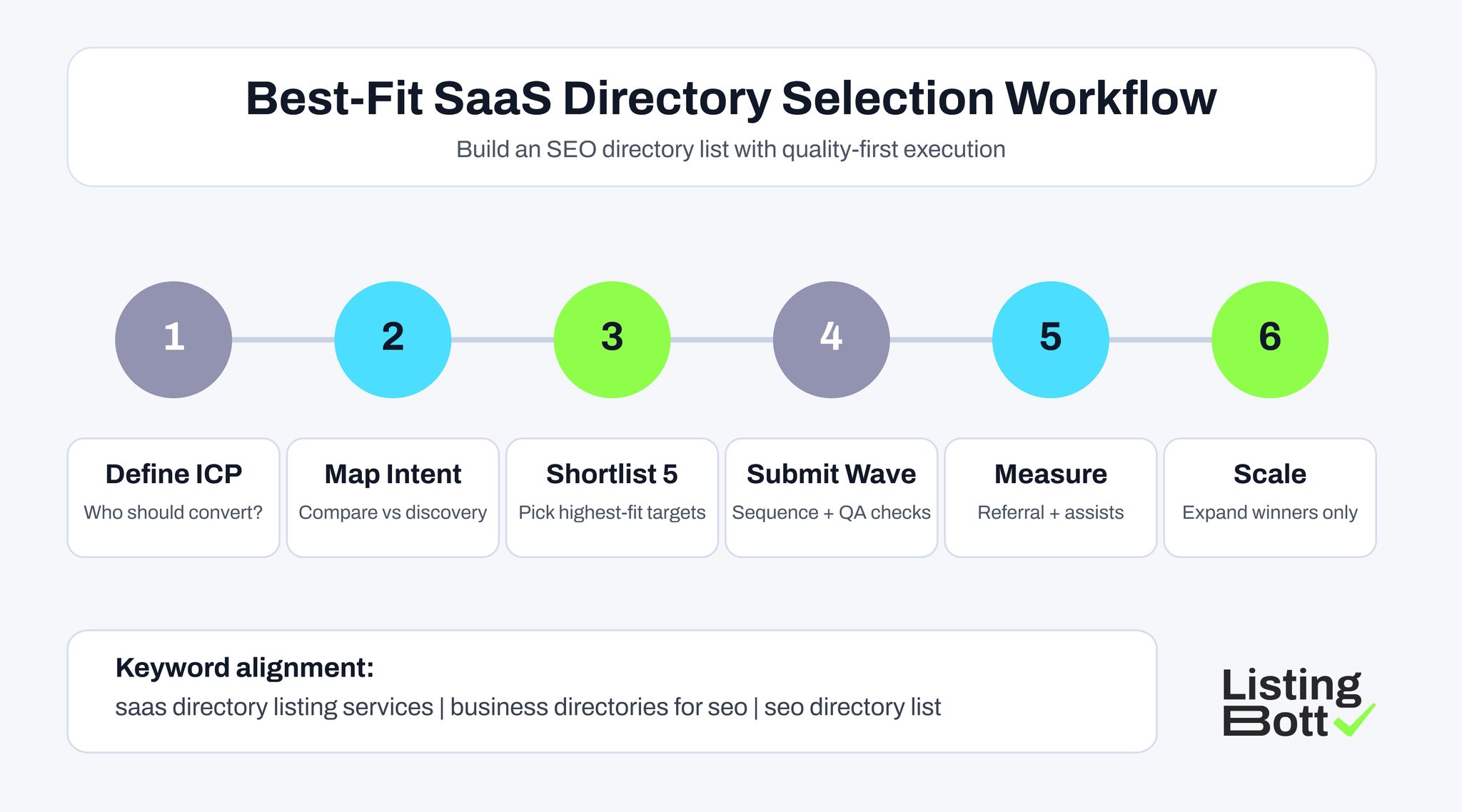
Best-Fit SaaS Directory Selection Workflow
Below are practical examples from your local platform pool and reference materials. These are not "universal best" for every SaaS, but they are strong candidates for many early and growth-stage products.
| Platform | URL | Why it is a best fit | Ideal company profile | Submission note |
| SubmitSaaS directory set | https://submitsaas.com/directories | Strong fit for teams that want SaaS-focused distribution coverage and clear directory discovery paths | Early-stage SaaS launching initial visibility campaigns | Review directory-level requirements before submission to avoid weak or incomplete profiles |
| OpenHunts | https://openhunts.com/ | Useful for product discovery cycles where new SaaS tools need attention from launch-oriented audiences | New SaaS products with clear positioning and concise value proposition | Prioritize clean product messaging and current screenshots to improve approval quality |
| FindYourSaaS | https://www.findyoursaas.com | Category-driven environment suitable for intent-focused SaaS buyers | B2B SaaS with defined categories/use cases | Category precision matters; wrong placement reduces relevance and conversion intent |
| Go-Publicly | https://www.go-publicly.com/ | Good for structured product announcements and visibility bursts around launches/updates | SaaS teams shipping new product versions or major features | Align launch timing and profile updates so listing content matches current product state |
| Open-Launch | https://open-launch.com | Useful for repeated launch exposure and campaign-style publishing workflows | SaaS founders running iterative launch campaigns | Keep one canonical product description to prevent inconsistent versions across platforms |
| ListYourTool | https://www.listyourtool.com/ | Straightforward directory-style inclusion path that can support supplemental discovery | Small SaaS teams building coverage beyond core listing channels | Expect moderation/approval checks; submit complete profile fields to reduce rework |
| Shipybara | https://shipybara.com/ | Can support broader startup-tool discovery when paired with tighter SaaS-specific platforms | SaaS with startup audience overlap | Treat as secondary channel; measure referral quality before scaling effort |
How to Pick the Best 5 for your SaaS
Start with one primary cluster and one supporting cluster:
- Primary cluster: 3 SaaS-focused targets (highest buyer fit)
- Supporting cluster: 2 broader discovery targets (additional reach)
Then run one wave, evaluate, and expand only if quality holds.
How this Maps to your Secondary Keyword Set
Your keyword cluster is connected, but each phrase supports a different page role:
- saas directory listing services -> core commercial decision page
- business directories for seo -> strategic context page (quality and SEO impact)
- seo directory list -> curated list format with selection logic
- free online business directories and free online directory listings -> cost-sensitive funnel entry pages
- local business directory listings and top business directories in usa -> geo-intent support pages
This helps avoid cannibalization. One page should keep one dominant intent, then support nearby phrases naturally.
30-Day Implementation Checklist
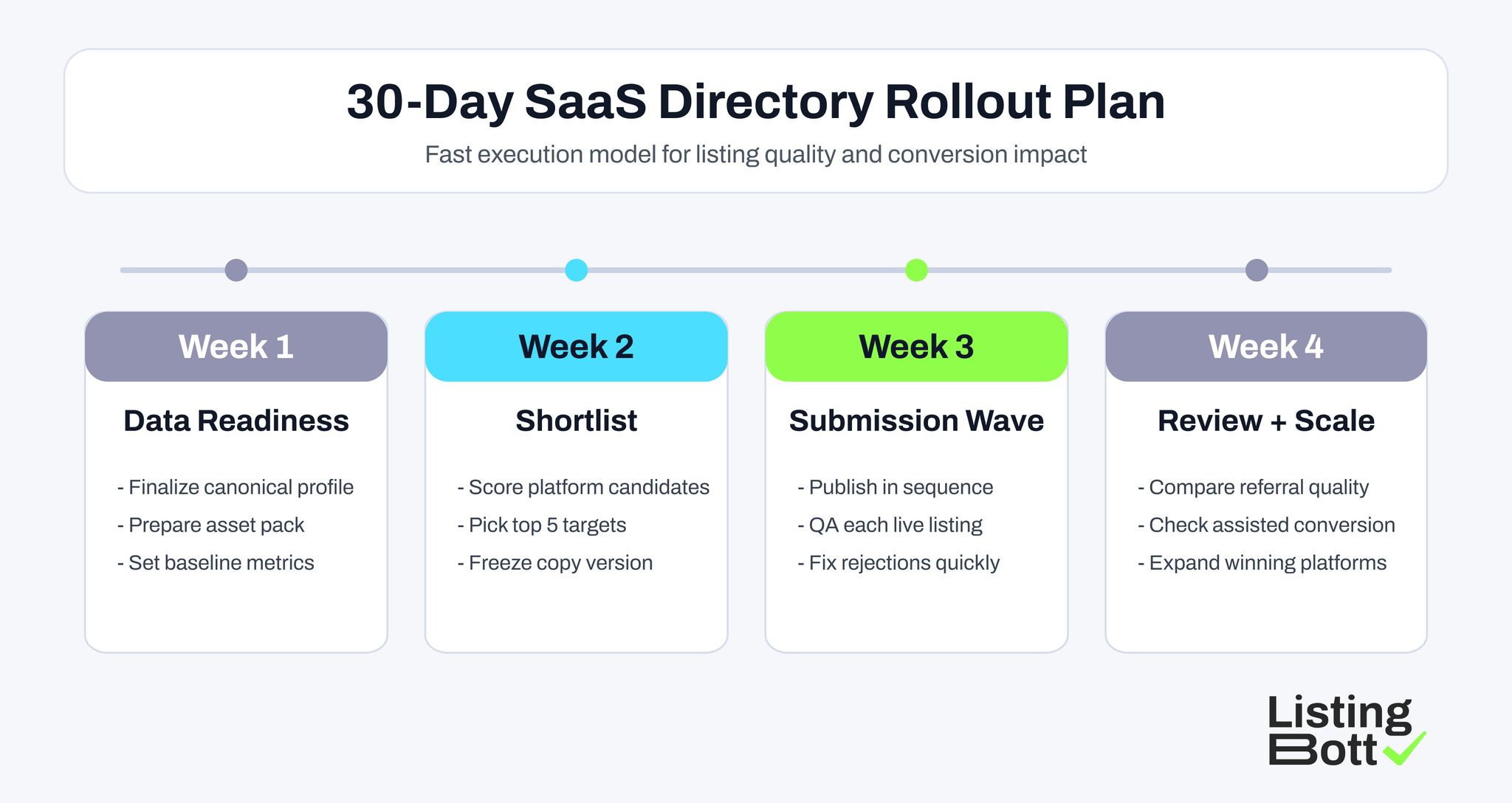
30-Day SaaS Directory Rollout Plan
Week 1: Data readiness
- Finalize canonical company profile (name, description, category, URL, core messaging).
- Prepare asset pack (logo, screenshots, short/long descriptions, pricing summary).
- Define outcome metrics: referral sessions, assisted conversions, profile approval rate.
Week 2: Platform shortlisting
- Pick 5 best-fit platforms from the table above.
- Assign platform owner and QA owner.
- Build submission tracker with dates, status, and required updates.
Week 3: Submission wave
- Submit profiles in controlled sequence (not all at once).
- Validate each published profile for completeness and consistency.
- Log rejections or edits and fix root causes immediately.
Week 4: Review and optimization
- Compare referral quality by platform.
- Check assisted conversion paths from listing traffic.
- Promote the top-performing platforms in the next cycle.
- De-prioritize weak channels that consume effort without quality outcomes.
Common Mistakes in SaaS Listing Execution
Mistake 1: Choosing platforms by volume claims only
Large directory count can look good on paper but fail in qualified traffic terms.
Mistake 2: Treating all listings as identical
Each platform has different audience and format expectations. Reusing one generic description reduces performance.
Mistake 3: No post-submission measurement
Without tracking, teams cannot tell which listings help discovery or conversion.
Mistake 4: Inconsistent profile data
Inconsistency across listings weakens trust and creates avoidable cleanup work.
Mistake 5: No iteration model
Directory work is not one-and-done. It needs review cycles and prioritization updates.
Directory Archetypes and When to Use Each
Not every directory plays the same role in a SaaS growth program. A practical plan uses different directory types for different outcomes.
| Archetype | Primary value | Best timing | Typical risk | Practical rule |
| SaaS-focused directories | Buyer-fit discovery | Early launch + ongoing | Small volume but high intent | Prioritize these first in your initial wave |
| Launch/discovery communities | Fast exposure for updates | Product launches | Short attention window | Pair with strong profile depth to convert interest |
| Broad business directories for SEO | Coverage and trust consistency | After core SaaS set | Lower buyer intent | Use as support layer, not main acquisition engine |
| Niche/industry directories | Segment-specific relevance | After signal validation | Audience mismatch if category is wrong | Test with one controlled batch before scaling |
| Local business directory listings | Geo relevance for hybrid motions | Only if local intent exists | Weak fit for purely global SaaS | Use selectively when local funnel exists |
This is where teams often confuse business directories for seo with buyer-intent channels. Both matter, but not equally. A practical stack starts with high-fit SaaS channels, then adds coverage channels only when the core set is healthy.
Profile Depth Checklist Before Any Submission
Submission quality depends more on profile quality than on directory count. Before publishing any listing, confirm that the profile includes:
- one-sentence value proposition with clear category fit,
- concise product description aligned with your site messaging,
- pricing context (starting point or pricing model),
- social proof or credibility element (customer type, use case, or trust marker),
- clear call-to-action destination (homepage or product page),
- up-to-date visuals that match current UI/positioning.
If one of these is missing, delay submission until it is fixed. Teams that skip this gate usually see approval without conversion value.
Ownership Model for Small Growth Teams
You do not need a large team to run good saas directory listing services execution, but you do need role clarity. A lightweight setup:
| Role | Core responsibility | Weekly output |
| Program owner | Prioritization and wave planning | Approved platform queue |
| Content owner | Profile copy quality and consistency | Updated profile asset pack |
| QA owner | Post-publish verification and fixes | Validation log + issue list |
| Analytics owner | Referral and assisted conversion analysis | Weekly outcome snapshot |
For very small teams, one person can hold two roles, but each responsibility still needs explicit ownership. Without this, updates stall and profile quality drifts.
90-Day KPI Board for Directory Execution
Use a compact KPI board to evaluate performance without overcomplicating reporting:
| KPI | What it answers | 30-day target pattern | Action if weak |
| Profile approval rate | Are submissions launch-ready? | stable, high acceptance | Improve profile completeness and category mapping |
| Referral quality | Are visitors relevant? | improving engagement quality | Re-score low-fit platforms and reduce effort |
| Assisted conversions | Do listings support pipeline? | gradual increase over cycles | Strengthen profile CTA clarity and proof depth |
| Data consistency score | Are listings aligned to canonical data? | near-zero critical mismatches | Run correction sprint and tighten QA gate |
| Time-to-update | Can you keep listings current? | short correction cycles | Reduce platform set if maintenance overhead is too high |
A common mistake is reacting to one week of weak traffic and pausing everything. Directory channels typically need at least one full cycle to produce stable quality signals.
Expansion vs Pause Matrix
After the first cycle, decide with explicit rules:
- Expand when:
- top platforms show strong referral quality,
- assisted conversion patterns improve,
- update workload stays manageable.
- Stabilize when:
- quality is mixed across platforms,
- profile consistency needs cleanup,
- conversion contribution is unclear.
- Pause or de-prioritize when:
- repeated low-intent traffic persists,
- profile maintenance costs exceed value,
- category fit remains weak after correction.
This matrix prevents random channel switching and helps your team build a durable seo directory list workflow instead of repeating trial-and-error cycles.
Documentation Habits that Improve Outcomes
Teams that get consistent results from saas directory listing services usually keep lightweight but disciplined documentation.
After each wave, log:
- which listings were approved without edits,
- which platforms requested corrections and why,
- which profile fields caused repeated friction,
- what changed in conversion-assist behavior after updates.
This creates a practical feedback loop. Instead of repeating the same mistakes in every cycle, your team can improve profile quality, shorten update time, and focus future submissions on platforms that keep showing useful discovery and conversion signal.
Where ListingBott Fits
ListingBott fits as the operational layer for teams that want to run submission workflows with less manual overhead and clearer process control.
In practical terms, the workflow is:
- you complete the client form and define goals,
- directory list is prepared and approved,
- submission process runs,
- delivery/report handoff follows.
Offer alignment to keep copy accurate:
- one-time payment model,
- publication to 100+ directories (per current website language),
- refund possible if process has not started,
- no hidden extra fees.
Important limits:
- no guaranteed ranking positions,
- no guaranteed traffic by a fixed date,
- no blanket guaranteed DR increase,
- no guaranteed indexing speed.
Qualified DR note: DR growth to 15 is only a qualified promise when starting DR is below 15, the explicit goal is domain growth, and the approved listing set is in place.
FAQ: SaaS Directory Listing Services
What are SaaS directory listing services?
They are workflows or tools that help SaaS teams submit and manage product profiles across relevant software and business directories.
How many directories should a SaaS start with?
For most teams, a first controlled wave of 5-10 high-fit platforms is more reliable than mass submission.
Are free directories enough?
Free directories can help, but quality and audience fit matter more than price. A mixed strategy is usually better.
How long until results appear?
Initial visibility can appear quickly, but measurable trend impact is typically evaluated over 30-90 days with consistent tracking.
Should directory listings be part of SEO only?
No. They should support broader acquisition: discovery, referral quality, assisted conversions, and trust consistency.