Table of Contents
- Why this Matters in 2026
- Build a Practical Portfolio: Core, Support, and Test Tiers
- 30-day Implementation Checklist
- Common Mistakes and How to Avoid them
- FAQ
sbb-itb-8e44301
Quick answer
The best saas business listing sites strategy is not to submit to as many platforms as possible. It is to build a short, high-fit portfolio of listings that matches your ICP, supports clear product positioning, and can be maintained without data drift.
In practice, most SaaS teams should launch with one controlled wave, then expand only after real quality signals appear. A simple baseline looks like this:
- choose 6-10 platforms with strong buyer-fit,
- publish complete and consistent profiles,
- measure acceptance, referral quality, and assisted conversion behavior,
- scale only the platforms that continue to produce useful outcomes.
If you are comparing options that include article submission sites, keep that channel secondary. For SaaS, buyer-intent software directories usually outperform broad content-submission sites when your goal is qualified discovery.
Why this Matters in 2026
In 2026, listing execution affects more than backlinks. It can influence:
- how buyers discover your product while comparing alternatives,
- how consistently your company information appears across the web,
- how clearly your product entity is represented in external sources.
That is why the keyword saas business listing sites should be treated as an operational decision, not a static list post.
Many teams still make three expensive mistakes:
- they submit everywhere in week one,
- they publish thin profiles without enough product context,
- they never build a maintenance process after first publication.
The result is predictable: low-quality traffic, stale listings, and unclear performance attribution.
You will also see overlap between related keyword families:
- free listing sites and free business listing sites usa can be useful for exploration,
- local citation sites, local business listing sites, and local listing sites can help for local or hybrid SaaS motions,
- but SaaS buyer directories should stay the core layer for most product-led teams.
The goal is not to avoid related channels. The goal is to sequence them correctly so they do not dilute your main SaaS distribution motion.
Method: The STACK-7 Scoring Model for SaaS Listing Selection
Use this framework before adding a platform to your listing portfolio.
| Dimension | What to validate | Why it matters | Score guide (1-5) |
| Segment fit | Does the platform attract your target buyer? | Prevents broad low-intent exposure | 1 = weak match, 5 = clear ICP overlap |
| Trust quality | Is the platform moderated and credible? | Affects perceived listing reliability | 1 = noisy, 5 = strong editorial quality |
| Asset depth | Can you show product proof (features, pricing context, use cases)? | Improves conversion readiness | 1 = shallow profile, 5 = deep profile support |
| Conversion path | Can users move from profile to relevant action cleanly? | Connects listing work to pipeline | 1 = weak click path, 5 = clear path |
| Keep-up speed | How quickly can you update details after product changes? | Reduces stale profile risk | 1 = hard updates, 5 = easy updates |
| Local relevance | Does it support geo intent if needed? | Helps hybrid/local SaaS teams | 1 = none, 5 = strong local alignment |
| Capacity fit | Can your team maintain quality at this platform count? | Keeps execution realistic | 1 = unsustainable, 5 = sustainable |
Practical Operating Rule
- Launch only platforms scoring 24+ out of 35.
- Keep platforms scoring 20-23 in test mode.
- De-prioritize anything below 20 unless there is a specific strategic reason.
This simple threshold prevents the common trap where teams collect every option from free listing sites posts and then spend months fixing inconsistent data.
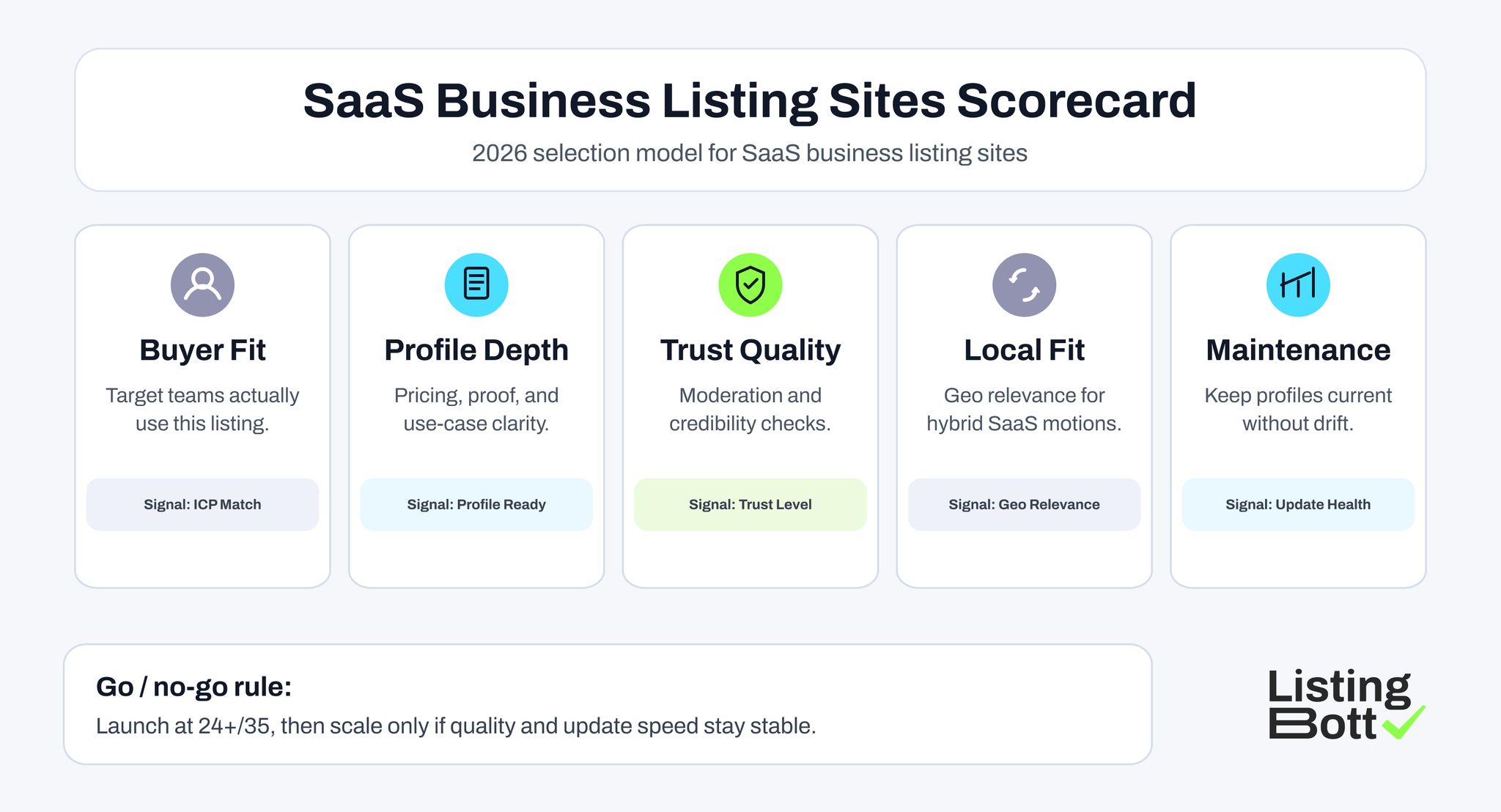
SaaS Business Listing Site Scorecard
Best-Fit Listing Platforms for SaaS Business Listing Sites
The following platforms are grounded in your local example corpus and are practical candidates for SaaS listing programs.
| Platform | URL | Why it is a best fit | Ideal company profile | Submission note |
| Capterra | https://www.capterra.com/ | High buyer-intent software research behavior makes it useful for category-level discovery | B2B SaaS with clear category fit and pricing narrative | Complete category mapping and profile depth before launch |
| G2 | https://www.g2.com/ | Strong comparison intent and trust-driven software evaluation behavior | SaaS teams with clear positioning and review strategy | Keep product messaging consistent across all review surfaces |
| GetApp | https://www.getapp.com/ | Useful for software buyers looking for shortlist-ready options | SaaS products with clear use-case segmentation | Profile structure and taxonomy accuracy are critical |
| Product Hunt | https://www.producthunt.com/ | Helpful for launch visibility and early-adopter audience reach | Early-stage or shipping-heavy SaaS teams | Timing and launch packaging strongly affect results |
| AlternativeTo | https://alternativeto.net/ | Works for replacement-intent users comparing alternatives directly | SaaS competing in mature categories | Positioning clarity matters more than broad copy |
| Crunchbase | https://www.crunchbase.com/ | Supports company-level discovery and credibility context | Venture-backed or growth-stage SaaS | Treat as entity/trust layer, not direct conversion channel |
| AppSumo | https://appsumo.com/ | Useful for promotion-led visibility for specific GTM windows | SaaS with promo-ready onboarding path | Use selectively; avoid over-reliance for long-term demand quality |
| SaaSHub | https://www.saashub.com/ | Practical discovery surface for users searching tool alternatives | SaaS with distinct job-to-be-done framing | Keep profiles updated when positioning or feature sets change |
How to Use this Table
Do not treat this as a universal top-8. Score each platform against your product stage and market motion.
For example:
- if your product is early and launch-heavy, Product Hunt and SaaSHub may be first-wave picks,
- if your product has category maturity, Capterra, G2, and GetApp may be core,
- if your motion needs entity-trust support, Crunchbase can be a supporting layer.
This portfolio logic is much stronger than copying a static free business listing sites usa checklist that was not built for SaaS buying behavior.
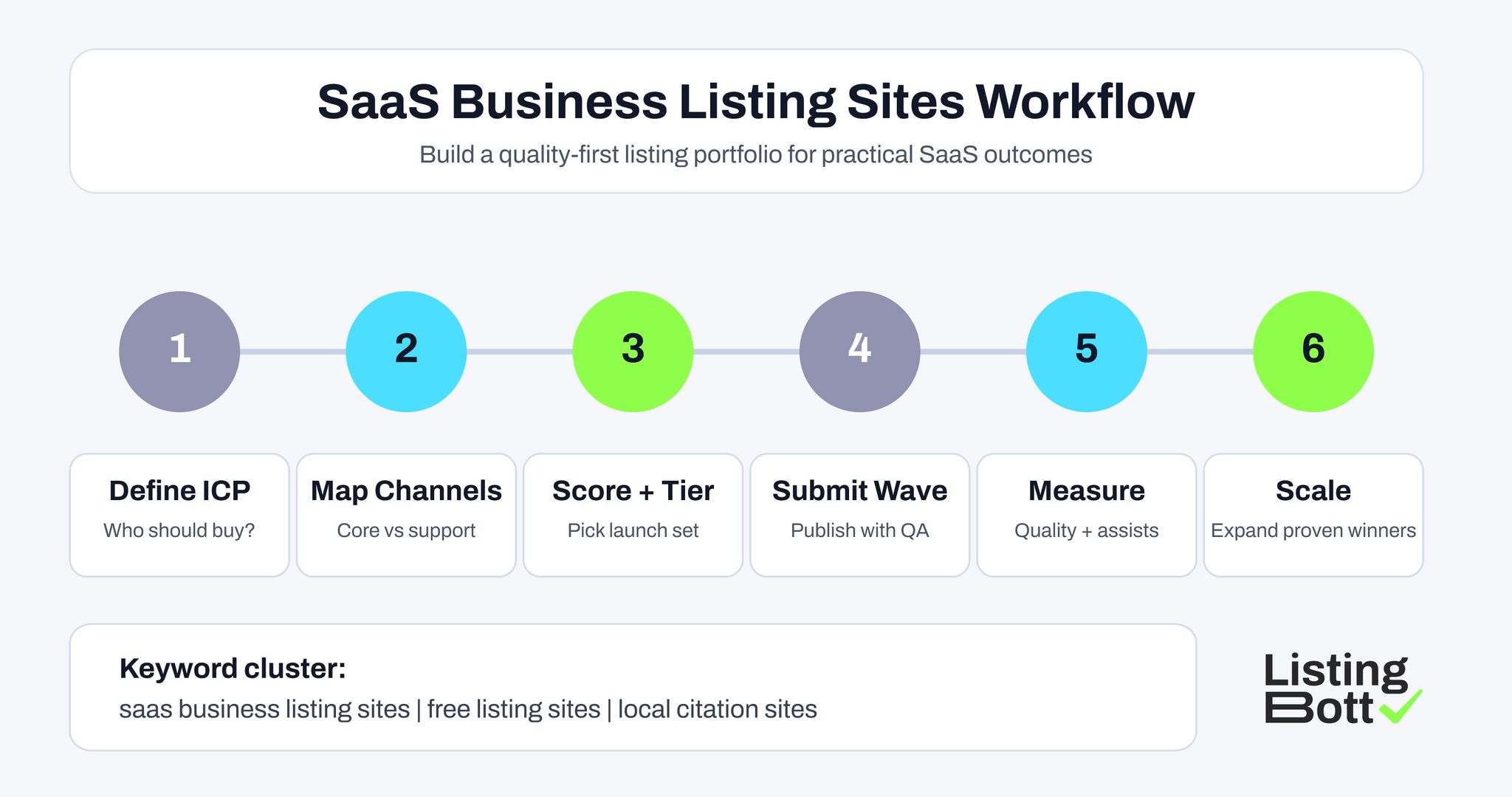
SaaS Business Listing Sites Workflow
Build a Practical Portfolio: Core, Support, and Test Tiers
A useful operating structure is a three-tier model.
Tier 1: Core platforms (3-4 listings)
These are your highest-intent, highest-maintenance platforms.
What goes here:
- strongest segment fit,
- best trust quality,
- deepest profile support,
- clear conversion path.
What you should expect:
- more setup effort,
- higher ongoing update discipline,
- higher strategic value.
Tier 2: Support platforms (2-4 listings)
These expand discovery without overloading operations.
What goes here:
- good fit but slightly lower conversion signal,
- useful visibility layer,
- manageable maintenance.
What you should expect:
- moderate operational effort,
- mixed traffic quality,
- solid support role when profile quality is high.
Tier 3: Test platforms (1-3 listings)
These are hypothesis channels you run with strict evaluation windows.
What goes here:
- uncertain value but potential niche relevance,
- channels often found in broad article submission sites or mixed listing roundups.
What you should expect:
- short test period,
- clear keep/de-prioritize criteria,
- no automatic long-term commitment.
This model gives you control and keeps your listing program measurable.
30-day Implementation Checklist
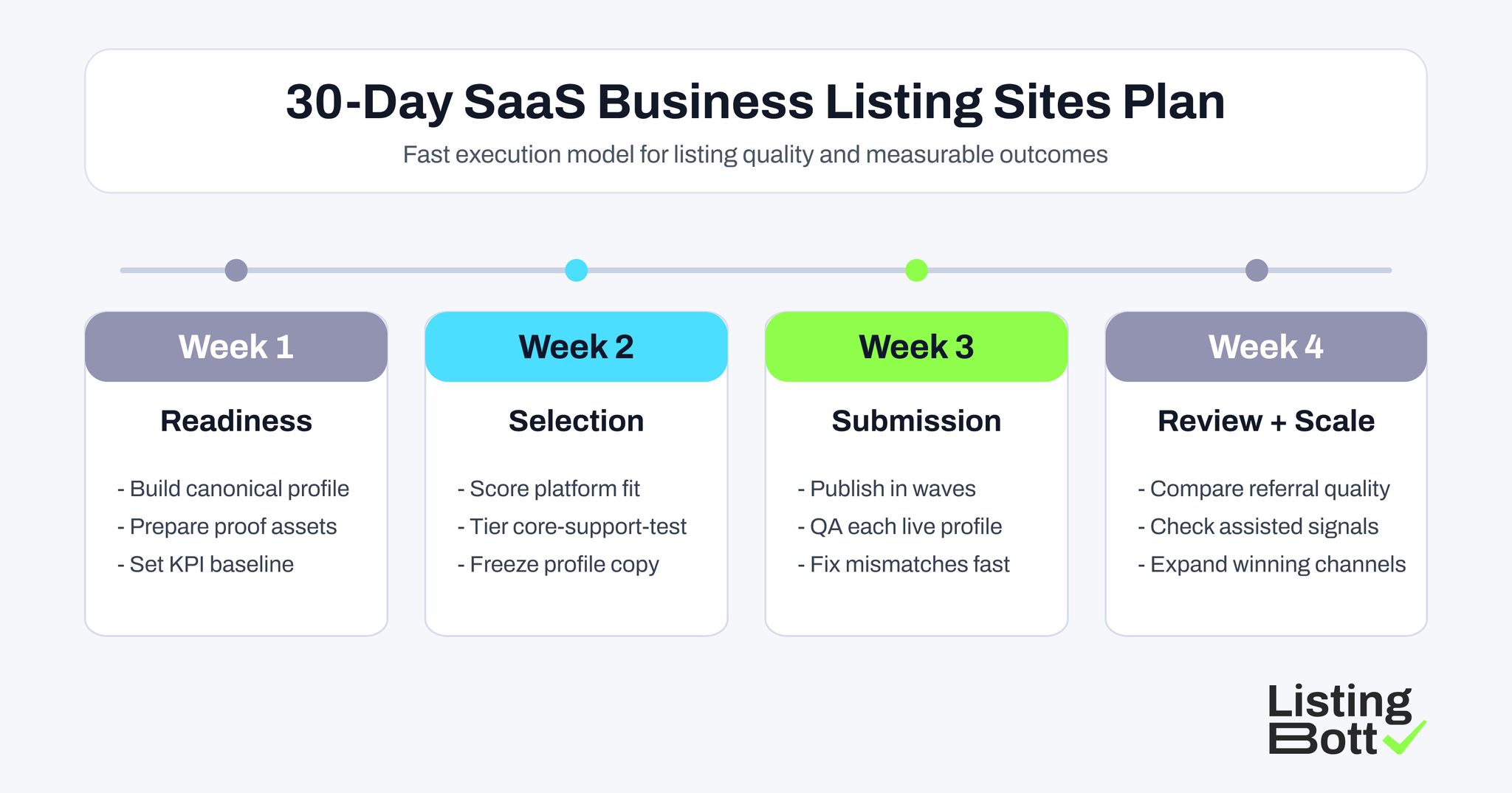
30-Day SaaS Business Listing Sites Plan
Week 1: Readiness and asset baseline
-
Define one canonical profile pack:
- product summary,
- category mapping,
- value proposition,
- pricing context,
- proof points.
-
Define outcomes you will track:
- profile acceptance rate,
- referral quality,
- assisted conversion signals.
- Score candidate platforms with STACK-7.
Week 2: Build the launch wave
- Select 6-10 initial platforms by score.
- Split into core/support/test tiers.
- Assign ownership for submissions and QA review.
Week 3: Publish and verify quality
- Submit listings in controlled batches.
- Verify each live profile against canonical source copy.
- Correct mismatches immediately.
Week 4: Evaluate and decide next wave
- Review platform-level performance.
- Keep top performers active.
- De-prioritize low-quality channels.
- Open next wave only if maintenance quality remains stable.
How to Handle Local and Regional Intent without Diluting SaaS Focus
Some SaaS companies serve local operators, regional service providers, or vertical geographies. In those cases, local citation sites, local business listing sites, and local listing sites can add value.
The key is sequencing:
- build SaaS-core listings first,
- add local channels only when they support a real geo use case,
- maintain one canonical profile source for both SaaS and local channels.
If your model is global software-first, local listing expansion should stay selective.
If your model is hybrid (software + regional demand), local citations can complement your core directory portfolio.
The main risk is not using local channels. The main risk is adding them too early and spreading your maintenance capacity too thin.
Common Mistakes and How to Avoid them
1) Treating quantity as strategy
Teams often pull every platform from broad free listing sites compilations and submit in bulk. This usually creates operational debt.
Fix:
- use a tiered portfolio,
- gate expansion with score thresholds,
- keep platform count proportional to update capacity.
2) Publishing thin profiles
Listings with weak product detail underperform even on high-authority platforms.
Fix:
- define a mandatory profile depth checklist,
- require feature clarity, proof, and category precision before publish.
3) Ignoring update operations
Product copy drifts fast in SaaS. If profiles are not updated, trust and conversion quality drop.
Fix:
- set a monthly refresh cadence,
- track changes in pricing, features, and positioning,
- push updates to core platforms first.
4) Mixing unrelated intent types in one page
Trying to fully cover article submission sites, local citation sites, and SaaS buyer directories in one undifferentiated strategy creates confusion.
Fix:
- keep one primary intent per page,
- use related intents as supporting context,
- split execution playbooks by channel role.
5) Measuring only clicks
Click volume without quality context is misleading.
Fix:
- track assisted conversion signals,
- compare engaged referral behavior by platform,
- maintain keep/de-prioritize rules.
KPI Model for Listing Decisions
Use a small scorecard every month.
| KPI | What it tells you | Healthy signal | De-prioritize signal |
| Acceptance rate | Submission quality and platform fit | stable approvals | repeated rejections |
| Profile consistency health | Data quality across platforms | low mismatch rate | recurring data drift |
| Referral engagement | Visit quality from listings | improving engaged sessions | low-intent bounces |
| Assisted conversion support | Downstream impact | recurring assist patterns | no assist trend after cycle |
| Update cycle speed | Operational reliability | quick updates | growing update backlog |
Keep/De-prioritize Rule
- Keep: quality and assist signals stable or improving.
- Stabilize: mixed quality but clear path to fix profile depth.
- De-prioritize: weak quality and weak assists after one full cycle.
This keeps decisions grounded in outcomes, not assumptions.
Where ListingBott Fits
ListingBott fits when you already have a clear target portfolio and want structured execution.
The workflow is straightforward:
- complete the client form,
- agree on the list of directories,
- run publication,
- receive report and next-step recommendations.
Offer alignment from current source docs:
- one-time payment model,
- publication to 100+ directories,
- refund possible if process has not started,
- no hidden extra fees.
Important limits:
- no guaranteed ranking position,
- no guaranteed traffic by specific date,
- no guaranteed indexing speed,
- no guaranteed third-party platform outcomes.
Qualified DR note: DR growth to 15 is only promised for qualified projects where starting DR is below 15, the goal is explicitly set to domain growth, and the client-approved directory list is in place.
For teams that want a structured execution layer rather than manual spreadsheet tracking, ListingBott can reduce operational friction while keeping submission quality and reporting clearer.
FAQ: SaaS Business Listing Sites
What are SaaS business listing sites in practice?
They are platforms where software buyers discover, compare, and evaluate products. The useful ones support clear profiles, category fit, and maintainable updates.
How many listing platforms should a SaaS company start with?
Most teams should start with 6-10 in one controlled wave, then scale only after quality and assisted-conversion signals are visible.
Are free listing sites useful for SaaS?
They can be useful as supporting channels, but they should not replace high-intent SaaS directory platforms in your core portfolio.
Do local citation sites matter for SaaS products?
They matter most for hybrid or geo-driven SaaS motions. For global software-first models, they are usually secondary.
Should we use article submission sites as a core SaaS listing strategy?
Usually no. They can support awareness, but buyer-intent software directories are typically stronger for SaaS decision journeys.
How do we avoid listing sprawl?
Use a scoring framework, cap first-wave volume, run monthly KPI reviews, and de-prioritize channels that do not show quality or assist value.