Quick answer
Small-business listing performance usually improves when teams stop treating listings as a one-time setup and start treating them as a managed routine. A 90-day plan with weekly checks, monthly quality reviews, and clear ownership can stabilize local presence and reduce costly correction loops.
The core approach is simple: prioritize high-value local profiles, standardize business data, resolve issues in fast cycles, and review outcome signals every month.
If you need a clear structure, build your local listing management process around repeatable cadence, not ad hoc fixes.
sbb-itb-8e44301
Problem framing
Most small businesses do not fail at local listings because they ignore them completely. They fail because listing updates are inconsistent, ownership is unclear, and corrections happen only when customers report problems.
Typical local-management pain points:
- business hours are outdated on some profiles,
- phone/address fields drift across platforms,
- duplicate listings compete for the same brand signal,
- category and service descriptions become inconsistent,
- no one tracks unresolved issues by priority.
These problems look small in isolation, but they compound quickly. When local profile data diverges, teams lose trust, waste time on repeated corrections, and miss predictable local discovery opportunities.
Why small-business listing workflows break
| Failure pattern | Why it happens | Operational cost | Fix priority |
|---|---|---|---|
| No listing owner | Listings are shared across team members | Slow response and no accountability | Assign one accountable owner |
| No weekly routine | Work happens only when issues surface | Growing correction backlog | Install fixed weekly checklist |
| No source-of-truth fields | Data copied from old docs or memory | Repeated inconsistency errors | Create one canonical profile dataset |
| No escalation ladder | Hard issues stay unresolved | Long pending times | Define escalation and SLA windows |
| No outcome review | Team tracks tasks, not impact | Low confidence in what to improve | Add monthly KPI review cadence |
A local listing program becomes sustainable only after these basics are standardized.
Small-business local priority stack
| Priority level | Focus area | Why it matters first | Common mistake |
|---|---|---|---|
| P1 | Core profile accuracy (name, address, phone, hours) | Foundational trust signal and customer utility | Treating this as one-time setup |
| P2 | Category and service relevance | Helps correct intent matching | Overloading profiles with broad categories |
| P3 | Duplicate suppression and cleanup | Reduces conflicting signals | Ignoring duplicates until rankings drop |
| P4 | Ongoing update cadence | Keeps data aligned with business changes | Updating only during promotions |
| P5 | Performance review loop | Converts maintenance into strategy | Looking at performance too rarely |
If P1 and P2 are weak, advanced tactics will not perform consistently.
90-day operating design for small teams
| Time window | Primary goal | Team behavior | Decision checkpoint |
|---|---|---|---|
| Days 1-30 | Stabilize data quality | Weekly correction routine and core profile normalization | Is baseline clean enough for scale? |
| Days 31-60 | Improve reliability | Faster resolution and fewer repeat errors | Are process KPIs trending correctly? |
| Days 61-90 | Optimize outcomes | Prioritize high-signal channels and actions | Which improvements should be scaled next quarter? |
This model works well for small businesses because it turns vague "manage listings" work into a concrete schedule.
Decision framework: what to do this week
Use this order each week:
- Fix customer-impacting errors first (wrong phone, wrong hours, wrong address).
- Resolve duplicate/conflict issues second.
- Apply category/service precision updates third.
- Defer low-impact cosmetic edits unless capacity allows.
This prioritization prevents low-value work from consuming limited team time.
How ListingBott works
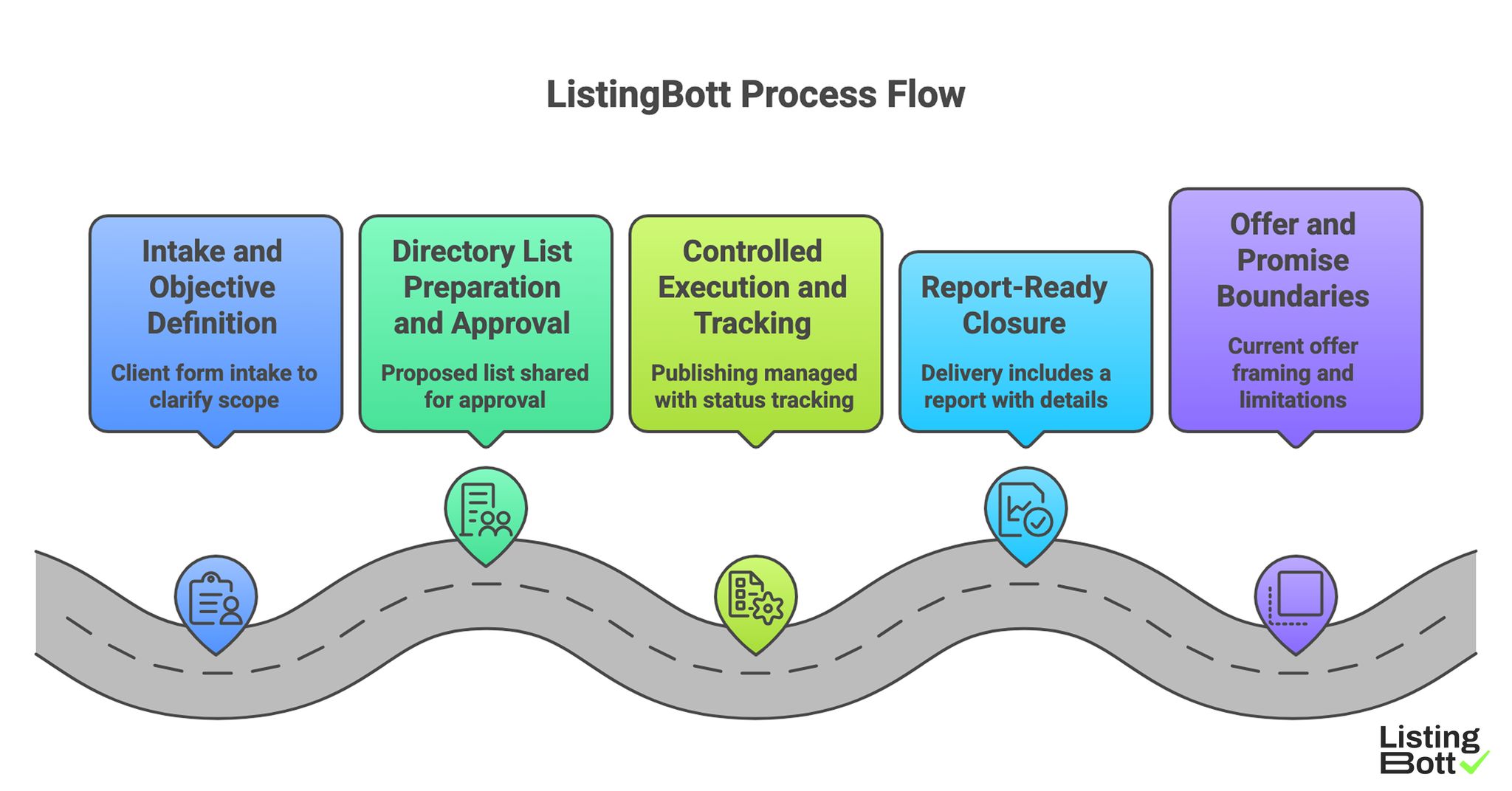
ListingBott supports listing execution with a structured flow: client form intake, directory-list approval, publish process, and report handoff. For small businesses, this structure helps keep execution predictable and communication clear.
1) Intake and objective definition
The process begins with a complete client form so listing scope and business context are clear before execution starts.
2) Directory list preparation and approval
A proposed list is prepared and shared for approval before broad publishing. This approval step helps ensure local relevance and scope control.
3) Controlled execution and tracking
Publishing is managed in a controlled sequence with status tracking, which makes issue handling and follow-up easier for small teams.
4) Report-ready closure
After execution, delivery includes a report with submitted directories, current statuses, pending items, and recommended next actions.
5) Offer and promise boundaries
Current offer framing includes one-time payment model, publication to 100+ directories (per current website language), and no hidden extra fees (per current FAQ language). Refund can apply if process has not started.
ListingBott does not promise guaranteed ranking position, guaranteed traffic by a specific date, guaranteed indexing speed, or third-party platform outcomes.
For DR-goal work, DR growth to 15 can be promised only in the qualified setup: starting DR below 15, explicit domain growth goal, and approved directory list.
If you need to connect maintenance to execution cycles, this model pairs with local directory submission in a controlled sequence.
ListingBott Process Flow
Proof/results
For small businesses, the most useful evidence model combines operational quality and business-support signals. Strong local outcomes usually follow stable operations, not the other way around.
Small-business KPI scorecard
| KPI group | Metric examples | Why it matters | Review cadence |
|---|---|---|---|
| Accuracy KPIs | profile completeness, inconsistency rate | Indicates data quality maturity | Weekly |
| Process KPIs | issue age, correction turnaround, SLA adherence | Indicates workflow reliability | Weekly |
| Coverage KPIs | accepted priority listings, duplicate resolution rate | Indicates execution quality | Biweekly |
| Outcome KPIs | referral trend, branded local query trend, assisted actions | Indicates business support | Monthly |
This scorecard helps owners avoid two common traps: over-focusing on raw activity and under-measuring operational reliability.
Practical 90-day expectation model
Do not treat month 1 as a final performance verdict. Early cycles are mainly for cleanup and process stabilization. Typical progression:
- month 1: data quality and workflow control improve,
- month 2: correction volume decreases and throughput stabilizes,
- month 3: outcome trends become easier to interpret.
This sequence supports better decision-making than immediate yes/no judgments.
What useful reporting should answer
A report should let a small-business owner answer these quickly:
- What changed this cycle?
- What still needs action?
- Which issues are recurring?
- What improved compared to baseline?
- What should happen next month?
If reporting cannot answer all five clearly, the process is still too operationally noisy.
Risk controls for local small-business teams
| Risk | Early indicator | Likely impact | Mitigation |
|---|---|---|---|
| Owner overload | Tasks pile up between reviews | Delayed corrections and inconsistent data | Time-box weekly routine and escalation support |
| Priority confusion | Low-impact edits dominate workload | High-impact issues stay unresolved | Weekly priority framework |
| Data drift after promotions | Campaign updates are not synchronized | Conflicting customer-facing information | Post-campaign data reconciliation checklist |
| Duplicate relapse | New duplicates appear after cleanup | Ongoing trust and visibility friction | Monthly duplicate audit window |
| Reporting fatigue | Reports are long but not actionable | Slower decisions and low follow-through | Keep action summary mandatory |
Measuring value without overpromising
Local listing management should be evaluated as compounding process quality plus directional outcome support. It should not be sold as guaranteed ranking movement by a specific date.
This expectation discipline protects trust and gives small businesses a realistic path to scale.
Implementation checklist
Use this practical plan to run local listing management with limited team capacity.
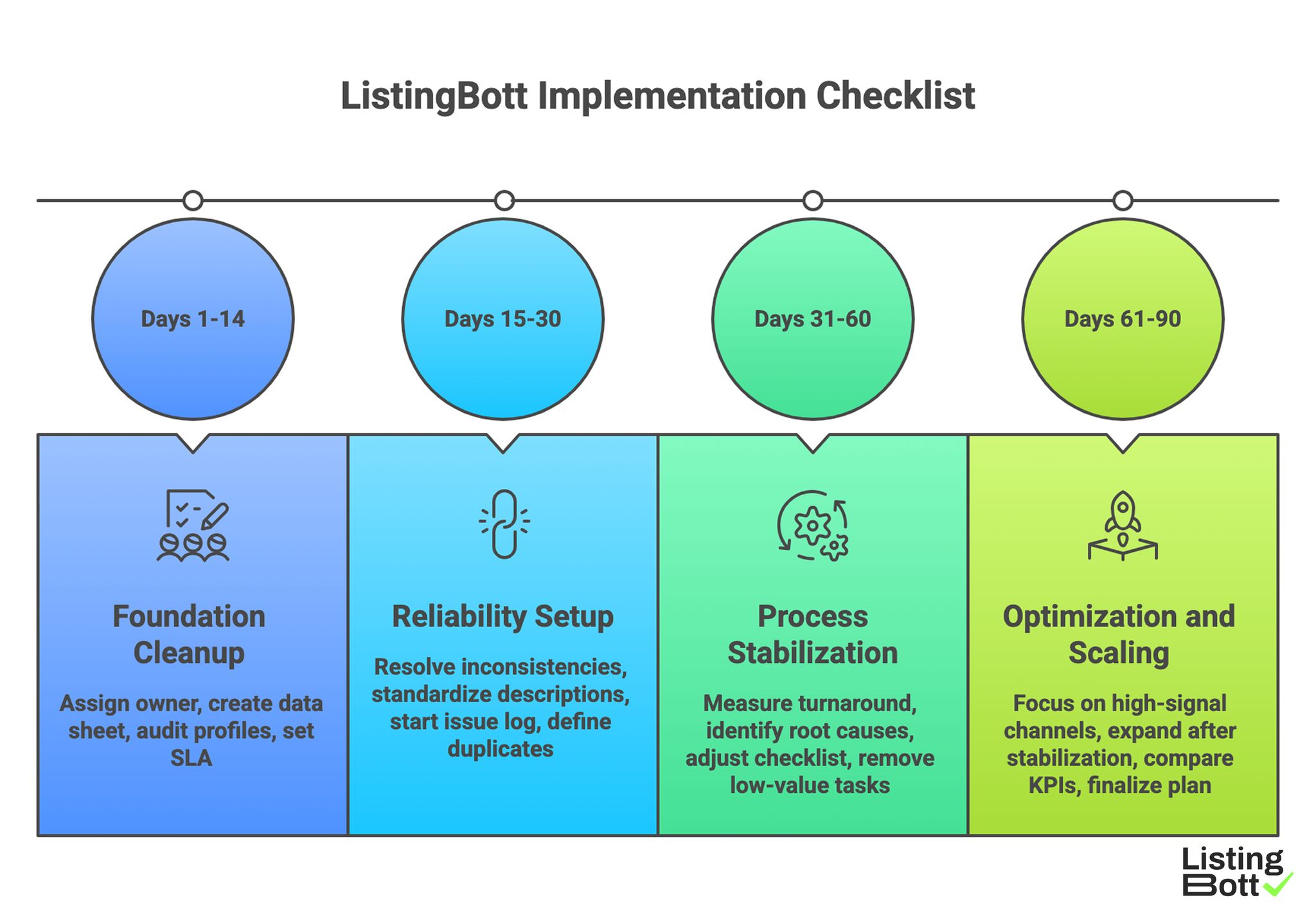
Days 1-14: Foundation cleanup
- Assign a single listing owner.
- Create source-of-truth data sheet.
- Audit top-priority profiles for critical errors.
- Set weekly update window and SLA rules.
- Capture baseline metrics before major updates.
Days 15-30: Reliability setup
- Resolve highest-impact inconsistencies first.
- Standardize category and service descriptions.
- Start issue log with owner + due date.
- Define duplicate detection and response protocol.
- Run first monthly review with decision summary.
Days 31-60: Process stabilization
- Measure correction turnaround trend.
- Identify recurring root causes.
- Adjust weekly checklist to reduce repeat errors.
- Remove low-value tasks from routine.
- Confirm reporting includes next-action ownership.
Days 61-90: Optimization and scaling
- Increase focus on highest-signal local channels.
- Expand only after error rates stabilize.
- Compare month-over-month KPI movement.
- Finalize quarterly plan based on measured results.
- Keep escalation path active for unresolved blockers.
Weekly small-business checklist (lightweight)
- Verify business hours and contact fields.
- Check top-priority profile status changes.
- Resolve urgent customer-impacting issues.
- Update issue log and pending status.
-
Confirm next weekly priorities.
ListingBott Implementation Checklist
Frequent mistakes and immediate fixes
| Mistake | Effect | Immediate fix |
|---|---|---|
| No weekly operating rhythm | Corrections happen too late | Lock fixed weekly review slot |
| Treating all tasks as equal | Critical issues stay open | Prioritize by customer impact |
| No baseline snapshot | Hard to prove progress | Record baseline before major updates |
| Over-editing low-impact fields | Team time consumed with little gain | Use impact-weighted backlog |
| Ignoring recurring issue themes | Same errors return each month | Run root-cause review every 30 days |
FAQ
1) How often should a small business update listings?
At minimum, run a weekly quality check and a monthly performance review.
2) What should be fixed first when time is limited?
Fix wrong phone/address/hours first, then duplicates, then category precision.
3) Can local listing management be done without a large team?
Yes. A lightweight routine with one owner, clear priorities, and fixed cadence can work well.
4) When should small businesses scale listing effort?
Only after process reliability improves and critical error rates are consistently low.
5) Can listing management guarantee rankings?
No. It should improve process quality and support outcomes, but rankings are not guaranteed by date.
6) Why is a 90-day plan better than ad hoc updates?
It creates measurable checkpoints, reduces repeated errors, and improves decision quality over time.
Final takeaway
For small businesses, local listing management is won through discipline, not volume. The best results usually come from a simple system: clear ownership, weekly maintenance rhythm, monthly KPI review, and controlled scaling once quality is stable.