Table of Contents
- Why Local Directories still Matter in 2026
- How to Turn a Directory List into Execution
- Decision Templates by Business Type
- Common Mistakes and How to Avoid Them
- 90-Day Operating Plan
- FAQ
sbb-itb-8e44301
Quick Answer
Local directories for business are still one of the most reliable ways to improve entity trust, local discovery, and referral visibility when you run them as an operational system instead of a one-time submission task. In 2026, the biggest gap is not finding more directories. The real gap is selecting the right channels, publishing complete profiles, and maintaining consistency as your offer, location data, and landing pages change.
A practical sequence is:
- define one canonical business profile baseline,
- score candidate directories before submission,
- launch in controlled waves,
- audit listing quality and duplicates,
- expand only when quality indicators remain stable.
This approach usually outperforms a mass-submit tactic from a generic seo directory list. It also gives better long-term value than chasing raw listing volume without ownership and QA.
Why Local Directories still Matter in 2026
Directory channels are often treated as old SEO tactics, but that framing misses how modern discovery works. Buyers still use maps, business profile portals, and review ecosystems to validate trust before they click through to a site. Search engines and AI summaries also use repeated business references as supporting context when they decide whether your brand looks consistent and credible.
What changed is how quality is judged:
- profile completeness now matters more than listing count,
- consistency across channels matters more than one strong profile,
- update speed matters more than initial submission speed,
- category and intent fit matter more than broad coverage.
This is why business directories for seo can still contribute real value, especially for teams that need high-confidence local demand capture. But directories work best when each channel has a clear role in your funnel.
Directory Value by Intent Layer
A strong directory portfolio usually covers three intent layers.
- Discovery layer Users are searching by category, city, or problem and are open to options.
- Validation layer Users already know your name and want trust checks: reviews, operating details, profile consistency.
- Action layer Users want to call, book, request a quote, or visit a location.
When your local business directory listings are mapped to these layers, you can prioritize effort instead of treating every platform as equal.
The LOCAL-FIT 8 Model
Use this framework to score candidate channels before submission.
| Factor | Practical question | Why it matters | Score (1-5) |
| Location intent match | Do users come here with local buying intent? | aligns effort with real conversion paths | 1-5 |
| Category alignment | Does the platform support your business type clearly? | reduces weak relevance signals | 1-5 |
| Editorial quality | Is the platform reasonably curated? | lowers spam adjacency risk | 1-5 |
| Profile depth | Can you publish complete, useful business data? | improves trust and entity clarity | 1-5 |
| Review signal quality | Are ratings/reviews meaningful for your market? | supports credibility checks | 1-5 |
| Update control | Can edits be made quickly and reliably? | protects data freshness | 1-5 |
| Duplicate risk | How likely are conflicting listings? | reduces confusion and cleanup load | 1-5 |
| Maintenance load | Can your team sustain quality monthly? | keeps execution scalable | 1-5 |
Scoring guidance:
- 32-40: core channels,
- 24-31: support channels,
- below 24: hold or test only.
Use this model before each wave, not once per year. Platform quality and ownership conditions can change quickly.
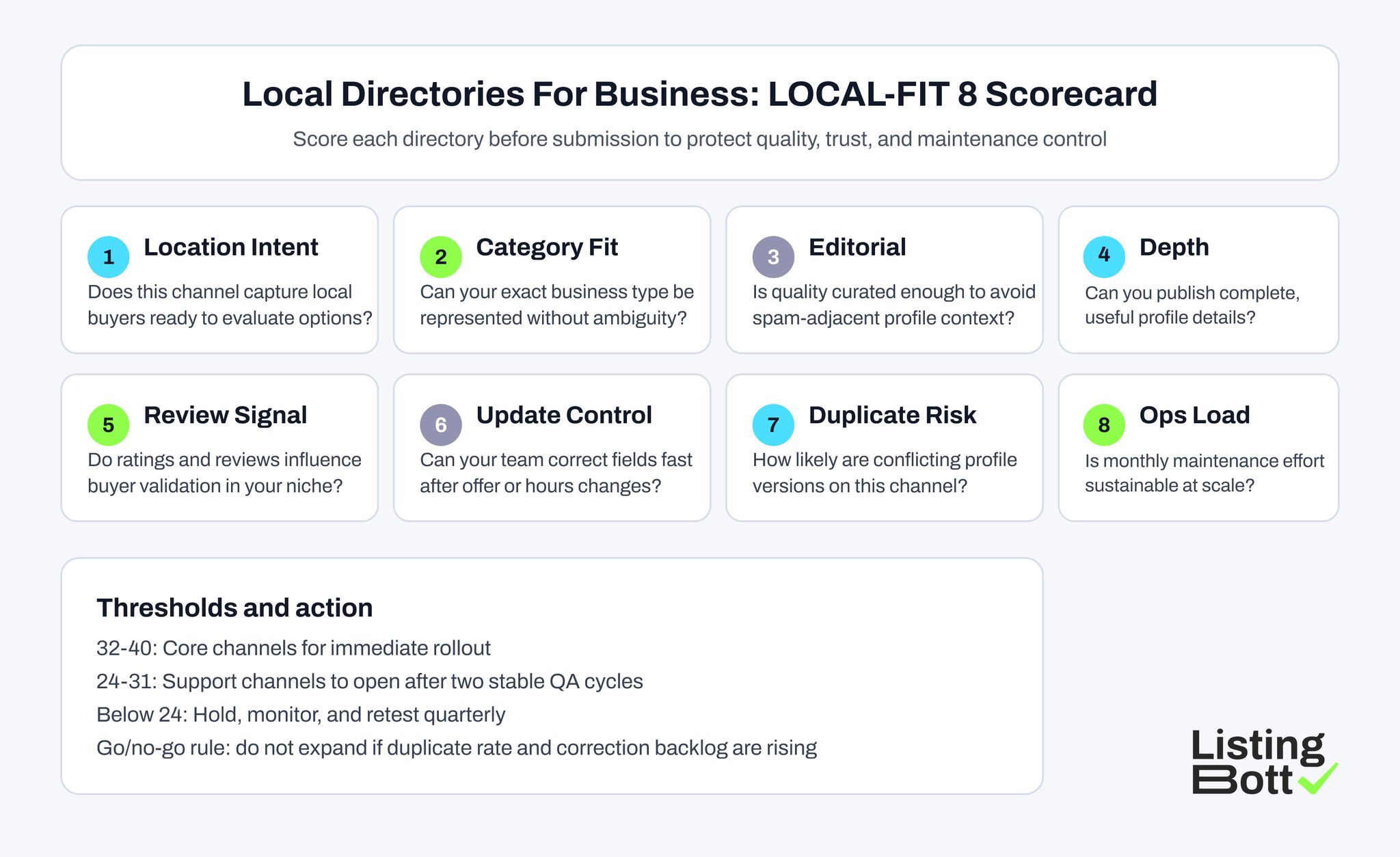
Local Directories For Business: LOCAL-FIT 8 Scorecard
Best-fit Listing Platforms for Local Directories for Business
The goal is not to list everywhere. The goal is to build a stack that matches your business model, audience, and maintenance capacity.
| Platform | URL | Why it is a best fit | Ideal company profile | Submission note |
| Google Business Profile | https://www.google.com/business/ | Dominant local discovery channel across map and branded queries | local SMBs, multi-location brands, hybrid online/offline businesses | complete categories, services, hours, and media before verification |
| Yelp | https://www.yelp.com/ | Strong validation and review-driven discovery in many service categories | local services, retail, food, healthcare-adjacent providers | monitor review and response workflow after publishing |
| Better Business Bureau | https://www.bbb.org/ | Trust and credibility signal for buyers comparing legitimacy | professional services, home services, finance-adjacent businesses | accuracy and policy-compliant profile data are essential |
| Apple Business Connect | https://mapsconnect.apple.com/ | Important map visibility layer for Apple ecosystem users | local businesses with mobile-first traffic | keep address and category taxonomy aligned with website |
| Bing Places | https://www.bingplaces.com/ | Useful additional search-map coverage with moderate management effort | SMBs and regional businesses | sync core NAP and hours after initial profile claim |
| Foursquare | https://foursquare.com/ | Strong location data layer and citation consistency support | restaurants, retail, lifestyle and location-sensitive brands | audit duplicates before and after launch |
| Yellow Pages | https://www.yellowpages.com/ | Broad directory visibility with category intent | local businesses in established categories | use clear category fit and complete contact fields |
| ChamberofCommerce.com | https://www.chamberofcommerce.com/ | Useful for local trust context and discoverability | B2B services, regional operators, community-based businesses | keep description and service areas specific |
| Manta | https://www.manta.com/ | Supports business profile exposure and supplemental citation coverage | small businesses building baseline presence | maintain consistent business descriptors across channels |
| Nextdoor Business | https://business.nextdoor.com/ | Neighborhood-level discovery and social proof for local demand | home services, clinics, local retailers, neighborhood-focused brands | use service area precision and response discipline |
| TripAdvisor | https://www.tripadvisor.com/ | High-intent validation and discovery for travel and hospitality contexts | hotels, tours, attractions, restaurants | keep media and operational data fresh |
| Angi | https://www.angi.com/ | Service-intent directory and lead visibility for contractor categories | home service contractors and local specialists | validate service categories and lead routing details |
How to select your first wave:
- choose 5-7 core channels with LOCAL-FIT 8 scores above 31,
- select 3-5 support channels with clear intent overlap,
- hold the rest until quality and maintenance KPIs are stable.
This gives you a practical alternative to copying top business directories in usa lists without strategic filtering.
How to Turn a Directory List into Execution
Most teams already have access to large lists, including free online business directories and free online directory listings. The problem is execution quality. A list by itself does not define ownership, QA gates, or update cadence.
Step 1: build a canonical profile pack
Prepare one source file with:
- legal business name and acceptable variants,
- primary phone and secondary phone rules,
- canonical address format,
- service area format,
- primary category and allowed secondary categories,
- short and long descriptions,
- URL mapping rules,
- logo and approved media set,
- review-response owner and SLA.
If you skip this step, mismatch and duplicate risk rises quickly.
Step 2: map channel roles
For each directory, mark the primary role:
- discovery,
- validation,
- action,
- citation consistency support.
Channel roles help with prioritization when resources are limited.
Step 3: launch a controlled core wave
Publish core channels first and track:
- submission date,
- claim/verification state,
- live listing URL,
- owner,
- QA review date.
Do not open support wave in parallel unless your correction queue is empty.
Step 4: run first QA review (day 7 to day 14)
Check each profile for:
- NAP consistency,
- category correctness,
- URL destination fit,
- duplicate presence,
- media and description completeness.
Step 5: fix high-impact issues
Prioritize fixes in this order:
- wrong phone/address,
- wrong destination links,
- duplicate profiles,
- category mismatch,
- incomplete profile fields.
Step 6: open support wave selectively
Only expand after two stable review cycles with low critical error rate.
Step 7: run monthly keep/improve/pause review
Every month, evaluate each channel by:
- quality consistency,
- correction effort,
- referral usefulness,
- conversion assist signals,
- operational burden.
This keeps your program lean and prevents stale channel accumulation.
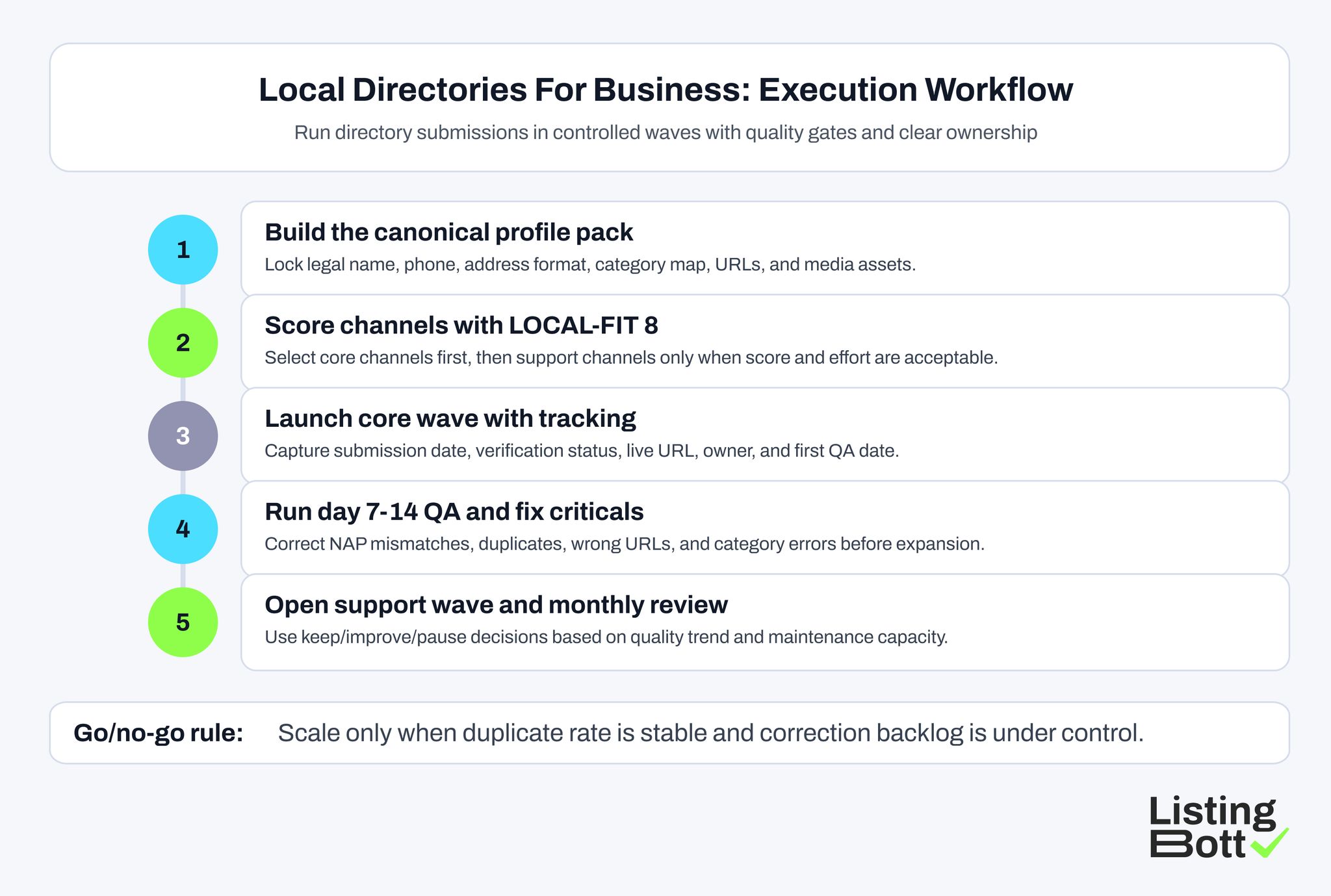
Local Directories For Business: Execution Workflow
Decision Templates by Business Type
No single directory mix works for everyone. Use these templates as starting points.
Template A: single-location local service
Suggested first stack:
- Google Business Profile,
- Yelp,
- BBB,
- Nextdoor Business,
- one category-specific support directory.
Why it works:
- strong discovery and trust validation,
- manageable maintenance load,
- clear route to action events (calls, quote requests, direction taps).
Template B: multi-location regional brand
Suggested first stack:
- Google Business Profile,
- Apple Business Connect,
- Bing Places,
- Yelp,
- ChamberofCommerce.com,
- one category-specific platform.
Why it works:
- map coverage across major ecosystems,
- layered trust signals,
- better consistency control for location-level data.
Template C: B2B local plus digital service mix
Suggested first stack:
- Google Business Profile,
- BBB,
- ChamberofCommerce.com,
- Manta,
- one industry directory,
- one review-support channel.
Why it works:
- captures local trust while supporting broader commercial validation,
- balances visibility with operational simplicity.
KPI System for Local Directory Programs
Teams that manage directories well use a compact KPI board.
| KPI | Why it matters | Healthy signal | Risk signal |
| Listing consistency rate | measures profile alignment quality | stable and improving trend | repeated mismatches across core channels |
| Duplicate profile rate | monitors citation hygiene | flat or declining | rising duplicate clusters after expansion |
| Correction closure time | reflects operational control | predictable closure windows | unresolved backlog accumulation |
| Profile completeness score | tracks information depth quality | high completion on core channels | partial profiles or missing fields |
| Assisted conversion signal | estimates business impact from directory paths | stable assisted leads or calls | volume without quality actions |
| Maintenance load ratio | checks scalability | stable effort per channel | growing effort with no quality gain |
Use this board in monthly channel reviews and quarterly scope decisions.
Common Mistakes and How to Avoid Them
1) Treating every directory as equal
A channel with weak intent and high maintenance load can consume capacity without adding useful outcomes.
Fix: score channels before submission and tier them.
2) Launching all channels at once
Mass launch creates correction debt.
Fix: run waves and gate expansion through QA outcomes.
3) Weak profile depth
Thin listings reduce trust and conversion readiness.
Fix: use profile templates with required field minimums.
4) No duplicate governance
Duplicate listings split authority and confuse users.
Fix: run duplicate checks before each wave and after major edits.
5) No ownership model
If no one owns corrections, quality decays fast.
Fix: assign one operational owner and one backup owner.
6) Over-reliance on one channel
Channel policy changes can quickly reduce coverage value.
Fix: keep a diversified core stack.
7) Measuring only submissions
Submission count is an activity metric, not an outcome metric.
Fix: review quality and assisted conversion indicators monthly.
90-Day Operating Plan
Days 1-30: foundation and launch
- finalize canonical profile pack,
- score and select core channels,
- publish first wave,
- document listing ownership,
- run first QA cycle.
Days 31-60: correction and stabilization
- close critical mismatches,
- resolve duplicate issues,
- refine category mapping,
- improve profile depth on core channels,
- confirm data consistency across properties.
Days 61-90: selective expansion
- open support channels that pass threshold,
- pause channels with high maintenance and low value,
- refine destination URL mapping,
- lock monthly keep/improve/pause cadence,
- prepare quarter-two optimization backlog.
A 90-day cycle gives enough time to separate useful channels from noise and prevents constant restarts.
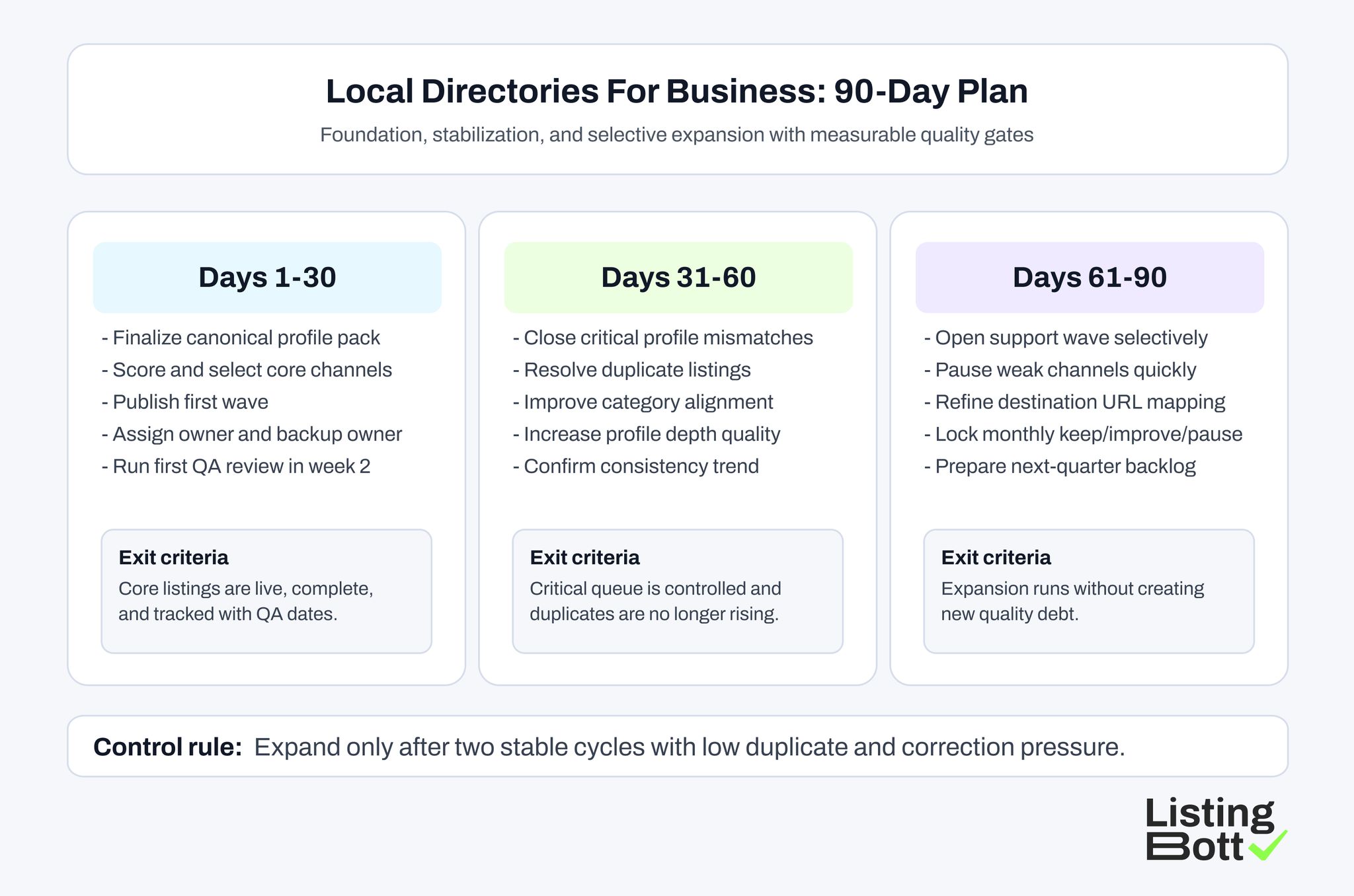
Local Directories For Business: 90-Day Plan
Where ListingBott Fits
ListingBott fits as an execution and reporting layer for teams that want directory publication to be repeatable and measurable.
Typical workflow:
- onboarding details are collected,
- listing scope is approved,
- publication is executed,
- reporting is delivered.
Public offer alignment:
- one-time payment model,
- publication to 100+ directories,
- refund possible if process has not started,
- no hidden extra fees.
Promise limits:
- no guaranteed ranking position,
- no guaranteed traffic by a specific date,
- no guaranteed indexing speed,
- no guaranteed outcomes controlled by third-party platforms.
Qualified DR statement: DR growth to 15 can be promised only when starting DR is below 15, the selected goal is domain growth, and the approved listing set is in place.
FAQ: Local Directories For Business
How many local directories should a business start with?
Most teams should start with 5-7 core channels, run two QA cycles, and only then add support channels.
Are free online business directories still useful in 2026?
Yes, if they are selected by quality and maintained consistently. Free channels can add value, but only as part of a controlled stack.
Should we submit to every directory on a large seo directory list?
No. Use broad lists as research input, then score channels for intent, quality, and maintenance feasibility before submission.
Do local business directory listings guarantee rankings?
No. They support trust, entity clarity, and discovery, but rankings depend on many factors outside directory control.
How often should listings be reviewed?
Run a first QA review in the first two weeks after publication, then review core channels monthly and support channels at a stable cadence.