Table of Contents
- What Effective Listing Management should Include
- 90-Day Listing Management Plan
- Common Failure Patterns in Local Listing Management
- How to Choose between Listing Management Tool Options
- FAQ
sbb-itb-8e44301
Quick Answer
Strong local business listing management is not about posting business data once and moving on. It is an ongoing operating system that keeps profile data accurate, channels relevant, and maintenance workload under control.
A practical 2026 approach is:
- choose channels by market fit,
- publish with one canonical profile baseline,
- run recurring QA and correction cycles,
- keep only channels that show quality and contribution.
Teams that skip this lifecycle usually end up with profile drift, duplicate listings, and unclear outcomes.
Why Local Business Listing Management is a Core Growth Operation
Local listing operations now affect more than directory visibility. They influence brand trust, map-level discovery, and consistency signals that users and search systems use when validating a business.
That is why related keywords such as local search listings management, local citation management, and local seo listing management remain commercially relevant. Businesses are not only looking for more channels. They are looking for a reliable system that does not break as they scale.
In practice, listing management performance depends on three conditions:
- accurate baseline data,
- controlled channel expansion,
- predictable update and correction workflows.
If any one of these is missing, listing quality usually decays over time.
What Effective Listing Management should Include
Many teams evaluate a listing management tool or provider based only on first-wave publication speed. That misses the core operational problem.
A good listing management setup should cover five responsibilities:
- channel selection logic,
- profile-quality standards,
- QA and correction controls,
- lifecycle maintenance process,
- measurable performance reporting.
Without all five, you do not have a listing management system. You have a one-time submission task.
The OPERATE-7 Framework for Listing Management Quality
Use this framework to evaluate any in-house or external setup.
| Dimension | Practical question | Why it matters | Score (1-5) |
| Ownership clarity | Is there a clear owner for updates and corrections? | prevents accountability gaps | 1-5 |
| Profile depth | Can listings include meaningful business context and proof? | improves trust and conversion readiness | 1-5 |
| Error control | Is there a recurring QA process after publish? | reduces drift and duplicate risk | 1-5 |
| Relevance fit | Are channels selected for real buyer intent? | improves traffic quality | 1-5 |
| Automation support | Does workflow reduce repetitive manual work safely? | improves scalability | 1-5 |
| Traceable outcomes | Can quality and contribution be measured by channel? | supports keep/de-prioritize decisions | 1-5 |
| Execution cadence | Are updates handled on a predictable schedule? | protects long-term consistency | 1-5 |
Threshold guidance:
- 28-35: scalable operating model
- 22-27: workable but needs tighter controls
- below 22: high risk of quality decay
This framework helps teams compare listing management software options and manual processes using operational quality, not marketing claims.
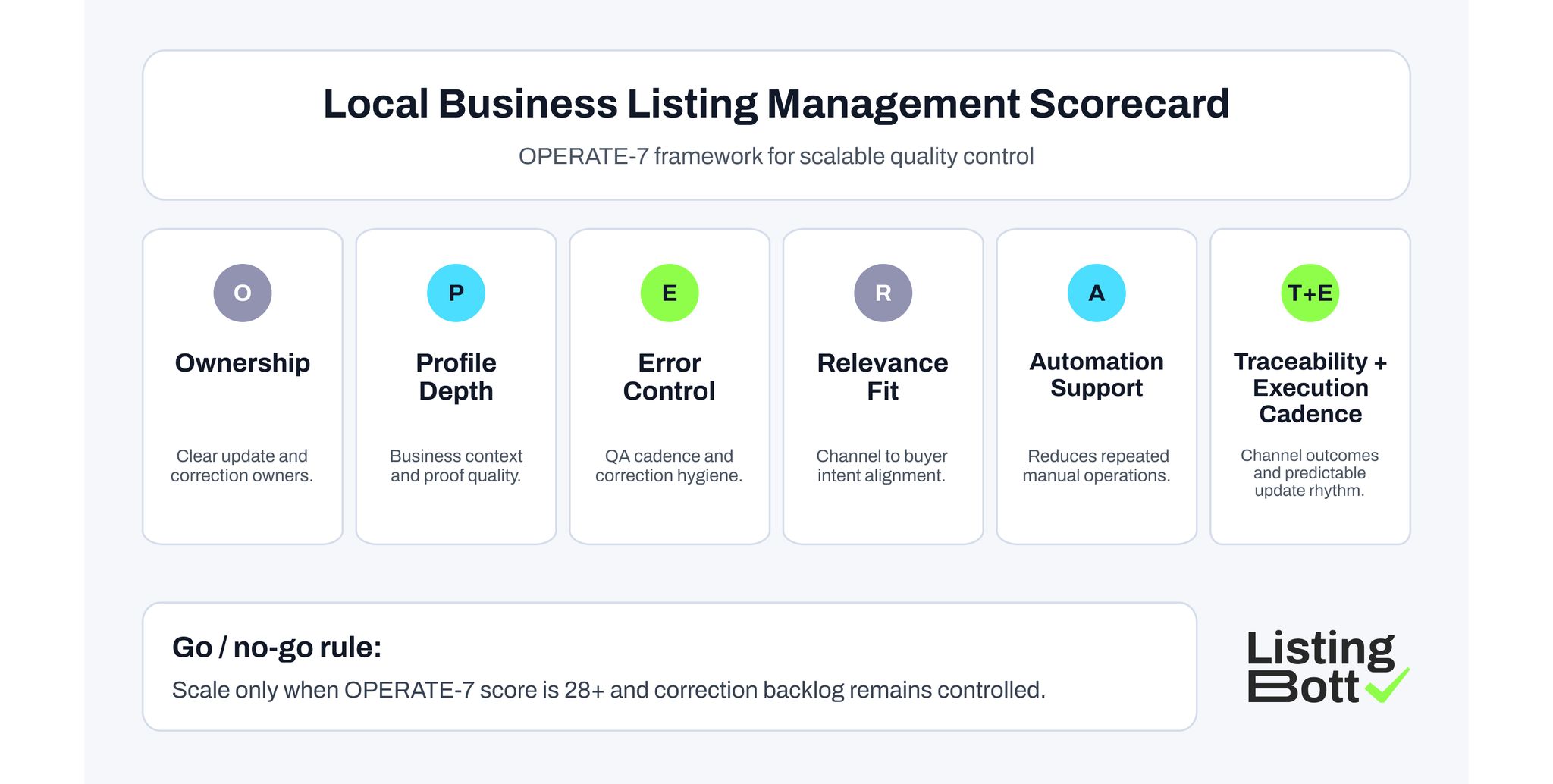
Local Business Listing Management Scorecard
Best-Fit Listing Platforms for Local Business Listing Management
This shortlist uses platform sources already present in your local research files and should be treated as a fit-based operating set, not a submit-all template.
| Platform | URL | Why it is a best fit | Ideal company profile | Submission note |
| Apple Business Connect | https://businessconnect.apple.com/ | Important map-level profile layer for Apple ecosystem | local businesses, multi-location brands, service-area operators | validate core profile baseline before publication |
| Bing Maps | https://www.bing.com/maps/ | Useful discovery support beyond Google ecosystem | SMBs with diversified search traffic | align category and service area fields with destination pages |
| Better Business Bureau (BBB) | https://www.bbb.org/get-listed | Strong trust-oriented listing channel for credibility-sensitive categories | home services, legal, healthcare-adjacent businesses | maintain complete business details and reputation context |
| Chamber of Commerce | https://www.chamberofcommerce.com/ | Practical baseline listing channel for US local visibility | local SMBs and regional providers | keep listing descriptions specific and current |
| Foursquare | https://foursquare.com/ | Valuable location and discovery support channel | retail, hospitality, and in-person service businesses | hours and location accuracy are critical |
| Hotfrog | https://admin.hotfrog.com/add/index-card | Useful support-tier channel for citation breadth | SMBs building broader visibility footprint | monitor quality and corrections after launch |
| Citysearch | http://www.citysearch.com/world | Legacy channel still useful in selected local segments | established local businesses | stale records can reduce trust, so recurring QA is required |
| EZlocal | https://ezlocal.com/ | Helpful support channel for additional local profile presence | local service businesses and single-location operators | verify URLs and contact data post-publish |
| US City | https://uscity.net/ | Adds support-layer directory coverage from your source pool | businesses adding controlled citation diversity | use only when NAP control is stable |
How to apply this list:
- choose 4-6 core channels first,
- add support channels only if correction load remains stable,
- de-prioritize channels that repeatedly fail quality checks.
Operating-model Comparison for Listing Management Teams
When teams evaluate business listing management software or services, they are usually deciding between operating models.
| Model | Best for | Primary risk | What to validate |
| Manual spreadsheet workflow | very small channel scope and low update frequency | inconsistent updates and missed corrections | owner availability and QA discipline |
| Freelancer execution model | short-term launches with limited scope | variability in standards and lifecycle ownership | checklist quality and correction accountability |
| Agency-managed operations | teams wanting outsourced execution | process quality varies by provider | channel scoring logic, QA cadence, reporting clarity |
| Tool-led workflow + controls | teams needing repeatable scale | weak results if governance is missing | baseline rules, ownership, and recurring review process |
The best model depends on scope and internal maturity, not on a fixed "best provider" list.
90-Day Listing Management Plan
Days 1-15: baseline and setup
- define canonical profile pack,
- score channels with OPERATE-7,
- classify channels as core or support,
- assign owners for publish, QA, and correction.
Days 16-35: first-wave execution
- publish to core set only,
- track approvals and live status,
- run post-launch QA across all core listings,
- fix category, NAP, and URL mismatches.
Days 36-60: stabilization and cleanup
- close correction backlog,
- refresh weak profiles,
- remove recurring duplicate sources,
- evaluate maintenance load versus output quality.
Days 61-90: scale decision
- keep channels with stable quality and useful contribution,
- pause channels with persistent mismatch or high load,
- add support channels only when quality thresholds hold,
- document cycle rules for repeatable monthly operations.
This plan keeps local citation management and listing quality synchronized as channel volume grows.
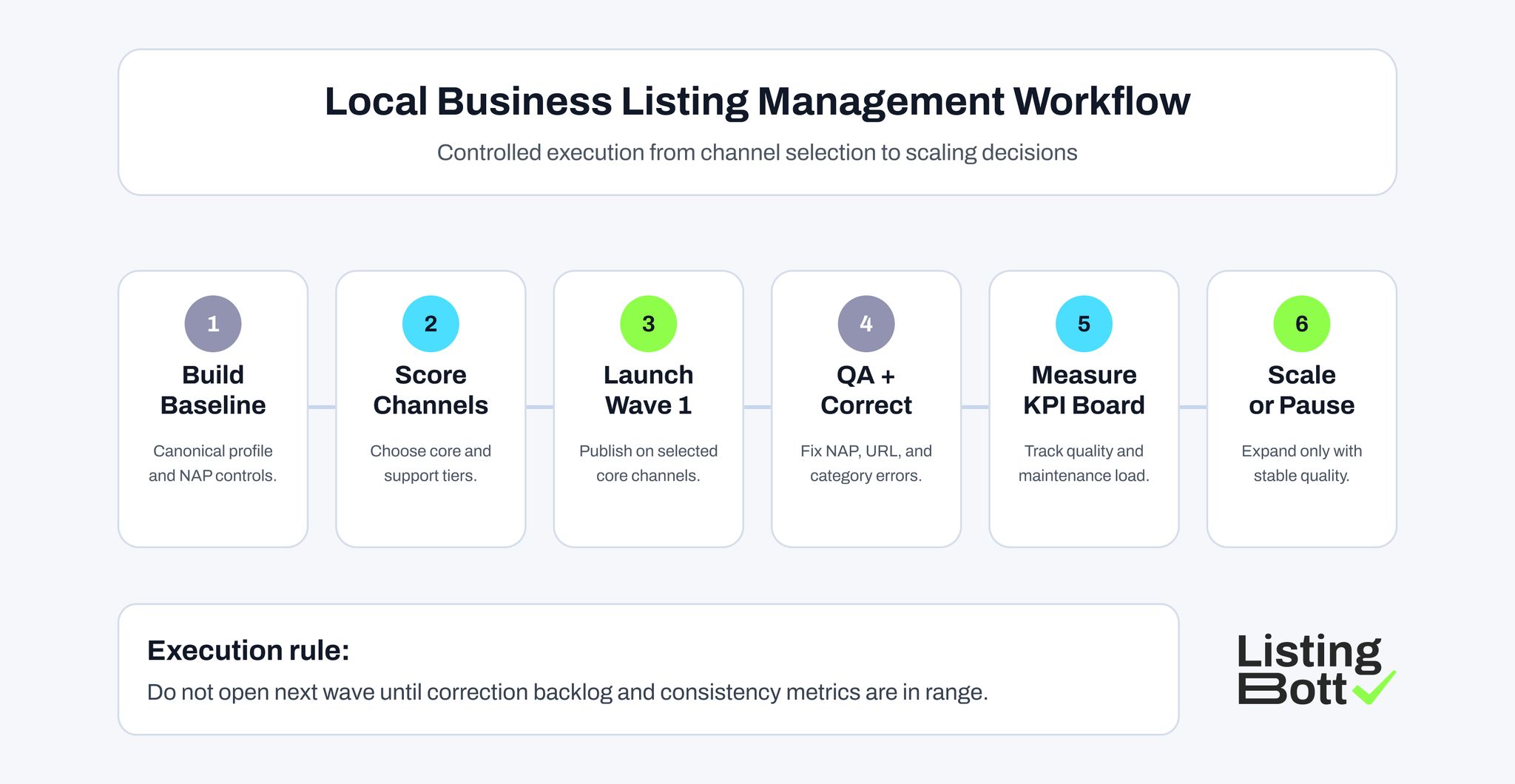
Local Business Listing Management Workflow
KPI Board for Listing Management Performance
Use a compact KPI board that supports decisions, not vanity reporting.
| KPI | Why it matters | Healthy signal | Risk signal |
| Listing consistency rate | measures data integrity across core channels | 95%+ stable consistency | repeated mismatch trend |
| Correction closure speed | reflects operational discipline | predictable closure cycle | growing aged backlog |
| Duplicate listing rate | shows data hygiene quality | low and declining duplicates | repeated duplicate creation |
| Referral engagement quality | indicates listing-channel relevance | stronger engagement over time | low-intent sessions dominate |
| Maintenance load ratio | tests process scalability | stable effort per cycle | rising effort without quality gain |
This board helps teams compare tools and processes objectively.
Common Failure Patterns in Local Listing Management
1) Treating launch as finish line
Fix:
- make maintenance a required monthly cycle,
- track updates and corrections by owner.
2) Expanding channel volume too early
Fix:
- keep first wave focused,
- expand only when consistency and correction metrics are stable.
3) No channel-fit scoring
Fix:
- score channels before launch,
- de-prioritize low-fit channels even if they are free.
4) Blending all outcomes into one metric
Fix:
- separate quality, maintenance, and contribution KPIs,
- review channel-level performance.
5) Poor destination mapping
Fix:
- map listings to intent-matched pages,
- avoid routing every channel to one generic URL.
6) Tool-first, process-second decisions
Fix:
- define workflow and governance first,
- choose tooling that supports the process rather than replacing it.
7) No NAP control discipline
Fix:
- enforce one canonical NAP baseline,
- run recurring checks before and after update cycles.
How to Choose between Listing Management Tool Options
When evaluating a listing management tool, use a practical decision matrix:
- Control depth: can you manage profile quality across core channels?
- Workflow clarity: can your team understand status, blockers, and next actions?
- Maintenance efficiency: does the system reduce repeated manual effort?
- Reporting usability: can you identify which channels to keep, improve, or pause?
This approach avoids buying based on feature lists alone.
Free vs Managed Listing Management: Decision Checkpoint
A quick monthly checkpoint can prevent wasted effort:
- If quality is stable and maintenance load is low, a lighter workflow can be enough.
- If quality is unstable but scope is still small, tighten process controls first.
- If quality is unstable and scope is large, move to a structured managed workflow.
The objective is not simply faster publication. The objective is sustained accuracy with manageable workload.
Multi-location Listing Management without Chaos
Multi-location teams often fail when they apply one flat workflow to every location. Local business listing management works better when location groups are segmented by complexity.
A practical grouping model:
- Tier A locations: high-volume and high-risk markets that need stricter QA cadence,
- Tier B locations: stable markets with standard update rhythm,
- Tier C locations: low-change markets that can run lighter cycles.
This tiering improves operational planning:
- Tier A gets priority correction queues and faster refresh windows.
- Tier B follows standard monthly cycles.
- Tier C runs periodic integrity checks with escalation rules.
If your team supports many locations, this approach usually improves both quality and workload predictability.
Fast Triage Model for Correction Backlogs
When correction volume spikes, use a triage model to keep operations stable:
- critical issues first (wrong NAP, broken URLs, missing core fields),
- medium issues next (category mismatch, outdated descriptions),
- cosmetic issues last (minor formatting inconsistencies).
This sequence protects customer-facing accuracy while preventing teams from burning time on low-impact edits. It also improves reporting clarity because backlog status reflects business impact, not just ticket count. It is especially useful during high-change periods when multiple listings need simultaneous updates.
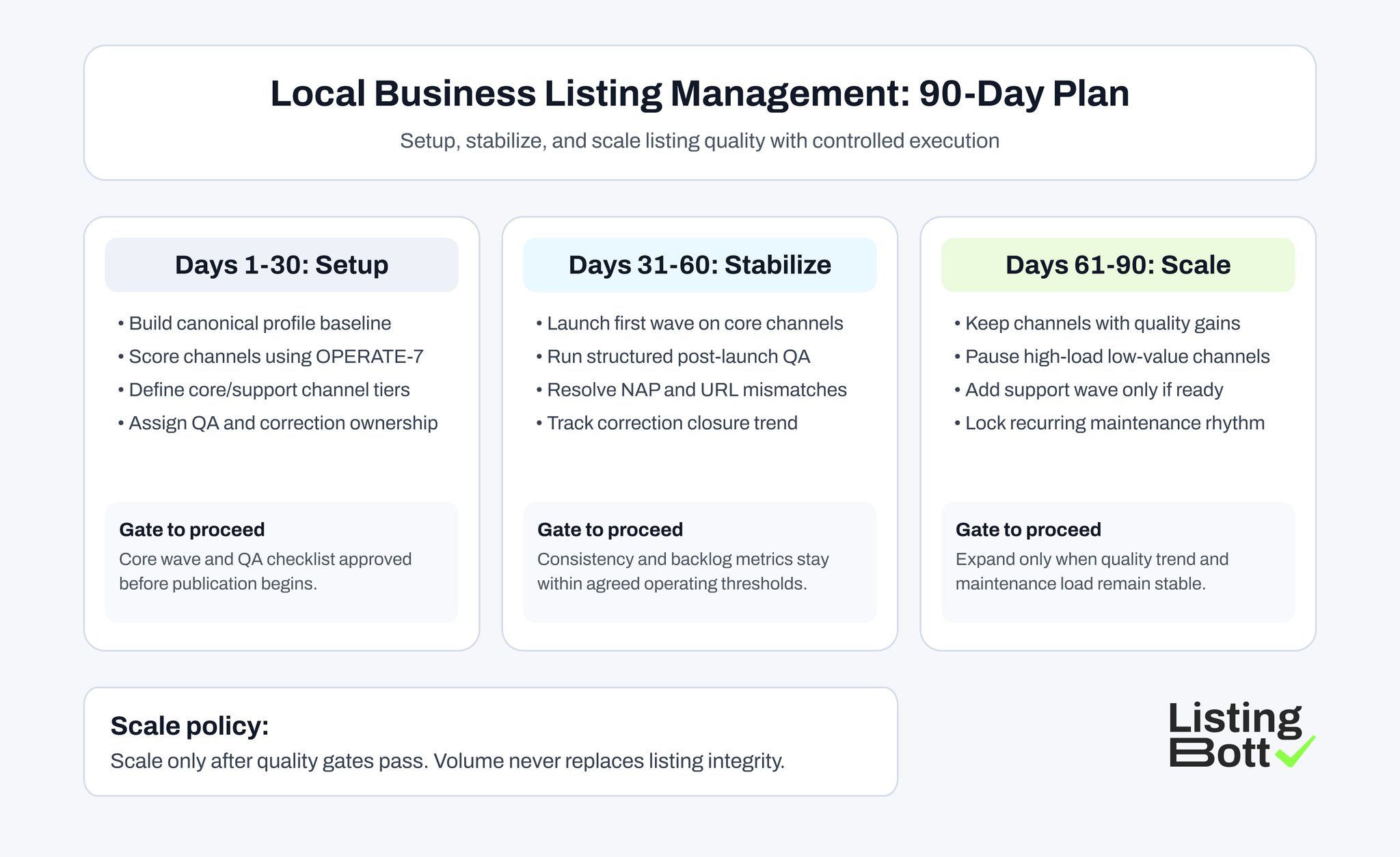
Local Business Listing Management: 90-Day Plan
Where ListingBott Fits
ListingBott supports structured directory execution and reporting workflows.
Typical flow:
- onboarding details are collected,
- listing scope is reviewed and approved,
- publication is executed,
- reporting is delivered with status visibility.
Offer alignment:
- one-time payment model,
- publication to 100+ directories,
- no hidden extra fees,
- refund possible if process has not started.
Promise limits:
- no guaranteed ranking position,
- no guaranteed traffic by a specific date,
- no guaranteed indexing speed,
- no guaranteed outcomes controlled by third-party platforms.
Qualified DR statement: DR growth to 15 can be promised only for qualified DR-goal projects where starting DR is below 15, the selected goal is domain growth, and the approved listing set is in place.
FAQ: Local Business Listing Management
What is local business listing management in practice?
It is the ongoing process of selecting channels, publishing accurate profiles, maintaining consistency, and measuring quality by channel over time.
Is listing management software always better than manual workflows?
Not always. For very small scope operations, manual workflows can work. As scope and update frequency grow, structured tooling and controls usually become more efficient.
How many channels should we manage in the first wave?
Most teams should start with a focused core set, usually 4-6 channels, then expand only after quality metrics stabilize.
Is local citation management the same as search engine submissions sites?
No. Citation/listing workflows support profile visibility and consistency, while search-engine submission workflows focus on indexing and diagnostics.
Do listing management tools guarantee ranking results?
No. They support operational quality and visibility layers, but ranking outcomes still depend on broader SEO, site quality, and market competition.