Quick answer
Local business directory submission in Wyoming should be planned as a coverage problem first, then an execution-volume problem. In lower-density states, the biggest risk is not only bad profile data; it is misallocated effort across areas where visibility payoff and maintenance load are not balanced.
A practical Wyoming sequence is:
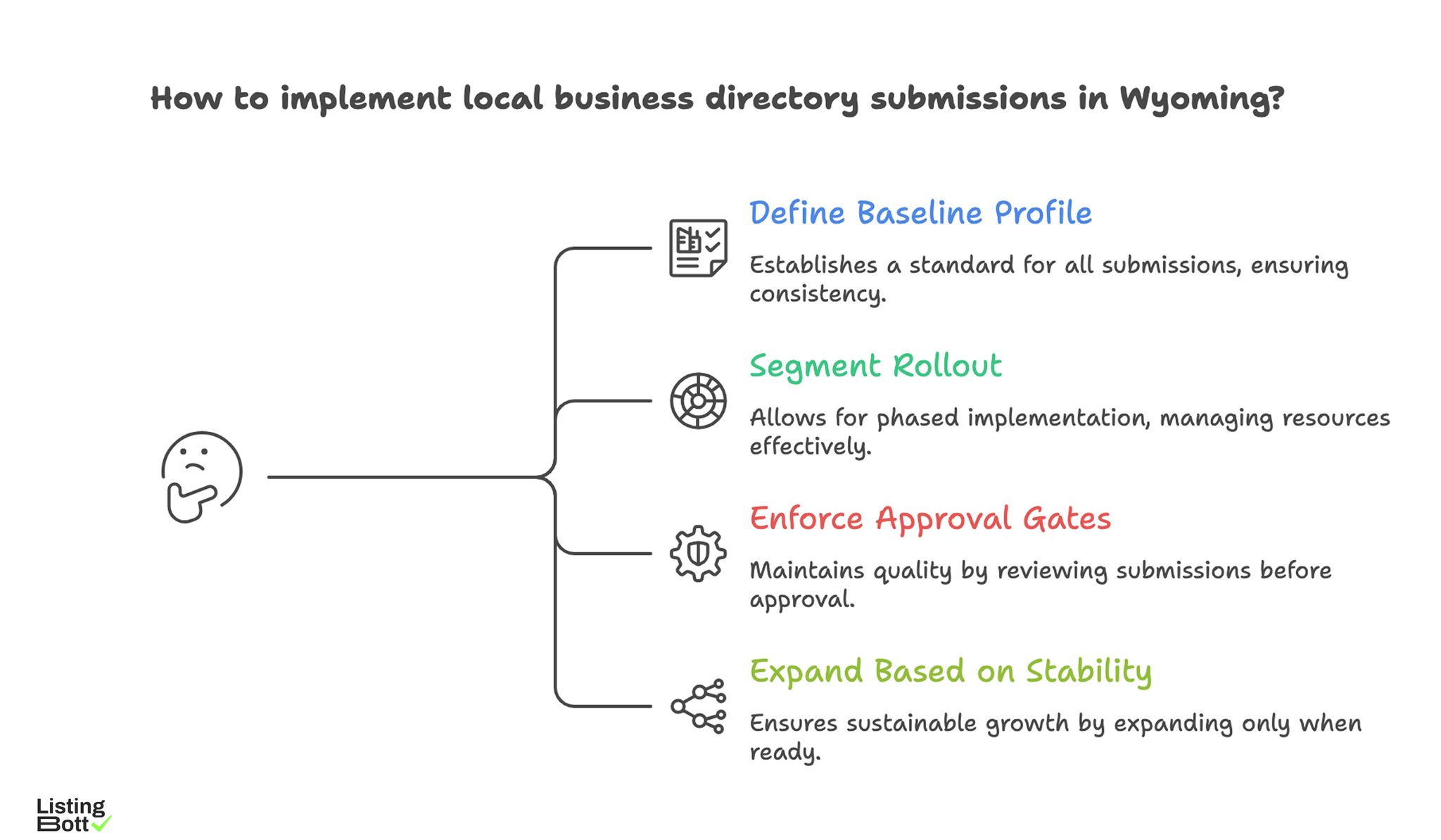
Local Business Directory Submission Implementation in Wyoming
- define one canonical profile baseline,
- segment rollout by coverage tier,
- enforce approval gates per tier,
- expand only when correction quality and maintenance capacity remain stable.
For broader U.S. planning, see Local business directory submission USA.
sbb-itb-8e44301
Methodology
This page uses a Wyoming-specific model focused on sparse-market coverage, operational discipline, and maintenance sustainability.
The SPARSE model (Segmentation, Prioritization, Accuracy, Resourcing, Sequencing, Evaluation)
| Pillar | Weight | Why it matters in Wyoming |
|---|---|---|
| Segmentation quality | 20 | Prevents treating all areas as equal when demand density differs |
| Prioritization discipline | 20 | Concentrates effort where execution can be sustained |
| Accuracy control | 25 | Protects listing consistency across large geographic spread |
| Resourcing realism | 15 | Aligns expansion pace with correction and monitoring capacity |
| Sequencing governance | 10 | Avoids premature rollout across low-readiness tiers |
| Evaluation cadence | 10 | Detects drift before it becomes operational debt |
How to use SPARSE:
- score each pillar from 1-5 every two weeks,
-
hold expansion if
AccuracyorResourcingis below 3, - reopen expansion only after two consecutive stable review cycles.
This model keeps coverage growth tied to control quality.
Wyoming coverage tiers
| Tier | Rollout order | Typical market pattern | Primary objective | Common failure mode |
|---|---|---|---|---|
| Tier 1: Anchor coverage | 1 | highest activity zones | establish clean baseline and QA rhythm | rushing scope before baseline matures |
| Tier 2: Connector coverage | 2 | medium-activity zones with cross-market dependencies | replicate baseline without drift | inconsistent source ownership |
| Tier 3: Distributed coverage | 3 | broad lower-density areas | maintain quality with lean operations | delayed correction loops |
| Tier 4: Long-tail coverage | 4 | low-volume edge cases | controlled breadth expansion | hidden maintenance backlog |
Coverage economics table
| Decision area | Wrong default | Better operating rule |
|---|---|---|
| Market expansion | expand by calendar date | expand by readiness threshold |
| Resource planning | assume all areas require equal effort | allocate by tier complexity and issue rate |
| Quality review | review only aggregate totals | review by tier, issue class, and correction age |
| Scope changes | allow ad hoc additions during execution | route all additions through approval gate |
| Success definition | count submissions only | combine integrity, correction speed, and progression metrics |
This table helps teams avoid output-heavy but quality-weak execution.
Approval-gate ladder for coverage tiers
| Gate | When | Required artifact | Hard-stop trigger |
|---|---|---|---|
| Gate 1: Baseline lock | before tier 1 launch | canonical profile policy + owner matrix | multiple profile sources active |
| Gate 2: Tier scope approval | before each new tier | approved inclusion/exclusion set | scope change without sign-off |
| Gate 3: Quality checkpoint | after first batch in tier | integrity report + critical-issue status | critical backlog above threshold |
| Gate 4: Maintenance readiness | before tier expansion | correction SLA trend + capacity plan | SLA trend deteriorating |
96-day Wyoming rollout map
| Phase | Days | Focus | Exit condition |
|---|---|---|---|
| Foundation | 1-18 | canonical data model, owner mapping, gate policy | baseline approved |
| Tier 1 execution | 19-40 | launch anchor coverage with strict QA loop | integrity + fix velocity stable |
| Tier 2 replication | 41-62 | extend to connector coverage with same controls | no drift vs tier 1 baselines |
| Tier 3/4 controlled expansion | 63-96 | add distributed and long-tail tiers by readiness | maintenance KPIs remain in threshold |
Skipping maintenance-readiness checks often causes long-tail execution debt.
Tier readiness checklist
| Checkpoint | Validation question | Pass criteria |
|---|---|---|
| Canonical baseline | Is one profile source enforced across all active tiers? | Yes, no parallel baselines |
| Ownership clarity | Is each tier mapped to a decision owner and escalation path? | Yes, owner list current |
| Correction SLA | Are critical issue targets defined and monitored weekly? | Yes, trendline available |
| Tier-level reporting | Can integrity/fix velocity be viewed per tier? | Yes, segmented reporting active |
| Expansion block rule | Is next-tier launch blocked when thresholds fail? | Yes, documented and enforced |
Comparison table
| Execution model | Best for | Strength | Tradeoff | Wyoming fit |
|---|---|---|---|---|
| Flat statewide rollout | small one-off tests | quick setup | weak control over coverage variance | Low |
| Manual tier planning | tiny teams with narrow scope | flexible local decisions | high coordination overhead | Medium-low |
| Managed coverage workflow | teams needing efficient but controlled rollout | lower ops burden with clearer process | requires transparent workflow partner | Strong |
| Hybrid governance model | teams balancing speed and strict QA | strong control/scale balance | needs explicit role boundaries | Very strong |
Model selection by operational maturity
| Team maturity | Recommended model | Why |
|---|---|---|
| Limited internal ops bandwidth | Managed coverage workflow | keeps quality while reducing execution load |
| Moderate maturity with growth goals | Hybrid model | supports scale under governance controls |
| High process maturity | Hybrid or software-led | enables deeper internal control |
| Persistent correction debt | Managed pilot + reset | stabilizes quality before expansion |
KPI stack for sparse-market execution
| KPI | Why it matters | Warning signal |
|---|---|---|
| Integrity pass rate by tier | tracks quality stability where it matters | sustained decline in active tier |
| Critical issue closure velocity | measures operational responsiveness | aging unresolved critical issues |
| Maintenance load index | shows if support burden is rising too fast | week-over-week increase |
| Expansion readiness score | blocks premature tier launches | score below threshold |
| BOFU progression actions | ties execution to commercial outcomes | informational activity without progression |
Teams that watch only submission counts usually miss maintenance risk until it compounds.
Best by use case
1) Single-location business
Best fit: managed execution with tier-appropriate coverage plan.
Reason: operations stay simple while quality controls remain explicit.
2) Multi-location operator
Best fit: hybrid governance with tier-based expansion gates.
Reason: this supports measured growth and correction accountability.
3) SaaS team building local visibility
Best fit: phased rollout by tier readiness, not fixed calendar.
Reason: quality remains stable when expansion follows thresholds.
4) Agency with mixed client profiles
Best fit: standardized workflow with clear issue-class escalation.
Reason: agencies need repeatable delivery across uneven coverage patterns.
5) Compliance-sensitive program
Best fit: approval-first execution with documented gate artifacts.
Reason: traceable decisions reduce governance risk.
For evaluation references, compare execution depth and operating controls via best directory listing services and best local business directories.
Where ListingBott fits in Wyoming execution
What ListingBott does
ListingBott is a workflow-based tool for business directory submission, built for teams that need structure, approval checkpoints, and clear reporting visibility.
How ListingBott works
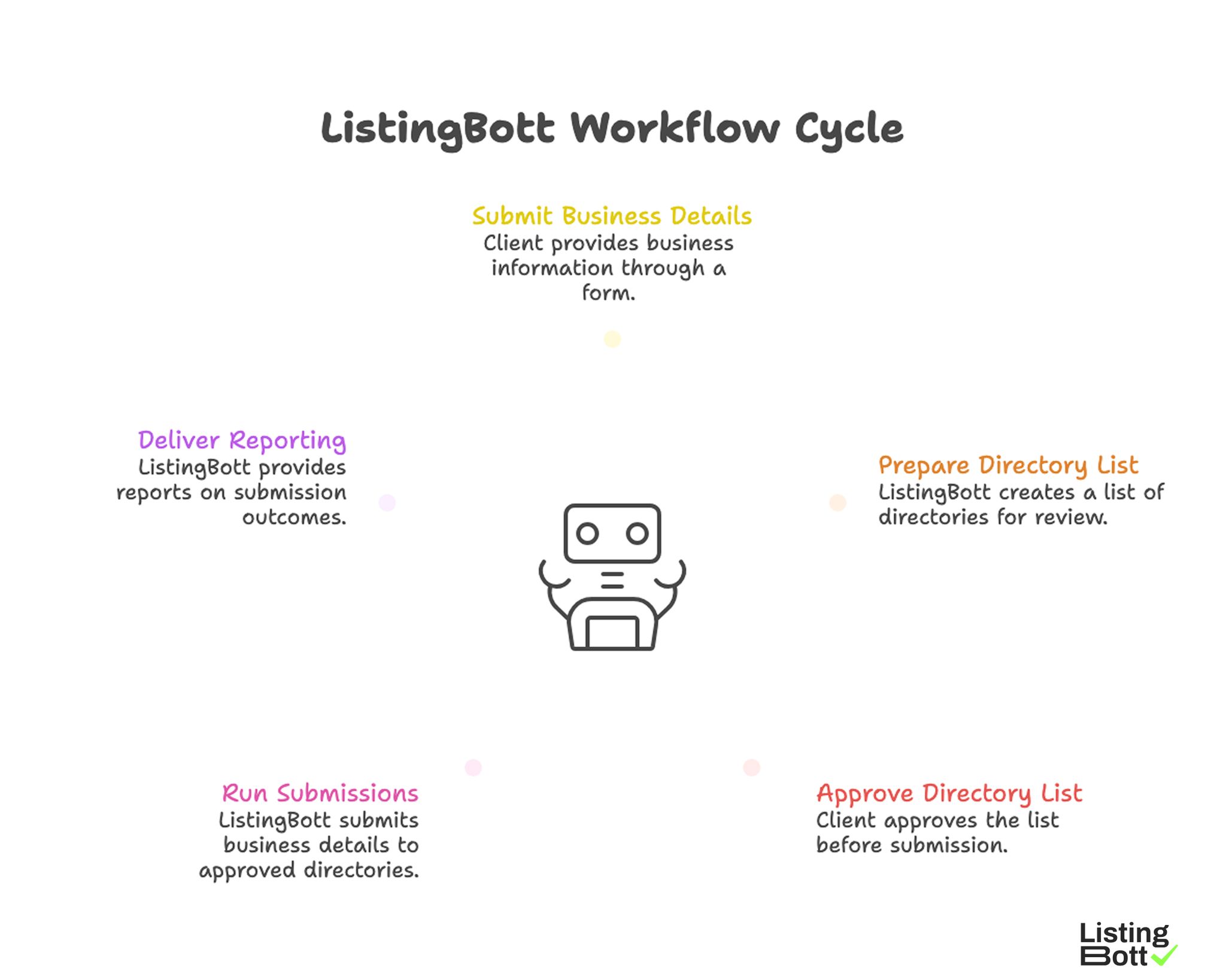
ListingBott Workflow Cycle
-
You submit business details through the
client form. -
ListingBott prepares a
list of directoriesfor scope review. - You approve the list before execution begins.
- ListingBott runs submissions based on approved scope.
- ListingBott delivers reporting for completed and pending outcomes.
Key features and practical value
- Intake validation: reduces preventable profile errors before launch.
- Pre-publish approval: aligns scope and expectations early.
- Workflow transparency: supports coordination and escalation.
- Reporting handoff: enables quality checks before next-tier expansion.
For teams scaling across sparse markets, workflow reliability is usually a stronger selection criterion than raw volume claims.
Expected outcomes and limits
Expected outcomes:
- structured submission execution,
- clearer status visibility,
- repeatable process for additional tier rollout.
Limits to keep explicit:
- no guaranteed ranking position,
- no guaranteed traffic by a specific date,
- no guaranteed indexing speed,
- no guaranteed outcomes controlled by third-party platforms.
DR commitment is conditional only. A promise to reach DR 15 can apply when starting DR is below 15, the client explicitly selects domain growth, and the directory list is approved before execution starts. Refunds may apply if process has not started, and public language remains no hidden extra fees.
Risks/limits
Common Wyoming rollout mistakes
- Launching broad coverage without tier segmentation.
- Expanding while correction capacity is already constrained.
- Allowing scope changes without approval-gate review.
- Tracking output totals but ignoring maintenance-load growth.
- Running without owner-level accountability per tier.
Practical limits
- Directory submission supports discoverability and consistency, but does not replace broader SEO foundations.
- Timing and impact vary by competition, category, and third-party platform behavior.
- Aggressive long-tail expansion without controls can create quality debt quickly.
Minimum control layer
- tier-based expansion gates,
- SLA-bound correction ownership,
- weekly tier-level KPI reviews,
- documented approval artifacts for every expansion wave.
FAQ
Why use a coverage-tier model in Wyoming?
Because coverage conditions differ across markets, and tier-based planning reduces one-size-fits-all execution errors.
Should all areas launch together?
Usually no. Launch by tier, stabilize quality, then expand.
Which metrics should block expansion?
Use integrity pass rate by tier, critical issue closure velocity, and maintenance-load index.
Can directory submission guarantee rankings?
No. It supports consistency and discoverability, but rankings depend on external factors.
Is DR growth guaranteed for all projects?
No. DR commitments are conditional and apply only to qualified setups.
What governance is required at minimum?
Canonical data control, named gate owners, correction SLA, and recurring tier-level reporting.