Quick answer
Local business directory submission in the USA works best when you treat it as an operational rollout, not a one-time posting task. Most teams fail when they expand state coverage before they have stable profile standards, clear ownership, and correction rules.
A practical approach is a hub-and-state model:
- standardize core business profile data,
- run controlled submission in priority states,
- validate quality and correction speed,
- expand to additional states only when quality holds.
This model helps avoid duplicate profiles, inconsistent business information, and reporting confusion across markets.
If you want one execution layer to support that rollout, start with a defined directory submission workflow before scaling state coverage.
sbb-itb-8e44301
Methodology
This page uses an execution-first framework designed for teams managing real rollout constraints across US states.
The STATE method for USA directory rollout
| Factor | Weight | What to evaluate |
|---|---|---|
| Standardization | 25 | Is your profile baseline consistent enough to submit at scale? |
| Territory fit | 20 | Is the state priority aligned with your market coverage and revenue goals? |
| Accountability | 20 | Is there a clear owner for submissions, fixes, and approvals? |
| Tracking | 15 | Can you report status by state and by directory tier? |
| Error control | 20 | Do you have correction loops before statewide expansion? |
How to apply the method
- Score your current operating readiness from 1-5 for each factor.
- If any factor scores below 3, fix process gaps before adding states.
- Expand only after first-wave correction rates are controlled.
This is not about moving slowly. It is about avoiding expensive rework after volume increases.
USA hub routing table (required state pages)
Use this hub to route execution decisions by state and keep rollout order explicit.
| State | Recommended order | Typical rollout trigger | State page |
|---|---|---|---|
| California | Wave 1 | Large addressable market and high execution discipline needs | Local business directory submission California |
| Texas | Wave 1 | Multi-city coverage requirements and broad service distribution | Local business directory submission Texas |
| Florida | Wave 2 | Strong local-intent vertical mix and regional sequencing needs | Local business directory submission Florida |
| New York | Wave 2 | Dense-market quality standards and correction-speed pressure | Local business directory submission New York |
| Illinois | Wave 3 | Metro plus statewide balance with governance checkpoints | Local business directory submission Illinois |
| Pennsylvania | Wave 3 | Multi-region rollout with structured approval handoff | Local business directory submission Pennsylvania |
90-day hub rollout model
| Phase | Window | Main objective | Gate to proceed |
|---|---|---|---|
| Foundation | Days 1-14 | Lock canonical profile data, categories, and ownership | Profile baseline approved |
| Pilot states | Days 15-35 | Run first two priority states with strict QA checks | Correction cycle stable |
| Controlled expansion | Days 36-65 | Add next states and monitor quality drift | No unresolved critical data conflicts |
| Scale governance | Days 66-90 | Expand with reporting and recurring control cadence | State-level reporting shows stable quality |
Teams that skip this phased model often hit the same pattern: good initial activity metrics followed by cleanup debt and delayed client confidence.
Quality metrics that matter at hub level
| KPI | Why it matters | Warning signal |
|---|---|---|
| Profile consistency rate | Measures cross-state data accuracy | Growing variance in address, category, or contact fields |
| Correction turnaround time | Measures operational reliability | Backlog of unresolved edits |
| State expansion readiness score | Prevents premature scaling | Adding new states with low readiness scores |
| Submission-to-report cycle time | Measures delivery predictability | Long delays between execution and status reporting |
| Assisted conversion path clicks | Connects execution to business outcomes | Informational traffic with no BOFU progression |
A strong hub page should help teams make these tradeoffs before rollout friction appears.
Comparison table
| Operating model | Best for | Strengths | Tradeoffs | Best use in USA rollout |
|---|---|---|---|---|
| Fully manual internal workflow | Very small scope with one owner | High direct control | High labor cost and poor scale repeatability | Temporary starting point only |
| Software-only internal execution | Teams with mature operations and QA ownership | Better workflow control and auditability | Requires process discipline and training investment | Works when team capacity is already strong |
| Service-led execution | Teams needing fast implementation with low internal overhead | Faster launch, lower operator burden | Requires clear provider transparency and correction ownership | Effective for early-to-mid rollout waves |
| Hybrid (service + internal governance) | Teams balancing scale and quality | Better speed-control balance | Needs explicit role boundaries and escalation rules | Usually strongest for multi-state expansion |
Decision matrix: choose model by operational readiness
| Readiness profile | Recommended model | Why |
|---|---|---|
| Low internal capacity, urgent rollout timeline | Service-led | Reduces execution delays and coordination burden |
| Moderate capacity, growing multi-state footprint | Hybrid | Preserves quality while improving throughput |
| High capacity, strong SOP and QA discipline | Software-led or hybrid | Maximizes control when internal team can sustain it |
| Early pilot with uncertain process ownership | Service-led first, then reassess | Avoids process breakdown during first expansion |
State prioritization checklist before expansion
| Checkpoint | Question | Pass condition |
|---|---|---|
| Data baseline | Is canonical profile data approved? | Yes, no critical missing fields |
| Owner clarity | Who owns corrections and state-level escalations? | Named owner and backup |
| Directory policy | Are inclusion/exclusion rules documented? | Written criteria and approval step |
| Reporting cadence | Is there recurring status reporting by state? | Weekly or biweekly cadence defined |
| Expansion gate | What blocks adding next state? | Quality threshold + backlog threshold |
This checklist keeps expansion tied to process quality instead of publication volume.
Best by use case
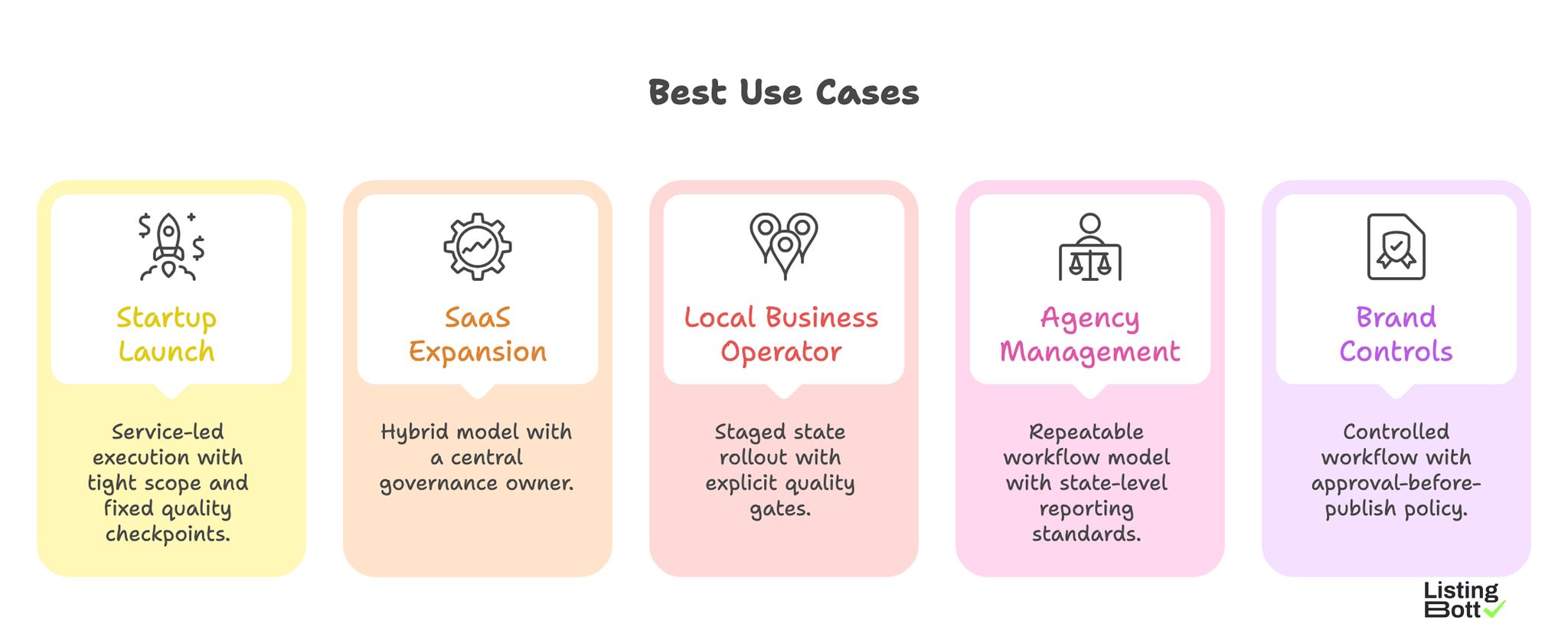
Best Use Cases Local Business Directory Submission
1) Startup launching in one to two US states
Best fit: service-led execution with tight scope and fixed quality checkpoints.
Reason: small teams usually need speed and predictable delivery more than full internal tooling ownership in the first phase.
2) SaaS team expanding to multiple US markets
Best fit: hybrid model with a central governance owner.
Reason: this model supports scale while keeping profile consistency and correction loops under control.
3) Multi-location local business operator
Best fit: staged state rollout with explicit quality gates.
Reason: expanding too fast without consistency control creates data drift that is expensive to reverse.
4) Agency managing many client accounts
Best fit: repeatable workflow model with state-level reporting standards.
Reason: agencies need predictable operating cadence and clear accountability across portfolios.
5) Team with strict brand/compliance controls
Best fit: controlled workflow with approval-before-publish policy.
Reason: compliance-sensitive operations require clear change control, not ad hoc submissions.
If your process is not yet stable, start with one execution backbone and then scale. Teams usually evaluate workflow reliability and approval controls before expanding state count.
Practical differences between USA hub and state pages
- Hub page objective: planning, sequencing, and governance across states.
- State page objective: state-specific execution details and tactical fit.
- Hub should remain decision-oriented and operational.
- State pages should focus on implementation nuance for each market.
This separation helps prevent cannibalization and keeps each page useful for its exact intent.
Where ListingBott fits in USA rollout
What ListingBott does
ListingBott provides a productized directory submission workflow for businesses that need structured execution. Current public offer language is aligned to a one-time payment model with publication to 100+ directories.
How ListingBott works
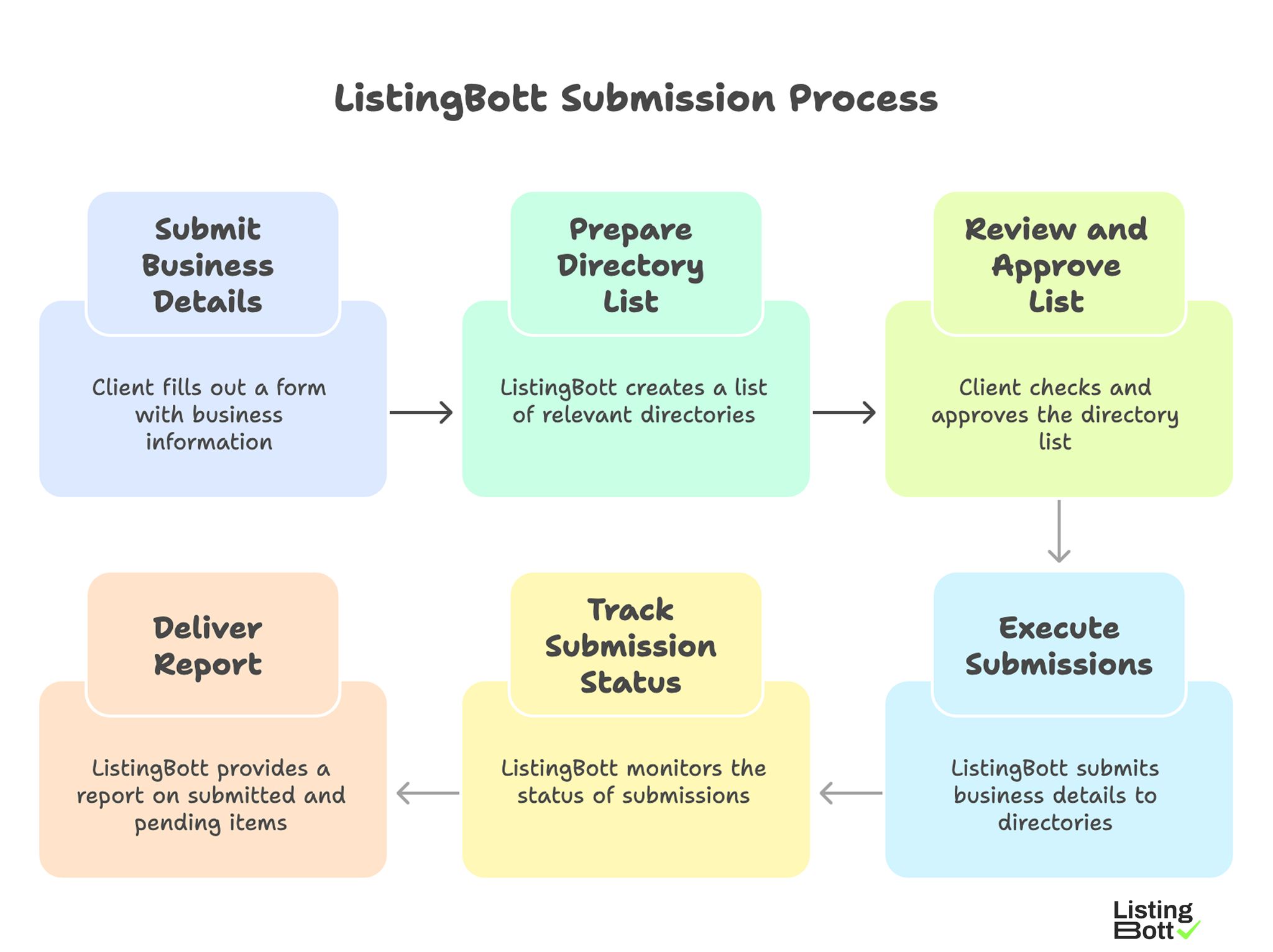
ListingBott Submission Process
-
You submit required business and profile details through a
client form. -
ListingBott prepares a
list of directoriesfor your project. - You review and approve that directory list.
- ListingBott executes submissions and tracks status.
- ListingBott delivers a report with submitted and pending items.
This flow is useful for teams that want a repeatable process instead of fragmented, spreadsheet-heavy manual coordination.
Key features and what they mean in operations
- Intake gating before execution: reduces downstream errors from incomplete data.
- Approval-before-publish: aligns scope before submissions start.
- Status visibility: improves handoff between operators, marketing, and stakeholders.
- Report delivery: supports post-execution clarity and next-step decisions.
For teams comparing options, submission execution clarity is usually a stronger predictor of long-term success than high-volume claims alone.
Expected results and limits
What you can expect from a well-run process:
- directory submission execution within agreed scope,
- transparent status communication,
- report visibility on what is completed and pending.
What no provider can responsibly guarantee:
- guaranteed ranking position,
- guaranteed traffic by a specific date,
- guaranteed indexing speed,
- outcomes fully controlled by third-party platforms.
DR commitments are conditional. A promise to reach DR 15 applies only for qualified projects: starting DR below 15, explicit campaign goal set to domain growth, and approved directory list. Refunds can be available if process has not started, and commercial terms should remain explicit with no hidden extra fees.
Risks/limits
Common mistakes in USA multi-state submission programs
- Expanding state coverage before profile standards are stable.
- Running submissions without a named correction owner.
- Treating all states as identical execution environments.
- Tracking activity only (counts) and ignoring quality metrics.
- Skipping approval checkpoints before scale expansion.
Practical limits to acknowledge
- Directory submission supports discoverability but does not replace broader SEO fundamentals.
- Results timing will vary across categories and market conditions.
- Third-party platform behavior remains outside direct control.
- High submission volume without quality governance often increases maintenance debt.
Risk controls to enforce
- state-by-state expansion gates,
- documented inclusion/exclusion policy,
- correction and escalation workflow,
- recurring reporting cadence with clear ownership.
GEO expansion note from client-data analysis
Client form data indicates strong demand concentration in additional US states and selected international markets. After this initial 6-state rollout, expand in waves using observed demand clusters and operational readiness, not only by estimated search volume.
FAQ
What is the purpose of a USA hub page for directory submission?
It centralizes rollout decisions, state sequencing, and governance standards so expansion happens with quality control.
Should we publish all state pages at once?
Usually no. Publish in waves and expand after correction and consistency metrics are stable.
How do we choose which states to prioritize first?
Use business coverage, operational readiness, and correction capacity together, then validate with early-wave performance signals.
Is this hub page meant to replace state-level pages?
No. The hub handles strategy and routing; state pages handle implementation specifics.
Can a directory submission workflow guarantee rankings?
No. It can improve execution quality and consistency, but rankings and traffic timing depend on many external factors.
Can DR growth be promised for all projects?
No. DR commitments must be conditional and require a qualified setup: starting DR below 15, domain growth goal, and approved directory list.