Quick answer
Local business directory submission in Texas usually fails when teams treat the state like one homogeneous market. Texas rollout is often multi-city by default, so execution quality depends on cluster-level planning, clear ownership, and correction discipline.
A practical Texas approach is:
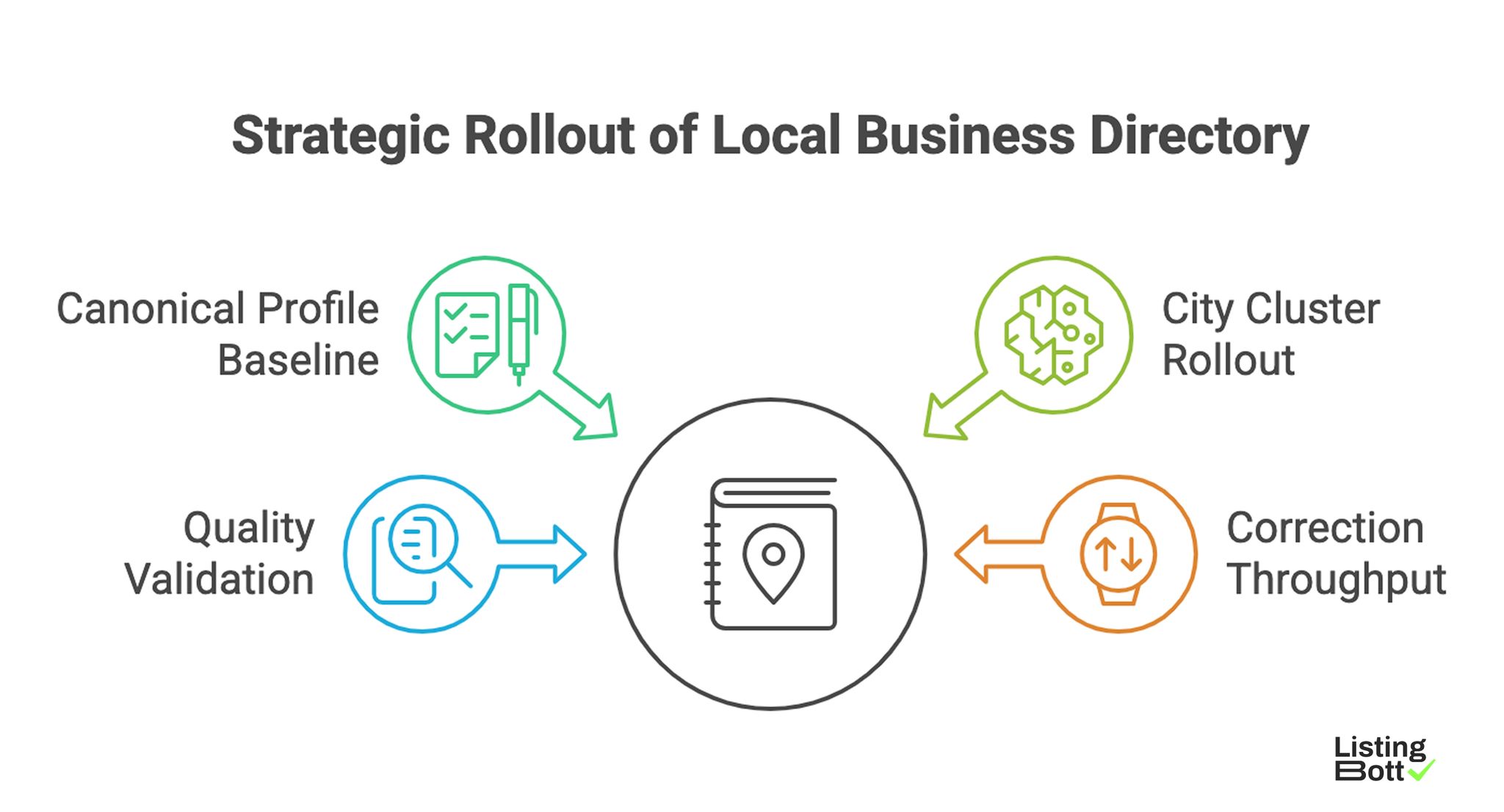
Strategic Rollout of Local Business Directory
- define one canonical profile baseline,
- split rollout by city clusters,
- validate quality before adding the next cluster,
- keep correction throughput faster than expansion pace.
This helps avoid fragmented listings, profile drift, and delayed reporting across multiple city contexts.
For broader U.S. planning, see Local business directory submission USA.
sbb-itb-8e44301
Methodology
This guide uses a Texas-focused operating model for teams that need repeatable execution across multiple metro areas.
The TEXAS model (Territory, Execution, Exceptions, Alignment, Scale)
| Factor | Weight | Why it matters in Texas |
|---|---|---|
| Territory design | 20 | Prevents random city expansion and weak sequencing |
| Execution quality | 30 | Keeps listings accurate under growing volume |
| Exception handling | 20 | Reduces unresolved fixes and process bottlenecks |
| Alignment | 15 | Ensures teams follow one profile and approval standard |
| Scale readiness | 15 | Validates whether next-city expansion is safe |
How to apply TEXAS
- Score each factor from 1-5 before each rollout wave.
-
Do not add a new cluster if
Execution qualityorException handlingis below 3. - Reassess every two weeks during active expansion.
This model keeps growth tied to operating reality rather than activity-only metrics.
Texas city-cluster rollout map
| Cluster | Priority wave | Main objective | Typical operational risk | Expansion gate |
|---|---|---|---|---|
| Dallas-Fort Worth | Wave 1 | Establish baseline quality at scale | Rapid volume increase without QA depth | Correction queue remains controlled |
| Houston | Wave 1 | Maintain consistency across broad service coverage | Field inconsistency across profiles | Consistency pass rate holds |
| Austin | Wave 2 | Expand while preserving profile precision | Scope creep from ad hoc additions | Approval discipline maintained |
| San Antonio | Wave 2 | Repeat proven workflow in second-wave cluster | Ownership ambiguity | Clear fix ownership and SLA adherence |
| Secondary metros | Wave 3 | Controlled long-tail expansion | Process fatigue and delayed updates | Stable reporting and low critical issue count |
75-day Texas rollout plan
| Phase | Window | Focus | Pass condition |
|---|---|---|---|
| Foundation | Days 1-12 | Canonical profile standard, owner assignment, category map | Required fields and owner model approved |
| First-wave launch | Days 13-30 | Initial cluster submissions + QA checks | Error trends remain stable |
| Correction stabilization | Days 31-50 | Fix loops, escalation handling, reporting cleanup | No unresolved critical correction backlog |
| Controlled scaling | Days 51-75 | Add next clusters with same SOP | Quality holds through second wave |
Teams that skip stabilization usually pay for it later through rework and reporting noise.
Texas pre-expansion checklist
| Checkpoint | Question | Pass criteria |
|---|---|---|
| Profile baseline | Is one source of truth enforced for all listings? | Yes, no conflicting values |
| Approval flow | Are additions approved before publish? | Yes, approval step documented |
| Fix loop | Are corrections tracked to closure? | SLA and closure log active |
| Reporting cadence | Is status reported by city cluster? | Recurring cluster-level reporting |
| Expansion threshold | What blocks next-city launch? | Explicit quality + backlog thresholds |
Comparison table
| Delivery model | Best for | Strengths | Tradeoffs | Texas suitability |
|---|---|---|---|---|
| Manual internal workflow | Narrow pilot with one owner | Full direct control | Weak scalability and high labor | Low after first cluster |
| Software-only internal | Teams with strong ops capability | Better control and audit trail | Requires mature internal governance | Medium when internal team is strong |
| Service-led execution | Teams needing predictable rollout speed | Faster launch, less internal execution burden | Requires provider transparency | Strong for first-wave Texas rollout |
| Hybrid governance model | Teams balancing speed and quality | Better scale-control balance | Needs clear roles and escalation map | Often strongest for multi-cluster Texas programs |
Decision matrix by readiness state
| Readiness state | Recommended path | Why |
|---|---|---|
| Low internal capacity | Service-led | Reduces launch friction and workload bottlenecks |
| Medium capacity, expanding footprint | Hybrid | Supports growth without sacrificing quality |
| High capacity, mature SOP | Software-led or hybrid | Enables stronger control with lower process risk |
| Unclear correction ownership | Service-led pilot + governance reset | Prevents scaling broken workflows |
Metrics to monitor by Texas cluster
| Metric | Why it matters | Warning sign |
|---|---|---|
| Cluster consistency pass rate | Tracks profile quality over time | Declining pass rate in new clusters |
| Correction cycle time | Measures operational reliability | Slow closure velocity |
| Backlog depth | Reveals hidden process debt | Growing unresolved issue queue |
| Submission-to-status lag | Shows reporting discipline | Late status updates after execution |
| BOFU pathway engagement | Connects operations to revenue path | Informational visits without progression |
If these metrics degrade, pause expansion and stabilize before adding the next cluster.
Best by use case
1) Single-location Texas business
Best fit: service-led rollout with strict baseline and correction rules.
Reason: teams can get consistent delivery without building a full internal operations engine.
2) Multi-location Texas operator
Best fit: hybrid model with centralized governance.
Reason: this model keeps cluster expansion controlled while preserving quality and accountability.
3) SaaS company targeting Texas local discovery
Best fit: staged rollout tied to readiness thresholds.
Reason: controlled sequencing reduces risk from aggressive expansion.
4) Agency with multiple Texas client accounts
Best fit: repeatable workflow with cluster-level reporting.
Reason: agencies need predictable cadence and clear status communication across portfolios.
5) Team with strict quality/compliance requirements
Best fit: approval-first workflow with mandatory correction tracking.
Reason: explicit governance reduces operational variance and protects trust.
For most teams, workflow reliability and correction transparency are better selection criteria than simple listing-volume promises.
Where ListingBott fits in Texas execution
What ListingBott does
ListingBott provides a productized directory submission workflow for teams that need structured execution instead of ad hoc manual tracking. Current public offer language is one-time payment with publication to 100+ directories.
How ListingBott works
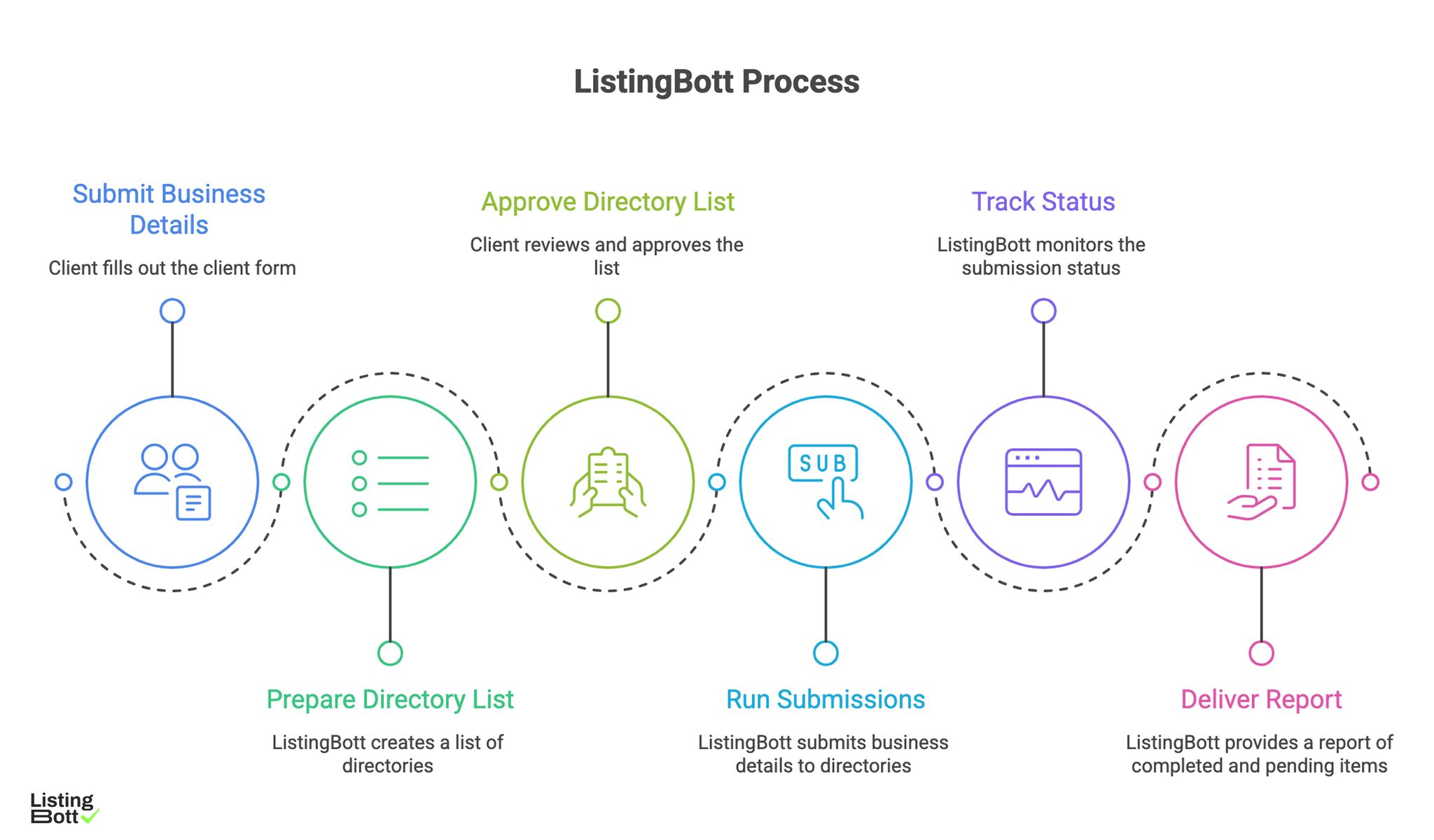
ListingBott Process
-
You submit business/profile details through the
client form. -
ListingBott prepares a
list of directoriesfor your project. - You approve the directory list before publish starts.
- ListingBott runs submissions and tracks status.
- ListingBott delivers a report with completed and pending items.
This process supports repeatable rollout across Texas clusters while reducing coordination friction.
Key features and what they mean in operations
- Intake gating: lowers avoidable errors from incomplete profile data.
- Approval checkpoint: aligns scope before submissions begin.
- Status transparency: improves coordination between operators and stakeholders.
- Report delivery: supports QA review and next-wave decisions.
When comparing options, submission workflow clarity is often more useful than vendor claims focused only on scale.
Expected results and limits
Expected outcomes:
- clear workflow and status updates,
- execution within agreed scope,
- report visibility for completed and pending submissions.
Limits to keep explicit:
- no guaranteed ranking position,
- no guaranteed traffic by a specific date,
- no guaranteed indexing speed,
- no guarantees for outcomes controlled by third-party platforms.
DR commitments are conditional only. A promise to reach DR 15 applies only for qualified projects with starting DR below 15, explicit domain growth goal, and approved directory list. Refunds can apply if process has not started, and pricing terms should remain clear with no hidden extra fees.
Risks/limits
Common Texas execution mistakes
- Expanding city coverage before correction throughput is stable.
- Allowing multiple profile sources with no canonical baseline.
- Measuring only submission volume and ignoring quality signals.
- Running multi-cluster rollout without clear escalation ownership.
- Treating every Texas cluster as operationally identical.
Practical limits
- Directory submissions support discovery but do not replace broader SEO fundamentals.
- Performance timing varies by category, competition, and third-party platform behavior.
- Uncontrolled expansion creates maintenance debt and weakens long-term consistency.
Risk controls to enforce
- cluster-by-cluster expansion gates,
- documented inclusion/exclusion criteria,
- correction workflow with owner and SLA,
- recurring reporting cadence with action status.
FAQ
Why is Texas handled as a multi-cluster rollout?
Texas programs commonly span multiple major metros, so cluster-level planning improves consistency and execution reliability.
Should we launch Dallas, Houston, Austin, and San Antonio at once?
Usually no. Start with a controlled first wave, validate quality, then expand by readiness criteria.
What is the best expansion gate for Texas?
Use consistency pass rate plus correction cycle performance before enabling the next cluster.
Is hybrid better than service-led for Texas?
It depends on internal capacity. Hybrid works well when governance is clear and teams can sustain oversight.
Can local directory submission guarantee rankings in Texas?
No. It can improve execution quality and visibility support, but rankings and traffic timing depend on many external factors.
Can DR growth be promised by default?
No. DR commitments are conditional and require qualified project criteria.