Quick answer
Local business directory submission in New York should be run as a quality-control program first and a scale program second. In dense markets, small profile inconsistencies compound quickly, so accuracy, correction speed, and approval discipline are more important than raw submission counts.
A practical New York sequence is:
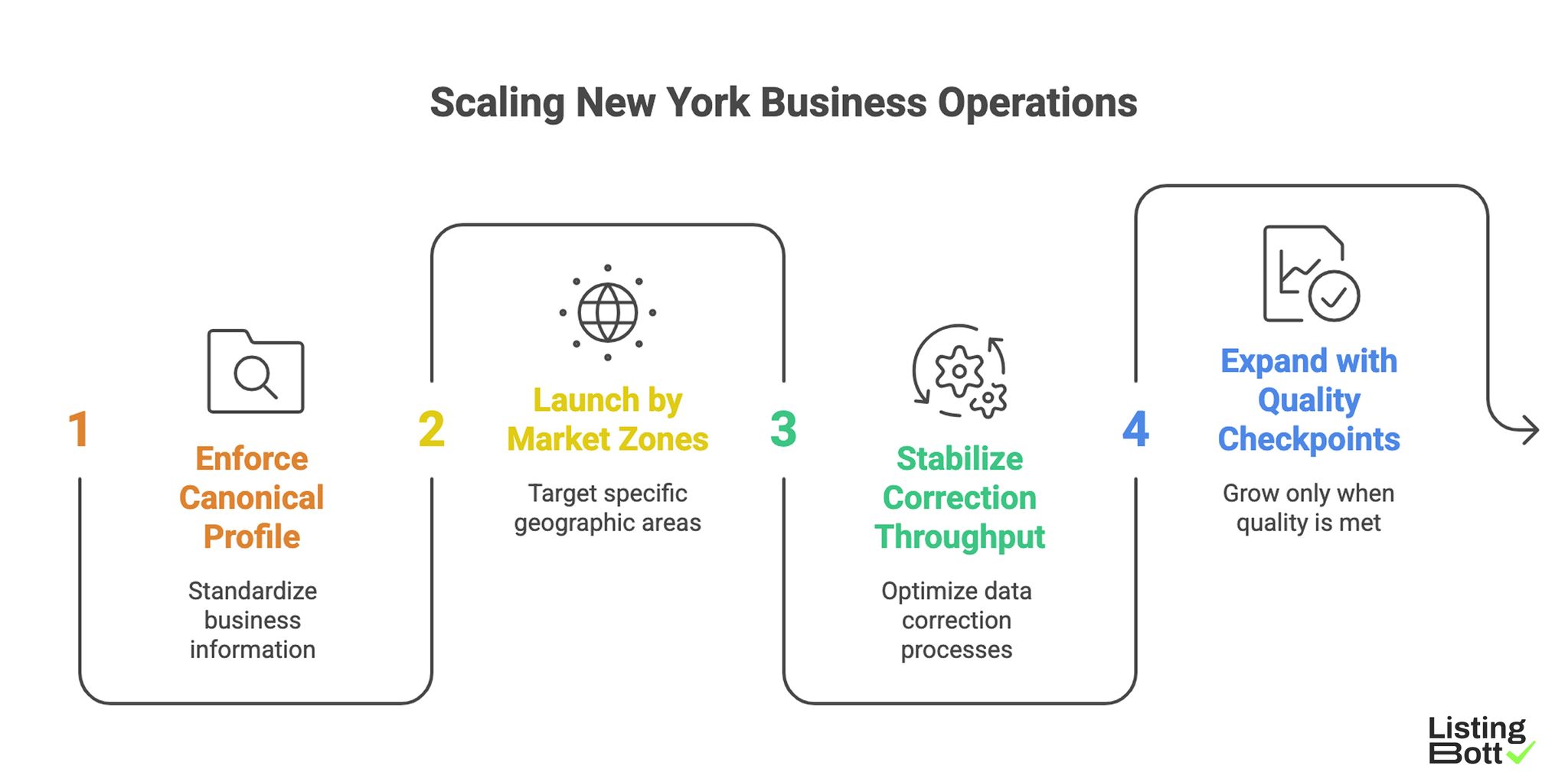
Scaling New York Business Operation
- enforce one canonical profile standard,
- launch by defined market zones,
- stabilize correction throughput,
- expand only when quality checkpoints pass.
This reduces rework and protects reporting reliability when operations grow across high-intensity market environments.
For broader U.S. planning, see Local business directory submission USA.
sbb-itb-8e44301
Methodology
This page uses a New York-specific operating model focused on dense-market control.
The GRID model (Governance, Resolution, Integrity, Density)
| Factor | Weight | Why it matters in New York |
|---|---|---|
| Governance discipline | 25 | Prevents uncontrolled process drift under high activity |
| Resolution speed | 25 | Keeps correction loops from becoming long-lived bottlenecks |
| Data integrity | 30 | Protects profile quality where minor errors scale quickly |
| Density readiness | 20 | Ensures rollout pace matches operational control capacity |
How to apply GRID
- Score each factor from 1-5 before each expansion wave.
-
Do not expand if
Resolution speedorData integrityis below 3. - Re-score on a fixed cadence during active rollout.
This prevents growth from outpacing operational control.
New York rollout zones
| Zone | Priority wave | Primary goal | Common risk | Expansion gate |
|---|---|---|---|---|
| NYC core | Wave 1 | Establish highest control standard | Rapid volume with weak correction bandwidth | Resolution SLA remains stable |
| Greater NYC perimeter | Wave 1 | Extend coverage without quality drop | Duplicate/variant profile drift | Integrity pass rate holds |
| Upstate metros | Wave 2 | Replicate proven process pattern | Ownership and reporting lag | Clear owner + recurring status cadence |
| Secondary markets | Wave 3 | Controlled long-tail expansion | Process fatigue and backlog growth | Backlog below expansion threshold |
New York risk-tier matrix
| Risk tier | Trigger pattern | Required response |
|---|---|---|
| Tier 1 (low) | Minor format inconsistencies | Correct in regular cycle |
| Tier 2 (medium) | Repeated profile mismatch in one zone | Freeze zone expansion and run focused QA |
| Tier 3 (high) | Cross-zone data integrity breakdown | Pause new submissions and execute correction sprint |
Using explicit risk tiers prevents silent quality decay.
80-day New York rollout plan
| Phase | Window | Focus | Pass condition |
|---|---|---|---|
| Control baseline | Days 1-14 | Canonical data, ownership map, approval policy | Baseline approved |
| First-wave execution | Days 15-34 | Initial zone submissions + QA checks | Error trend controlled |
| Correction hardening | Days 35-56 | Fix loops, escalation paths, reporting quality | High-priority issues resolved |
| Managed expansion | Days 57-80 | Add next zones under same controls | Quality remains stable after expansion |
Skipping the hardening phase is the most common cause of performance volatility in dense-market rollout.
New York pre-expansion checklist
| Checkpoint | Question | Pass criteria |
|---|---|---|
| Canonical data policy | Is one approved profile source enforced? | Yes, no conflicting sources |
| Approval workflow | Are scope additions approved before publish? | Yes, documented step |
| Correction ownership | Who owns fix closure per zone? | Named owner + escalation path |
| Reporting cadence | Is status visible by rollout zone? | Recurring zone-level reporting |
| Expansion block rule | What stops next-wave launch? | Explicit quality + backlog thresholds |
Comparison table
| Execution model | Best for | Strengths | Tradeoffs | New York suitability |
|---|---|---|---|---|
| Manual internal workflow | Small pilot scope only | Full direct control | Low scalability under dense-market load | Low fit after pilot stage |
| Software-only internal | Teams with mature operations | Better auditability and process control | Requires high governance discipline | Medium fit for strong internal teams |
| Service-led execution | Teams prioritizing speed with controlled support | Faster implementation, reduced operator burden | Requires transparent provider workflow | Strong fit for first-wave rollout |
| Hybrid governance model | Teams balancing expansion speed and quality | Strong balance of control and throughput | Requires clear role ownership | Often strongest for multi-zone execution |
Decision matrix by operational maturity
| Maturity state | Recommended model | Why |
|---|---|---|
| Limited internal capacity | Service-led | Reduces execution friction while protecting controls |
| Moderate capacity, active expansion | Hybrid | Keeps governance while scaling |
| High maturity with strong SOP | Software-led or hybrid | Increases control with manageable risk |
| Weak correction ownership | Service-led pilot + control reset | Prevents expansion on unstable process |
KPIs to track by New York zone
| KPI | Why it matters | Warning sign |
|---|---|---|
| Integrity pass rate | Tracks profile quality stability | Drop in pass rate for expansion zones |
| Correction closure velocity | Measures operational responsiveness | Growing unresolved high-priority issues |
| Zone readiness index | Prevents premature rollout | Expansion triggered below threshold |
| Submission-to-status latency | Tracks reporting reliability | Delayed operational visibility |
| BOFU progression clicks | Connects execution to revenue path | Informational traffic with weak progression |
If these indicators weaken, hold expansion and restore control before adding new zones.
Best by use case
1) Single-location New York business
Best fit: service-led rollout with strict correction accountability.
Reason: teams can move faster without sacrificing process control.
2) Multi-location operator across New York zones
Best fit: hybrid model with centralized governance.
Reason: this supports controlled scale while preserving quality discipline.
3) SaaS team targeting local New York discovery
Best fit: phased zone rollout tied to readiness checkpoints.
Reason: expansion remains stable when tied to control metrics.
4) Agency running multiple New York client programs
Best fit: repeatable workflow with zone-level reporting.
Reason: agencies need predictable delivery and transparent status communication.
5) Compliance-sensitive environments
Best fit: approval-first rollout with explicit risk-tier escalation.
Reason: control clarity reduces operational variance and protects trust.
Teams evaluating providers usually get better outcomes by prioritizing workflow transparency and correction reliability over marketing claims centered on raw listing volume.
Where ListingBott fits in New York execution
What ListingBott does
ListingBott provides a workflow-based directory submission system for teams that need structured execution rather than ad hoc manual tracking. Current public offer language remains one-time payment with publication to 100+ directories.
How ListingBott works
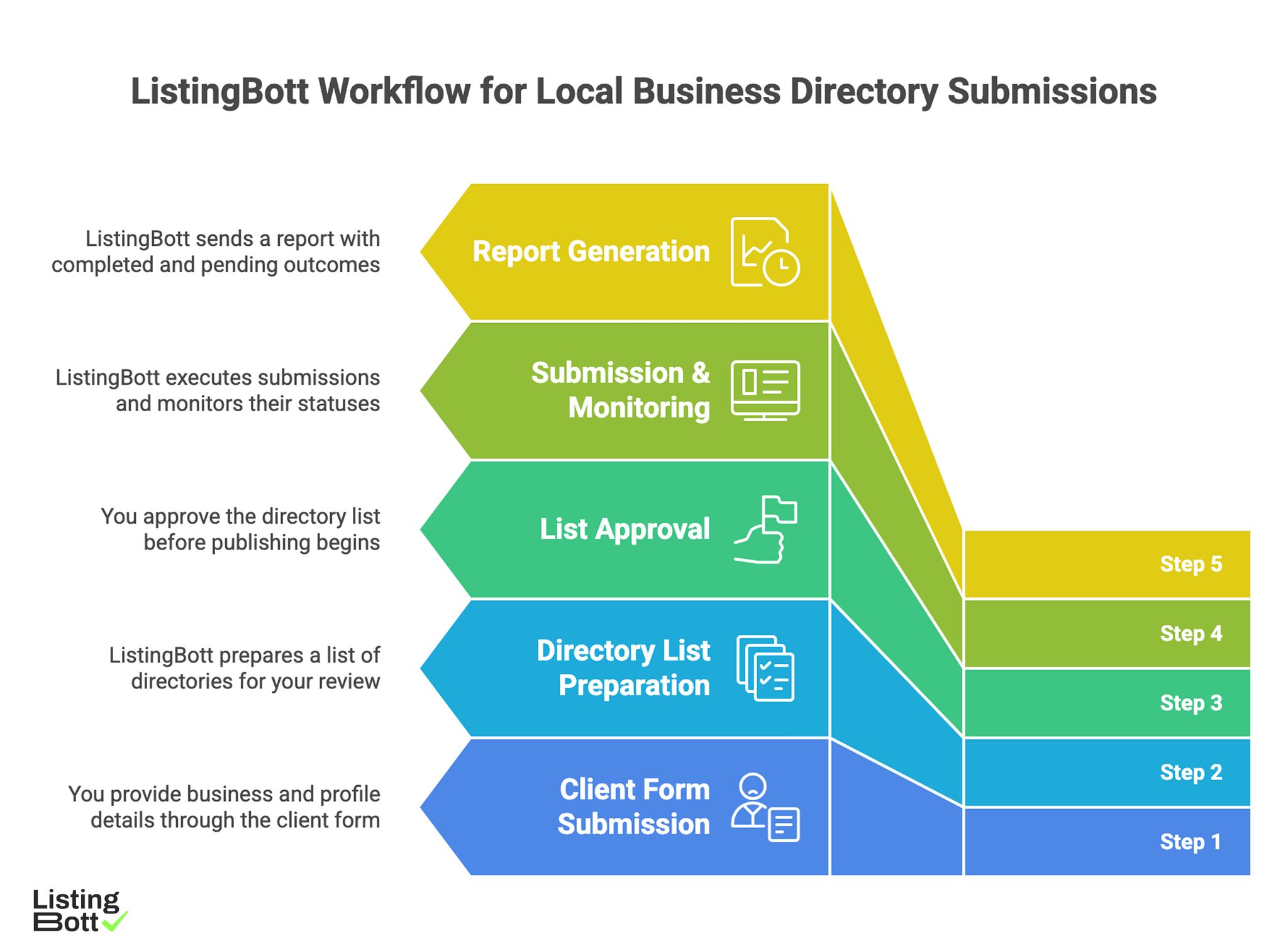
ListingBott Workflow for Local Business Directory Submissions
-
You provide business/profile details through the
client form. -
ListingBott prepares a
list of directoriesfor review. - You approve the list before publish starts.
- ListingBott executes submissions and monitors statuses.
- ListingBott sends a report with completed and pending outcomes.
This structure helps teams keep execution predictable while scaling across demanding local markets.
Key features and what they mean in operations
- Intake gating: reduces preventable errors from incomplete source data.
- Pre-publish approval: aligns scope before launch.
- Status transparency: supports cross-team coordination and escalation.
- Report handoff: enables quality review before next-wave expansion.
For dense-market rollout, submission process clarity is usually a stronger long-term signal than scale-focused promises.
Expected results and limits
Expected outcomes:
- clear workflow and communication,
- submission execution within agreed scope,
- report visibility for completed and pending items.
Limits to keep explicit:
- no guaranteed ranking position,
- no guaranteed traffic by a specific date,
- no guaranteed indexing speed,
- no guarantees for outcomes controlled by third-party platforms.
DR commitments are conditional only. A promise to reach DR 15 applies only for qualified projects with starting DR below 15, explicit domain growth goal, and approved directory list. Refunds can apply if process has not started, and offer terms should remain clear with no hidden extra fees.
Risks/limits
Common New York rollout mistakes
- Expanding zones before correction throughput is stable.
- Allowing multiple profile baselines in active rollout.
- Measuring only submission output and ignoring integrity KPIs.
- Running dense-market expansion without explicit escalation ownership.
- Ignoring risk-tier triggers until quality debt accumulates.
Practical limits
- Directory submissions support discoverability but do not replace broader SEO foundations.
- Timing and impact vary by category, competition, and external platform behavior.
- Uncontrolled expansion creates operational debt and weakens future reliability.
Risk controls to enforce
- zone-based expansion gates,
- documented inclusion/exclusion policy,
- correction workflow with SLA and named owner,
- recurring status reporting by rollout zone.
FAQ
Why does New York need a dense-market control model?
Higher market density increases execution pressure, so quality controls and correction speed need to be stronger from the start.
Should all New York zones launch simultaneously?
Usually no. Use phased zone rollout and expand only after quality gates pass.
What is the most important expansion KPI in New York?
Use integrity pass rate together with correction closure velocity before opening new zones.
Is hybrid always the best model for New York?
Not always. Model choice depends on internal capacity and control maturity.
Can directory submission guarantee New York rankings?
No. It improves execution quality and visibility support, but rankings and timing remain influenced by many external factors.
Can DR growth be promised by default?
No. DR commitments are conditional and require qualified setup criteria.