Quick answer
Local business directory submission in the Netherlands should be executed as a blueprint program, not a one-time launch. Teams run into instability when each rollout wave uses slightly different quality rules, ownership assumptions, or launch timing.
A practical Netherlands sequence is:
- define one canonical profile blueprint,
- run wave launch through mandatory handshake checkpoints,
- enforce correction and reporting cadence before expansion,
- scale only when blueprint compliance and queue indicators stay stable.
For broader U.S. planning, see Local business directory submission USA.
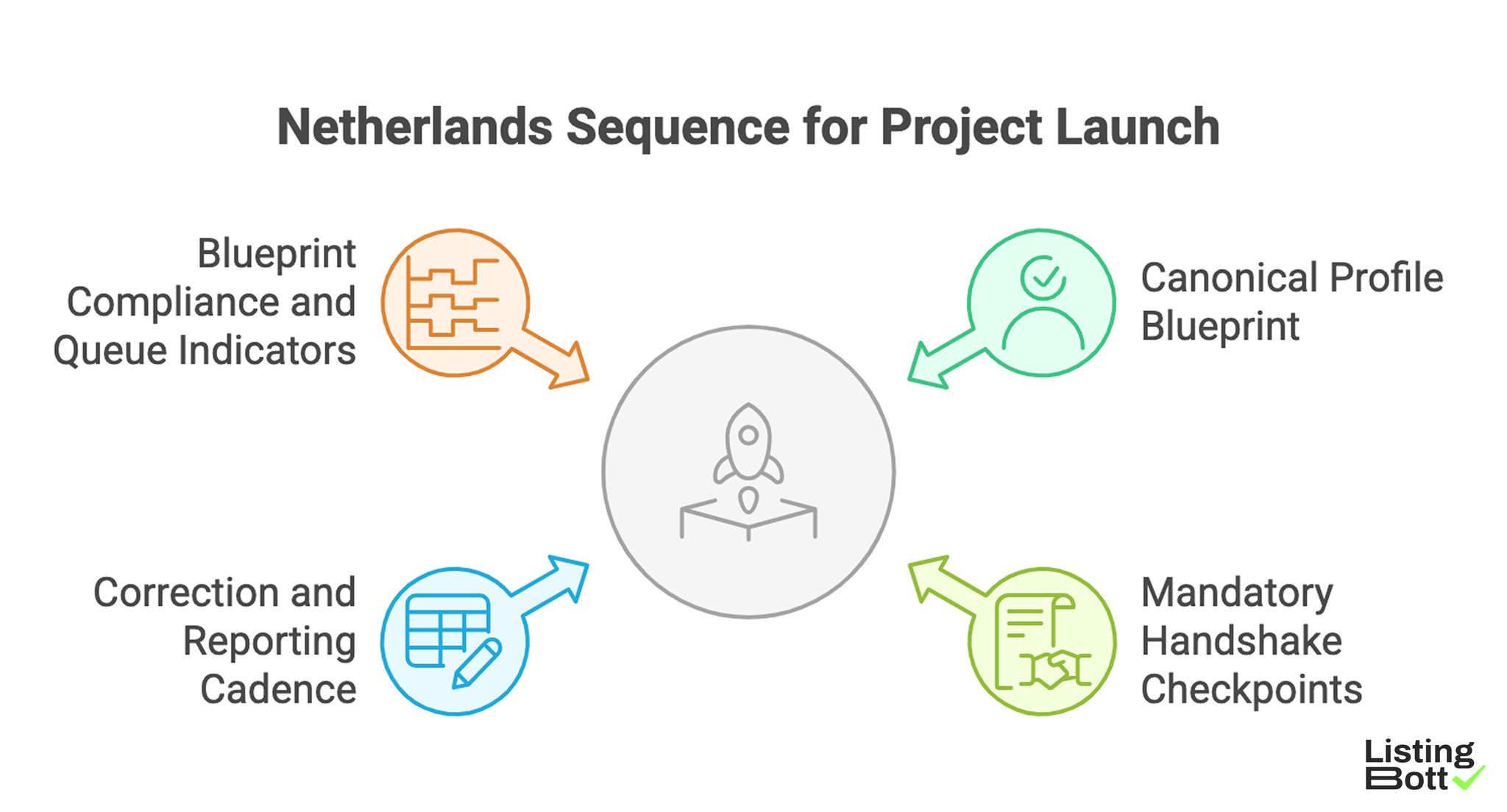
Netherlands Sequence for Project Launch
sbb-itb-8e44301
Methodology
This page uses a blueprint-handshake operating model designed for country-hub execution where policy consistency and decision cadence must remain synchronized.
The DELTA framework (Definition, Enforcement, Ledgering, Thresholds, Adaptation)
| Dimension | Weight | Primary control question |
|---|---|---|
| Definition quality | 20 | Is the baseline blueprint complete and unambiguous? |
| Enforcement reliability | 20 | Are wave launches blocked when blueprint checks fail? |
| Ledger discipline | 20 | Are gate decisions and exceptions fully traceable? |
| Threshold governance | 25 | Do expansion decisions follow measured readiness thresholds? |
| Adaptation control | 15 | Are changes managed without fragmenting standards? |
DELTA operating rule:
- score each dimension from 1-5 every two weeks,
-
block expansion if
Enforcement reliabilityorThreshold governanceis below 3, - resume expansion only after two stable review cycles.
Blueprint architecture
| Blueprint layer | What it defines | Validation artifact | Failure indicator |
|---|---|---|---|
| Data blueprint | required profile fields and accepted variants | baseline specification sheet | recurring field-variant conflicts |
| Scope blueprint | inclusion/exclusion boundaries per wave | signed scope packet | post-approval scope mutation |
| Ownership blueprint | gate owner, escalation owner, backup owner | owner matrix | unresolved owner ambiguity |
| SLA blueprint | issue classes and closure targets | SLA card | high-severity queue aging |
| Reporting blueprint | KPI cards, freshness rules, review schedule | dashboard index | stale KPI cards at vote time |
Handshake checkpoint system
| Checkpoint | Handshake question | Required evidence | If failed |
|---|---|---|---|
| H1: baseline handshake | does scope fully comply with blueprint definitions? | baseline compliance audit | stop launch and re-validate records |
| H2: scope handshake | is launch scope approved and frozen? | approved inclusion/exclusion packet | defer launch decision |
| H3: owner handshake | are all decision and escalation owners active? | owner matrix confirmation | block gate vote |
| H4: quality handshake | are early quality signals in threshold? | integrity + queue snapshot | freeze expansion |
| H5: continuity handshake | are dashboards current and complete? | KPI freshness log | postpone expansion until refresh |
Handshake checkpoints reduce variance between planned policy and real execution.
Wave blueprint classes
| Class | Purpose | Risk profile | Required control |
|---|---|---|---|
| Class B1 | baseline calibration | high early mismatch risk | daily acceptance and correction review |
| Class B2 | controlled expansion | medium ownership handoff risk | ownership and SLA handshake |
| Class B3 | distributed growth | medium-high queue carryover risk | queue pressure threshold guard |
| Class B4 | optimization phase | high drift risk if controls loosen | full compliance re-audit |
Decision-latency budget
| Decision step | Target time budget | If exceeded | Escalation action |
|---|---|---|---|
| Intake triage | <= 24h | quality queue buildup | assign additional triage owner |
| Gate approval | <= 48h | launch sequencing delay | invoke backup approver |
| Critical correction assignment | <= 12h | SLA breach risk | escalate to correction lead |
| Dashboard refresh | <= 7 days | stale decision inputs | reporting lock on expansion vote |
Latency budgets prevent expansion decisions from drifting behind operational reality.
Queue-lane blueprint
| Queue lane | Entry condition | Priority policy | Exit rule |
|---|---|---|---|
| Lane D1 | low-impact format or metadata issues | batch in weekly cycle | close in standard review window |
| Lane D2 | repeated mismatch in active class | prioritize over new launch tasks | close within weekly SLA |
| Lane D3 | systemic cross-wave blueprint conflict | freeze expansion until resolved | clear before next expansion vote |
Control-board program
| Board | Frequency | Input packet | Decision scope |
|---|---|---|---|
| Intake board | weekly | acceptance funnel report + exception list | tune intake strictness |
| Quality board | weekly | integrity trend + D-lane status | continue, hold, rollback |
| Expansion board | biweekly | DELTA score + handshake evidence | open next class or hold |
| Portfolio board | monthly | quality-cost trend + BOFU progression | reprioritize capacity and roadmap |
Scenario atlas for Netherlands rollout
| Scenario | Leading signal | First response | Recovery condition |
|---|---|---|---|
| Handshake failure cluster | two or more failed checkpoints in one cycle | freeze next class launch and run root-cause review | checkpoints pass for two consecutive cycles |
| Queue inversion | D3 growth while D2 closure declines | correction surge mode + launch pause | D3 queue below threshold |
| Scope drift event | post-approval scope changes appear | reject drift and re-run H2 handshake | no unauthorized scope edits next cycle |
| Ownership fracture | missing owner during active vote | activate backup owner protocol | complete owner matrix restored |
| Dashboard decay | KPI freshness breach at vote time | defer vote and refresh reporting set | all mandatory KPI cards current |
Compliance ledger template
| Field | Description | Why it is required |
|---|---|---|
| Gate ID | unique decision identifier | ties outcomes to exact approval event |
| Wave class | B1/B2/B3/B4 identifier | preserves traceability across phases |
| Evidence refs | links to packet files and KPI snapshots | proves decision basis |
| Threshold result | pass/hold status at vote time | enforces objective governance |
| Owners at vote | gate and escalation owners | prevents accountability gaps |
| Follow-up checkpoint | scheduled revalidation date | ensures decision continuity |
95-day rollout roadmap
| Phase | Days | Focus | Exit criteria |
|---|---|---|---|
| Blueprint setup | 1-18 | finalize baseline blueprint, handshake policy, ledgers | governance package approved |
| B1 launch | 19-40 | run baseline calibration with strict queue controls | stable integrity + closure trend |
| Stabilization loop | 41-64 | reduce D2/D3 pressure and reopen drift | queue pressure normalized |
| Controlled B2-B4 expansion | 65-95 | launch remaining classes by handshake approvals | no post-wave KPI regression |
Pre-wave compliance checklist
| Checklist item | Verification method | Pass threshold |
|---|---|---|
| Blueprint adherence | random audit against baseline definition | no conflicting baseline edits |
| Ownership completeness | matrix preflight validation | all decision owners assigned |
| SLA readiness | high-severity closure trend audit | two stable weekly cycles |
| Dashboard freshness | KPI timestamp and completeness check | no stale cards |
| Evidence completeness | gate packet checklist | all required artifacts present |
KPI formula card
| KPI | Formula | Decision purpose |
|---|---|---|
| Intake acceptance rate | accepted records / evaluated records | validates intake quality against blueprint |
| Wave integrity rate | records passing audit / sampled records | validates execution consistency |
| High-severity closure velocity | high-severity issues closed per week | tracks correction throughput |
| Reopen ratio | reopened issues / closed issues | measures correction durability |
| Queue pressure index | weighted age of D2 and D3 queues | signals compounding debt risk |
| Decision latency | average hours from issue detection to action | tracks governance responsiveness |
Rollback drill matrix
| Drill | Simulated trigger | Pass condition | If failed |
|---|---|---|---|
| Scope rollback drill | unauthorized scope delta in active class | scope reverts in one cycle | freeze new approvals |
| Queue containment drill | D3 threshold breach | D3 normalized before next vote | dedicated correction sprint required |
| Dashboard recovery drill | missing KPI card during vote | dashboard recovered within 24h | postpone expansion decision |
| Owner continuity drill | unavailable gate owner | backup owner completes vote on time | owner matrix revision mandatory |
Comparison table
| Execution model | Best for | Strength | Tradeoff | Netherlands hub fit |
|---|---|---|---|---|
| Flat country rollout | short pilot tests | quick startup | weak control over blueprint drift | Low |
| Manual segmented execution | narrow-scope teams | local flexibility | high coordination overhead | Medium-low |
| Managed blueprint execution | teams needing structured speed | predictable flow with lower internal load | depends on workflow transparency | Strong |
| Hybrid governance execution | teams with internal QA ownership | strongest control-throughput balance | requires strict owner accountability | Very strong |
Model selection by maturity
| Team maturity signal | Recommended model | Why |
|---|---|---|
| Limited internal ops capacity | Managed blueprint execution | preserves controls with lower operational burden |
| Moderate maturity with growth goals | Hybrid governance | supports scale without losing oversight |
| High maturity with strong SOP | Hybrid or software-led | enables deeper optimization |
| Recurring blocker instability | Managed pilot + control reset | restores stable baseline before expansion |
Weekly KPI board
| KPI | Why it matters | Expansion stop trigger |
|---|---|---|
| Intake acceptance rate | intake quality signal | sustained decline in active class |
| Wave integrity rate | policy consistency signal | repeated class-level drop |
| High-severity closure velocity | correction responsiveness | critical queue aging beyond SLA |
| Reopen ratio | correction durability | two-cycle upward trend |
| BOFU progression actions | commercial linkage | informational activity with weak progression |
Best by use case
1) Single-location launch
Best fit: managed blueprint execution with strict handshake checks.
Reason: keeps operations clear while preserving quality control.
2) Multi-location rollout
Best fit: hybrid governance with evidence-based class approvals.
Reason: scale remains controlled and accountability stays explicit.
3) Product-led SaaS expansion
Best fit: phased rollout tied to handshake thresholds.
Reason: threshold-led expansion reduces correction-debt risk.
4) Agency portfolio delivery
Best fit: standardized packet validation and queue-lane escalation.
Reason: repeatable controls reduce cross-account variance.
5) Governance-sensitive operations
Best fit: approval-first workflow with ledgered decisions.
Reason: traceability improves reliability and audit readiness.
For benchmark references, compare governance rigor and workflow transparency on best directory listing services and best local business directories.
Where ListingBott fits in Netherlands execution
What ListingBott does
ListingBott is a workflow-based directory submission tool for teams that need structured execution, approval checkpoints, and transparent reporting.
How ListingBott works
-
You submit business details through the
client form. -
ListingBott prepares a
list of directoriesfor scope review. - You approve the list before launch starts.
- ListingBott executes submissions based on approved scope.
-
ListingBott provides reporting for completed and pending outcomes.
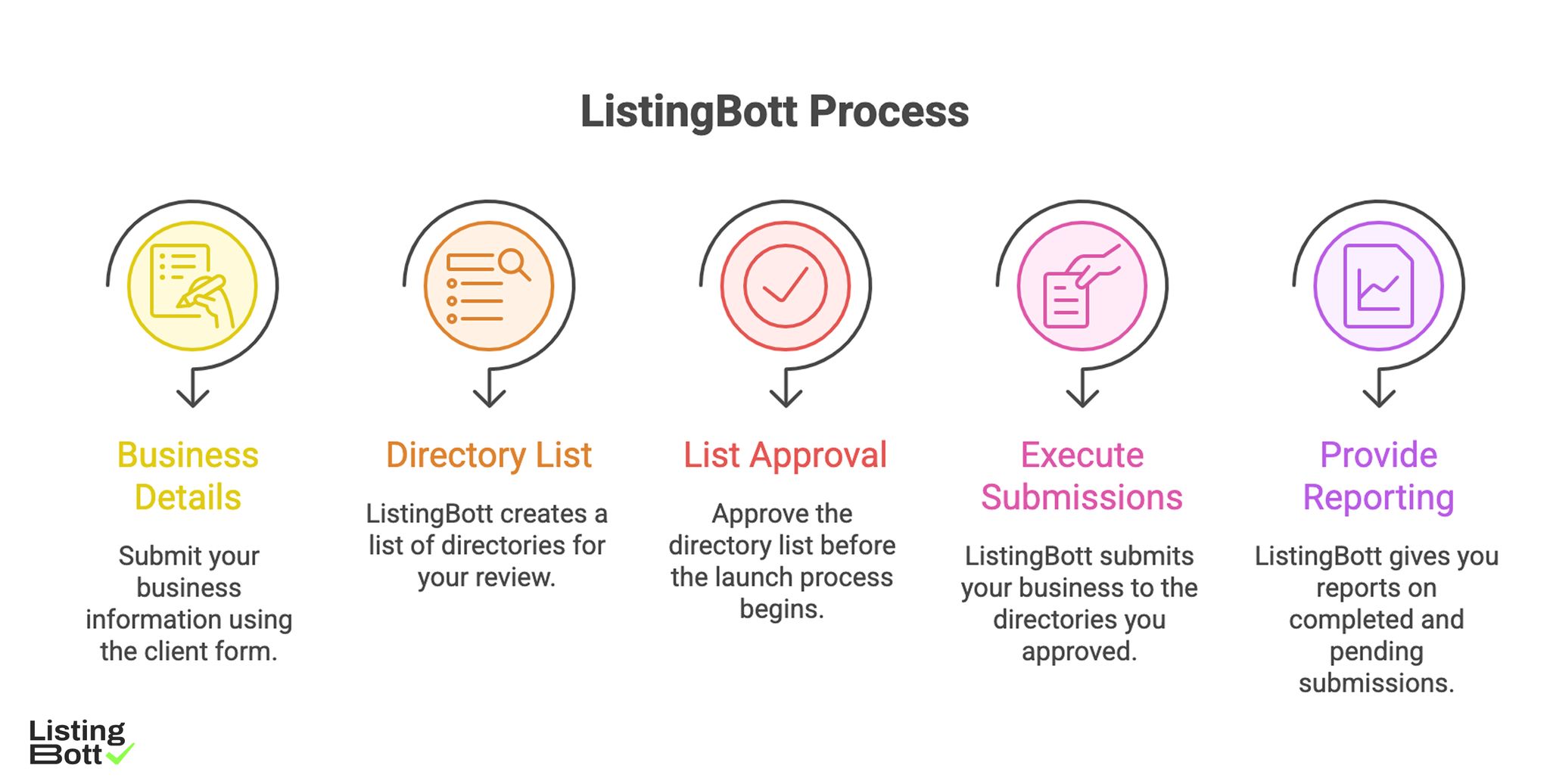
ListingBott Process
Key features and practical value
- Intake validation: reduces preventable profile-data errors before launch.
- Approval checkpoint: aligns scope and expectations before execution.
- Workflow transparency: supports ownership and escalation control.
- Reporting handoff: supports data-backed decisions before each wave.
Teams that prioritize workflow reliability usually maintain stronger long-term execution quality than teams focused only on submission volume.
Expected outcomes and limits
Expected outcomes:
- structured submission execution,
- clear wave-level visibility,
- repeatable process for additional expansion waves.
Limits to keep explicit:
- no guaranteed ranking position,
- no guaranteed traffic by a specific date,
- no guaranteed indexing speed,
- no guaranteed outcomes controlled by third-party platforms.
DR commitment is conditional only. A promise to reach DR 15 can apply when starting DR is below 15, the client explicitly selects domain growth, and the directory list is approved before process launch. Refunds may apply if process has not started, and public offer language remains no hidden extra fees.
Risks/limits
Common failure patterns
- Launching waves without complete handshake evidence.
- Expanding while D3 queue issues remain unresolved.
- Running mixed baseline policy rules in active classes.
- Tracking output totals while ignoring queue and reopen signals.
- Escalating issues without clear owner accountability.
Practical limits
- Directory submission supports discoverability and consistency, but does not replace broader SEO systems.
- Timing and outcomes vary by category, competition, and third-party platform behavior.
- Expansion without packet and queue discipline can create compounding correction debt.
Minimum control layer
- wave-based gate approvals,
- SLA-bound correction ownership,
- weekly KPI and queue-lane review,
- complete evidence packet before each expansion decision.
FAQ
Why use a blueprint model in the Netherlands?
Because stable execution depends on consistent baseline rules, synchronized decisions, and queue discipline.
Should all waves launch in parallel?
Usually no. Launch sequentially, stabilize quality, then expand.
Which KPI should block expansion first?
Use high-severity closure velocity together with intake acceptance and wave-integrity rates.
Can directory submission guarantee rankings?
No. It supports consistency and discoverability, but rankings depend on external factors.
Is DR growth guaranteed for every project?
No. DR commitments are conditional and apply only to qualified setups.
What is the minimum governance stack?
Canonical data control, gate ownership, correction SLA, and recurring wave-level KPI reviews.