Quick answer
Local business directory submission in Illinois works best when you treat Chicago-area execution and downstate execution as separate operating lanes with one shared governance layer. Most teams fail because they scale one checklist everywhere, then discover quality and correction speed break at different points by market type.
A practical Illinois sequence is:
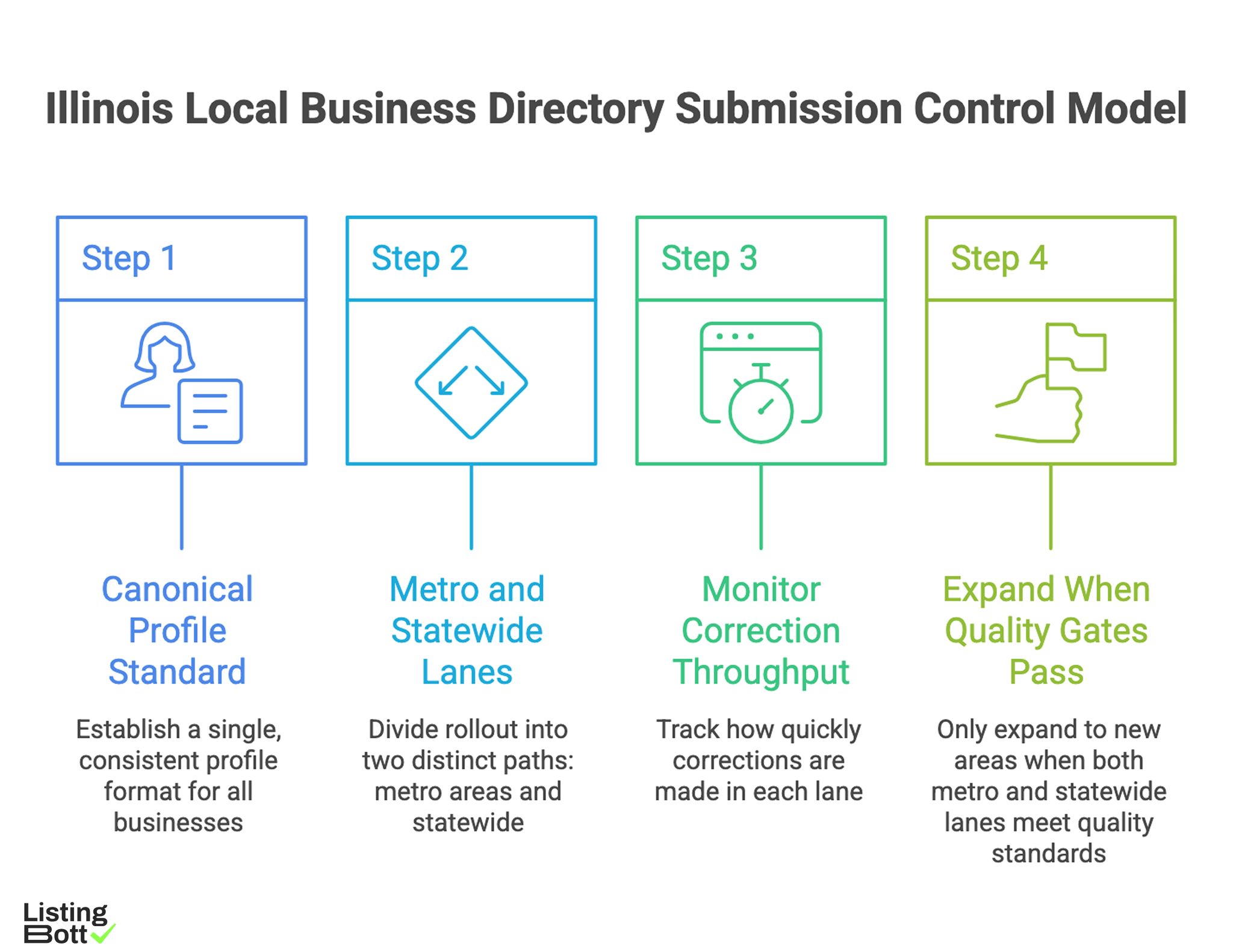
Illinois Local Business Directory Submission Control Model
- lock one canonical profile standard,
- split rollout into metro and statewide lanes,
- monitor correction throughput by lane,
- expand only when both lanes pass quality gates.
For broader U.S. planning, see Local business directory submission USA.
sbb-itb-8e44301
Methodology
This page uses an Illinois-specific control system designed for mixed market density: a heavy metro core, mid-density suburban corridors, and lower-density regional markets.
The LANE model (Layering, Accountability, Normalization, Expansion)
| Factor | Weight | Why it matters in Illinois |
|---|---|---|
| Layering design | 25 | Prevents applying one rollout rhythm to very different local market conditions |
| Accountability clarity | 25 | Keeps correction ownership explicit across metro and statewide teams |
| Normalization rigor | 30 | Maintains clean profile consistency as submissions scale |
| Expansion discipline | 20 | Stops premature growth when one lane underperforms |
How to use LANE:
- score each factor from 1-5 every two weeks,
-
pause new submissions when
Normalizationis below 3, - block expansion if either lane drops below threshold.
This creates a repeatable control loop instead of reactive fire-fighting.
Illinois operating lanes
| Lane | Typical geography | Primary objective | Common failure mode | Gate before next wave |
|---|---|---|---|---|
| Lane 1: Chicago core | City-center and dense service zones | Protect data integrity under high change frequency | Fast volume, slow correction closure | Stable high-priority fix closure |
| Lane 2: Collar counties | Suburban and commuter markets | Standardize rollout with lower variance | Mixed profile sources from different teams | Single source-of-truth enforcement |
| Lane 3: Regional metros | Peoria, Rockford, Springfield, Champaign-Urbana type markets | Replicate process quality from lane 1-2 | Inconsistent ownership handoffs | Named owner per market cluster |
| Lane 4: Long-tail statewide | Smaller and distributed local markets | Add efficient coverage without quality drop | Backlog growth hidden by lower volume | Backlog + SLA threshold pass |
Governance cadence map
| Cadence | Owner | What gets reviewed | Decision output |
|---|---|---|---|
| Daily | Operations lead | New exceptions + broken fields | Immediate fix assignment |
| Weekly | QA + execution | Error categories, closure speed, lane variance | Keep/freeze lane status |
| Biweekly | Program owner | Expansion readiness score | Expand, hold, or rollback |
| Monthly | Leadership/stakeholders | Cost vs quality trend and BOFU progression | Capacity plan update |
Without cadence discipline, lane-level issues stay invisible until they damage reporting quality.
90-day Illinois rollout blueprint
| Phase | Days | Focus | Exit criteria |
|---|---|---|---|
| Foundation | 1-20 | Canonical profile schema + ownership map + approval rules | Baseline accepted |
| Controlled launch | 21-45 | Execute lane 1 and lane 2 with tight QA windows | Error trend stable |
| Replication | 46-70 | Extend proven workflow to lane 3 | Comparable pass rate to lanes 1-2 |
| Scaled coverage | 71-90 | Add lane 4 with backlog controls | No correction debt spike |
Most programs should not open statewide long-tail until lane 1-2 quality is predictable for at least two consecutive review cycles.
Readiness checklist before statewide scaling
| Checkpoint | Validation question | Pass rule |
|---|---|---|
| Canonical source | Is there one approved source for NAP and business details? | Yes, no dual-source edits |
| Approval protocol | Are inclusion/exclusion decisions approved before launch? | Yes, explicit approval step |
| Correction SLA | Is there a defined time-to-fix target for critical errors? | Yes, tracked weekly |
| Lane reporting | Can you view quality by lane, not just global totals? | Yes, lane dashboards active |
| Expansion trigger | Is next-wave launch tied to thresholds, not calendar date? | Yes, threshold documented |
Comparison table
| Execution model | Best fit | Advantages | Tradeoffs | Illinois fit |
|---|---|---|---|---|
| Manual spreadsheet workflow | Very small single-market pilots | Low tool overhead | High error risk and weak scalability | Low fit beyond initial pilot |
| Internal software-led workflow | Teams with mature ops and QA ownership | Strong control and auditability | Requires disciplined process management | Medium fit |
| Managed execution workflow | Teams prioritizing speed with controlled operations | Faster rollout and lower ops load | Requires provider transparency | Strong fit for many teams |
| Hybrid governance workflow | Teams balancing expansion and strict control | Combines external execution with internal quality oversight | Needs clear role boundaries | Often best for multi-lane Illinois rollout |
Model choice by team maturity
| Team maturity signal | Recommended model | Why |
|---|---|---|
| Low operational bandwidth | Managed execution | Prevents process failure from under-resourced teams |
| Moderate bandwidth + growth pressure | Hybrid governance | Keeps quality oversight while scaling |
| Strong QA discipline and stable SOPs | Internal software-led or hybrid | Maximizes control with manageable risk |
| Recurring correction backlog | Managed pilot + governance reset | Stabilizes quality before expansion |
Illinois KPI stack
| KPI | Why it matters | Warning threshold |
|---|---|---|
| Profile integrity pass rate | Primary quality signal across lanes | Sustained decline in any active lane |
| Critical-fix closure time | Tracks operational responsiveness | High-priority fixes aging past SLA |
| Expansion readiness score | Prevents calendar-driven rollout | Score below launch threshold |
| Lane variance index | Detects uneven quality between lanes | One lane consistently underperforming |
| BOFU progression events | Connects traffic to commercial outcomes | High informational visits, weak action rate |
A strong KPI stack helps teams avoid the common mistake of evaluating only submission volume.
Best by use case
1) Chicago-focused single-location business
Best fit: managed execution with high correction visibility.
Reason: dense local competition requires strong consistency and fast corrections.
2) Multi-location brand across Illinois metros
Best fit: hybrid governance with lane-by-lane rollout.
Reason: this balances operational speed with measurable quality control.
3) SaaS or product-led team entering Illinois local markets
Best fit: phased rollout tied to readiness thresholds.
Reason: program stability improves when expansion follows quality signals, not launch pressure.
4) Agency running Illinois client portfolios
Best fit: standardized workflow with explicit owner mapping.
Reason: agencies need repeatable delivery and clear escalation paths for each lane.
5) Teams with compliance-sensitive review requirements
Best fit: approval-first model with strict audit trail.
Reason: policy-driven operations reduce execution variance and trust risk.
If you are comparing local execution options, benchmark process quality first, then pricing. These references can help frame evaluation criteria: best directory listing services and best local business directories.
Where ListingBott fits in Illinois execution
What ListingBott does
ListingBott is a workflow-based tool for business directory submission. It is designed for teams that need predictable execution with visible process stages instead of ad hoc manual tracking.
How ListingBott works
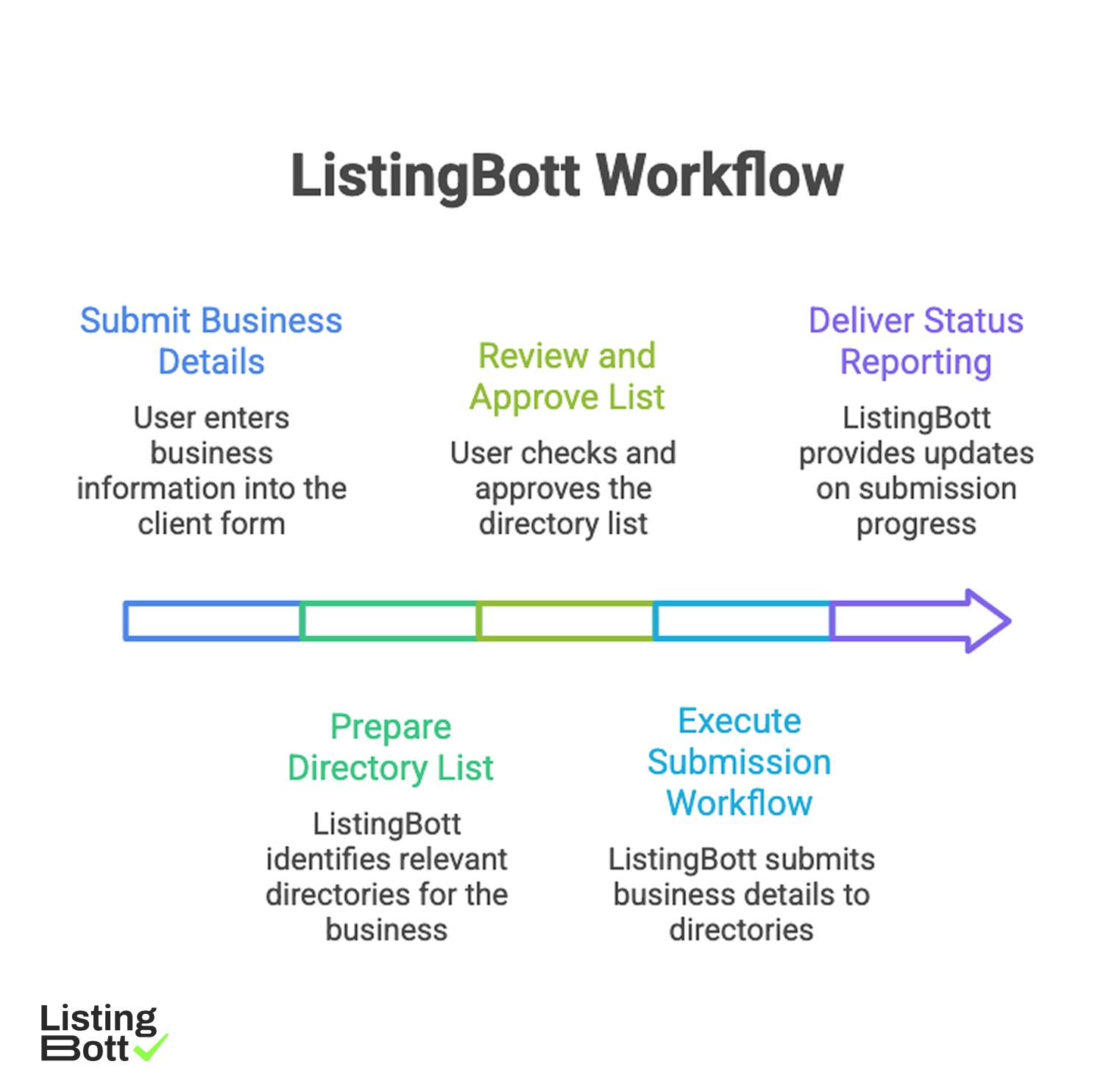
ListingBott Workflow
-
You submit business details through the
client form. -
ListingBott prepares a
list of directoriesrelevant to your scope. - You review and approve the list before publishing starts.
- ListingBott executes submission workflow based on approved scope.
- ListingBott delivers status reporting with completed and pending outcomes.
Key features and what they mean operationally
- Intake validation: reduces preventable data errors before launch.
- Pre-publish approval checkpoint: aligns scope and expectations up front.
- Submission workflow transparency: improves coordination across teams.
- Reporting handoff: supports QA review before next-wave expansion.
Teams evaluating execution platforms generally get better long-term outcomes by prioritizing workflow reliability over volume-first promises.
Expected results and explicit limits
Expected outcomes:
- structured submission execution,
- transparent status communication,
- repeatable process for future rollout waves.
What should stay explicit:
- no guaranteed ranking position,
- no guaranteed traffic by a specific date,
- no guaranteed indexing speed,
- no guarantee for outcomes controlled by third-party platforms.
Conditional DR commitment only: a promise to reach DR 15 can apply when starting DR is below 15, the client selects domain growth as the goal, and the directory list is approved before execution. Per current public language, refunds are possible if process has not started and there are no hidden extra fees.
Risks/limits
Frequent Illinois rollout mistakes
- Scaling to statewide long-tail before metro lanes stabilize.
- Letting multiple profile sources bypass canonical controls.
- Measuring output totals without lane-level quality signals.
- Expanding while critical correction backlog is growing.
- Running execution without clear owner/escalation rules.
Practical limits of directory submission programs
- Directory submission supports discoverability and consistency, but it does not replace broader SEO fundamentals.
- Outcome timing depends on category, competition, and external platform behavior.
- Quality debt compounds quickly when expansion pace exceeds correction capacity.
Risk controls worth enforcing
- lane-based rollout gates,
- named correction owners with SLA accountability,
- explicit inclusion/exclusion policy,
- recurring governance review cadence.
FAQ
Why split Illinois execution into lanes?
Because Chicago-core and statewide markets behave differently operationally. Lane-based planning prevents one-size-fits-all rollout errors.
Should statewide expansion start immediately?
Usually no. Start with metro and suburban lanes, then expand after quality and correction metrics stabilize.
Which KPI is most important before adding new markets?
Use profile integrity pass rate with critical-fix closure time. If either degrades, hold expansion.
Can directory submissions guarantee rankings in Illinois?
No. They improve local data consistency and operational readiness, but ranking outcomes depend on many external factors.
Is DR growth guaranteed for every project?
No. DR commitments are conditional and require qualified setup criteria.
What if team capacity is limited?
Use a managed or hybrid model first, then increase internal ownership once controls are stable.