Quick answer
Local business directory submission in Florida works best when rollout is organized by regional clusters and demand cycles, not by flat statewide volume targets. Teams that scale too fast without cluster controls usually accumulate data inconsistency and correction backlog.
A practical Florida sequence is:
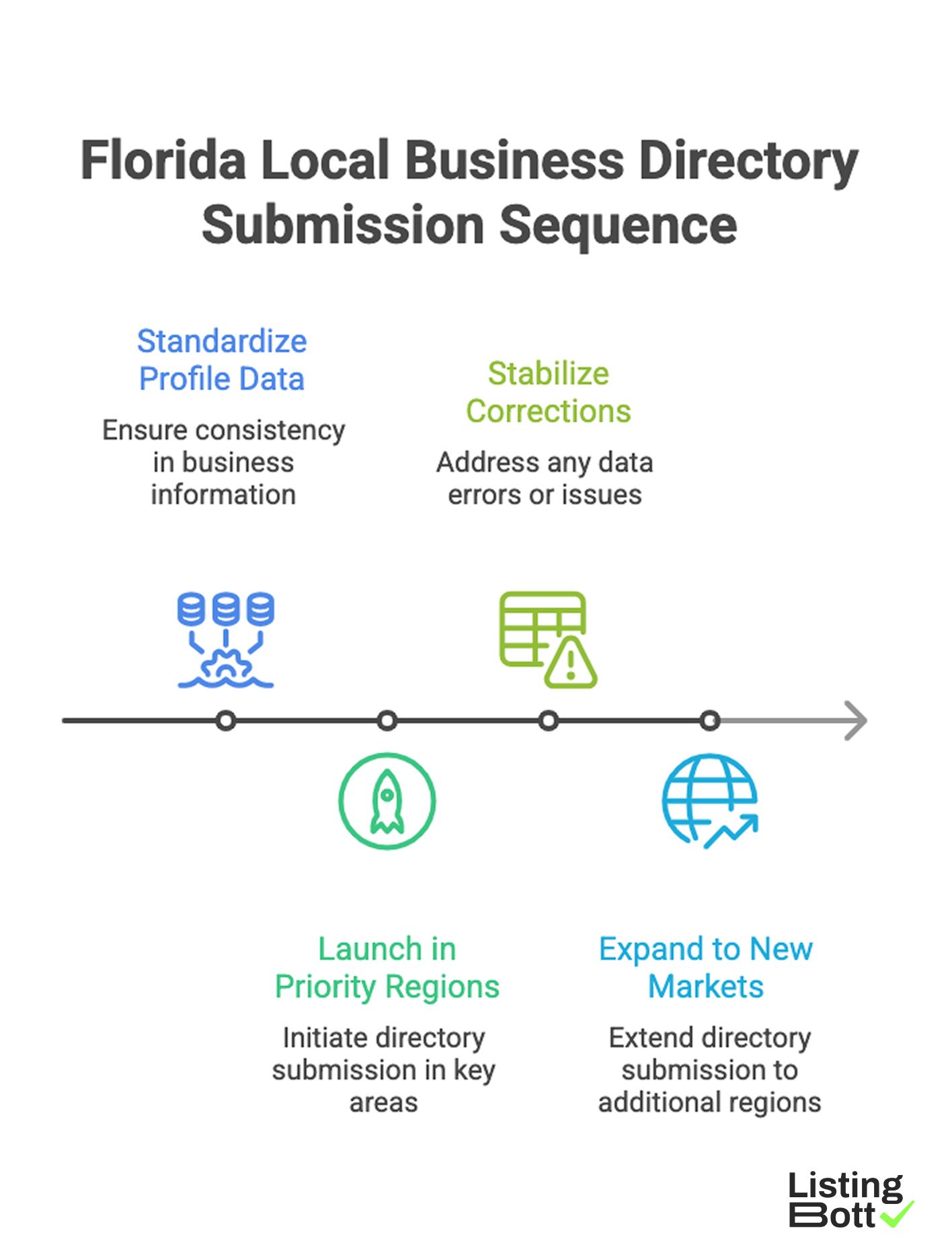
Florida Local Business Directory Submission Sequence
- standardize profile data and ownership,
- launch in priority regions with clear quality gates,
- stabilize corrections,
- expand only when readiness thresholds are met.
This approach improves consistency and keeps reporting reliable while growth expands across multiple local markets.
For broader U.S. planning, see Local business directory submission USA.
sbb-itb-8e44301
Methodology
This page uses a Florida-specific execution model focused on controlled regional scaling.
The FLARE model (Fit, Locality, Accuracy, Response, Expansion)
| Factor | Weight | Why it matters in Florida |
|---|---|---|
| Fit by region | 20 | Prevents one-size-fits-all rollout across different local market contexts |
| Local data precision | 25 | Reduces profile mismatches across service regions |
| Accuracy discipline | 25 | Keeps listings consistent through expansion waves |
| Response speed | 15 | Measures correction and escalation throughput |
| Expansion readiness | 15 | Ensures next-wave launch happens only after quality holds |
How to apply FLARE
- Score each factor from 1-5 before each rollout wave.
-
Pause expansion if
Local data precisionorAccuracy disciplinedrops below 3. - Re-check scores every 2 weeks while rollout is active.
This keeps growth tied to quality instead of activity volume.
Florida regional rollout map
| Region | Priority wave | Primary objective | Common execution risk | Expansion gate |
|---|---|---|---|---|
| South Florida | Wave 1 | Establish strong baseline in high-demand cluster | Fast expansion with weak correction capacity | Stable correction cycle |
| Central Florida | Wave 1 | Maintain consistency while scaling coverage | Scope drift and profile inconsistency | Consistency pass rate maintained |
| Tampa Bay | Wave 2 | Replicate process with low variance | Ownership overlap across teams | Clear owner model + SLA adherence |
| Northeast Florida | Wave 2 | Controlled growth with repeatable SOP | Delayed status visibility | Reporting cadence remains stable |
| Panhandle + secondary markets | Wave 3 | Long-tail expansion with governance checks | Process fatigue and backlog growth | Backlog within defined threshold |
Florida timing and demand window planning
Florida teams often get better control when rollout is aligned with operational windows, not just static monthly targets.
| Window type | Operational objective | What to tighten before scaling |
|---|---|---|
| High-demand window | Preserve profile accuracy under rising execution volume | Correction SLA capacity and ownership coverage |
| Normal-demand window | Improve process efficiency and cleanup speed | Reporting cadence and closure quality |
| Transition window | Prepare next regional wave without quality drop | Readiness scoring and expansion gate checks |
This timing layer helps prevent quality dips during high-activity periods.
70-day Florida rollout plan
| Phase | Window | Focus | Pass condition |
|---|---|---|---|
| Baseline setup | Days 1-12 | Canonical profile, owner assignment, category map | Required fields approved |
| First-wave rollout | Days 13-30 | Initial regional submissions + QA checks | Error trends remain controlled |
| Correction stabilization | Days 31-48 | Fix loops and escalation management | Critical correction backlog cleared |
| Controlled expansion | Days 49-70 | Add next regions with same SOP | Quality thresholds hold after scaling |
Teams that skip stabilization often lose reporting clarity and operational trust.
Florida pre-expansion checklist
| Checkpoint | Question | Pass criteria |
|---|---|---|
| Profile source of truth | Is one canonical profile enforced across regions? | Yes, no conflicting versions |
| Ownership clarity | Who owns fixes and escalation per region? | Named owner and backup |
| Correction loop | Are fixes tracked to closure with SLA? | Yes, closure tracking active |
| Reporting cadence | Is status tracked by region? | Recurring region-level reporting |
| Expansion threshold | What blocks next-wave launch? | Explicit quality and backlog thresholds |
Comparison table
| Delivery model | Best for | Strengths | Tradeoffs | Florida suitability |
|---|---|---|---|---|
| Manual internal workflow | Small pilot programs | Maximum direct control | Low scalability, high operator load | Low beyond pilot scope |
| Software-only internal | Teams with mature internal operations | Better process control and auditability | Requires strong governance bandwidth | Medium when internal ops are strong |
| Service-led execution | Teams prioritizing faster rollout and support | Lower internal workload, quicker launch | Requires transparent provider operations | Strong for first and second waves |
| Hybrid governance model | Teams balancing speed with strict quality control | Best speed-control balance for growth | Needs explicit role boundaries | Often strongest for regional Florida expansion |
Regional operating mode selection
Use this if you want a faster decision than full vendor scoring:
| Condition | Suggested Operating Mode | Why It Fits |
|---|---|---|
| Rapid rollout required with low internal operator bandwidth | Service-led | Maintains execution speed while protecting baseline quality and reducing internal workload |
| Mixed account complexity with a moderate internal team | Hybrid | Balances throughput with governance, allowing scale without losing control |
| Mature internal operations team with strong QA discipline | Software-led or hybrid | Provides higher control and customization without sacrificing repeatability |
| Repeated quality regressions during regional expansion | Rollback to controlled service-led wave | Stabilizes execution, resolves correction backlog, and restores process reliability |
Decision matrix by operating readiness
| Readiness profile | Recommended model | Why |
|---|---|---|
| Low internal capacity | Service-led | Reduces execution burden and launch friction |
| Medium capacity with expansion goals | Hybrid | Supports scaling while preserving governance |
| High maturity and strong SOP discipline | Software-led or hybrid | Increases control with manageable risk |
| Weak correction ownership | Service-led pilot plus governance reset | Prevents growth on unstable process |
Metrics to monitor by Florida region
| Metric | Why it matters | Warning signal |
|---|---|---|
| Regional consistency pass rate | Measures profile quality stability | Falling pass rate in new regions |
| Correction cycle time | Indicates operational reliability | Growing unresolved queue |
| Expansion readiness index | Prevents premature growth | New rollout with low readiness score |
| Submission-to-status lag | Tracks reporting discipline | Slow status updates after submission |
| BOFU progression clicks | Connects execution to commercial path | Informational visits with weak progression |
When these signals degrade, pause expansion and stabilize operations first.
Best by use case
1) Single-location operator
Primary need: fast setup with low internal operational burden.
Recommended model: service-led first wave with strict correction controls.
2) Regional multi-location business
Primary need: consistency across different Florida regions.
Recommended model: hybrid governance with centralized owner and regional QA checkpoints.
3) Growth-stage SaaS targeting local discovery
Primary need: controlled scale while preserving data quality.
Recommended model: phased regional rollout tied to readiness scoring.
4) Agency portfolio delivery
Primary need: repeatability across multiple client workflows.
Recommended model: standardized SOP plus region-level status reporting and escalation rules.
5) High-sensitivity categories
Primary need: strict change control and traceable correction history.
Recommended model: approval-before-publish with explicit fix ownership.
For most teams, workflow reliability and correction transparency are stronger vendor criteria than simple directory-count claims.
Where ListingBott fits in Florida execution
What ListingBott does
ListingBott is a workflow-driven submission tool for teams that need repeatable execution instead of fragmented manual tasking. Current public offer language is one-time payment with publication to 100+ directories.
How ListingBott works
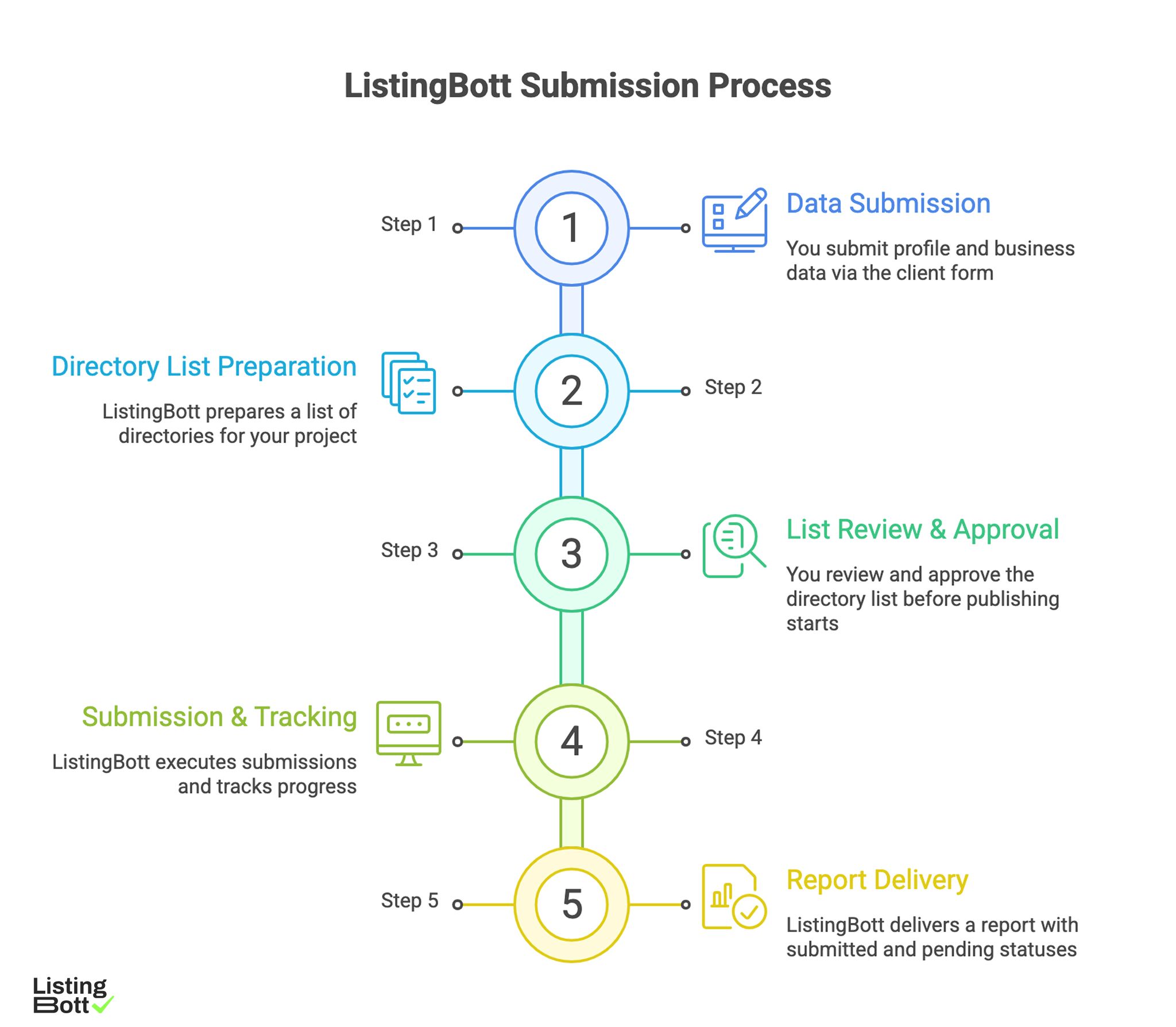
ListingBott Submission Process
-
You submit profile/business data via the
client form. -
ListingBott prepares a
list of directoriesfor your project. - You review and approve that list before publishing starts.
- ListingBott executes submissions and tracks progress.
- ListingBott delivers a report with submitted and pending statuses.
For Florida teams, this structure is useful when regional expansion must happen without losing process visibility.
Key features and what they mean in operations
- Intake gating before publish: catches missing data before rollout begins.
- Pre-publish approval: keeps regional scope aligned with actual priorities.
- Status tracking: supports region-level coordination and escalation.
- Report handoff: enables post-wave quality review before expansion.
When evaluating providers, submission workflow clarity usually predicts better long-term outcomes than scale-only promises.
Expected results and limits
Expected outcomes:
- clear workflow and status communication,
- submission execution within agreed scope,
- final reporting on completed and pending items.
Limits to keep explicit:
- no guaranteed ranking position,
- no guaranteed traffic by a specific date,
- no guaranteed indexing speed,
- no guarantees for third-party platform outcomes.
DR commitments are conditional only. A promise to reach DR 15 applies only for qualified projects with starting DR below 15, explicit domain growth goal, and approved directory list. Refunds can apply if process has not started, and offer terms should remain explicit with no hidden extra fees.
Risks/limits
Common Florida execution mistakes
- Expanding region coverage before correction throughput stabilizes.
- Running multiple profile versions without one source of truth.
- Tracking volume only and ignoring quality indicators.
- Scaling without named ownership for fixes and escalation.
- Assuming every Florida region behaves the same operationally.
Florida-specific operational friction points
- uneven execution quality between first-wave and later-wave regions,
- delayed fix closure when escalation ownership is unclear,
- reporting lag that hides quality drift until expansion is already underway.
Practical limits
- Directory submissions support visibility but do not replace broader SEO fundamentals.
- Timeline and impact vary by category, competition, and platform dynamics.
- Uncontrolled expansion creates maintenance debt that slows future execution.
Risk controls to enforce
- region-by-region expansion gates,
- documented inclusion/exclusion criteria,
- correction workflow with SLA and ownership,
- recurring reporting cadence with status accountability.
FAQ
Why use a region-based approach for Florida?
Florida rollout often spans multiple distinct local markets, so region-based sequencing improves consistency and control.
Should all Florida regions be launched at once?
Usually no. Start with first-wave regions, validate quality, then expand by readiness gates.
What is the core KPI before adding the next Florida region?
Use consistency pass rate plus correction cycle time as the primary expansion gate.
Is hybrid always better than service-led in Florida?
Not always. The right model depends on team capacity and governance maturity.
Can local directory submission guarantee Florida rankings?
No. It improves execution quality and support for visibility, but rankings and timing depend on many external factors.
Can DR growth be promised by default?
No. DR commitments are conditional and require qualified project criteria.