Table of Contents
- Building a Better SEO Directory List without Bloat
- Implementation Checklist: From Baseline to Stable Portfolio
- Practical Scenarios by Business Type
- Common Mistakes and Risk Controls
- 90-Day Optimization Plan
- FAQ
sbb-itb-8e44301
Quick Answer
Local business directory listings work best when they are managed as an ongoing quality system, not a one-time submission campaign. Most teams see stronger long-term results when they launch a focused set of high-fit platforms, verify data quality quickly, and expand only after stability is proven.
In practical terms, a reliable 2026 approach is:
- build one canonical business profile baseline,
- select listing platforms by fit and control, not by list size,
- run a two-wave rollout (core first, support second),
- maintain recurring QA and correction routines.
This approach improves consistency, reduces duplicate-cleanup costs, and protects listing quality as scope grows.
Why Local Business Directory Listings still Matter in 2026
Search journeys now combine maps, business directories, reviews, and AI-generated answer layers. Because users move across multiple surfaces before converting, profile consistency across external listings continues to matter.
Teams usually discover this the hard way. They publish to many sites, then encounter recurring mismatch problems:
- outdated phone or URL fields,
- category drift between platforms,
- duplicate profiles in legacy directories,
- unclear ownership for corrections.
That is why local listing execution should be treated as an operating workflow. Directory coverage helps only when profile quality remains stable.
A good rule is simple: every new directory added must have a clear reason to exist and a realistic maintenance path. If not, the channel becomes a long-term liability.
The CQM Model: Coverage, Quality, Maintenance
Use this model to decide whether a directory belongs in your portfolio.
| Dimension | Key question | Strong signal | Risk signal |
| Coverage fit | Does this platform reach the audience and location context you need? | clear intent match for your market | broad but low-relevance exposure |
| Profile quality | Can you publish useful detail (services, categories, media, trust fields)? | rich, accurate profile options | shallow or inconsistent profile structure |
| Maintenance control | Can your team keep this listing accurate over time? | updates and corrections are manageable | edits are slow and quality drifts quickly |
Score each dimension from 1-5, then calculate total score (3-15):
- 12-15: core-wave candidate,
- 9-11: support-wave candidate,
- below 9: hold or skip.
The benefit of CQM is that it balances visibility with operational reality. This prevents the "submit everywhere" pattern that inflates workload without improving outcomes.
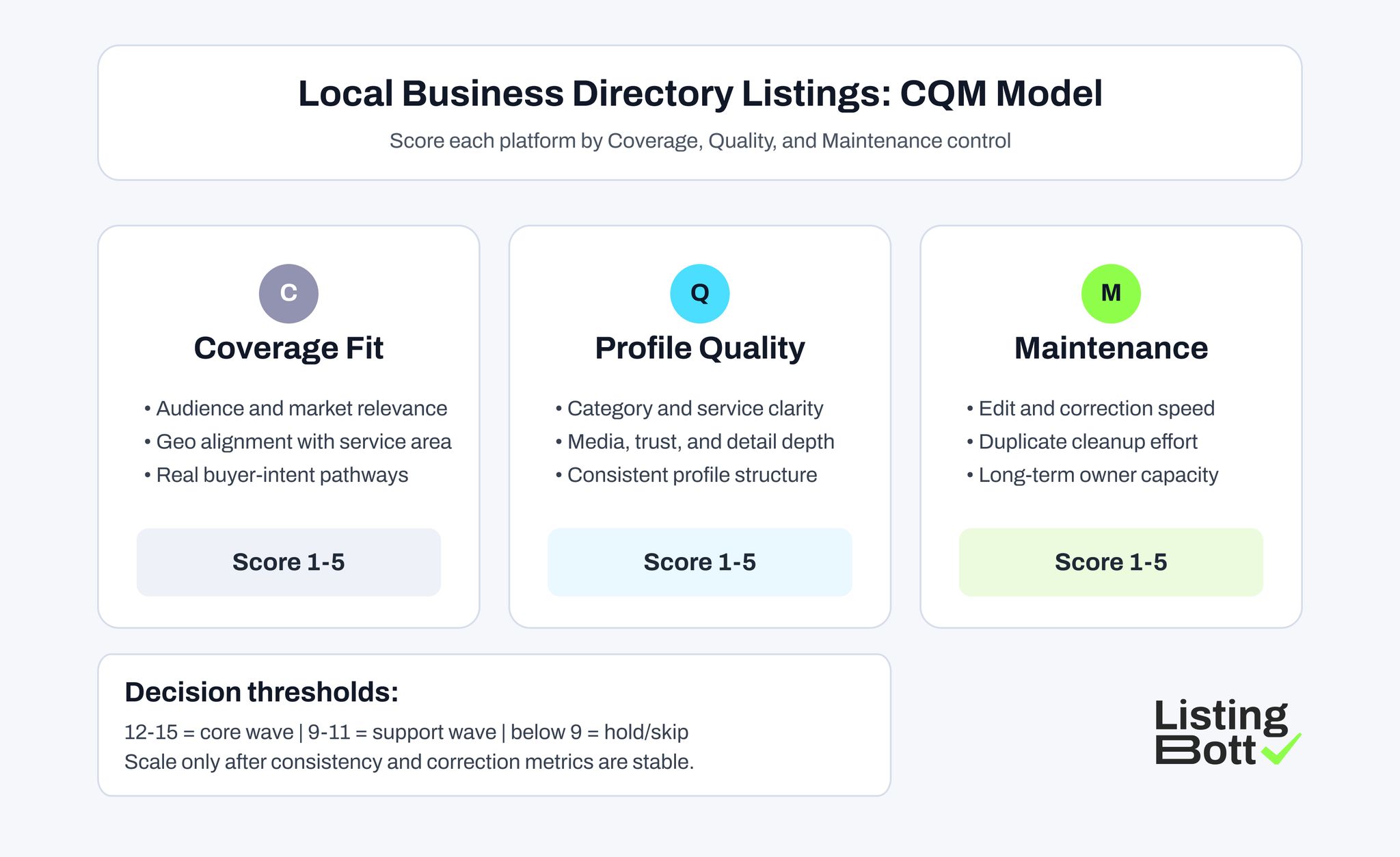
Local Business Directory Listings: CQM Model
Best-fit Listing Platforms for Local Business Directory Listings
This list is structured for practical execution in U.S.-focused local visibility projects.
| Platform | URL | Why it is a best fit | Ideal company profile | Submission note |
| Google Business Profile | https://www.google.com/business/ | Core local discovery layer with major visibility impact in map and local search journeys | local SMBs, service-area businesses, multi-location operators | lock primary category and service areas before launch |
| Apple Business Connect | https://businessconnect.apple.com/ | Strong iOS and Apple Maps presence for location-aware discovery | retail, food, health, in-person services | verify hours, attributes, and logo consistency |
| Bing Places | https://www.bingplaces.com/ | Useful secondary search ecosystem coverage for profile consistency | SMBs wanting broader search coverage | align NAP and landing page URLs with canonical baseline |
| Yelp for Business | https://business.yelp.com/ | High-intent local discovery channel in many consumer categories | restaurants, home services, wellness providers | maintain service details and category precision |
| Better Business Bureau | https://www.bbb.org/get-listed | Trust-oriented profile layer for reputation-sensitive categories | legal, home services, finance-adjacent businesses | keep policy and business details complete and current |
| Chamber of Commerce | https://www.chamberofcommerce.com/ | Broad local business directory presence with practical citation support | local SMBs and regional providers | use specific value-focused descriptions |
| Manta | https://www.manta.com/ | Adds useful directory breadth when quality controls are in place | small businesses and B2B local operators | run post-publish QA for field formatting |
| Yellow Pages | https://www.yellowpages.com/ | Legacy channel still relevant for selected local discovery paths | established local businesses with clear service categories | monitor duplicates and outdated legacy entries |
| MerchantCircle | https://www.merchantcircle.com/ | Support-layer exposure for neighborhood discovery use cases | local service businesses | keep contact and service descriptions updated |
| Foursquare | https://foursquare.com/ | Location graph support channel useful for in-person businesses | retail and hospitality brands | verify map location accuracy and hours |
How to apply this portfolio:
- pick 5-7 channels for core wave,
- keep 3-5 channels as support-wave candidates,
- expand only after consistency and correction metrics stabilize.
Building a Better SEO Directory List without Bloat
Many teams keep a large seo directory list, but only part of it should stay active. A practical way to avoid bloat is to split the list into three tiers:
Tier 1: active core
Directories with strong CQM scores and clear buyer relevance.
Tier 2: conditional support
Directories that can work, but only after core quality is stable.
Tier 3: archive/watchlist
Directories that are currently low value, high maintenance, or unclear fit.
This tiering system keeps business directories for seo decisions strategic. It also gives teams a simple framework for pruning low-value channels instead of growing a permanent backlog.
Implementation Checklist: From Baseline to Stable Portfolio
Step 1: create canonical profile baseline
Define one approved profile record including:
- business name rules,
- address and service-area standards,
- preferred phone and tracking-number policy,
- canonical destination URLs,
- category and service taxonomy.
Step 2: prepare reusable listing assets
Before submission, prepare:
- short and long descriptions,
- service/offer summaries,
- image/logo set,
- FAQ snippets for profile fields,
- review and trust evidence references.
Step 3: score directories with CQM
Rate each candidate and classify by tier. Exclude low-scoring channels before launch.
Step 4: launch core wave only
Publish to core channels and capture:
- submission date,
- approval state,
- live URL,
- assigned owner.
Step 5: run post-launch quality checks
Within 7-14 days, verify:
- NAP consistency,
- category alignment,
- URL correctness,
- duplicate presence,
- profile completeness.
Step 6: clear critical backlog first
Fix critical errors (wrong NAP, wrong URL, duplicates) before adding more channels.
Step 7: open support wave selectively
Add support directories only when two consecutive review cycles show stable quality.
Step 8: run monthly keep/improve/pause review
For each channel, choose one status:
- keep,
- improve with time-bound correction plan,
- pause and reallocate effort.
This sequence helps teams avoid runaway maintenance costs common in unmanaged listing expansion.
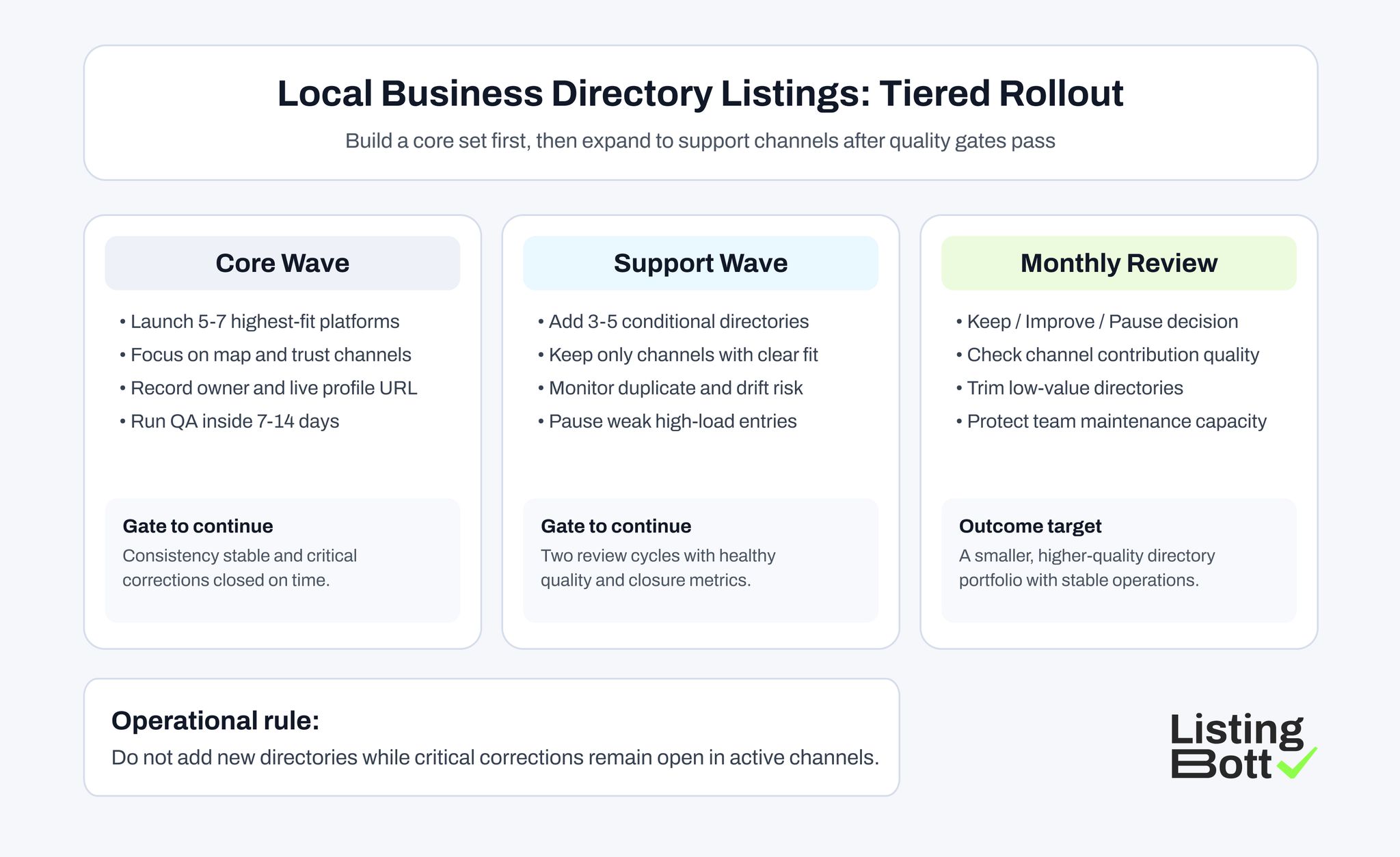
Local Business Directory Listings: Tiered Rollout
KPI Board for Local Listing Operations
Use a compact board that supports action.
| KPI | What it shows | Healthy range | Red flag |
| Listing consistency rate | profile data integrity across active channels | 95%+ and stable | recurring field mismatch |
| Duplicate incidence | hygiene quality of portfolio | low and declining | new duplicates each cycle |
| Correction closure time | operational discipline | predictable weekly closure | aging backlog |
| Profile completeness score | depth and trust quality of listings | improving trend | stale/partial profiles |
| Channel contribution quality | relevance of referral traffic | stable engagement quality | low-intent sessions dominate |
This reporting framework improves decisions around free online business directories and paid channels alike, because each platform is measured by real operational value.
Practical Scenarios by Business Type
Single-location service business
Start with map and reputation channels first. Keep copy specific to service area and offer scope. Avoid broad expansion until QA cycles become routine.
Multi-location operator
Segment locations by complexity (high-change vs low-change markets). Roll out in batches so correction teams can keep pace.
Regional B2B company
Prioritize category precision and destination mapping. Directory traffic quality often depends on clear service positioning.
Early-stage local brand
Use a small, high-fit set to establish consistency fast. Scale only after baseline quality is repeatable.
These scenarios show why one generic directory plan rarely works for every business model.
Profile Template that Improves Listing Consistency
One of the simplest ways to reduce correction workload is to use a fixed profile template across all active channels. Teams often maintain a canonical NAP record but still allow category, service, and description fields to vary too much between platforms. That creates silent drift over time.
A practical template should include:
- one approved short business description (70-120 words),
- one long profile description (150-250 words),
- category mapping guidance (primary + acceptable secondary options),
- service list with standardized naming,
- destination URL mapping by service intent,
- image set standards (logo, cover, location or service visuals),
- response rules for platform-specific fields that commonly vary.
Use this template as a controlled source, not as a rigid copy-paste block. Each directory can have field constraints, but the core business identity should remain stable.
Operationally, this template helps in three areas:
- it reduces approval time for new submissions,
- it lowers mismatch rates during QA cycles,
- it makes monthly updates faster when offers, hours, or contact details change.
For teams scaling listings across many locations, a profile template usually becomes the difference between manageable operations and permanent cleanup work.
How to Evaluate Listing Portfolio Health after 6 Months
A 30-day launch view is useful, but not enough for strategic decisions. After six months, review portfolio health using channel-level evidence.
Ask these questions:
- Which directories still maintain strong profile integrity with low correction effort?
- Which channels produce low-intent traffic or weak engagement patterns?
- Which listings are repeatedly creating duplicate or data-quality issues?
- Where does maintenance effort exceed realistic ROI?
Then decide per channel:
- retain channels with stable quality and clear contribution,
- repair channels with strategic value but fixable quality gaps,
- retire channels with recurring instability and low business impact.
This six-month review keeps local business listing management aligned with outcomes instead of vanity coverage. It also prevents the common pattern where teams keep every channel active only because it was once added to the list.
Common Mistakes and Risk Controls
1) Confusing coverage with quality
Publishing to more sites does not automatically improve outcomes. Quality controls must scale with coverage.
2) Treating free channels as no-cost
Free online directory listings still require time, QA, and update ownership.
3) No ownership map
If correction ownership is unclear, data drift becomes inevitable.
4) Expanding before stabilization
Opening support wave too early usually creates correction debt that compounds over time.
5) Weak destination mapping
Routing every listing to one generic page lowers relevance and conversion quality.
6) No de-prioritization policy
Without a pause rule, low-value channels continue consuming effort indefinitely.
7) Inconsistent profile language across channels
Ad hoc edits create message drift and weaken trust signals.
90-Day Optimization Plan
Days 1-30: foundation
- baseline definition,
- asset preparation,
- CQM scoring,
- core-wave launch.
Days 31-60: stabilization
- structured QA checks,
- duplicate cleanup,
- correction queue reduction,
- profile-depth improvements.
Days 61-90: performance tuning
- support-wave rollout where justified,
- channel pruning for low-value entries,
- monthly reporting rhythm,
- ownership reinforcement.
A 90-day cycle gives enough time to see whether a directory portfolio is becoming sustainable or simply larger.
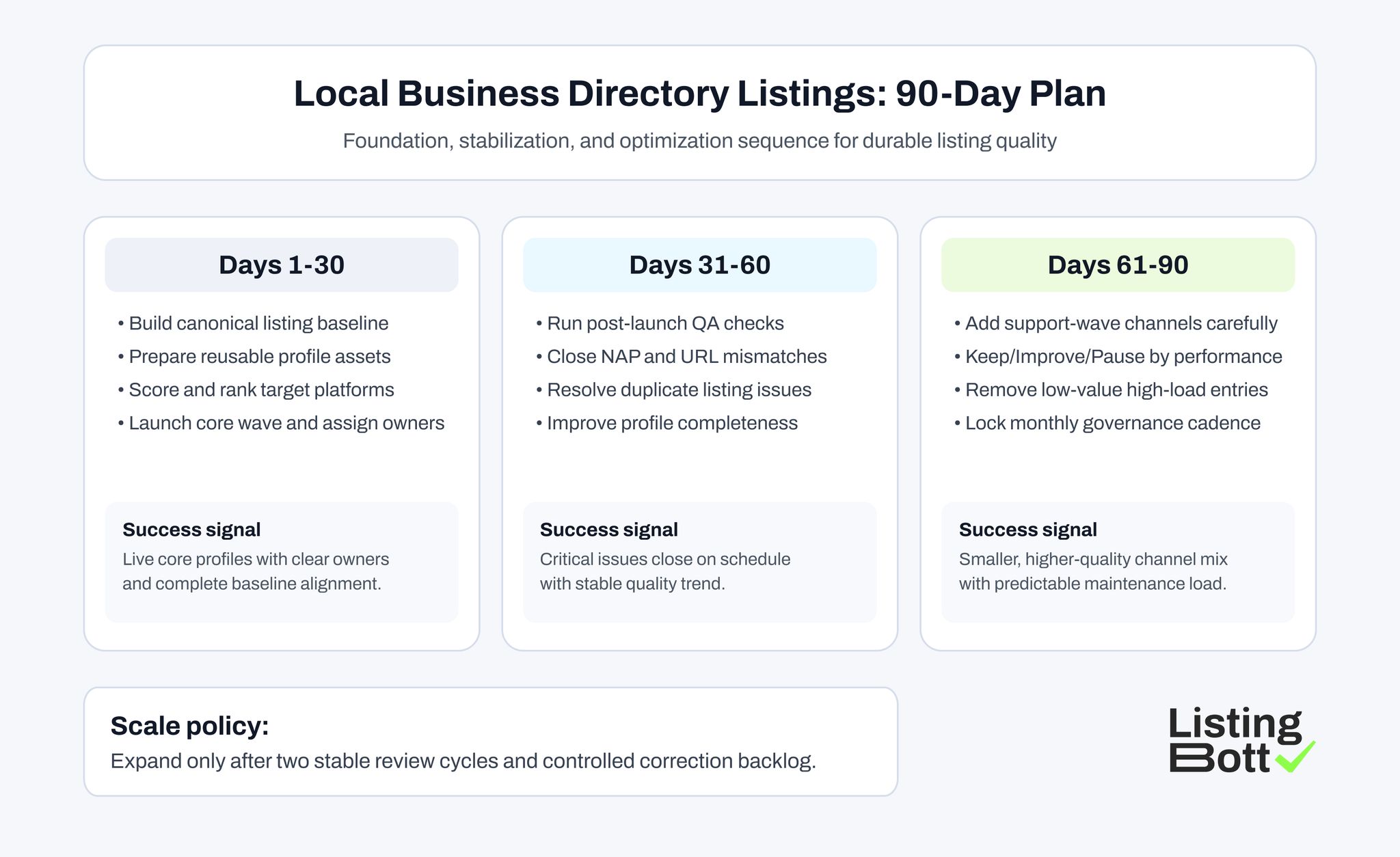
Local Business Directory Listings: 90-Day Plan
Where ListingBott Fits
ListingBott supports structured directory publication and reporting workflows for teams that want consistent execution.
Typical flow:
- onboarding details are collected,
- listing scope is reviewed,
- publication is executed,
- progress reporting is delivered.
Offer alignment:
- one-time payment model,
- publication to 100+ directories,
- no hidden extra fees,
- refund possible if process has not started.
Promise limits:
- no guaranteed ranking position,
- no guaranteed traffic by a specific date,
- no guaranteed indexing speed,
- no guaranteed outcomes controlled by third-party platforms.
Qualified DR statement: DR growth to 15 can be promised only where starting DR is below 15, the selected goal is domain growth, and the approved listing set is in place.
FAQ: Local Business Directory Listings
How many local business directory listings should we start with?
Most teams should start with 5-7 core listings and expand only after quality metrics remain stable across two review cycles.
Are free directories always worth adding?
Not always. Free channels can still create maintenance load. Add them only when fit, profile quality, and ongoing control are acceptable.
What is the difference between local listing management and citation submission?
Citation submission is one task in the process. Listing management covers the full lifecycle: selection, publishing, QA, corrections, and ongoing optimization.
Should we use the same directory list for every niche?
No. Buyer behavior and maintenance economics differ by niche, so platform selection should be filtered by fit.
Do local business directory listings guarantee rankings?
No. They support trust and visibility signals, but rankings still depend on broader SEO factors and market competition.