Table of Contents
- What Changed for Agency Directory SEO in 2026
- Channel Architecture: Core, Support, Reserve
- 8-Step Execution Checklist for Agencies
- Mistakes that Reduce Agency Directory ROI
- 90-Day Operating Plan for Agency Teams
- FAQ
sbb-itb-8e44301
Quick Answer
Most agencies get better SEO outcomes from directory work when they treat channel selection as a qualification exercise, not a volume exercise. In practice, the best marketing agencies directories for SEO are platforms where your agency can show service clarity, proof quality, and specialization in a way that matches how real buyers shortlist vendors. In 2026, directory performance is mostly a selection and execution problem: choose the right channels, publish strong profiles, and keep them updated.
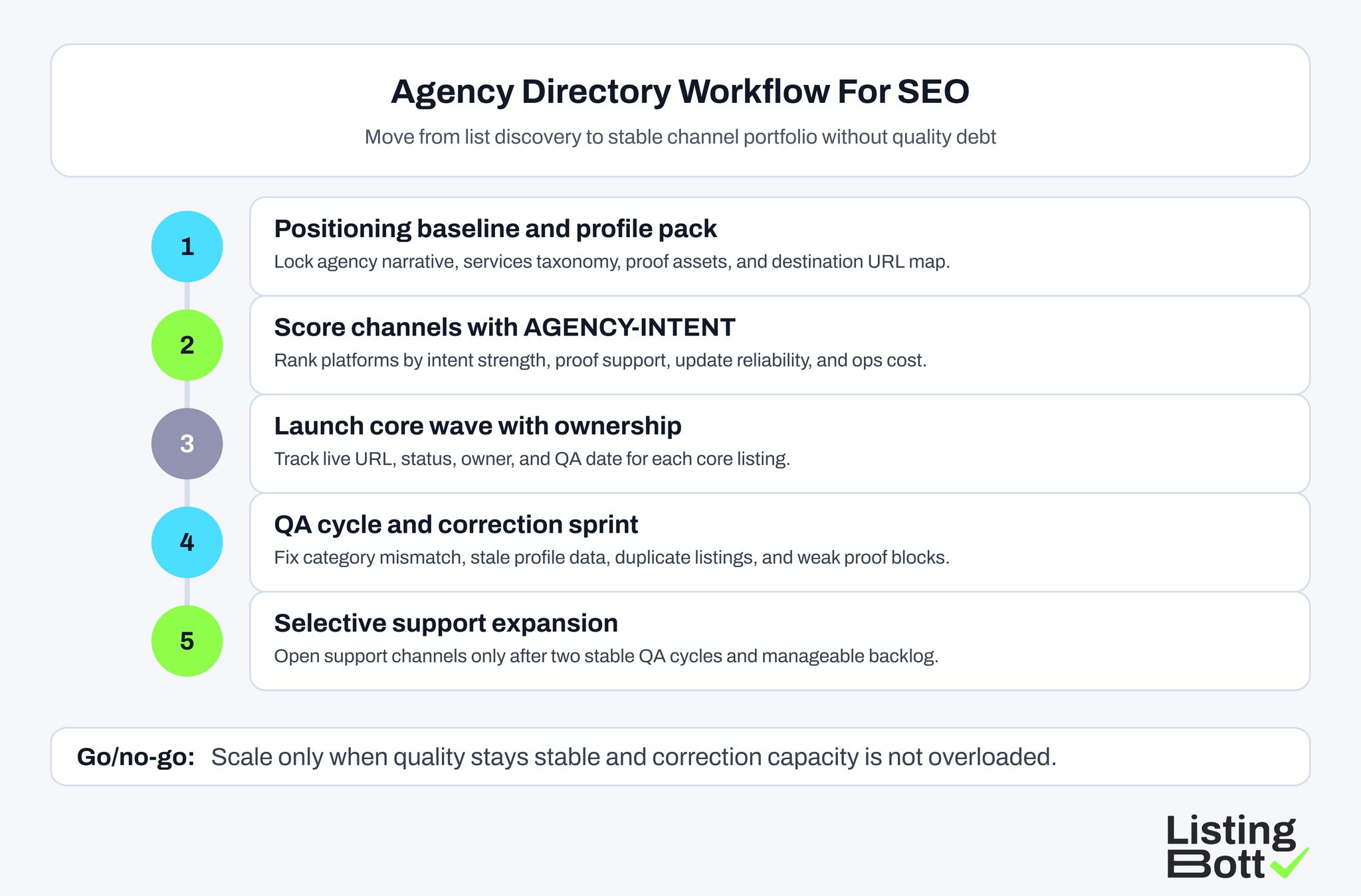
A practical sequence is:
- define agency positioning and proof baseline,
- score platforms by buyer intent and profile quality depth,
- launch a compact core portfolio,
- run QA and correction cycles,
- expand only after stability signals are strong.
If you skip this discipline and submit to every seo directory list you find, channel volume can increase while qualified lead quality stays flat.
What Changed for Agency Directory SEO in 2026
Agency buyers now evaluate vendors across multiple surfaces before sending a brief. They compare specialization, category fit, trust signals, and proof quality quickly. This means directory profiles are no longer simple citations. They act like external positioning pages that influence shortlisting.
Three shifts matter most:
- shortlist speed is faster, so weak profiles are filtered out earlier,
- buyers expect proof framing, not generic service claims,
- consistency across channels is used as a trust check.
For agencies, this changes how business directories for seo should be used. The goal is to create a clean, high-intent portfolio that supports discoverability and qualification, not just visibility.
Why List Size is a Weak Strategy Metric
Large directory lists can still be useful as research input. They help you discover channel options and competitor presence patterns. But list size alone does not tell you:
- whether your ICP actually uses the platform,
- whether your service model fits platform categories,
- whether profile fields are rich enough to tell your story,
- whether your team can keep listings accurate over time.
So a public list can start the process, but it cannot replace channel scoring and operations.
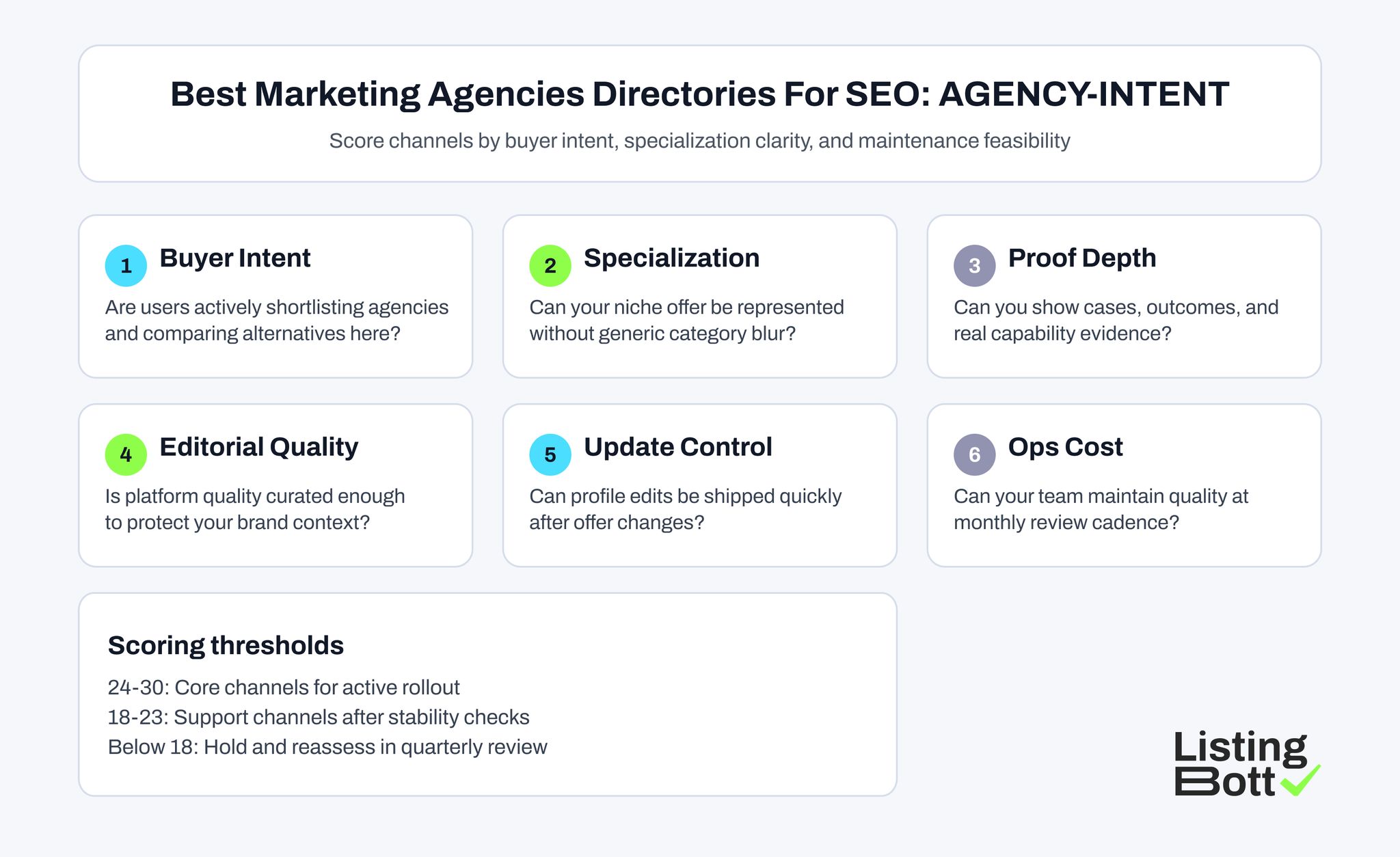
The AGENCY-INTENT Matrix
Use this model before adding any platform to active scope.
| Factor | Practical question | Why it matters | Score (1-5) |
| Buyer intent strength | Are users actively comparing agencies here? | improves lead relevance | 1-5 |
| Specialization clarity | Can niche services be represented clearly? | improves qualification | 1-5 |
| Proof support | Can you show cases, outcomes, and trust evidence? | raises conversion confidence | 1-5 |
| Editorial quality | Is the platform reasonably curated? | protects brand context | 1-5 |
| Update reliability | Can you edit quickly when offers change? | keeps profiles current | 1-5 |
| Maintenance cost | Can your team sustain this channel monthly? | keeps program scalable | 1-5 |
Score interpretation:
- 24-30: core portfolio,
- 18-23: support portfolio,
- below 18: hold/test only.
This matrix makes agency selection less opinion-driven and more operationally realistic.
Best Marketing Agencies Directories For SEO: AGENCY-INTENT
Best-fit Listing Platforms for Best Marketing Agencies Directories for SEO
The table below focuses on platforms many agency buyers use for discovery or validation and where profile quality can influence shortlisting behavior.
| Platform | URL | Why it is a best fit | Ideal agency profile | Submission note |
| Clutch | https://clutch.co/ | High-intent B2B agency discovery and comparison behavior | SEO, PPC, growth, and full-service agencies with case depth | align service categories to your true revenue mix |
| UpCity | https://upcity.com/ | Agency marketplace context with service and location relevance | regional and national digital agencies | keep verticals and specializations explicit |
| DesignRush | https://www.designrush.com/ | Broad directory visibility across multiple marketing service categories | creative and performance agencies | use concise positioning plus proof-first portfolio highlights |
| Agency Spotter | https://www.agencyspotter.com/ | Brand-focused agency discovery with specialization filters | branding, content, and integrated agencies | make differentiation visible in first profile screen |
| Sortlist | https://www.sortlist.com/ | Service matching flow useful for agency shortlisting | agencies with clear delivery scope and market focus | keep capability taxonomy and geography accurate |
| GoodFirms | https://www.goodfirms.co/ | B2B evaluation ecosystem with service segmentation | SEO and development-adjacent agencies | maintain profile detail consistency across categories |
| The Manifest | https://themanifest.com/ | Category-based service discovery linked to business needs | agencies with vertical case narratives | structure profiles around problem and result framing |
| HubSpot Solutions Directory | https://ecosystem.hubspot.com/marketplace/solutions | High-intent ecosystem buyers searching for delivery partners | CRM, inbound, RevOps, and lifecycle agencies | keep certifications, services, and implementation scope current |
| Semrush Agency Partners | https://www.semrush.com/agencies/ | Relevant discovery surface for search-led agency buyers | SEO-heavy and analytics-driven agencies | align positioning with search and growth outcomes |
| Google Business Profile | https://www.google.com/business/ | Strong trust and local discovery layer for agency brand presence | local and hybrid agencies | keep NAP and service categories clean for local intent |
| Yelp | https://www.yelp.com/ | Local validation and reputation layer in service categories | local agencies and consultants | maintain review response discipline |
| ChamberofCommerce.com | https://www.chamberofcommerce.com/ | Supplemental local trust/discovery support | B2B regional agencies | keep business details synchronized with main channels |
How to pick your first wave:
- choose 5-7 channels scoring 24+,
- include at least one local-trust layer if geo demand matters,
- hold lower-scoring channels until correction capacity is stable.
This creates a smaller but stronger portfolio than submitting broadly to every seo business directory candidate.
Which Directories Fit which Agency Model
Not all agencies should use the same directory mix. The best portfolio depends on service model, deal size, and buyer behavior.
Model A: boutique SEO agency
Primary needs:
- highly qualified search buyers,
- visible specialization,
- strong proof density.
Suggested channel mix:
- Clutch,
- UpCity,
- Semrush Agency Partners,
- The Manifest,
- one local validation layer if needed.
Why this mix works:
- high-intent comparison channels cover mid-funnel research,
- search-focused positioning remains clear,
- you avoid bloating operations with low-fit channels.
Model B: full-service performance agency
Primary needs:
- multi-service credibility,
- vertical coverage,
- outcome framing across channels.
Suggested channel mix:
- Clutch,
- DesignRush,
- Sortlist,
- GoodFirms,
- HubSpot Solutions Directory,
- Google Business Profile.
Why this mix works:
- broad coverage with enough profile depth to communicate different capabilities,
- stronger matching for mixed-intent buyers.
Model C: local or regional growth agency
Primary needs:
- local trust validation,
- service clarity,
- efficient maintenance.
Suggested channel mix:
- Google Business Profile,
- Yelp,
- ChamberofCommerce.com,
- Clutch,
- one category-specific support channel.
Why this mix works:
- balances local proof and B2B discovery,
- practical maintenance footprint for smaller teams.
Model D: productized SEO service studio
Primary needs:
- clear packaging,
- fast qualification,
- low-complexity profile management.
Suggested channel mix:
- UpCity,
- GoodFirms,
- The Manifest,
- one ecosystem directory aligned to your tool stack,
- one local/trust layer if applicable.
Why this mix works:
- channels support structured offer communication,
- profile scope stays manageable.
Integration with Agency Growth Stack
Directory strategy should support your wider growth system, not operate as a disconnected activity.
Most agencies already use seo tools for agencies to manage site performance, tracking, and audits. But directory channels are often managed separately, which creates message drift between off-site profiles and on-site service pages.
A stronger setup connects:
- positioning source file,
- directory profile templates,
- landing page map,
- review and update cadence,
- KPI dashboard.
This helps teams using seo tools for seo agencies avoid a common problem: excellent technical SEO on-site but weak off-site profile consistency.
Channel Architecture: Core, Support, Reserve
A tier model simplifies portfolio decisions.
Core channels
Use channels with:
- strong buyer intent,
- high profile depth,
- manageable updates,
- proof-friendly structure.
Core channels deserve the best assets and fastest correction SLAs.
Support channels
Use channels with moderate fit that still add incremental reach or validation. Keep expectations realistic and avoid over-investing in low-signal channels.
Reserve channels
Reserve channels are not bad; they are just low-priority right now. Keep them documented and reassess quarterly.
A tier system turns static list work into ongoing channel portfolio management.
Agencies Directory Workflow
8-Step Execution Checklist for Agencies
Step 1: lock canonical agency profile
Include:
- one primary positioning statement,
- service taxonomy,
- vertical focus,
- proof assets,
- destination URL mapping.
Step 2: score channels with AGENCY-INTENT
Tag each channel as:
- core,
- support,
- reserve.
Step 3: prepare profile assets by intent
Build variant copy for:
- awareness intent,
- comparison intent,
- local validation intent.
Step 4: launch core channels first
Track:
- publish date,
- approval/verification state,
- live URL,
- assigned owner.
Step 5: QA at day 7-14
Verify:
- service/category accuracy,
- profile completeness,
- destination URL fit,
- brand consistency,
- duplicate risk.
Step 6: close critical issues before expansion
Never open support wave while core issues are unresolved.
Step 7: open support channels selectively
Add only channels with acceptable score and available maintenance capacity.
Step 8: monthly keep/improve/pause review
For each channel decide:
- keep as-is,
- improve with targeted fixes,
- pause and reallocate effort.
This process gives structure to seo local business listings work when agencies target mixed local and national demand.
KPI Board for Directory Quality and Pipeline Fit
Use operational KPIs that support decisions.
| KPI | Why it matters | Healthy signal | Risk signal |
| Profile consistency rate | tracks cross-channel data quality | stable, high consistency | recurring field mismatches |
| Correction closure speed | reflects operational control | predictable close cycles | growing unresolved queue |
| Duplicate profile rate | protects listing hygiene | low and stable | repeated duplicate creation |
| Qualified lead share | tests real pipeline relevance | stable qualified inquiry trend | traffic with low fit |
| Maintenance load ratio | keeps program scalable | effort proportional to value | effort rises without quality lift |
| Channel retention value | helps prune weak platforms | clear keep/improve decisions | unclear long-term utility |
Practical KPI rhythm:
- weekly operational check for active fixes,
- monthly channel decision review,
- quarterly scope reset.
Mistakes that Reduce Agency Directory ROI
1) Reusing one generic description everywhere
Generic copy removes differentiation and lowers shortlist quality.
2) Treating platform setup as a one-time task
Without ongoing maintenance, profile quality decays quickly.
3) No mapping between listings and landing pages
If the listing promise and destination page do not match, lead quality drops.
4) Expanding too early
Opening too many channels before core stability creates correction debt.
5) Ignoring local trust layers
Even national agencies can benefit from localized trust validation depending on buyer geography.
6) Measuring only submission volume
Submission count does not reflect buyer quality or conversion support.
7) Keeping weak channels indefinitely
Every channel should earn its place through quality and contribution.
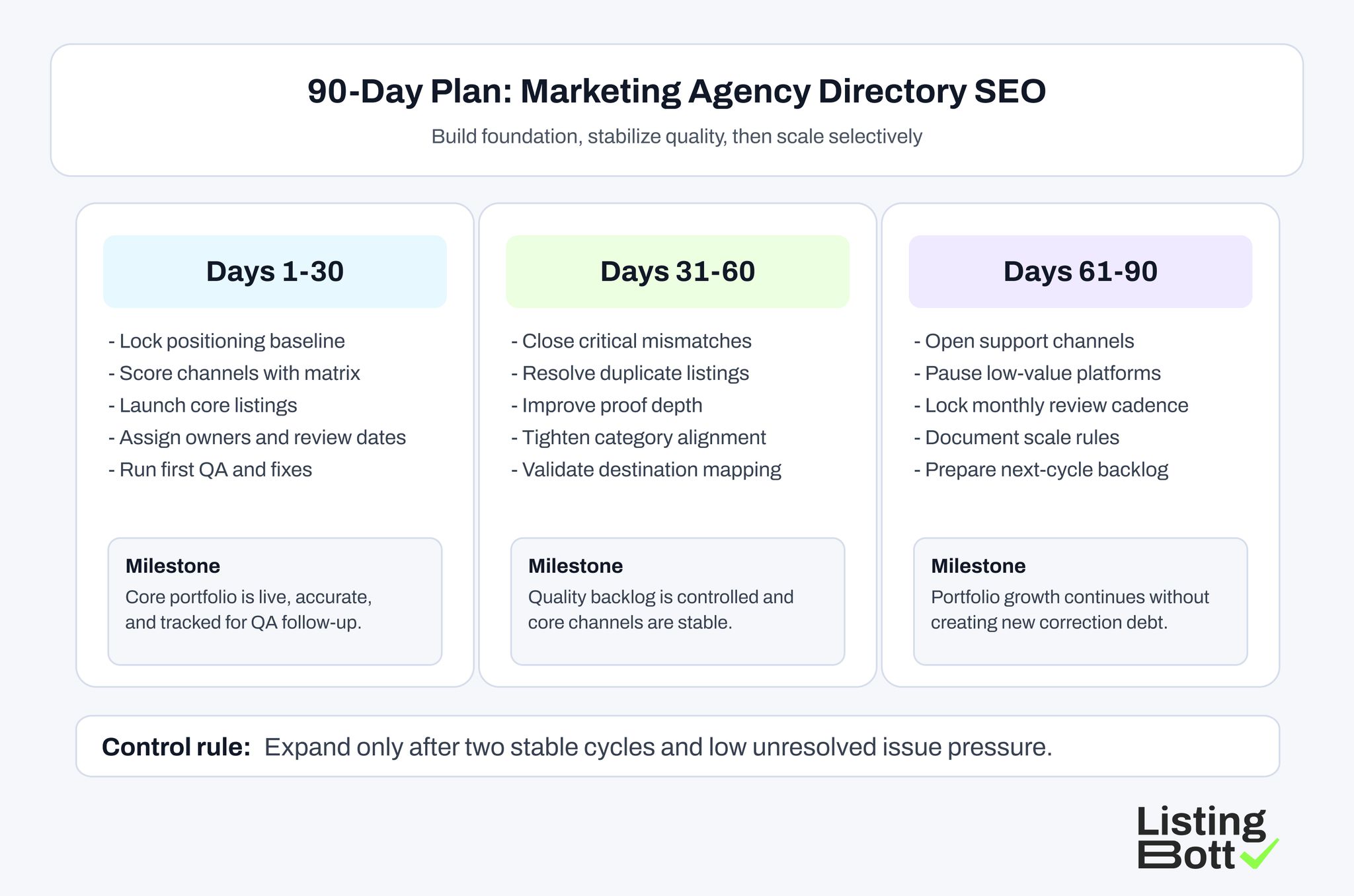
90-Day Operating Plan for Agency Teams
Days 1-30: foundation and core launch
- finalize agency positioning baseline,
- score channels with AGENCY-INTENT,
- publish core set,
- assign clear ownership,
- run first QA review.
Days 31-60: stabilize and improve
- close high-impact profile issues,
- fix duplicates,
- improve proof depth,
- refine category/service fit,
- tighten destination mapping.
Days 61-90: optimize and scale carefully
- open support channels that pass threshold,
- pause weak channels,
- lock monthly review cadence,
- document lessons for next cycle,
- prepare controlled expansion backlog.
By day 90, the objective is not maximum profile count. The objective is a resilient directory portfolio that improves agency discoverability and qualification quality.
90-Day Plan: Marketing Agency Directory SEO
Where ListingBott Fits
ListingBott fits as a structured publication workflow for teams that want predictable directory execution and reporting.
Typical process:
- onboarding details are collected,
- listing scope is approved,
- publication is executed,
- report delivery is completed.
Public offer alignment:
- one-time payment model,
- publication to 100+ directories,
- refund possible if process has not started,
- no hidden extra fees.
Promise limits:
- no guaranteed ranking position,
- no guaranteed traffic by a specific date,
- no guaranteed indexing speed,
- no guaranteed outcomes controlled by third-party platforms.
Qualified DR statement: DR growth to 15 can be promised only when starting DR is below 15, the selected goal is domain growth, and the approved listing set is in place.
FAQ: Best Marketing Agencies Directories For SEO
How many directories should a marketing agency start with?
Most agencies should start with 5-7 core channels and expand only after two stable QA cycles.
Are directories still useful if we already rank for branded terms?
Yes. Directories support off-site validation and can influence shortlisting behavior even when branded visibility is strong.
Should agencies submit to every platform in a seo directory list?
No. Use lists as discovery input, then score platforms by intent, profile depth, and maintenance feasibility.
What is the difference between a core and support channel?
Core channels have high buyer-intent fit and strong proof capabilities. Support channels add incremental reach but are lower priority.
Do directories replace technical SEO or content work?
No. Directory execution complements site SEO and content strategy; it does not replace them.