Quick answer
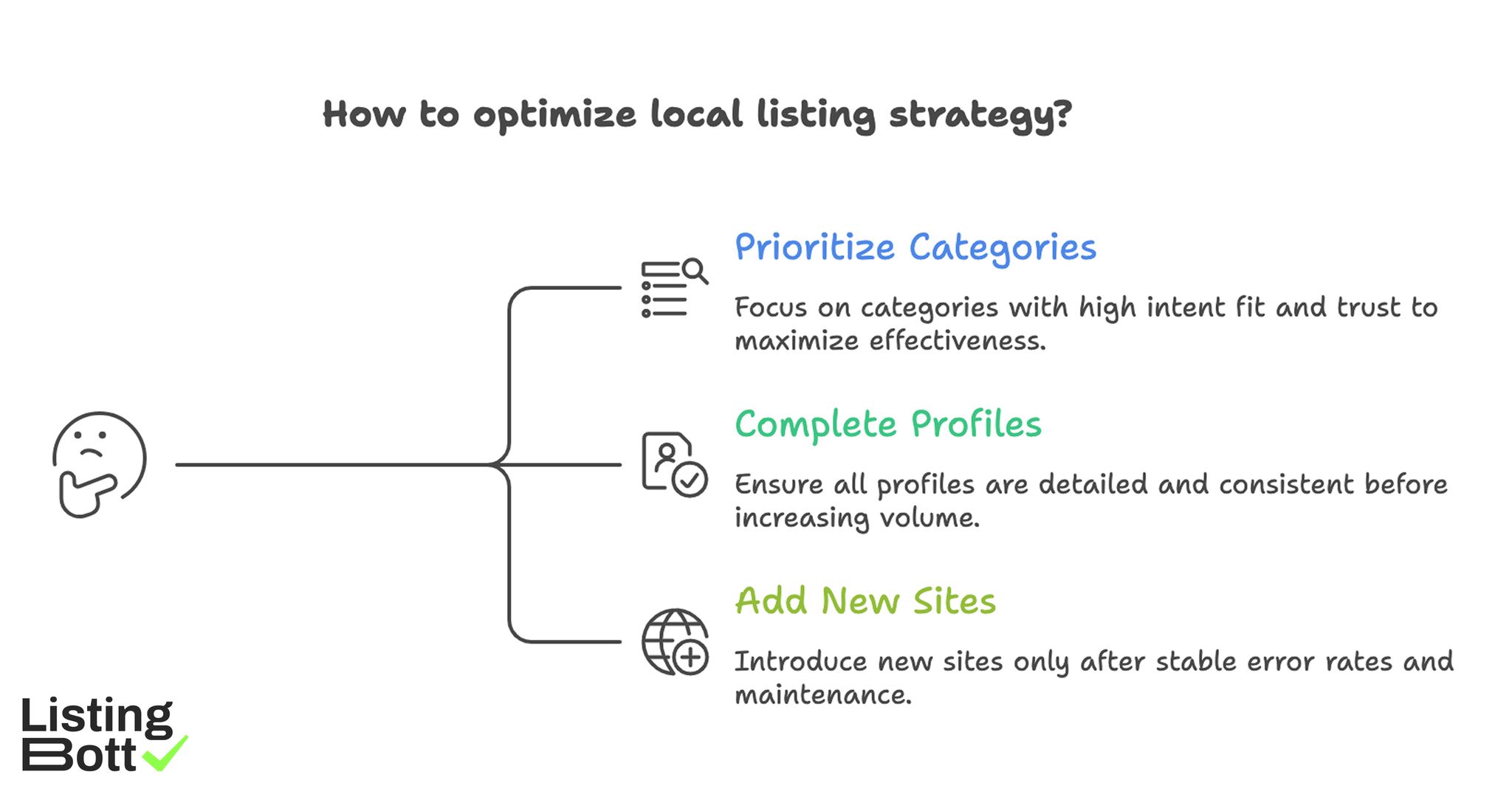
The best local listing strategy is not to submit everywhere. The highest-performing teams choose local listing sites using explicit criteria, then execute in controlled waves with quality checks.
A simple rule works in most markets:
- Prioritize local listing categories by intent fit and trust.
- Publish complete, consistent profiles before expanding volume.
- Add new sites only after error rates and maintenance load are stable.
If you need to shortlist best local listing sites for your next cycle, use a criteria-first workflow instead of directory-count targets.
Local Listing Strategy Optimization
sbb-itb-8e44301
Methodology
This methodology is designed for local growth teams that need repeatable execution. It evaluates local listing options at category level first, then platform level, so decisions stay strategic.
100-point criteria model
| Dimension | Weight | What to evaluate | Why it matters |
|---|---|---|---|
| Local search-intent fit | 30 | Does this listing category match how customers search locally? | Improves relevance and discovery quality |
| Directory trust quality | 20 | Are listings moderated and generally high quality? | Reduces weak-signal footprint |
| Profile depth potential | 20 | Can you publish complete business details, services, and context? | Better user clarity and conversion support |
| Operational feasibility | 15 | How much effort is needed to submit and maintain profiles? | Protects execution speed |
| Multi-location readiness | 15 | Is the site practical for one or many locations? | Prevents scaling bottlenecks |
Use these criteria to assign priority tiers before any submission wave.
Priority tier rules
- Tier 1 (80-100): launch first.
- Tier 2 (65-79): add after Tier 1 quality stabilizes.
- Tier 3 (<65): avoid unless there is a specific business reason.
Tiering keeps local listing work focused on quality, not just activity volume.
Local data readiness gates
Before selecting any sites, confirm that source business data is stable.
| Data gate | Minimum standard | Risk if not ready |
|---|---|---|
| Identity consistency | Name, website, and location details are standardized | Duplicate or conflicting local entries |
| Service taxonomy | Service labels are mapped by market/industry | Wrong category assignment |
| Proof assets | Current logo, photos, and profile copy are available | Thin or low-trust profiles |
| Owner assignment | One editor and one approver per wave | Untracked changes and delays |
| Change logging | Every publish/update action is logged | Slow issue diagnosis |
Most local listing failures come from weak data governance, not from lack of directory options.
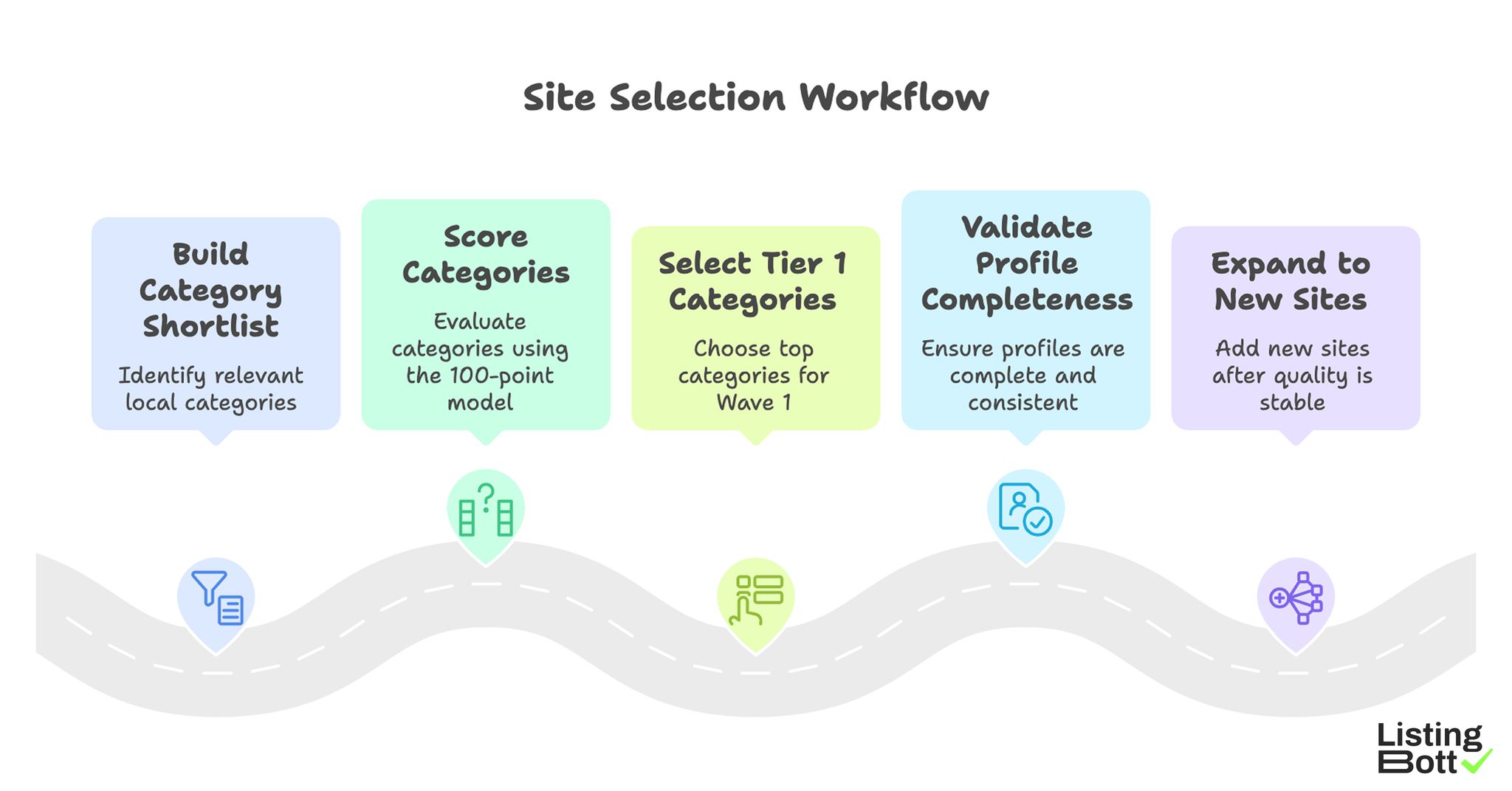
Site selection workflow
- Build category shortlist by local-intent relevance.
- Score each category with the 100-point model.
- Select two to three Tier 1 categories for Wave 1.
- Validate profile completeness before submitting.
- Expand only when quality and maintenance are stable.
This workflow helps teams avoid correction debt during growth periods.
Site Selection Workflow
90-day execution cadence
| Phase | Timeline | Focus | Exit condition |
|---|---|---|---|
| Foundation | Days 1-14 | Data standardization and criteria scoring | Tier 1 shortlist approved |
| Wave 1 | Days 15-40 | Publish core local listings | Core coverage complete |
| Stabilization | Days 41-65 | Resolve errors and improve weak profiles | Error backlog low |
| Expansion | Days 66-90 | Add Tier 2 listings selectively | No quality drop after expansion |
A cadence model makes local listing programs easier to scale and audit.
Comparison table
This table compares major local listing-site groups by strategic value and maintenance reality.
| Listing-site group | Best fit | Strengths | Constraints | Recommended priority |
|---|---|---|---|---|
| Core local map/business platforms | Most local SMBs and multi-location brands | Strong local discovery alignment | Requires strict data consistency | Tier 1 |
| Industry-specific local directories | Legal, healthcare, home services, niche B2B | Better category-intent matching | Narrower audience outside niche | Tier 1 |
| Local community and chamber directories | Service businesses and local B2B | Trust and legitimacy support | Traffic volume can vary | Tier 2 |
| Review-driven local sites | Restaurants, clinics, hospitality, services | Social proof and buyer confidence | Needs ongoing response and upkeep | Tier 1 or Tier 2 |
| National directories with local pages | Regional and national operators | Scalable footprint | Template quality may vary | Tier 2 |
| Low-trust bulk listing networks | Any business chasing fast count growth | Quick volume only | High maintenance, weak strategic value | Usually exclude |
Criteria scoring example by group
| Group | Intent fit (30) | Trust (20) | Profile depth (20) | Ops (15) | Multi-location (15) | Total |
|---|---|---|---|---|---|---|
| Core local map/business | 28 | 18 | 17 | 12 | 14 | 89 |
| Industry-specific local | 27 | 17 | 16 | 10 | 12 | 82 |
| Review-driven local | 24 | 16 | 15 | 11 | 10 | 76 |
| Community/chamber | 20 | 15 | 12 | 13 | 8 | 68 |
| National with local pages | 19 | 13 | 11 | 13 | 13 | 69 |
| Low-trust bulk | 10 | 6 | 7 | 14 | 9 | 46 |
The model shows why low-trust high-volume options usually create more cost than value.
Decision checks before expansion
- Are Tier 1 listings complete and accurate?
- Are category mappings still valid by location?
- Is correction backlog below your control threshold?
- Is ownership clear for future updates?
If any answer is no, pause expansion and fix quality issues first.
Fast red-flag audit for candidate listing sites
Run this audit before adding any new local listing site to your plan.
| Red flag | What it looks like | Why it matters |
|---|---|---|
| Category ambiguity | Categories are broad or inconsistent across similar businesses | Increases mismatch risk and weakens local relevance |
| Thin profile templates | Limited space for services, proof, and local details | Reduces quality and user trust |
| Low editorial standards | High volume of low-quality or duplicate-looking listings | Adds noise with limited strategic value |
| Opaque review process | Unclear publish or approval rules | Creates delays and unpredictable maintenance effort |
| Weak update controls | Corrections are slow or difficult to manage | Raises long-term operating cost |
If a site fails multiple red-flag checks, do not add it to active rollout. Keep your shortlist conservative and quality-weighted.
Shortlist by use case
Use-case shortlists make execution more practical than a single "universal" local listing list.
1) Single-location home services company
Priority stack:
- Core local business/map listings.
- Home-service-specific directories.
- Select review-driven local sites.
Execution focus:
- service-area clarity,
- consistent contact fields,
- strong before/after proof assets.
2) Local legal practice
Priority stack:
- Core local listings.
- Legal-category directories.
- Selected community/chamber trust channels.
Execution focus:
- practice-area taxonomy,
- office profile precision,
- controlled updates for compliance-sensitive details.
3) Healthcare or wellness clinic
Priority stack:
- Core local listings.
- Healthcare-focused directories.
- Review-centric channels with high trust signals.
Execution focus:
- specialty accuracy,
- location-level consistency,
- conservative claims and profile language.
4) Restaurant or hospitality business
Priority stack:
- Core local listing sites.
- Review-driven local platforms.
- Local city/visitor channels where relevant.
Execution focus:
- accurate hours and category tags,
- menu/service detail freshness,
- seasonality-driven update cadence.
5) Multi-location service brand
Priority stack:
- Scalable core local listings.
- National directories with local-page support.
- Industry-specific channels for key markets.
Execution focus:
- cluster-based rollout,
- location template governance,
- spot audits every wave.
6) Local B2B service firm
Priority stack:
- Industry-specific local directories.
- Core local listings.
- Chamber/community directories for trust support.
Execution focus:
- service-language precision,
- clear business positioning,
- consistent proof assets across markets.
Where a structured tool workflow helps
Many teams can define good criteria but struggle with consistent execution across dozens of listing targets.
ListingBott is a one-time-payment workflow tool for directory publication: intake, approved directory list, submission process, and report handoff. It is not a consulting-call service.
If your team needs a repeatable local listing management tool workflow, this model can reduce manual coordination and improve process visibility.
Risks/limits
Local listing programs can improve consistency and visibility support, but they cannot control third-party platform behavior.
Common risk patterns
| Risk pattern | Typical cause | Mitigation |
|---|---|---|
| Site over-expansion | Prioritizing volume over fit | Keep expansion tier-based and gated |
| Category drift | Reusing generic categories across markets | Validate category mapping per location |
| Data inconsistency | Multiple editors using different source values | Enforce one canonical data source |
| Correction backlog | Publishing without QA gates | Pause and resolve issues before scaling |
| Misleading success metrics | Reporting submission counts only | Track quality + maintenance metrics together |
What this process can and cannot promise
What it can support:
- cleaner local profile consistency,
- structured rollout and maintenance,
- directional local discovery improvements.
What it cannot guarantee:
- exact ranking positions,
- guaranteed traffic by specific dates,
- guaranteed indexing speed,
- outcomes controlled by third-party directories.
DR growth boundary (qualified)
If DR growth to 15 is discussed, that promise is only valid when all conditions are met: starting DR below 15, explicit domain growth goal, and client-approved directory list.
Policy alignment snapshot
Keep public framing aligned with current offer language:
- one-time payment model,
- publication to 100+ directories (per current website language),
- refund possible if process has not started,
- no hidden extra fees (per current FAQ language).
FAQ
1) How many local listing-site groups should I launch first?
Two to three Tier 1 groups are usually enough for the first wave.
2) Are review-driven sites mandatory for every local business?
Not always. They are high priority for some sectors, but relevance depends on your industry and buyer behavior.
3) Should multi-location businesses publish to all sites at once?
Usually no. Cluster-based rollout with QA gates is safer and more scalable.
4) Do local listings guarantee better rankings?
No. They can strengthen consistency and discovery support, but rankings depend on multiple external factors.
5) What is the biggest execution mistake?
Expanding too quickly before Tier 1 profile quality and maintenance ownership are stable.
6) How often should I re-score listing priorities?
Review priorities after each wave and run a deeper refresh at least once per quarter.