Table of Contents
- Why Fintech Directory Strategy needs a Trust-first Model
- Implementation Playbook
- Risk Controls Specific to Fintech Directory Execution
- Common Mistakes
- 90-Day Fintech Directory Plan
- FAQ
sbb-itb-8e44301
Quick Answer
The best fintech startups directories for SEO are usually not the largest list you can find. They are the channels where fintech audience fit, trust context, and profile maintenance control stay strong over time.
In 2026, high-performing teams usually follow this order:
- define a single canonical fintech profile baseline,
- score channels with trust and intent criteria,
- launch a controlled core wave,
- run quality checks and correction cycles,
- expand only after two stable review cycles.
This method tends to outperform volume-first submission because fintech products are judged heavily on trust signals. Inconsistent listings can reduce credibility before users ever reach your product pages.
Why Fintech Directory Strategy needs a Trust-first Model
Fintech buying journeys usually include more risk checks than many other categories. Users compare products, validate company legitimacy, review proof signals, and cross-check brand presence across multiple external profiles. That means directory publishing influences both discovery and confidence.
Teams that treat directories as one-off backlinks often hit predictable problems:
- profile statements drift after pricing or positioning updates,
- product categories are inconsistent across channels,
- destination links do not match user intent,
- operations spend more time fixing old listings than scaling useful channels.
A plain seo directory list can still be useful for research, but execution decisions should come from channel fit scoring, quality gates, and ownership clarity. This is especially true in fintech, where messaging precision and trust consistency matter more than raw listing count.
For many teams, directory management also integrates with broader seo tools for agencies workflows when agencies run distribution programs for multiple fintech products.
The FINTRUST-6 Framework
Use this model to select and prioritize channels.
| Factor | Practical question | Why it matters | Score (1-5) |
| Fintech audience fit | Does this platform attract users evaluating fintech products? | improves relevance | 1-5 |
| Intent quality | Are users close to trial, demo, or deeper evaluation intent? | supports conversion quality | 1-5 |
| Trust context | Can listings include clear proof, positioning, and company credibility signals? | reduces confidence friction | 1-5 |
| Editorial quality | Is the platform clean enough to avoid low-quality noise? | protects brand context | 1-5 |
| Update control | Can your team correct profile details quickly? | reduces profile drift risk | 1-5 |
| Maintenance load | Can this channel be sustained with current team capacity? | protects scalable execution | 1-5 |
Score thresholds:
- 24-30: core wave,
- 18-23: support wave,
- below 18: hold/skip.
This keeps business directories for seo decisions evidence-based and avoids over-expanding into channels that cannot be maintained.
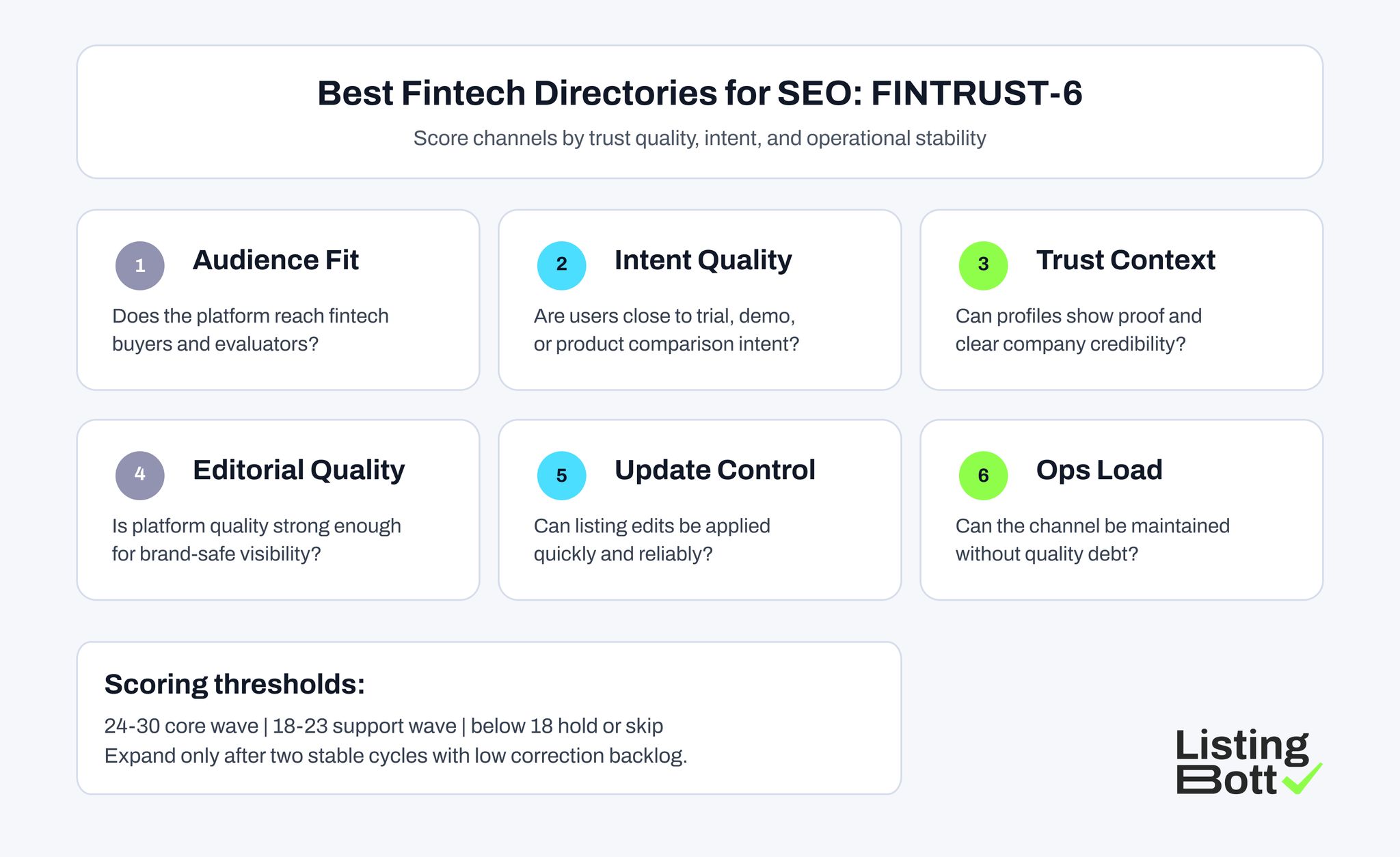
Best Fintech Directories for SEO: FINTRUST-6
Best-fit Listing Platforms for Best Fintech Startups Directories for SEO
This set combines fintech-specific channels and high-intent general platforms that frequently influence fintech discovery.
| Platform | URL | Why it is a best fit | Ideal company profile | Submission note |
| Fintech Marketing Community | https://fintechmarketingcommunity.com/solutions | Fintech-specific context and audience alignment | growth-stage fintech SaaS and service platforms | keep positioning and proof statements concise |
| Growthlist Fintech Startups | https://growthlist.co/fintech-startups/ | Niche fintech startup visibility layer | early and mid-stage fintech startups | keep company description specific to use case |
| Crunchbase | https://www.crunchbase.com/ | Strong entity/profile visibility and trust checks | venture-backed and scaling fintech products | maintain profile fields and company facts regularly |
| F6S | https://www.f6s.com/ | Startup ecosystem visibility with program-driven discovery | accelerator-ready fintech startups | keep milestone and company details current |
| Wellfound | https://wellfound.com/ | Startup identity and credibility layer for buyers and talent | fintech startups in active growth mode | align company positioning with current product scope |
| Product Hunt | https://www.producthunt.com/ | Launch visibility and early-adopter discovery behavior | product-led fintech launches | prepare launch assets before submission |
| G2 | https://www.g2.com/ | High-intent software comparison environment | B2B fintech software products | prioritize profile depth and category mapping |
| Capterra | https://www.capterra.com/ | Mid-funnel comparison traffic for software buyers | fintech workflow and operations tools | align feature claims with landing page content |
| Google Business Profile | https://www.google.com/business/ | Local trust and brand validation layer where geo intent exists | fintech brands with regional footprint | maintain NAP and service details consistently |
| OnTopList (example list source) | https://www.ontoplist.com/blog/top-business-directories/ | Useful comparative research source for directory discovery | teams building support-wave research inputs | use as research input, not automatic submit list |
How to use this set in practice:
- choose 5-6 channels as core wave,
- keep 3-4 channels in support queue,
- expand only after quality gates pass.
This gives enough coverage without creating immediate maintenance debt.
Core Wave Architecture for Fintech Teams
A strong first wave usually includes:
- 2 fintech-focused channels,
- 1 startup ecosystem channel,
- 1 launch/discovery channel,
- 1-2 high-intent comparison channels.
Practical launch checklist:
- finalize canonical profile baseline,
- map one intent-aligned destination URL per channel,
- assign owner for submissions and corrections,
- define QA review at day 7 to day 14,
- close critical mismatches before opening support wave.
This structure keeps the channel portfolio balanced and easier to maintain.
Implementation Playbook
Step 1: build canonical fintech profile pack
Include:
- short and long product description,
- clear audience/use-case mapping,
- trust and proof statements,
- category taxonomy,
- URL mapping by intent.
Step 2: score channels with FINTRUST-6
Classify each candidate as core, support, or hold.
Step 3: prepare reusable assets
Before submission, prepare:
- profile copy variations,
- screenshots and logo set,
- trust snippets,
- FAQ-ready support responses,
- QA checklist.
Step 4: launch core wave
Track for each channel:
- submission date,
- approval status,
- live URL,
- assigned owner.
Step 5: run post-launch QA
Validate:
- consistency of profile fields,
- category alignment,
- destination URL relevance,
- duplicate risk,
- profile completeness.
Step 6: fix high-impact issues first
Do not expand while critical mismatches remain open.
Step 7: open support wave selectively
Only add support channels after two stable review cycles.
Step 8: run monthly keep/improve/pause decisions
Evaluate each channel by:
- trust quality trend,
- correction workload,
- intent fit,
- contribution potential.
This cycle is usually more valuable than adding extra channels too early.
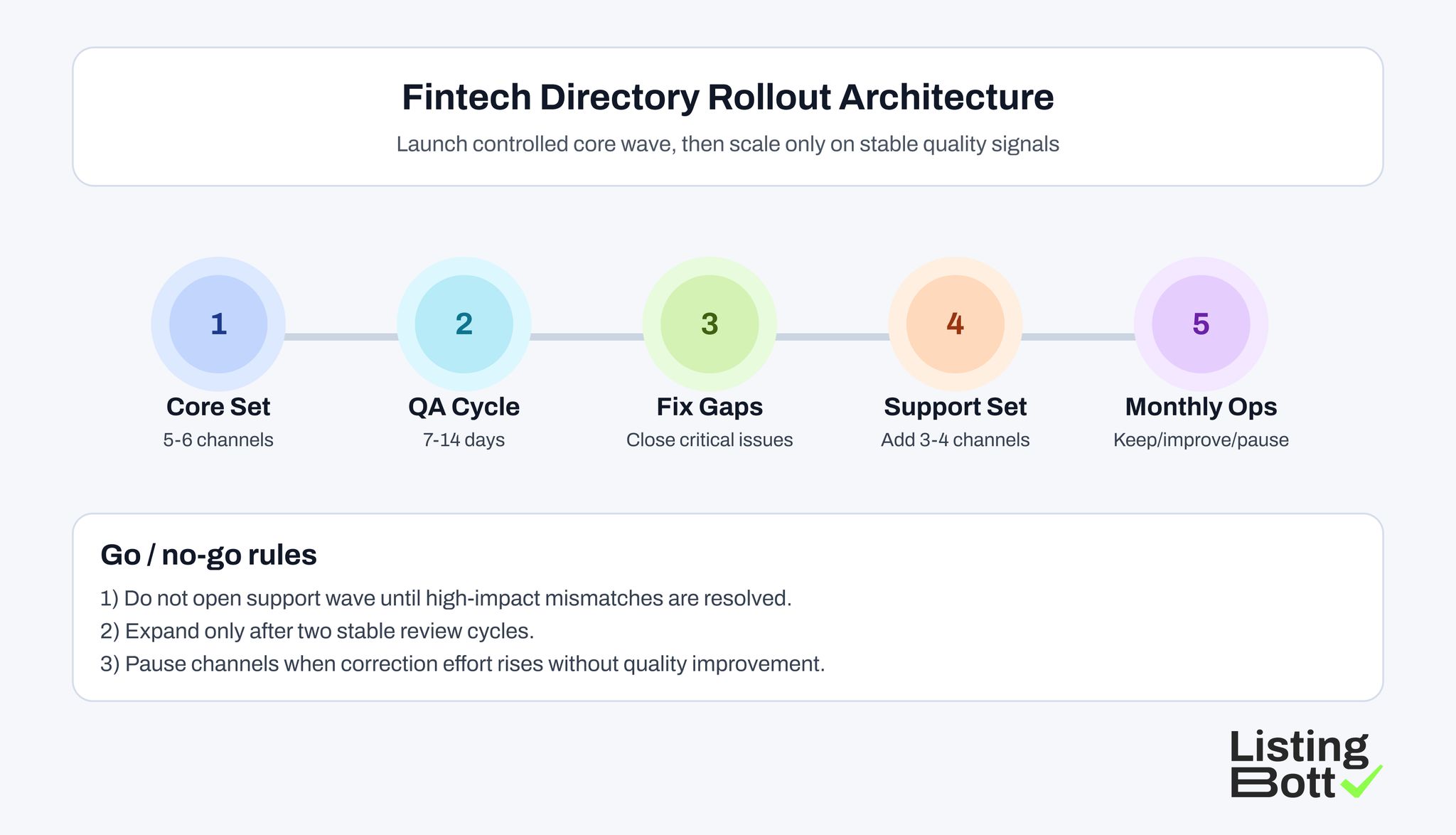
Fintech Directory Rollout Architecture
KPI Board for Fintech Directory Operations
Use a KPI board that supports real decisions, not vanity metrics.
| KPI | Why it matters | Healthy signal | Risk signal |
| Consistency rate | validates profile integrity across channels | stable 95%+ | recurring field mismatches |
| Correction closure speed | measures operational responsiveness | predictable closure window | aging correction backlog |
| Duplicate profile rate | tracks listing hygiene | low and declining | repeated duplicates |
| Intent-quality share | tests relevance of incoming visits | stable high-intent behavior | low-intent traffic dominates |
| Maintenance load ratio | checks scalability | controlled effort per cycle | rising effort with flat quality |
This board is critical when teams operate both fintech-specific and broad channels.
What is Citation in SEO and Why it Matters for Fintech
what is citation in seo is a common question, and for fintech teams the practical answer is straightforward: citations are references to your business identity across external platforms, typically including name, website, location/contact details, and profile information.
For fintech, citation consistency matters because:
- users often verify company legitimacy across multiple sources,
- inconsistent profile data weakens trust during evaluation,
- operational teams lose time fixing conflicting records,
- low-quality consistency can reduce visibility effectiveness over time.
In practice, citation quality is less about volume and more about consistency, relevance, and maintenance discipline.
Risk Controls Specific to Fintech Directory Execution
1) Messaging drift control
Fintech positioning changes quickly. Keep listing copy synchronized after major updates.
2) Trust-proof control
Proof statements should be precise and supportable. Avoid vague claims.
3) URL-intent control
Map each channel to the destination page that best matches user intent.
4) Fast correction ownership
Assign clear owners for correction tasks and closure SLAs.
5) Duplicate suppression routine
Run duplicate checks after each wave and after branding updates.
6) Expansion gate
Require two stable cycles before adding channels.
7) Channel retirement policy
Pause channels with high maintenance load and weak contribution quality.
These controls help teams scale visibility without losing profile integrity.
Keep/Improve/Pause Decision Scenarios
Scenario 1: high visibility, low intent quality
If channel visibility grows but intent-quality share stays low for two cycles, move it to improve or pause after one corrective attempt.
Scenario 2: moderate visibility, strong quality
If volume is modest but intent quality and trust signals stay strong, keep channel active and improve profile depth.
Scenario 3: strong fit, high correction load
If fit is high but correction backlog rises, channel is still valuable, but operations need tighter ownership and update cadence.
Scenario 4: duplicate growth after expansion
If duplicates rise after support-wave expansion, pause expansion, close duplicate backlog, and reopen only after stability returns.
Scenario rules reduce subjective debates and make monthly operations more predictable.
Niche vs Broad Directory Mix for Fintech SEO
One of the most common planning questions is whether fintech teams should focus only on fintech-specific channels or rely on broader discovery platforms. In practice, most teams need both, but in controlled proportions.
When niche fintech channels should lead
Niche channels should lead when:
- your product category is specialized and needs domain context,
- buyers require clear fintech framing before evaluation,
- trust and credibility signals are central to adoption.
Niche platforms usually provide stronger audience alignment, but they can have lower total volume. That is acceptable when intent quality is high.
When broader channels should lead
Broader channels should lead when:
- product use case overlaps mainstream software categories,
- you need wider comparison visibility,
- your team can maintain higher profile volume consistently.
Broader channels can increase visibility, but only if profile quality remains stable and messaging stays accurate.
Practical portfolio rule
Start with a 60/40 mix:
- 60% niche/fintech-aligned channels for trust and fit,
- 40% broader comparison and discovery channels for scale.
Then rebalance monthly based on evidence:
- increase niche share if intent quality drops on broad channels,
- increase broad share if niche channels plateau and maintenance remains healthy.
This approach avoids all-or-nothing channel strategy and keeps your directory program adaptive.
Common Mistakes
1) Submitting to every directory from one list
Volume-first expansion creates cleanup debt quickly.
2) Reusing one generic profile everywhere
Channel context differs, so generic messaging weakens relevance.
3) Ignoring correction speed
Slow corrections compound trust and routing issues.
4) Measuring only launch counts
Submission count does not show channel quality.
5) Expanding without stability gates
Support wave should follow quality stability, not calendar pressure.
6) No channel retirement rule
Low-value channels remain active and consume resources.
7) Mixing all channels into one metric set
Blended reporting hides which channel type is working.
90-Day Fintech Directory Plan
Days 1-30: foundation
- finalize canonical profile pack,
- score channels with FINTRUST-6,
- launch core wave,
- assign correction ownership.
Days 31-60: stabilization
- run QA cycles,
- close high-impact mismatches,
- reduce duplicates,
- improve weak profile sections.
Days 61-90: optimization
- open support wave if gates pass,
- pause weak channels,
- refine destination mapping,
- lock monthly KPI cadence.
By day 90, the goal is sustainable quality and trustworthy visibility, not only more listings.
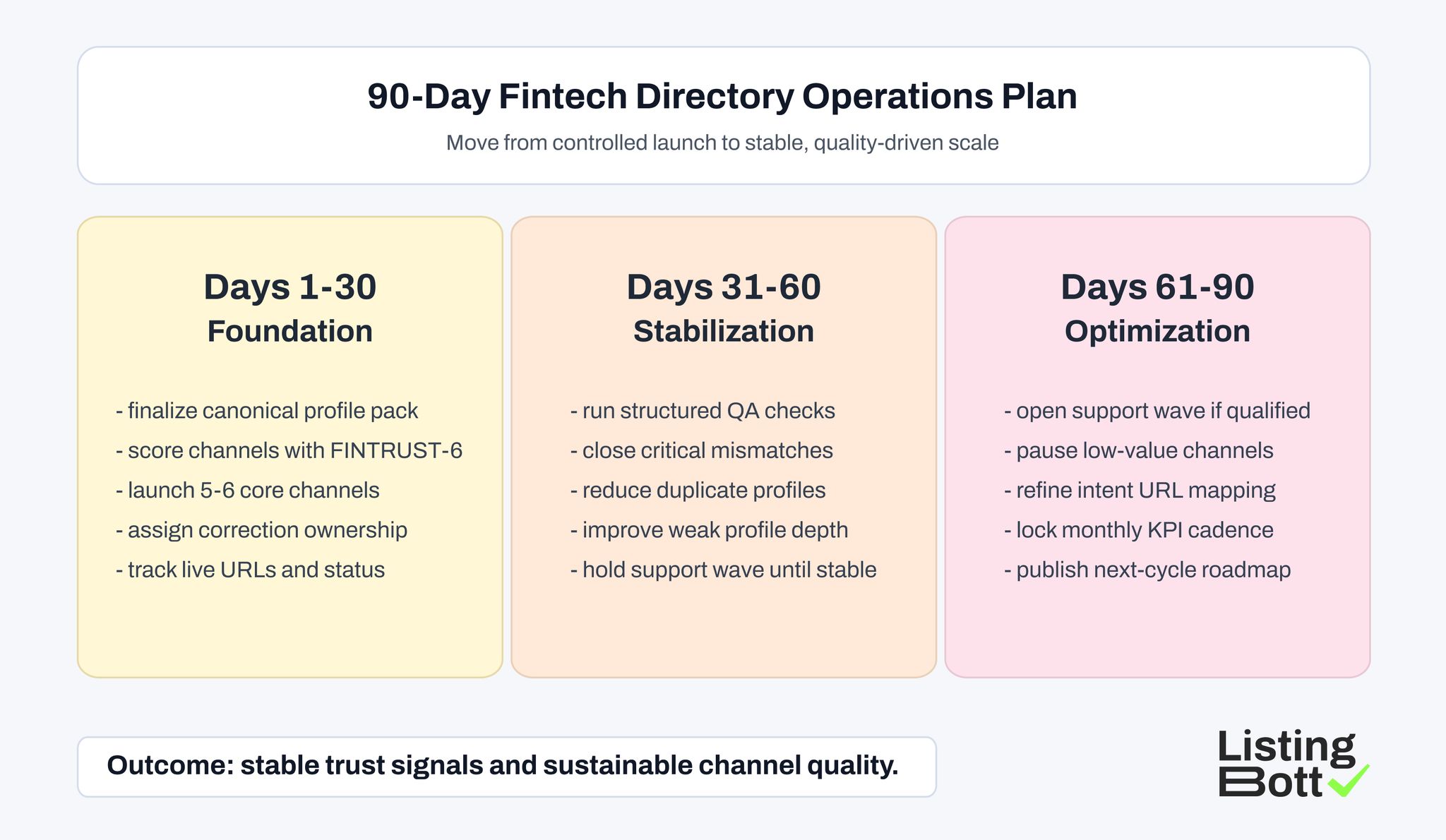
90-Day Fintech Directory Operations Plan
Where ListingBott Fits
ListingBott supports structured directory publication and reporting workflows for teams that need repeatable execution.
Typical flow:
- onboarding details are collected,
- listing scope is approved,
- publication is executed,
- reporting is delivered.
Offer alignment:
- one-time payment model,
- publication to 100+ directories,
- no hidden extra fees,
- refund possible if process has not started.
Promise limits:
- no guaranteed ranking position,
- no guaranteed traffic by a specific date,
- no guaranteed indexing speed,
- no guaranteed outcomes controlled by third-party platforms.
Qualified DR statement: DR growth to 15 can be promised only when starting DR is below 15, the selected goal is domain growth, and the approved listing set is in place.
FAQ: Best Fintech Startups Directories for SEO
How many channels should fintech teams launch first?
Most teams should start with 5-6 high-fit channels and expand only after quality and maintenance metrics stabilize.
Should fintech teams use only niche fintech directories?
No. A balanced mix of niche and high-intent general channels is usually stronger than one channel type alone.
Is a seo business directory strategy still useful in 2026?
Yes, when channels are selected for fit and maintained with strong QA controls.
Are seo local business listings useful for fintech products?
They can be useful for geo-specific fintech operations or hybrid models, but should run as a separate tracked stream.
Can directories guarantee SEO rankings?
No. Listings support visibility and trust signals, but rankings depend on broader SEO and market dynamics.