Table of Contents
- Why Backlink Directory Strategy Changed in 2026
- Best-fit Listing Platforms for Best Directories for Backlinks
- Implementation Playbook
- Decision Scenarios Teams Face in Practice
- Common Mistakes
- 90-Day Directory Backlink Plan
- FAQ
sbb-itb-8e44301
Quick Answer
The best directories for backlinks are usually the ones with strong editorial quality, relevant audience fit, and manageable maintenance effort. In 2026, teams that get stable SEO value from directories follow a quality-first process: score channels before submission, publish in waves, and keep profile data consistent over time.
A practical sequence is:
- define one canonical profile baseline,
- score channels by relevance and trust quality,
- launch a controlled core wave,
- run QA and correction cycles,
- expand only when quality metrics stay stable.
This is more effective than mass-submitting to every list. Directory channels can support authority and discovery, but low-quality expansion often creates cleanup work without meaningful SEO return.
Why Backlink Directory Strategy Changed in 2026
Directory links still matter in many SEO programs, but the way they matter has shifted. Teams now need to optimize for trust, consistency, and relevance instead of raw listing count. Search visibility and AI-assisted summaries both react better to clear entity signals and accurate profile data than to broad low-quality coverage.
When directory strategy is weak, the same problems appear repeatedly:
- listings are published on irrelevant channels,
- profile fields drift after product or offer changes,
- duplicate pages dilute trust signals,
- teams track submission volume but not quality outcomes.
That is why a generic seo directory list should be treated as research input, not an execution plan. The best results come from scored selection, ownership discipline, and recurring QA.
For many teams, directory operations also intersect with broader marketing workflows and seo tools for agencies processes, especially when one team manages multiple brands.
The LINKFIT-7 Scoring Model
Use this model before you add any directory to active scope.
| Factor | Practical question | Why it matters | Score (1-5) |
| Topical relevance | Is the directory context relevant to your business category? | improves link quality context | 1-5 |
| Audience intent | Are users on this platform likely to evaluate real solutions? | improves qualified discovery | 1-5 |
| Editorial quality | Is listing quality reasonably curated and not spam-heavy? | protects trust signal | 1-5 |
| Profile depth support | Can you publish meaningful profile data, not only a name and link? | improves entity clarity | 1-5 |
| Update control | Can your team correct listings quickly when details change? | reduces drift risk | 1-5 |
| Duplicate risk | How likely is duplicate profile creation on this channel? | protects data hygiene | 1-5 |
| Maintenance load | Can your team sustain this channel monthly? | protects scale quality | 1-5 |
Threshold guidance:
- 28-35: core tier,
- 21-27: support tier,
- below 21: hold/skip.
LINKFIT-7 gives teams a better way to evaluate business directories for seo than volume-first checklists.
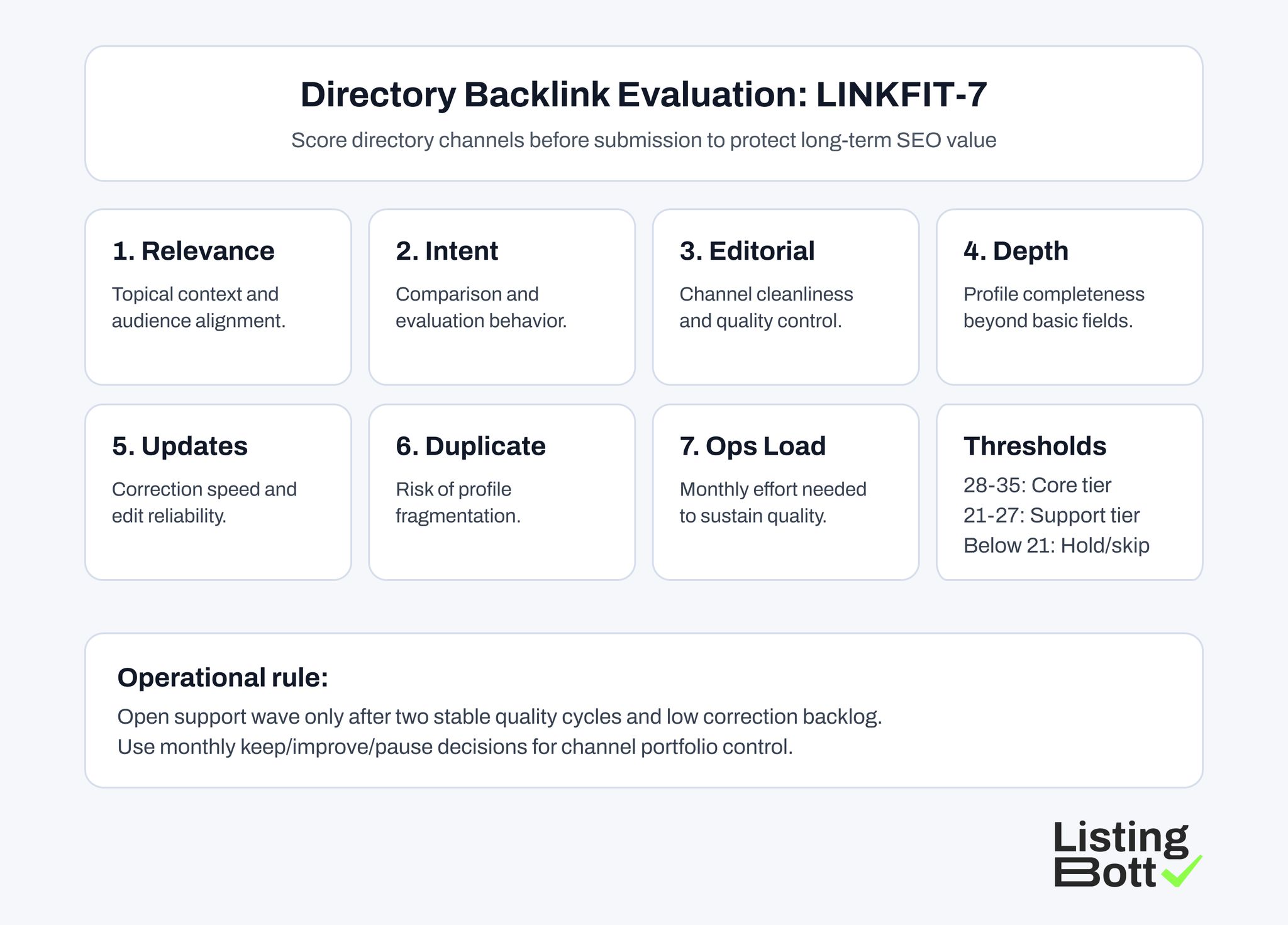
Directory Backlink Evaluation: LINKFIT-7
Best-fit Listing Platforms for Best Directories for Backlinks
This table mixes higher-trust discovery channels and structured citation layers that many teams use in practice.
| Platform | URL | Why it is a best fit | Ideal company profile | Submission note |
| Product Hunt | https://www.producthunt.com/ | Strong launch and discovery visibility with active audiences | product-led startups and software tools | prepare positioning and proof assets before launch |
| Crunchbase | https://www.crunchbase.com/ | Widely used entity/profile reference source | funded startups and scaling companies | maintain company fields and updates consistently |
| G2 | https://www.g2.com/ | High-intent software comparison context | B2B software and SaaS teams | prioritize category alignment and profile depth |
| Capterra | https://www.capterra.com/ | Mid-funnel evaluation platform for buyers | software vendors with clear use cases | align profile claims with landing pages |
| F6S | https://www.f6s.com/ | Startup ecosystem exposure and discoverability | early-stage and accelerator-linked teams | keep company milestones current |
| Wellfound | https://wellfound.com/ | Startup trust and presence layer for multiple stakeholders | startup teams in active growth | keep description and product scope synchronized |
| BetaList | https://betalist.com/ | Early-discovery platform for new products | pre-seed and seed software startups | concise value proposition performs better |
| AlternativeTo | https://alternativeto.net/ | Useful discovery for solution comparison intent | products in established categories | keep alternative positioning clear and accurate |
| SaaSHub | https://www.saashub.com/ | Category discovery and comparison context | SaaS and workflow tools | optimize tags and profile completeness |
| Google Business Profile | https://www.google.com/business/ | Core citation and trust layer where local intent exists | local and hybrid business models | keep NAP consistency and links updated |
| Yelp for Business | https://biz.yelp.com/ | Strong trust and review context for local discovery | service and location-based businesses | monitor profile quality and review operations |
| Brownbook | https://www.brownbook.net/ | Supplemental citation and entity consistency layer | teams building broader profile coverage | enforce duplicate checks and QA cadence |
How to use this list:
- choose 5-7 core channels,
- keep 3-5 support channels,
- add channels only after quality gates pass.
This protects quality while still growing coverage.
Tiering Strategy: Core vs Support vs Hold
A tier model helps teams avoid random expansion.
Core tier
Use channels with:
- strong relevance,
- high editorial quality,
- clear profile depth support,
- manageable maintenance effort.
Core tier is where most of the durable backlink and discovery value comes from.
Support tier
Use channels that are still useful but less critical. These often include broader directories and secondary citation layers. They can add incremental value when operations are stable.
Hold tier
Keep channels in hold if:
- profile quality is inconsistent,
- duplicate risk is high,
- maintenance effort is too heavy,
- intent quality is weak.
Hold does not always mean “never use.” It means “not now, given current constraints.”
Implementation Playbook
Step 1: build canonical listing profile pack
Include:
- short and long description,
- category and use-case mapping,
- logo and screenshot set,
- destination URL map,
- ownership and QA checklist.
Step 2: score candidate directories
Apply LINKFIT-7 to every candidate before submission.
Step 3: launch core wave
Publish to core channels and track:
- submission date,
- status,
- live URL,
- owner.
Step 4: run first QA cycle (day 7 to day 14)
Validate:
- field consistency,
- category fit,
- URL correctness,
- duplicate risk,
- completeness.
Step 5: fix critical issues
Do not open support wave until high-impact issues are closed.
Step 6: open support wave selectively
Expand coverage only after two stable review cycles.
Step 7: run monthly keep/improve/pause review
Use evidence, not assumptions:
- consistency trend,
- correction load,
- intent quality,
- contribution potential.
This process turns free online business directories and other channels into a controlled system instead of unmanaged submissions.
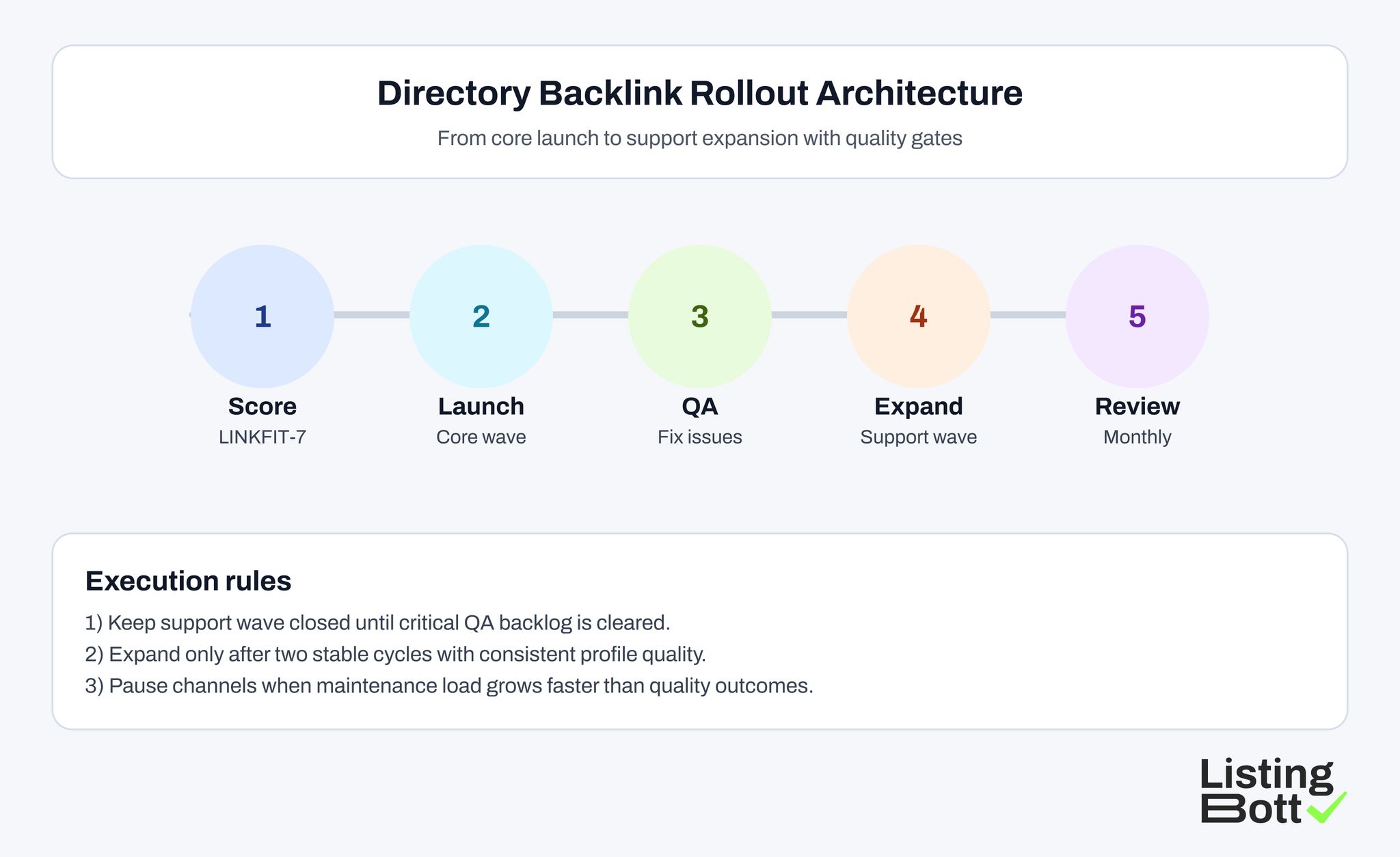
Directory Backlink Rollout Architecture
Citation Backlinks and Entity Consistency
Citation backlinks are references that reinforce your business entity across external platforms. Their value often comes from consistency and trust clarity, not from one isolated link.
Practical consistency rules:
- keep business identity fields synchronized across channels,
- align profile claims with current site pages,
- avoid duplicate listings and conflicting variants,
- update core channels first after major changes.
This is also why teams asking “what is citation in seo” should focus on operational consistency, not only list size. For most brands, quality citation upkeep creates more durable value than aggressive one-time submission bursts.
KPI Board for Directory Backlink Operations
Use a KPI board that supports decisions, not vanity counts.
| KPI | Why it matters | Healthy signal | Risk signal |
| Listing consistency rate | validates data integrity | stable 95%+ | repeated field mismatch |
| Correction closure speed | measures operational control | predictable closure cycle | aging backlog |
| Duplicate profile rate | tracks listing hygiene | low and declining | duplicate growth |
| Intent-quality share | tests relevance of channel traffic | stable qualified engagement | low-intent traffic dominates |
| Maintenance load ratio | protects scalable operations | controlled effort per cycle | rising effort without quality gain |
This board makes channel pruning and expansion decisions faster and less subjective.
Decision Scenarios Teams Face in Practice
Scenario 1: high volume, weak quality
If a channel sends traffic but intent quality is low for two cycles, move it to improve or pause after one corrective test.
Scenario 2: lower volume, strong quality
If a channel sends less traffic but high-quality visits, keep it and improve profile depth.
Scenario 3: good fit, high correction burden
If fit is strong but correction backlog grows, improve operational cadence before expanding.
Scenario 4: duplicates after expansion
If duplicate rate increases after support-wave launch, pause expansion and clean backlog before adding more channels.
These scenarios prevent reactive decisions and keep growth quality-first.
Directory Selection Templates by Business Model
Teams often ask which directory mix to choose first. A practical answer depends on business model and growth stage, not a universal list.
Template A: early-stage SaaS
Recommended first mix:
- 2 startup discovery channels,
- 2 software comparison channels,
- 1 citation-oriented trust layer.
Why it works:
- startup channels support awareness and early feedback,
- comparison channels help mid-funnel evaluation,
- citation layers improve entity consistency across the web.
Template B: local or hybrid service business
Recommended first mix:
- 2 local business directory listings channels,
- 1 review-focused trust channel,
- 2 broader business profile channels.
Why it works:
- local channels strengthen geo relevance,
- review context supports conversion confidence,
- broader profiles improve discoverability in mixed search intent.
Template C: multi-product portfolio
Recommended first mix:
- 3 cross-category channels with strong profile depth,
- 2 product-specific channels by vertical,
- 1 centralized citation governance layer.
Why it works:
- cross-category channels reduce fragmentation,
- vertical channels capture niche demand,
- centralized governance lowers duplicate and mismatch risk.
Rollout Priority Rule
If budget or team capacity is limited, prioritize channels that score high on:
- editorial quality,
- audience intent fit,
- update control.
This rule usually produces better long-term outcomes than prioritizing channels only by estimated traffic or list popularity.
When to Pause Expansion
Pause channel expansion when one of these happens:
- correction backlog grows for two consecutive cycles,
- duplicate profile rate increases after a new wave,
- profile consistency drops below internal threshold.
Expansion can resume when quality signals recover and ownership capacity is clear.
Common Mistakes
1) Treating every directory as equal
Platform quality and audience intent vary significantly.
2) Submitting everywhere at once
Coverage expands faster than team capacity.
3) Ignoring profile maintenance
Unmaintained listings lose trust value quickly.
4) Tracking only submission counts
Launch volume alone does not reflect useful SEO outcomes.
5) Mixing local and non-local signals
Blended reporting hides channel-specific performance.
6) No retirement rule
Low-value channels remain active and consume resources.
7) No ownership model
Without assigned owners, correction speed drops and quality decays.
90-Day Directory Backlink Plan
Days 1-30: foundation
- finalize profile pack,
- score channels with LINKFIT-7,
- launch core wave,
- assign QA ownership.
Days 31-60: stabilization
- run QA cycles,
- close critical mismatches,
- reduce duplicates,
- improve weak profiles.
Days 61-90: optimization
- open support wave if qualified,
- pause low-value channels,
- refine destination mapping,
- lock monthly KPI cadence.
By day 90, the objective is sustainable, high-quality profile coverage rather than maximum submission count.
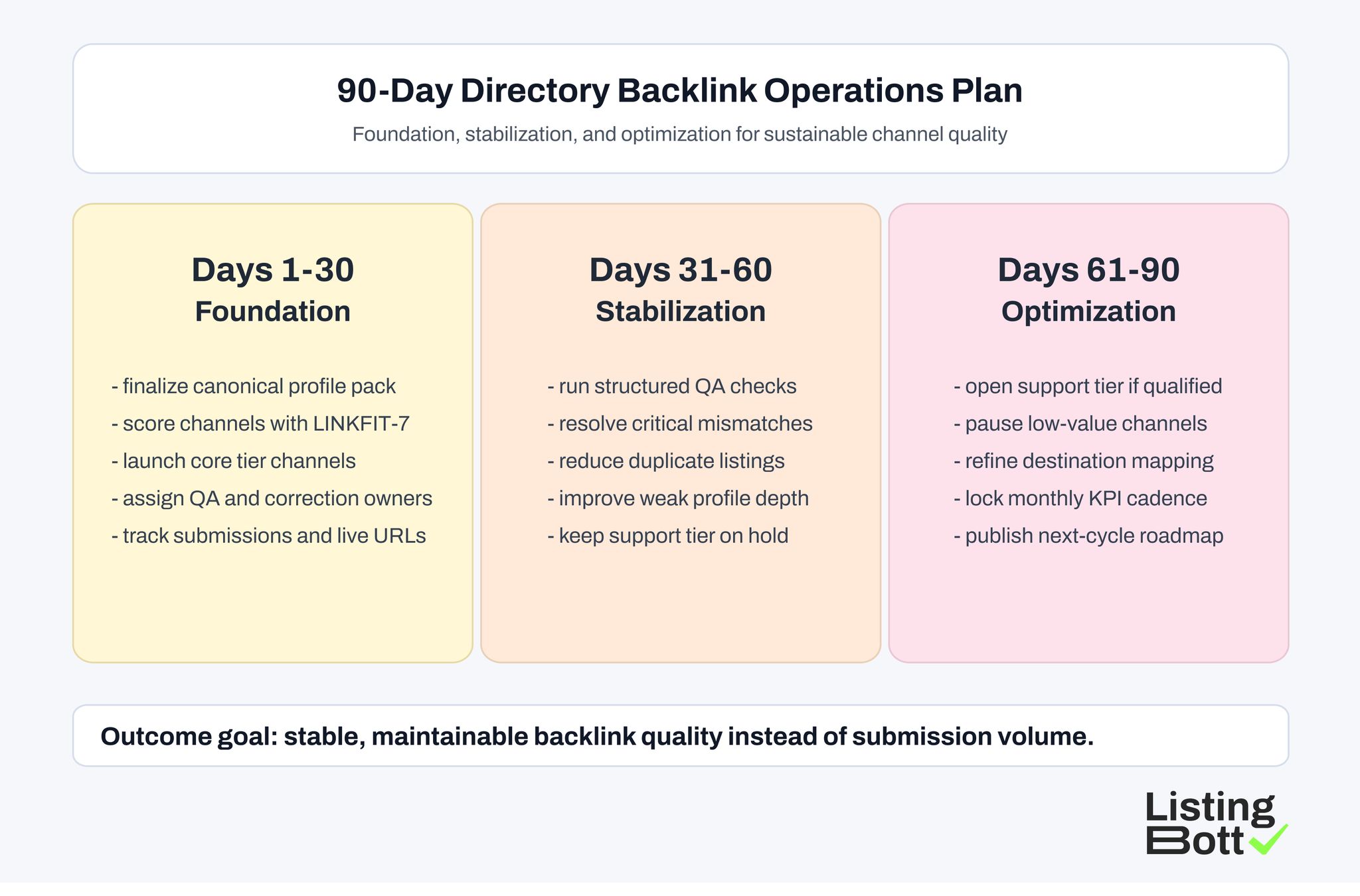
90-Day Directory Backlink Operations Plan
Where ListingBott Fits
ListingBott supports structured directory publication and reporting workflows for teams that need repeatable execution.
Typical flow:
- onboarding details are collected,
- listing scope is approved,
- publication is executed,
- reporting is delivered.
Offer alignment:
- one-time payment model,
- publication to 100+ directories,
- no hidden extra fees,
- refund possible if process has not started.
Promise limits:
- no guaranteed ranking position,
- no guaranteed traffic by a specific date,
- no guaranteed indexing speed,
- no guaranteed outcomes controlled by third-party platforms.
Qualified DR statement: DR growth to 15 can be promised only when starting DR is below 15, the selected goal is domain growth, and the approved listing set is in place.
FAQ: Best Directories for Backlinks
How many directories should we start with?
Most teams should start with 5-7 core directories and expand only after two stable review cycles.
Are free online business directories worth using?
They can be useful as support channels if profile quality and maintenance cadence are controlled.
Should every listing point to homepage?
No. Destination pages should match channel intent and user expectations.
Are local business directory listings always required?
No. Use them when local intent matters for your business model.
Can directory backlinks guarantee rankings?
No. They support trust and visibility, but rankings depend on broader SEO and competition.